Telcoin Triumphs Over Security Hurdle, Fortifies User Trust
Telcoin overcomes a security challenge, reinforcing its commitment to user security and trust through transparency and enhanced measures.
 Brian
Brian


Will Crypto Be Better in 2026?
A repricing of "true and false value" is quietly taking place...
Why Is It Different This Time?
In the last few months of 2025, the sentiment in the crypto market is undergoing a subtle but real shift.
Over 70% of people believe the market has entered a bear market! Bitcoin has fallen from its all-time high of $126,700, and net inflows into ETFs have begun to plateau; altcoins are showing significant divergence, with Memecoin, once the most emotionally charged coin, gradually fading into obscurity. The whole market seems to have entered a "winter." Strangely, this time there hasn't been a sudden, heavy-handed regulatory crackdown like at the end of 2021, nor a systemic collapse like FTX's in 2022. Aside from the sharp drop on October 11th, the market has even been relatively calm. But everyone can sense that something is amiss. If we were to summarize the current state in one sentence, it would be—the market isn't dead, but beliefs are beginning to diverge. 2025 may not be a simple shift between bull and bear markets, but rather a recalibration of the true and false values. Thus, an unavoidable question confronts everyone: Will crypto be better in 2026? In this article, Yongqi attempts to provide an answer that is as honest and long-term as possible.
Over the past year, Bitcoin's price performance and market positioning have undergone crucial changes.
After reaching a record high of $126,700, Bitcoin entered a high-level consolidation phase, with increased volatility and gradually cooling market sentiment. However, unlike in the past, the core driving force of this round of market activity is not retail investors, but rather the institutional funds behind ETFs..
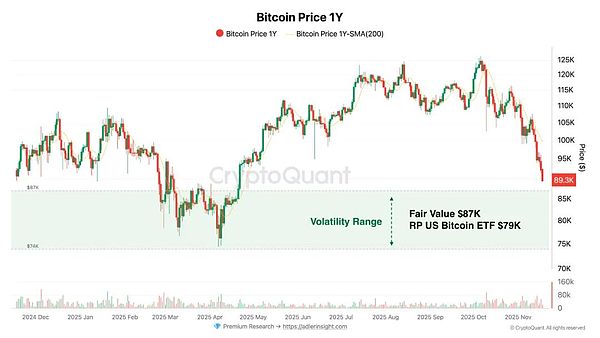
What does this mean? This means that the trading logic of Bitcoin is gradually shifting from an "emotional asset" to a form closer to a hybrid of gold and tech stocks: On the one hand, it possesses a long-term narrative of hedging against inflation and fiat currency credibility; on the other hand, like tech stocks, it is strongly constrained by macro liquidity, risk appetite, and interest rate expectations, and Bitcoin's beta attribute is being amplified. 2. Macroeconomic Environment: Liquidity Expectations Are Indeed Improving From a broader perspective, 2025 is expected to be a year of significant recovery for global risk assets. AI has become the main narrative in global capital markets; US stocks continue to hit new highs; the Federal Reserve confirmed a path of three rate cuts this year in December. In its latest economic forecasts, the FOMC revised its 2026 US GDP growth forecast upward from 1.8% to 2.2%–2.5%. Market consensus for 2026 is shifting towards a "moderately loose" approach. This is certainly a positive environment for Bitcoin. However, it's equally important to be wary: if the economy unexpectedly weakens in 2026, or inflation rises again, risk assets could still face significant corrections. Bitcoin is no longer an "independent market that ignores macroeconomic conditions."
If prices determine short-term sentiment, thenregulation determines long-term boundaries.
And in 2025, the crypto industry underwent a crucial change in terms of regulation—the gray areas were being systematically cleaned up. The United States: From Confrontation to Structured Regulation In 2025, the United States enacted two landmark laws: First, the GENIUS Stablecoin Act. This act clearly defines the legal attributes of stablecoins; establishes reserve requirements and auditing requirements; and provides a clear path for compliant issuers. The act was formally signed into law in July 2025. The new regulations will take effect 18 months later or within 120 days of the release of regulatory details. Secondly, the "Crypto Asset Market Structure Act (CLARITY Act)" clarifies the regulatory boundaries between "security tokens" and "commodity tokens"; the division of responsibilities between the SEC and CFTC is clearer; and a tiered regulatory framework is introduced. This bill is expected to be submitted to the Senate for consideration in early 2026. Meanwhile, the SEC is significantly accelerating the approval process for crypto ETFs, opening more compliance channels for institutional funds. Hong Kong: A “Model Institution for Crypto Finance” In Asia, Hong Kong's actions are equally noteworthy. In 2025, the Hong Kong Monetary Authority officially launched the Stablecoin Issuer Regulatory System; all Hong Kong-based stablecoin issuers must be licensed; HashKey successfully IPO'd on the Hong Kong Stock Exchange, becoming the first compliant platform with crypto trading as its core business to go public. This means that, for the first time, crypto businesses are entering the Asian financial system in a form that can be priced by mainstream capital markets. Overall, the regulatory logic in the US and Hong Kong is highly consistent: reducing gray areas and opening up compliance channels.
After countless narratives have risen and fallen, there are actually not many directions that have truly run out of the "certain growth curve".
The four most noteworthy trends to follow are:
When AI starts trading, signing contracts, and invoking contracts, who is it? What can it do? How is responsibility assigned? KYA (Know Your Agent) may become a fundamental threshold for on-chain AI.
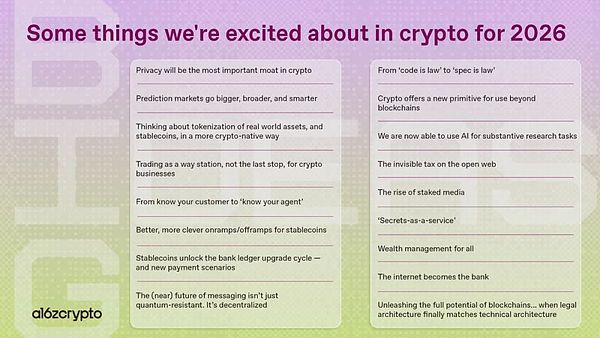
The truly important change is that encryption is starting to be used by "non-encrypted users".
Lagos merchants use USDT to receive payments; users in high-inflation countries hold USDC simply as a hedge; the Philippines uses USDC for low-cost remittances.
Lagos merchants use USDT to receive payments; users in high-inflation countries hold USDC simply to hedge against risk; the Philippines uses USDC to complete low-cost remittances.
Telcoin overcomes a security challenge, reinforcing its commitment to user security and trust through transparency and enhanced measures.
BrianIndonesia launches CFX, a pioneering national crypto bourse, setting new standards for crypto regulation and oversight.
 Alex
AlexBlast blockchain's $1.1 billion pre-launch deposits draw mixed reactions amidst controversy and high yield promises.
 Kikyo
KikyoThe New York Times sues OpenAI and Microsoft over alleged copyright violations, highlighting a growing legal battle in AI and journalism.
BrianIndia's FIU demands compliance with AML laws from major crypto exchanges like Binance and Huobi, signaling tighter regulatory control.
AlexArgentina's new law aims to regulate undeclared cryptocurrencies, reflecting a shift in policy and embracing digital assets within its economic framework.
KikyoThe ruling permits Celsius to deviate from its previously approved bankruptcy plan, with the judge asserting that the restructuring does not harm creditors and customers.
 Davin
DavinBONK, transcending its memecoin image, shows significant market and technological growth
BrianFTX's repayment plan, undervaluing assets against market rates, incites customer backlash, with a looming January 11 objection deadline.
AlexThe India-UAE oil trade in rupees signifies a major shift from dollar dominance, reflecting the BRICS nations' commitment to alternative trade currencies and the rising influence of emerging economies in global finance.
Kikyo