Coinbase: Crypto Market Outlook for 2026
Coinbase: The cryptocurrency market landscape in the first half of 2026 is closer to "1996" than "1999," meaning we are optimistic about next year.
 JinseFinance

Tao Zhu, Jinse Finance
Summary:On May 7, 2026, Coinbase released its Q1 2026 financial report: revenue plummeted 31% to $1.41 billion, exceeding market expectations, primarily due to reduced cryptocurrency trading activity caused by the sluggish market. However, Coinbase's financial report presents a "seemingly losing but actually winning" characteristic.
Affected by the decline in Bitcoin prices and the overall weakening of the cryptocurrency market, Coinbase's Q1 2026 financial report is not optimistic, marking the company's second consecutive quarter of losses.
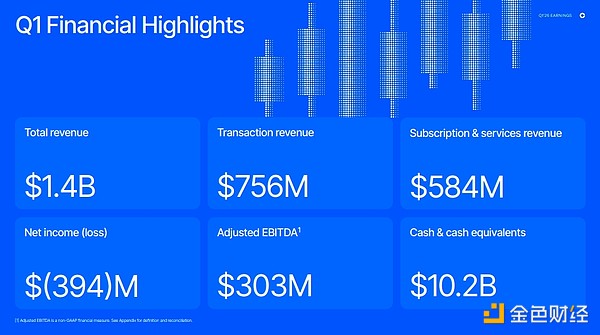
Coinbase CFO Alesia Haas stated during the company's earnings call: "The macroeconomic situation is indeed very challenging. Both the total market capitalization and total cryptocurrency trading volume have declined by more than 20% quarter-over-quarter. We can only control what we can control, but our fundamentals remain strong."
As mentioned above, Coinbase's financial report data does not seem optimistic at first glance. However, if we look at its market share, stablecoin ecosystem, derivatives business, AI payments, prediction markets, international expansion, and institutional business, Coinbase is actually at a critical juncture in its strategic transformation.
Let's first look at the advantages revealed in the financial report.
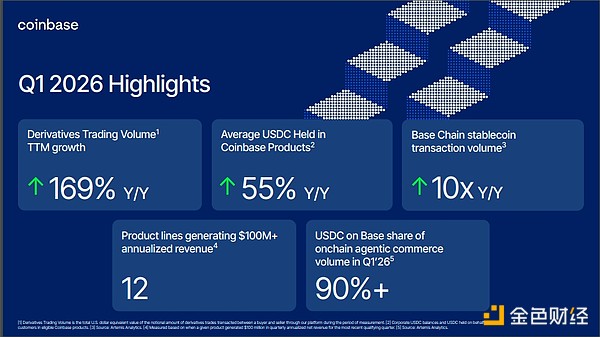
Coinbase Core Advantages Coinbase's core advantages Coinbase's assets reached $294 billion in Q1 2026 (the world's largest cryptocurrency custody platform) Coinbase's market share in the US cryptocurrency spot trading market Coinbase's market capitalization reached a record high of $80 billion in March Coinbase's market capitalization Coinbase's 12 product lines with annualized revenue exceeding $100 million Coinbase's total trading volume reached $5.2 trillion in the past 12 months Coinbase holds 80+ licenses, ensuring a solid global compliance foundation Coinbase's average USDC holdings reached $19 billion in Q1 2026 Subscription and service revenue accounted for 44% of net revenue Subscription and service revenue accounted for 44% of net revenue Subscription and service revenue accounted for 44% of net revenue Subscription and service revenue accounted for 44% of net revenue Subscription and service revenue accounted for 44% of net revenue Subscription and service revenue accounted for 44% of net revenue Subscription and service revenue accounted for 49% of net revenue Subscription and service revenue accounted for 49% of net revenue Subscription and service revenue accounted for 49% of net income ... src="https://img.jinse.com.cn/7462158_watermarknone.png" title="7462158" alt="G0c2r8JPIsAahwXqxh9Y5xsgFC3q11M3TnTllJFB.jpeg">Derivatives trading volume (past 12 months) increased by 169% year-over-year
Average USDC holdings in platform products increased by 55% year-over-year
Base chain stablecoin trading volume increased by 10 times year-over-year
Annualized revenue exceeds $100 million Product lines: 12
Q1 2026 Base chain USDC share of on-chain smart proxy transactions: exceeding 90%
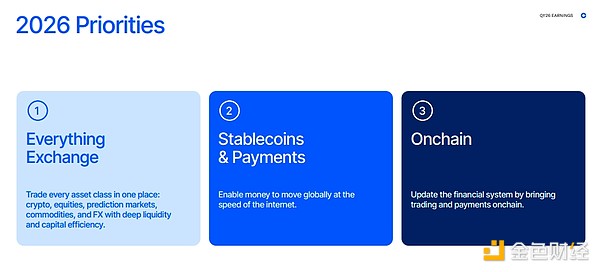
The financial report also listed three major strategic priorities for 2026: Everything Exchange, stablecoins and payments, and on-chain technology.
Exchange of Everything: One-stop trading of crypto, stocks, prediction markets, commodities, and forex
Stablecoins and Payments: Achieving global internet-level fund transfers
On-chain: Putting transactions and payments on-chain, reconstructing the financial system
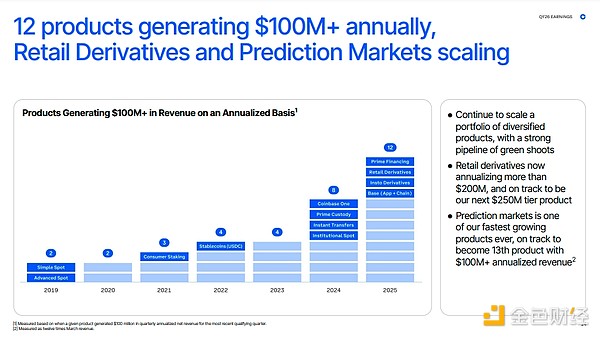
Previously, Coinbase Primarily known for its cryptocurrency trading platform, Coinbase is currently attempting to diversify its revenue streams through subscription and service businesses, including stablecoins and staking income, as it continues to grow. Coinbase CFO Alesia Haas stated, "We are working to diversify the types of goods people can trade so that, as markets and people's behavior change, we can always offer what people want to trade. This diversification will help mitigate the volatility we see in pure cryptocurrency trading." Coinbase is demonstrating its vision of becoming an "exchange for everything"—a plan proposed a year ago by CEO Brian Armstrong to reduce the company's reliance on trading tokens such as Bitcoin, Ethereum, and XRP. It must be acknowledged that the biggest highlight of this quarter was the success of Coinbase's "exchange for everything" strategy. Armstrong views this move as part of the company's intention to diversify its investments and move away from pure spot cryptocurrency trading: "In any market, there will always be ups and downs. That's the nature of trading. Diversification through an exchange of everything is crucial." Derivatives According to the financial report, Coinbase's derivatives trading volume TTM increased by 169% year-over-year, mainly due to increased adoption by consumers and institutions, with retail derivatives annualized revenue exceeding $200 million, a record high. Coinbase's derivatives can be divided into four main categories: cryptocurrency futures (including perpetual); cryptocurrency options (mainly from the acquired Deribit); traditional financial asset derivatives (non-crypto, but counted in derivatives volume); and prediction markets (newly incorporated in 2026). Crypto futures and options, as the core of Coinbase's derivatives system, go without saying. Coinbase's emphasis on traditional finance and prediction markets fully reflects its development goal of becoming a comprehensive financial trading platform. In traditional finance, Coinbase announced on May 6th the launch of perpetual gold and silver contracts, open to eligible non-US users. GOLD-PERP corresponds to 1 troy ounce of spot gold, and SILVER-PERP corresponds to 1 troy ounce of spot silver, both settled in USDC, supporting 24/7 trading, and offering up to 25x leverage. Regarding prediction markets, Coinbase has already mentioned in its financial report that prediction markets are one of its fastest-growing products and are expected to become its 13th product to exceed $100 million in annualized revenue. Coinbase's rapid growth in this area signifies that it is no longer just a traditional exchange—it is entering a new financial market centered on event probability pricing.
Stablecoins
According to the financial report, stablecoin revenue totaled $305 million, up from $274 million last year. This was mainly due to the growth in the market capitalization of USDC stablecoin and the record high average price of USDC holdings in Coinbase products. Coinbase currently accounts for approximately 50% of total USDC trading volume, and its Base chain dominates stablecoin trading with a market share of 62%.
In the short term, Coinbase is facing challenges such as declining revenue and net losses due to the overall sluggish cryptocurrency market. However, Coinbase has already been quietly transforming. Its record-high market share, rapid development of derivatives, early deployment of AI payment infrastructure, and dominant position of stablecoins all demonstrate Coinbase's ambition to transform into a next-generation digital financial infrastructure platform.On December 17th last year, Coinbase published a blog post "The future of finance is on Coinbase", directly announcing its ambition that "the future of finance is on Coinbase." The article also stated, "We believe that the future of finance is automated, intelligent, and accessible to everyone."
Coinbase's strategy has already been laid.
Coinbase: The cryptocurrency market landscape in the first half of 2026 is closer to "1996" than "1999," meaning we are optimistic about next year.
JinseFinanceRWA perpetual contracts, professional exchanges and trading terminals, next-generation DeFi, AI and robotics.
JinseFinanceGolden Finance launched the 2599th issue of "Golden Morning 8", a morning report on the cryptocurrency and blockchain industry, to provide you with the latest and fastest digital currency and blockchain industry news.
JinseFinanceNew Paradigm is a liquidity incentive activity within the Manta ecosystem launched by the Manta public chain.
JinseFinance Coinlive
 Many experts believe that the introduction of blockchain technology and cryptocurrency is a giant leap in human evolution. For some ...
 Bitcoinist
The basic premise for making a profit in cryptocurrencies is to buy cheap and sell high. There is no certain ...
Bitcoinist
The first tweet ever sent on Twitter was turned into an NFT and sold by founder Jack Dorsey for $2.9 million but is pulling about one percent of that in a current auction.
 Cointelegraph
Other notable NFT news this week includes Larva Labs deleting all of its tweets and Elon Musk briefly changing his Twitter profile picture to a Bored Ape Yacht Club collage.
Cointelegraph