Author: Biraajmaan Tamuly Source: cointelegraph Translation: Shan Ouba, Jinse Finance
Bitcoin's reaction to Federal Open Market Committee (FOMC) decisions often contradicts traders' expectations. Will the Fed's interest rate decision announced today boost Bitcoin or trigger a sell-off?
On Tuesday, the day before the Fed's interest rate meeting, the price of Bitcoin (BTC) briefly broke through the $94,000 mark, currently priced at $90,302. Historical data shows that traders should be prepared for sharp market fluctuations.
Throughout 2025, Bitcoin's performance before and after each Fed interest rate meeting reveals a pattern: the market has already priced in macroeconomic expectations, and traders' preemptive positioning often overshadows the actual impact of the policy decision itself.
Key Takeaways
Historical data shows that Bitcoin has fallen after most Federal Reserve interest rate meetings, including during interest rate cut cycles.
Significant inflows of funds into Bitcoin and the accumulation of leveraged positions both occurred before the Federal Reserve interest rate meetings, leading to a tightening of spot liquidity and thus amplifying price volatility after the Fed's decision was announced.
Fed Interest Rate Meeting Results Reveal Unique Bitcoin Price Patterns
After the seven Federal Reserve interest rate meetings in 2025, Bitcoin's price movement exhibited a clear pattern: the market pre-priced in the price, and the price movement after the meeting was volatile, often ending in a decline.
Here are the Bitcoin price changes within seven days after each meeting: January 29th, interest rates unchanged: down 4.58% March 19th, interest rates unchanged: up 5.11% May 7th, interest rates unchanged: up 6.92% June 18th, interest rates unchanged: up 1.48% July 30th, interest rates unchanged: down 3.15% September 17th, interest rate cut by 25 basis points: down 6.90% October 29th, 25 basis point rate cut: down 8.00%
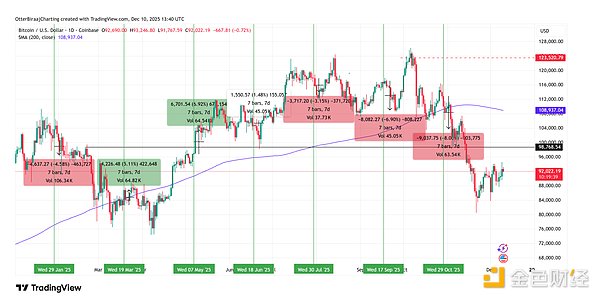
Bitcoin price change data in the seven days following the 2025 Fed rate meeting. Data source: Cointelegraph/TradingView
The seven-day return rate of Bitcoin after seven meetings ranges from an increase of 6.9% to a decrease of 8%, with the weakest performance following the rate cut meeting. Stepping outside the macroeconomic news and analyzing from the perspective of market structure, this divergence in trends becomes even clearer.
Bitcoin's seven-day return rate after seven meetings ranges from an increase of 6.9% to a decrease of 8%, with the weakest performance following the rate cut meeting.
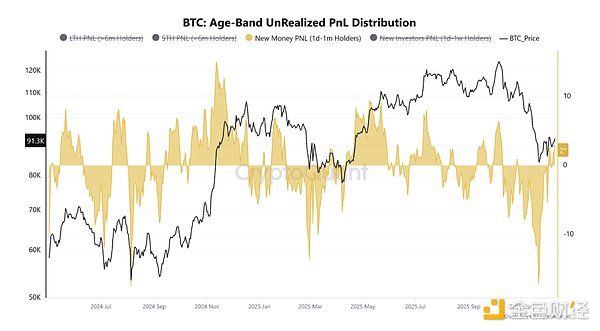
Data source for unrealized profit and loss distribution across different periods: CryptoQuant
The market had already factored in the "upside potential brought by dovish policies" into the price, resulting in a severe lack of marginal buying power for Bitcoin after the release of the Fed's interest rate meeting statement.
The market had already factored in the "upside potential brought by dovish policies" into the price, which led to a severe lack of marginal buying power for Bitcoin after the release of the Fed's interest rate meeting statement.
2. Interest Rate Cuts Trigger the Largest Decline
Following the announcement of the two 25 basis point interest rate cuts in September and October, Bitcoin fell by 6.9% and 8% respectively within a seven-day period. In fact, the Fed's easing cycle had already been priced in through pre-meeting fund inflows and aggressive long positions. Therefore, when the interest rate cut decisions were officially implemented, the market not only failed to gain support but also exposed its fragility.
3. Volatility Caused by Pre-Pricing Highlights Market Fragility Rather Than Stability
When the certainty of the policy outcome is extremely high, market volatility will narrow before the meeting and immediately expand after the meeting—because traders will reduce their positions based on the clear signal of the policy implementation, thus causing predictable short-term market misalignment.
Cryptocurrency analyst Ardi predicts a similar market movement after this meeting, writing in his analysis: "The gravitational effect of historical price action will become apparent tomorrow. If this movement follows the average decline (approximately 8%), Bitcoin may fall back to the $88,000 support level before potentially continuing its upward trend." Overall, the data suggests that the Fed's interest rate meeting is not a catalyst for one-way Bitcoin price movements, but rather a market reset point. Even if the interest rate decision leans dovish, previously overextended positions may be liquidated during this period.


 Kikyo
Kikyo

