Author: Mankiw Blockchain Law
When we talk about domestic Web3 entrepreneurship, we always talk about the 924 document of 2021, and emphasize that providing virtual currency financial services in the country is an illegal financial activity, which will constitute a crime and be held criminally liable in accordance with the law.
However, we will find that in recent years, there is such a model between Hong Kong and Shenzhen, called "front shop and back factory", that is, setting up projects/companies in Hong Kong, facing supervision and overseas capital; organizing development and some operations in Shenzhen, enjoying strong technical research and development and low costs.
This can't help but make people wonder: Is this model really compliant? If it is compliant, does it mean that I can set up a project in Hong Kong and then operate it in the country?
It has to be said that this is a very interesting and practical question.
Why does "front shop and back factory" exist?
Some people may be curious. Since the 924 document in 2021 has clearly pointed out that financial activities related to virtual currencies in the country are illegal, why has this "Hong Kong front shop, Shenzhen back factory" model been active in the vision of many Web3 entrepreneurs in recent years?
In 2023, Kong Jianping, director of Hong Kong Cyberport, also publicly stated in an interview with The Paper that the "front shop and back factory" model between Shenzhen and Hong Kong will facilitate the development of Web3.
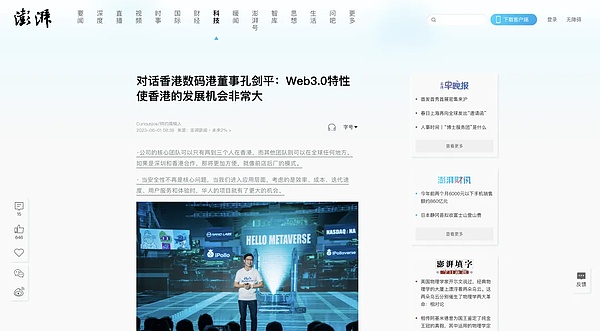
*Image source: The Paper
Lawyer Mankiw believes that the reason why this model can exist is that the focus of supervision is not only on whether the project directly serves domestic users, but also on the location of the actual operation, core decision-making and fund management of the project, that is, the actual control and distribution of key resources.
From the surface structure, the Web3 project will register all legal entities and businesses in Hong Kong or other overseas jurisdictions; through IP restrictions, KYC and other technical means, the provision of financial services is limited to Hong Kong and overseas users; at the same time, fund settlement, license application, market promotion and other links are also completed through overseas entities.
In this way, both in terms of business operations and service objects, users in China are avoided, catering to China's regulatory policies.
From the perspective of underlying development, the choice of setting up a technical team in Shenzhen is based on cost, efficiency and technical advantages. As an important part of the Guangdong-Hong Kong-Macao Greater Bay Area, Shenzhen has a mature technical research and development foundation and a large number of Web3 talent reserves. Compared with the local development team in Hong Kong, Shenzhen has obvious advantages in terms of employment costs, research and development cycles and technical accumulation. For many Web3 project parties, purely outsourcing underlying research and development to Shenzhen is a normal business choice, which is not much different from the "overseas company + domestic outsourcing development" model in the traditional Internet industry.
In short, the Hong Kong-Shenzhen "front shop and back factory" model seems to have temporarily avoided the risk of direct regulatory intervention by clearly dividing the domestic and overseas operating functions. However, this model is still inherently highly sensitive to compliance.
Potential challenges of "front shop and back factory"
On the surface, the "front shop and back factory" model seems to achieve a "clear division" between domestic and overseas businesses by registering a compliant entity in Hong Kong and retaining only the technical research and development links in China, so as to circumvent the regulatory red line. But the problem lies precisely in that the technical development, product iteration and business operation of the Web3 project itself are highly coupled. In many cases, the domestic technical team may not only undertake the development work, but also inevitably intervene in the token design, partial operation, data processing and even user support, which buries the hidden danger of the compliance of the Web3 project.
Because the regulatory authorities will not only look at whether the nominal structure complies with the regulations, but will penetrate and pay attention to the actual control chain of the project - who is in control of the core operation rights of the project, the decision-making power of capital flow, and the management rights of user data. If the daily operation management, key decision-making and capital processing of the project are still concentrated in China, even if the project entity is registered in Hong Kong and the service objects are limited to overseas users, it is easy to be identified by the regulator as "substantially" using domestic resources to provide illegal financial services in disguise.
What is more noteworthy is that some projects choose to outsource some marketing, community management and even customer service to Shenzhen teams in order to save costs or for efficiency considerations, or even directly initiate operations for global users from domestic teams. At this time, the regulatory authorities may well believe that the core operation chain of the project is not clearly cut and suspected of circumventing legal provisions.
In addition, since the technical team is deeply involved in the product logic design, even if the project is a new product or new function launched overseas, its development and launch process may have been completed in Shenzhen, which further blurs the boundary between domestic teams and financial services.
In other words, the risk of "front shop and back factory" has never been whether a compliance entity has been established on the surface, but whether domestic and foreign resources have truly achieved functional isolation. As long as the domestic team is involved in the core links of funding decision-making, operation management or user services, the compliance risk of Web3 projects will increase suddenly, and it is very likely to be identified by the regulatory authorities as "selling dog meat under the guise of sheep", and then pursue legal responsibility.
Mankiw's Advice
As mentioned above, the "front shop and back factory" model has achieved a seemingly compliant structure by setting up a Hong Kong compliance entity and restricting the participation of domestic users. However, at a time when regulatory authorities are increasingly concerned about "substance over form", if Web3 project parties want to truly reduce legal risks, formal division of functions alone is far from enough.
Mankiw's Advice
As mentioned above, the "front shop and back factory" model has achieved a seemingly compliant structure by setting up a Hong Kong compliance entity and restricting the participation of domestic users ...Mankiw's Advice
Secondly, avoid mixing technology research and development with product operation functions. Many projects are used to letting the technical team participate in token design, user interaction, etc. at the same time because the technical team has a high degree of mastery of product logic, which actually leads to the blurring of domestic and foreign functions. The project party should clarify the scope of work of the technical team, strictly separate it from the compliance team and operation team of the Hong Kong entity, and ensure that technology development only exists as a "back factory" rather than participating in the business operation of the "front store".
In addition, establish a clear legal and compliance firewall. Web3 project parties should establish a clear isolation mechanism with domestic teams at the contract level, personnel structure level, and capital flow chain with the assistance of professional legal personnel. Including but not limited to explicitly prohibiting domestic teams from getting involved in fund settlement, token distribution, and user management in the technology development contract; at the same time, setting up an independent legal person or foundation overseas to hold the project IP, assets, and brand rights, to prevent domestic entities from being held accountable as de facto partners or co-operators for nominal "technical services".
Finally, make compliance filings in various jurisdictions in advance. If the Web3 project entity is registered in Hong Kong, it is recommended to apply for relevant licenses as soon as possible, either independently or by hiring professional legal advisors, to ensure that all user-oriented financial services operate within the compliance framework. At the same time, avoid conducting any promotional marketing, community operation, payment settlement and other activities in mainland China to reduce the risk of being identified as "providing services to domestic residents in disguise."
In the final analysis, the current "front shop and back factory" model can still be used as a realistic option, but the premise is that the team must truly achieve a clear separation of domestic and foreign resources and rights and responsibilities, and avoid turning domestic technology development into an "invisible support" for overseas financial business. However, under the existing regulatory policies, this model is not the best long-term solution. As supervision becomes increasingly stringent, risks will inevitably increase. If you are not careful, you may face criminal penalties and all your previous efforts will be wasted.
Therefore, Mankiw still recommends that Chinese entrepreneurs try their best to truly implement the "going overseas" model, fully implement technology research and development, corporate governance and financial operations overseas, and accept compliance management from overseas regulatory agencies.


 Anais
Anais


