Hyperliquid: The Next Generation Nasdaq
The next generation of Nasdaq may no longer be a single company, but rather a blockchain on which anyone can open an exchange.
 JinseFinance

Author: Dongdong Fusi; Source: X, @dongdongRobin
Priority Fee is the first time Hyperliquid has systematically redirected the costs of the HFT* arms race from off-chain back into the protocol and permanently destroyed them through $HYPE.
Before this, the money flowed to private operators; after this, it became a shared benefit for the entire ecosystem. HFT (High-Frequency Trading) refers to a trading method that utilizes algorithms and extremely low latency to buy and sell large quantities of goods in a very short time. In traditional finance and the crypto market, HFT teams invest heavily in optimizing infrastructure to gain a speed advantage of milliseconds or even microseconds faster than others. This "speed arms race" extracts billions of dollars in revenue from the global market annually. Before this upgrade, API traders on Hyperliquid who wanted competitive latency had to privately pay validator nodes for sentry peering or other dedicated access services. This cost tens of thousands of dollars per month, flowing to private operators and completely opaque to ordinary users. Priority Fee directly targets and replaces this mechanism, transferring this money from the validator nodes' pockets to the protocol's burning mechanism. Faced with the HFT arms race, traditional exchanges and Hyperliquid have taken three completely different paths. In simpler terms: IEX (Investors Exchange) chose "I won't let you run." They added a 350-microsecond delay to their system, forcing all orders to wait a short while before execution. This effectively neutralized the speed advantage—but at the cost of slowing down serious market makers, resulting in a significant loss of liquidity for exchanges. This confrontational stance drove HFT away, but also drove everyone else away. The NYSE and CME chose to "collect rent since they couldn't escape." They built increasingly larger server rooms, forcing the HFT team to pay to place their servers as close to the exchanges as possible. This colocation fee went into the exchanges' pockets, but the arms race continued; the exchanges simply went from bystanders to landlords. Hyperliquid took a third path: "turning the competition itself into protocol revenue." Instead of hindering it or collecting rent, it channeled the money the HFT team was willing to spend on speed directly into the platform through a Priority Fee mechanism—and then burned it all. The arms race continued, but every penny of the competitive cost became HYPE's burning pressure, returned to the entire ecosystem. BIS research estimates that the HFT arms race extracts approximately $5 billion annually from the global stock market, and Priority Fees are the mechanism by which agreements proactively take a share of this competition. Figure 1: Three Completely Different Paths When Facing the Same Problem. II. The Complete Order Path. To truly understand where Priority Fee is inserted, we need to know what an order goes through from "click to buy" to "position opening". From signature to position opening, an order goes through six stages within 70ms. Priority Fee doesn't just appear out of thin air—Gossip Priority lets you see data earlier than the Mempool, while Order Priority directly affects the execution order within the matching engine. Understanding this path is key to understanding why this mechanism works.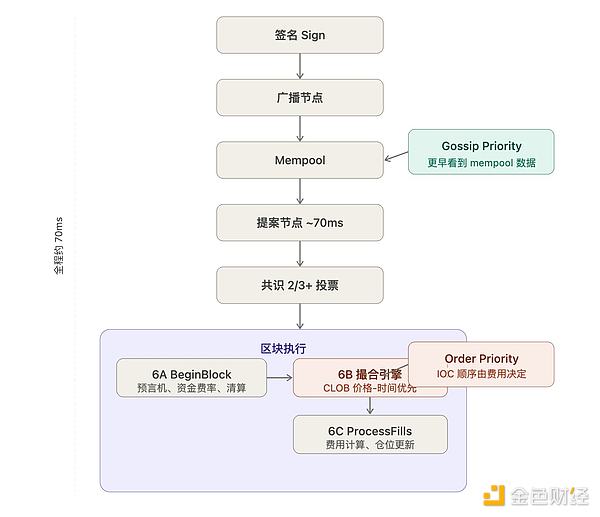
Figure 2: The 70ms journey of a transaction in Hyperliquid
Signature — Users sign orders via API, using EIP-712 signatures, which include assets, direction, price, quantity, order type, and nonce. **Broadcast Nodes:** — Signed transactions enter a single whitelist of broadcast nodes. All user transactions are pushed to validator nodes through the same entry point. **Mempool:** — Transactions are enqueued after completing seven checks in sequence: format, signature, authorization, nonce, duplicate, and commit status. **Proposal Nodes:** — Every approximately 70ms, one of the 24 validator nodes is designated as the proposal node, packaging pending transactions into a block. **Consensus:** Other validator nodes vote on the block hash signature. A block is committed when 2/3+ of the staking weight is reached, ensuring immediate finality and preventing reorganization.
Block Execution — This is the most crucial stage, and the order is fixed: First is BeginBlock, where oracle updates, funding rate distribution, and liquidation occur before your order is processed. If the funding rate consumes your margin at this step, your order will be rejected in the next step even if you have sufficient balance 70ms beforehand. Next is the matching engine DeliverSignedActions, where price-time priority CLOBs run. Finally, ProcessFills completes fee calculations and position updates.
Priority Fee intervenes at two different points in this process.
Gossip Priority intervenes in the information layer, allowing users to bid for 5 simultaneous Dutch auction slots and see mempool data earlier after paying—officially described as "these are the fastest transaction inputs to execution, broadcast even before they are executed by the L1." However, it's important to note that this only means faster viewing, not faster transactions. Fees are deducted from the spot balance in HYPE and permanently destroyed.Order Priority During the matching engine phase, the rule is that all cancelled orders always take precedence over all IOC orders. Among IOC orders, the higher the fee, the earlier they are executed. Fees are deducted from the undelegated staked balance and permanently destroyed. Currently, this only applies to HIP-3 assets. Figure 3: Two Priority Fees, Two Dimensions of Competition. Gossip Priority buys informational advantage, while Order Priority buys execution advantage. Their sources of fees differ, their intervention levels differ, and their functions differ—but they share one thing in common: all fees are permanently destroyed and directly converted into protocol value.
The official documentation states the purpose of Order Priority very directly:
"Order priority reduces the need for market makers to hyper-optimize their order entry and connectivity, and instead focus on the strategy itself. It further protects makers and allows responsiveness to price moves driven by traditional venues."
“The order priority mechanism reduces the need for market makers to hyper-optimize their order entry and network connectivity, allowing them to focus on the strategy itself. This mechanism further protects market makers, enabling them to respond promptly to price changes driven by traditional venues.”
This statement reveals an important design intention: this mechanism is not helping HFT.
It's not about being faster, but about **reducing market makers' reliance on the infrastructure arms race**, allowing them to focus on the strategy itself and respond quickly to price fluctuations in traditional markets. Here's a key game theory point worth clarifying: market makers' order cancellations always take precedence over takers' IOCs. This means market makers can always cancel their orders before submitting outdated quotes, and the only competitive tool for takers is paying the Order Priority Fee. **This design directly converts the costs of the HFT arms race into protocol revenue and destroys it.** Figure 4: Racing within the same block. The most direct use case for this mechanism is during highly volatile, event-driven moments.
Take the
The next generation of Nasdaq may no longer be a single company, but rather a blockchain on which anyone can open an exchange.
JinseFinanceETH, Ethereum Transaction Priority and Block Building Mechanism Analysis (Jinse Finance), How MEV and Block Builders Shape Ethereum Transaction Ordering.
JinseFinanceThe rise of Hyperliquid is the result of multiple factors including technology, products, marketing, and economic models.
JinseFinanceAccording to Bloomberg, cryptocurrency has been listed as a national "priority" by Trump.
JinseFinance0x's new API offers a simpler, more intuitive way to trade cryptocurrencies by integrating gas fees into trade costs and promoting user-friendly, intents-based systems. However, it also raises questions about transparency and control in the evolving landscape of decentralized finance.
 Miyuki
FTX clientele finds itself confronted by a deceptive priority withdrawal scam. These misleading emails purportedly originate from FTX Trading, West Realm Shires Services, and FTX EU.
 Catherine
PolkaFantasy is a holistic GameFi ecosystem integrated with metaverse and play-to-earn mechanisms and multichain solutions to create a seamless NFT gaming experience for anime lovers, collectors, and gamers across the globe to connect, interact and have fun.
 Bitcoinworld
War Legends is a military-themed, multiplayer online battle arena (MOBA) game and metaverse built on blockchain technology for PC and mobile gaming.
Bitcoinworld Beincrypto
The entire industry has just changed, and you should recalibrate your assessment of the current situation. Don't rely on old assumptions. We could see a huge change in the way Crypto works.
 Ftftx
Ftftx