Must tokens die?
Artificial Intelligence, AIGC, and Tokens Must Die? Jinse Finance: Can the Large Language Model Paradigm Lead to AGI (Artificial General Intelligence)?
 JinseFinance

Source: Merkle3s Capital; Translation: @Jinse Finance xz
In May 2026, AI chip manufacturer Cerebras went public on Nasdaq. An hour before the opening bell, the price on the traditional over-the-counter (OTC) market deviated by as much as 35%. On one blockchain, a perpetual contract was priced at $340. An hour later, the actual opening price on Nasdaq was $350—a deviation of less than 3%.
The "exchange" that generated this price never received any approval or license from concept to launch. Its deployers did only one thing: staked 500,000 HYPE tokens on the Hyperliquid chain—approximately $25 million—and then opened for business.
That same month, SpaceX's perpetual contracts went live. On its first day, as traders bid for the world's most watched private company, $33 million changed hands, pushing its valuation from $1.78 trillion to $2.5 trillion. Contracts for OpenAI and Anthropic were also listed nearby. These pricing games—once only open to top institutions in traditional finance—are now open to anyone to participate in and anyone to host. When Nasdaq was founded in 1971, the crowd at the New York Stock Exchange (NYSE) scoffed: An electronic quotation system is an exchange? Fifty years later, it became the world's second-largest stock exchange. Today, the same scorn has fallen on blockchain.
“Anyone can open an exchange” is not a figure of speech. On Hyperliquid, these are three operational product layers.
First Layer: Opening a Marketplace. Launched in October 2025, HIP-3 allows anyone who stakes 500,000 HYPE to deploy their own perpetual futures exchange—choosing the underlying assets, setting leverage, connecting to oracles, and earning up to half of the transaction fees. The staked amount is locked for 183 days; malicious actors will face validator slashing until their last token is deducted. This is not a listing application—it's a business license backed by collateral.
To date, 14 deployer platforms have launched.
The underlying assets range from US stocks like Tesla and NVIDIA, to indices tracking the Nasdaq 100, to gold and crude oil, and even extend to pre-IPO companies like SpaceX. These “private exchanges” processed over $62 billion in trading volume in May 2026 alone—35% of the entire platform, with a single-day peak approaching 50%. Open interest has grown nearly sixfold this year, reaching $2.7 billion. As a scale reference: When Binance launched similar pre-IPO contracts, the total volume in the first five days was $280 million. On Hyperliquid, a similar market exceeded $1.6 billion in a single month. Layer Two: Set up a front-end. If operating a market is too cumbersome, you can simply operate a “broker”: connect to Hyperliquid’s back-end matching engine, charge your own front-end fees, and let on-chain settlement happen automatically. Over 100 teams have already integrated; approximately 40% of daily active users access the platform through third-party interfaces. Phantom Wallet, which completed its integration less than a year ago, has earned over $20 million in builder fees and routed approximately $39 billion in transactions. MetaMask is currently integrating; OpenSea is in the queue. Layer 3: Launching a prediction market. HIP-4, launching in May 2026, transforms binary prediction contracts into deployable public goods: validators directly act as oracles, fees start at zero to compete with Polymarket, and each market requires 1 million HYPE to be staked. Bitcoin's intraday price movements, US inflation data—all of this can be bet on within the same margin account. What Hyperliquid does is break down the corporate structure of an "exchange" into permissionless public components. 3. Land Rent Economics: If anyone can open an exchange, who collects the taxes? Nasdaq shareholders earn listing fees and trading fees. So, who collects the rent for this on-chain financial land? The answer is written in the protocol: everything is denominated in HYPE. Opening a market requires staking 500,000 HYPE; opening a prediction market requires 1 million. Adding new trading pairs requires HYPE to participate in Dutch auctions. Every on-chain contract call consumes HYPE as a gas fee. Deployer staking alone has locked approximately 7 million tokens; the HyperEVM ecosystem holds nearly $8 billion in assets, with HYPE as the underlying collateral. The largest pipeline is buybacks. The vast majority of transaction fees—based at 97%, increased to 99% for certain categories after validator voting—automatically flow into an on-chain vault called the "Assistance Fund," which buys HYPE on the open market every moment. This is not a quarterly buyback, nor a board resolution, but the default execution of the protocol. This machine has cumulatively bought back over $1.3 billion, approximately $1 million per day, with an annualized buyback amount of about 7% of the market capitalization—far exceeding comparable metrics for Ethereum and BNB. In December 2025, a validator referendum permanently destroyed approximately 37 million HYPE held by the fund. On March 27, 2026, daily buybacks exceeded daily new issuances for the first time—HYPE turned into net deflation. More importantly, the revenue structure has shifted. The HIP-3 market now accounts for 35% of the platform's trading volume. Stocks, commodities, and pre-IPO companies are becoming a second cash flow outside of the crypto market cycle. Some institutional studies predict that this business could generate an additional $800 million in revenue annually. A perpetual contract platform's revenue fluctuates with the crypto market; while an exchange's parent company's revenue follows the entire financial world. HYPE is no longer just a dividend receipt from a single exchange—it's a deed to financial infrastructure. 4. Rule by Man or Rule by Protocol? Looking back at the history of exchange tokens, a recurring formula emerges. BNB's quarterly burns are decided by Binance. OKB's scarcity narrative is controlled by OKX's management. FTT proves in the most brutal way that when a token's value stems from human commitment, human greed is the ultimate risk—user assets are misappropriated, tokens are re-collateralized, and $8 billion belonging to 1 million users evaporates in a week. The historical formula for exchange token returns is: the owner's discretion multiplied by the profit-sharing ratio. HYPE replaces that formula. The buyback ratio is written into the protocol as the default rule; changing it requires a public vote by more than twenty validators on-chain. User assets are self-custodied on-chain—misappropriation of assets is physically impossible. To be precise: humans still exist in this system. In the 2025 JELLY manipulation incident, it was the validator vote that resolved the crisis, and the community's criticism was sharp. The difference is that every exercise of human will must occur in full view of the public. The 14 deployer platforms and over 100 front-ends mentioned in Section 2 are the other half of the answer. They invested real capital to start their businesses. Their livelihoods don't depend on any founder's promises, but on one thing: the rules of the protocol won't change. This is what an "independent ecosystem" looks like in practice—not a vision on a white paper, but a monthly transaction volume of $62 billion. The former is rule by man; the latter is rule of law. Rule of law doesn't mean the absence of people—it means people must act in the open. 5. One question, three answers. When you place the three sets of ledgers side by side, the dividing line between rule by man and rule of law becomes more concrete. Put BNB, OKB, and HYPE on the same page and start by looking at the sources of deflation. BNB operates on a dual-track system: a formulaic burn each quarter targeting a reduction from 200 million to 100 million tokens, plus real-time burns from on-chain gas fees. Approximately 1.57 million tokens were burned in Q1 2026; the current supply is approximately 134.8 million, meaning an annual burn of approximately 6.3 million tokens—nearly 5% of the supply. OKB adopted a one-off solution: in August 2025, approximately 65.25 million tokens were burned in a single operation, and a contract upgrade permanently capped the supply at 21 million tokens. Minting and burning functionality was completely removed—the deflationary narrative was closed. HYPE is a continuous stream: transaction fee buybacks are executed every second, on-chain gas fees are fully burned, and there is also a referendum burn of 37 million tokens. The annualized net burn is approximately 6.17 million tokens—about 2.7% of the circulating supply—and the token is already in a net deflationary state. Next, let's look at the source and destination of the buyback funds. BNB's burns were initially linked to platform profits, but are now formula-driven; however, who sets the formula and when to adjust it remains a company decision. Revenue belongs to the company; holders profit from scarcity-driven appreciation. OKB does not have ongoing buybacks. Its value relies on two pillars: a fixed supply and on-chain gas consumption. HYPE channels approximately 99% of its protocol transaction fees into code-driven buybacks. Almost all revenue flows back to holders by reducing the supply—unique among the three. Finally, let's calculate the demand pipeline. BNB has two or three pipelines: on-chain gas, transaction fee discounts, and Launchpad access. OKB primarily relies on on-chain gas after burning; it recently added staking for market deployment to its roadmap—a direction that looks familiar, echoing the HIP-3 path. HYPE has at least five pipelines: transaction fee buybacks, on-chain gas, market deployment staking (500,000 tokens per market), listing auctions, and indirect demand from over a hundred third-party front-ends. The native staking annualized yield is approximately 2.2%, and this yield can be passed on to traditional market buyers through ETFs. The difference between these three is not in how much is burned, but in who decides on the burning—and whether burning can continue.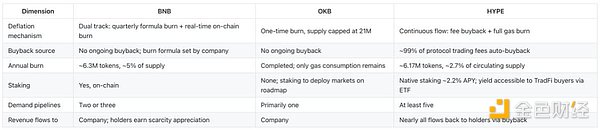
If its benchmark is Nasdaq rather than a decentralized exchange, valuation becomes an interesting issue.
Grayscale Research released a set of price-to-earnings (P/E) ratio comparisons: Coinbase is about 44x, Robinhood about 37x, CBOE about 29x, Nasdaq about 25x, CME about 24x—while Hyperliquid is only about 14x. If you accept the "Nasdaq on the blockchain," it's 40% cheaper than Nasdaq itself. Let's do the short sellers' math first, because they have a point: the denominator of 14x is protocol fees, not the net profit of publicly traded companies; if all unclaimed tokens are included in the market capitalization, the multiple almost doubles. Both of these points hold true. But even under the most stringent adjustments, it only goes from being the cheapest in its class to mid-range—and none of the companies on this list can achieve $1 billion in annualized fees in the third year. Supporting this figure is an 11-person team, with an average revenue per person exceeding $80 million. Among licensed financial institutions—including Goldman Sachs—there are no comparable figures. No benchmark among licensed institutions? Let's return to the perpetual contract arena. The answer remains the same. This space is never short of challengers: In September 2025, Aster, backed by BNB Chain, launched a subsidy war, slashing Hyperliquid's daily transaction volume share from 70% to below 40%. After the subsidies subsided, Hyperliquid regained its lead in early 2026, with its share rising from 36% to 44%—the only leading platform to reverse the trend. Aster fell back to around 20%; newcomer EdgeX held approximately 27%. Former "King of Perpetual Exchanges" dYdX's annualized transaction fees have shrunk to $2-3 million, with a market share of less than 3%; veteran GMX's market capitalization has fallen below $100 million, and its market share is also less than 3%. In terms of revenue, the strongest challenger, Aster, has an annualized revenue of approximately $120 million; Hyperliquid alone is several times the combined revenue of all its major competitors. In terms of market capitalization, the two are an order of magnitude apart. Market share can be bought with subsidies and will be returned when subsidies fade. Revenue cannot. Hyperliquid's real challenge has never been other exchanges in the sector—it's the entire ceiling of traditional finance above its head.
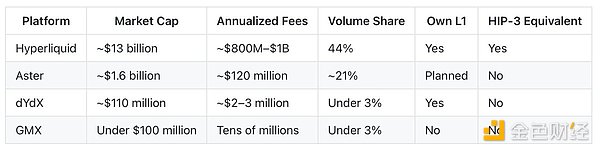
The essence of the valuation debate lies in what you consider it to be: a trading application or the parent company of an exchange.
Traditional finance is responding to it with two approaches. One is suppression: CME and ICE are jointly pressuring US regulators, warning of manipulation risks and sanctions risks.
Another distribution: Three HYPE spot ETFs have been listed on Nasdaq and the NYSE, with a combined inflow of over $150 million and no single-day net outflows. Four listed companies have added approximately 22.3 million HYPE tokens to their treasuries—about 9% of the circulating supply. Enemies and shareholders are becoming the same group. However, before believing this story, we must acknowledge three cracks. First, it lacks the regulatory backing of Nasdaq. The gray area between front-end blocking and actual use in the US could become a point of entry for law enforcement at any time. This is the biggest source of valuation discounts and the most uncontrollable variable. Second, the paper unlock amount is twenty times that of the buybacks. Core contributors can theoretically unlock approximately 9.92 million tokens per month, while buybacks net remove approximately 490,000 tokens—a huge gap. However, the actual amount claimed is less than 6% of the unlockable amount; the team only claims 300,000-400,000 tokens per month, roughly equivalent to the repurchase amount. How long this self-discipline can be maintained is the biggest variable for the next two years. Third, "Anyone can open an exchange" means anyone can open a bad exchange. In May 2026, a SpaceX contract from a certain deployer plummeted 45% within 30 minutes due to an oracle's erroneous handling of a stock split, liquidating over 400 traders. Staking penalties are hedging, not insurance—and the largest deployer holds 90% of the open contracts, while there are only 24 validators. Under the permissionless shell, concentration still exists. In 1971, no one considered an electronic quotation system worthy of being called an exchange. Judgment never requires universal agreement—only time and a ledger that cannot be falsified. The next-generation Nasdaq may no longer be a company, but a blockchain on which anyone can open an exchange. You don't have to believe this assessment—the blockchain's ledger is publicly recorded daily.
Artificial Intelligence, AIGC, and Tokens Must Die? Jinse Finance: Can the Large Language Model Paradigm Lead to AGI (Artificial General Intelligence)?
JinseFinanceWhile everyone is using tokens to measure the value of AI, two papers published almost simultaneously raise a more fundamental question: must the core computation of language generation take place in the token space?
JinseFinanceFrom ownership to usage rights, how Huang Renxun's formula is reshaping the entire AI industry.
JinseFinanceHuge amount of unlocking: 237.8 million HYPE tokens (approximately $11.9 billion) will be unlocked linearly over 24 months; DAT is underfunded; competition from Binance Aster and others is increasing;
JinseFinanceWith multiple AI tokens set to triple in 2024, observers are questioning whether many of these projects are valuable.
JinseFinanceOverall capitalization of such tokens has risen over 21% in the past 24 hours, outperforming most other token sectors.
 Coindesk
While some exchanges are keen on embracing crypto and crypto products, others have indicated a more ambivalent outlook
 Clement
Weeks after Microsoft announced a new AI-powered version of its search engine Bing, scammers have been flooding the market with tokens trying to cash in on hype.
 decrypt
The ShibaDoge team is excited to announce the release of the SHIBDOGE token. According to the team, the token was ...
 Bitcoinist
After the decline of cryptocurrencies and stablecoins, what will happen to NFT?
 Ftftx
Ftftx