香港警察、暗号犯罪捜査のためBitraceから研修を受ける
Bitraceの技術専門家チームは、香港のサイバーセキュリティ・テクノロジー犯罪局(CSTCB)と香港の商業犯罪局(CCB)を対象に暗号トレーニングセッションを実施した。
 Catherine

Author: Chen Mo, Source: X, @cmdefi
The recent heated debate between Aave DAO and Aave Labs, concerning governance power at the protocol and product layers, reflects the governance dilemma across the entire industry. This article analyzes the issue. Who truly owns Aave?
Aave Labs replaced its front-end integrated ParaSwap with CoW Swap, and the resulting fees flowed to Labs' private address. Anonymous DAO member EzR3aL exposed this on a governance forum, accusing Labs of "privatizing" the protocol's value. Labs' position is that this revenue belongs to the front-end and product layers and belongs to Labs, unrelated to the core protocol.
2. First, let's break down who Aave DAO and Aave Labs are. The core controversy is whether Aave is a Protocol (managed by the DAO) or a Project (built by the Labs), and the impact on revenue rights. Aave DAO is easy to understand; it's a governance organization unique to the Crypto world, composed of AAVE token holders who vote and exercise power within the DAO. Almost 90% of crypto projects use this structure, hence the definition of "governance token." Its greatest power is voting on project proposals, deciding whether to implement updates and developments, and determining the future direction of the project. Aave Labs, on the other hand, is a development team responsible for building, updating, and maintaining the protocol. (Such as front-end interfaces and mobile apps), they usually also maintain the Aave brand and IP, so on social media and in the market, Aave Labs is usually assumed to be Aave. Its founders are also quite influential on social media. Generally speaking, Aave Labs and Aave DAO need to collaborate. For example, Labs will formulate many development plans, optimize certain functions, and even upgrade versions V3 and V4. These plans are led by Aave Labs, but ultimately decided by the DAO through voting. Usually, when their interests align, they support each other and together form Aave. 3. What core resources do they control respectively? Once a conflict of interest arises, these two roles can be separated, as they are two independent entities. Let's look at the core resources and powers they each possess: Aave DAO controls the underlying core, such as smart contracts and the treasury. Although Labs can propose development plans, they need to be voted on by the DAO before implementation. Therefore, it's a protocol, and any product can operate on top of it. Theoretically, multiple front-end products can be built on a single protocol—Aave? Bave? Cave, etc. Aave Labs controls the front-end, branding, product marketing, and partners. Therefore, it directly interacts with users and represents a high-quality product. Thus, Labs' supporters generally believe that the integration of CoW Swap is entirely a front-end action, unrelated to Aave's underlying architecture. They even argue that Labs could unilaterally decide not to integrate, and any revenue generated would naturally belong to Labs. Correspondingly, DAO supporters believe this is a form of exploitation because of the existence of the AAVE governance token; all benefits should flow primarily to AAVE holders or remain in the treasury for the DAO to decide. Furthermore, previously, ParaSwap revenue continuously flowed into the DAO; the new CoW Swap integration changed this, further reinforcing the DAO's perception of exploitation. Both sides hold their own opinions. 4. Governance Dilemma This presents a rather awkward governance and power dilemma. From the perspective of AAVE holders, they usually side with the DAO because revenue going into the national treasury benefits token holders. While Labs has annual expenses, these can be accounted for through the DAO. If a separate channel for profit could be opened, it seems that community power is being gradually eroded. However, from Aave Labs' perspective, although theoretically the core control lies with the DAO, and the final plan requires a vote to be implemented, Labs has played a coordinating role since the first version of Aave, making significant contributions to the project's growth. As Stani said, "If Emilio hadn't convinced me to adopt the design direction of the Aave protocol in 2018-2019, when we were still working on ETHLend, I think the Aave protocol might not even exist." Who is the true owner of Aave?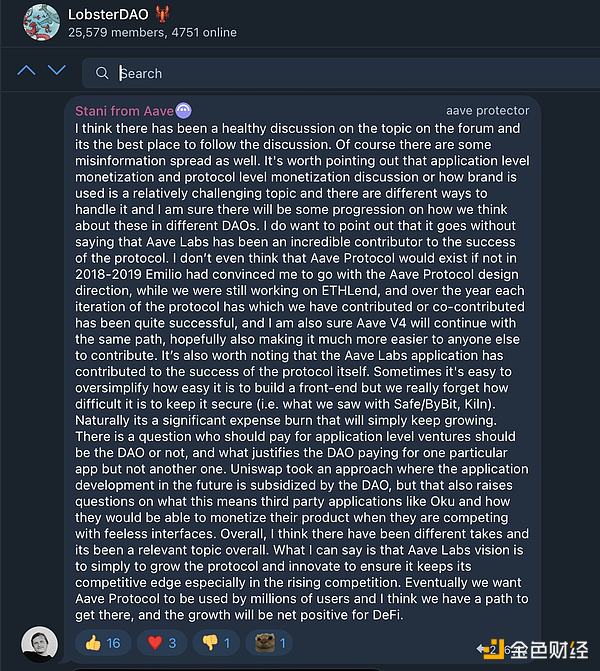
This governance dilemma exists in most projects. Governance tokens are purchased with real money, and ideally, these holders should jointly decide the future of the project. When the team no longer holds voting rights, they can even forcibly replace Labs.
However, the reality is very different from the ideal. Even projects with a certain market share will inevitably lose market share when problems and disputes arise within the team, and after the drama, they will inevitably lose market share. Sushi is a good example. The DAO can exercise power, and the project can also change personnel. Although thanks to the design of smart contracts, even if a project undergoes a major overhaul, the original stability can be perfectly preserved at the product functionality level.
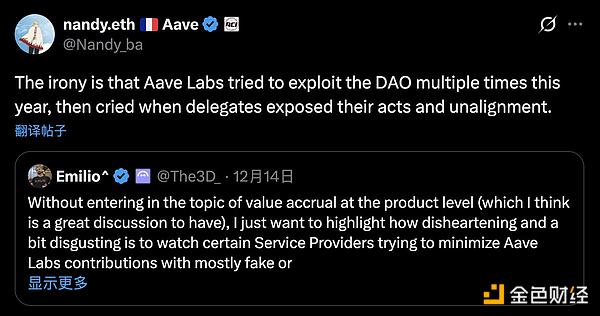
However, past cases show that splits usually end badly. The core issue here is that DAOs are currently decentralized organizations. While they have voting rights, they struggle to operate efficiently. The community may contain independent developers, VCs, and large investors. Once each role begins to fully exercise its power, a proposal may undergo multiple rounds of drafting, modification, and negotiation from the outset. A project's success requires a professional team and continuity. While a DAO can hire new teams, it may struggle to quickly integrate and iterate, easily losing its market position. Therefore, Labs, on the surface, seems more like an entity capable of "controlling" the protocol (requiring collaboration with the DAO). Personally, I prefer that the two sides eventually reach a solution that balances the distribution of benefits. However, everything is currently under discussion, and no governance vote has taken place. A potential hidden danger is that even if a reconciliation is ultimately reached, this incident has already exposed a divergence in expectations between the founding team and token holders. In the long run, I remain optimistic about Aave's development because it is one of the few DeFi projects that has been proven by the market to have a strong competitive advantage. The conflict over governance power is a problem the entire industry needs to address, and how Aave handles this incident may become a model case for the industry in the future. 6. Voices and Discussions Emilio believes that someone is maliciously belittling Aave Labs' contributions and value. ACI team members point out that Aave Labs has repeatedly attempted to exploit the DAO, and these attempts have been exposed.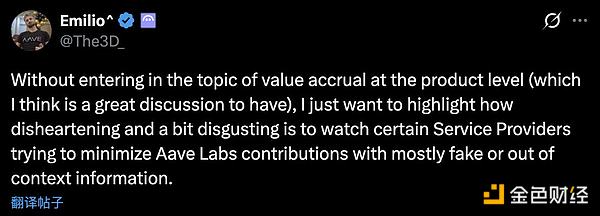
Community members' suggestions for Labs:
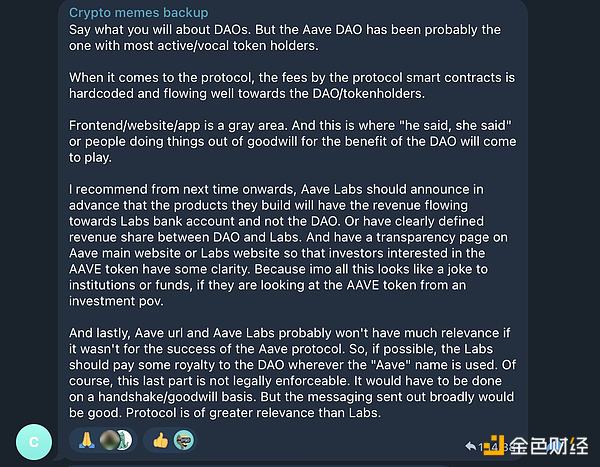
In the future, Labs should announce in advance that the revenue from the products it builds will go to Labs, not DAO.
Community members' suggestions for Labs:
In the future, Labs should announce in advance that the revenue from the products it builds will go to Labs, not DAO.
Alternatively, clearly define the revenue sharing ratio between the DAO and Labs. Establish a transparency page on the Aave main website or Labs website, providing clear information to help investors (especially institutions or funds) interested in AAVE tokens make informed decisions. Despite the controversy surrounding the DAO model, Aave DAO token holders are the most active and vocal group, demonstrating its community vitality. The front-end, website, and application are the focus of controversy, where conflicting interpretations and a lack of clear definition are common.
Zeller's accusations against Labs for extracting value from protocols:
The projects he listed (Portals, Credit Delegation Vault, Lens, etc.) do indeed show that many of Aave Labs' exploratory initiatives have failed to directly translate into protocol revenue or significant adoption.
He also mentioned version V4, where the DAO has cost $15 million to date, and its value proposition is unclear compared to the liquidity moat of V3, expressing concern about whether this is a new trap for extracting revenue.
Failure is inevitable in the process of innovation. Not every feature or product will succeed.
DAO is, to some extent, an investment in Aave Labs' R&D capabilities. My understanding is that Zeller isn't denying contributions, but rather calling for higher standards of accountability, transparency, and value alignment.
Bitraceの技術専門家チームは、香港のサイバーセキュリティ・テクノロジー犯罪局(CSTCB)と香港の商業犯罪局(CCB)を対象に暗号トレーニングセッションを実施した。
Catherineナイジェリア当局は、脱税やマネーロンダリングなど総額3,540万ドル(約35億円)にのぼる重大な容疑で身柄を拘束されたまま逃走したバイナンスの幹部ナディーム・アンジャワラを追及しており、暗号通貨の規制や金融犯罪の訴追における国際協力の課題が浮き彫りになった。
 Joy
JoyXは、スパムを抑制する目的で、新規ユーザーが投稿、「いいね!」、ブックマーク、返信機能を利用できるようになる前に、少額の年会費を支払うことを義務付ける改定ポリシーを導入した。
Catherine数週間にわたる取引失敗の後、Solanaはメインネットバリデーター向けの最初のアップデートを展開し、ブレークスルーの兆しを見せているようだ。
 Kikyo
KikyoBinance Launchpoolでは当初、60億FDUSDが入金され、総供給量を上回っていた。イーサリアムとBNBチェーンの供給量を考慮した結果、31.9億FDUSDに修正。
 Alex
AlexOKXの新しいレイヤー2ネットワークであるX Layerは、イーサリアムベースのDAppsに対してより低い手数料と強化された相互運用性を提供し、Web3エコシステムを前進させます。
 Miyuki
Grand Baseトークンは、ハッキング事件で200万ドルの損失を被り、その結果、価格が99%急落し、そのセキュリティプロトコルに対するコミュニティの信頼を著しく損なった。
CatherineCZ(Binanceの元CEO)は4月30日に処分を受けた。SBFのケースとの違いは、CZが米国当局に積極的に協力したことだ。
 Weiliang
Solanaの新しいミームコインであるSlothanaは、プレセールで1000万ドル以上を調達し、BONKの成功を彷彿とさせる4億2000万ドルの時価総額を目指している。ユーモラスなナマケモノのマスコットと強力なソーシャルメディアでの存在感で、Slothanaはミームコインマニアの波に乗ろうとしており、暗号市場におけるBONKの爆発的な上昇を再現する可能性がある。
Joyイーサリアムの共同創設者であるヴィタリック・ブテリンが最近、Railgunのプライバシー・プロトコルに33万ドル相当の暗号を入金したことで、X上の暗号コミュニティのメンバーは憶測に沸いている。
Kikyo