The Future of Hyperliquid: HIP-3 and HyperStone
The future of Hyperliquid lies in HIP-3, and the foundation of HIP-3 lies in HyperStone.
 JinseFinance

Market Position
Accounts for 70% of the total decentralized perpetual contract trading volume, and 9.9% of Binance's daily trading volume
665,000 tradersgenerating an average of US$300,000 in trading volume per month (the trading density is 65 times that of Binance's retail users)
Fundamentals
Monthly revenue of 116 million US dollars, of which 97%returned to ecological participants
Fundamentals
Monthly revenue of 116 million US dollars, of which 97%returned to ecological participants
leaf="">38% of the total token supply (388 million HYPE) is still reserved for future growth incentives
24 validator nodes Maintaining network security vs Ethereum's 1 million+ (trade-off between centralization and performance)
Competitive situation
Expected
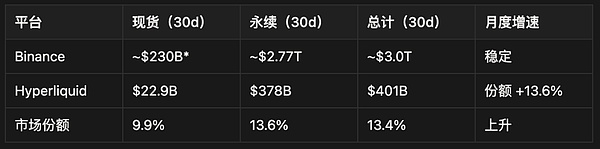
Market share of Binance perpetual contracts increased from 2.2% to 13.6% in 12 months, and $32 billion on Jupiter platform in 60 days.
While most people focus on token price appreciation, I analyze its underlying business sustainability through multiple market cycles (including bear market stress tests and competitive pressures).
The 238 million token unlocking starting at the end of the year will generate an average daily selling pressure of US$17 million - equivalent to 8 times the current repurchase capacity. Most bulls ignore this structural resistance.
Hyperliquid may face user churn due to token depreciation and yield compression, but 97% fee refund model and sustainable income generation capabilities. leaf="">making it a potential multi-cycle infrastructure project. Unlike traditional DeFi protocols that rely on token emissions or subsidy income, Hyperliquid generates income from real economic activities and returns almost all of it—demonstrating resilience when unsustainable income models collapse A 60-80% drop is expected during the 2025-2027 unlock period, but its business acumen and infrastructure advantages make it likely to emerge strongly amid industry consolidation #
Initially guided and launched by the Hyperliquid core team
In a cryptocurrency world where everyone is eagerly seeking convenient leverage channels (such as meme coins, prediction markets, derivatives, altcoin beta, etc.) during a bull market, perpetual contracts have found a foothold with their simplest leverage access method and achieved product-market fit (PMF).
Airdrop
Then, their airdrop began to be distributed - this airdrop covered nearly 94,000 wallets, and each participant received an average of $45,000 to $50,000 worth of HYPE tokens:
No selling pressure from insiders
Wide user holding promotes loyalty and interest alignment
It is worth noting that the Hypios community also provided extremely generous airdrops to its holders, and even meme coins on Hyperliquid (such as $BUDDY, $PURR) also maintained low selling pressure and a committed holder base.
As traders and deep DeFi participants received tokens, many chose to stake (to reduce trading fees) and deposit them into the HLP vault (https://hyperliquid.gitbook.io/hyperliquid-docs/hypercore/vaults/protocol-vaults), improving the trading experience and kickstarting a powerful flywheel effect.
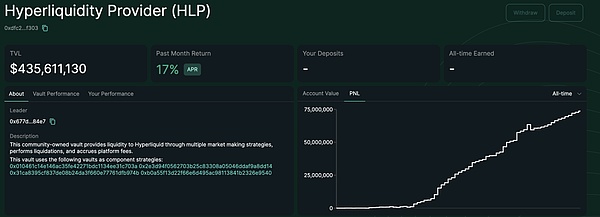
Heavy users continued active use with their newfound wealth—fee revenue was used to repurchase tokens—strengthening the product and market influence—and attracting more users and trading volume to Hyperliquid.
Thus, this massive distribution allowed HYPE to avoid the price drop that is common after an airdrop. In fact, in the following months, the price of HYPE soared 1,179% - from $3.90 at the time of launch in November 2024 to $47 in August 2025.
The HyperEVM
On February 18, HyperEVM officially debuted. ▲ Source: ASXN It is not a standalone chain, but is instead secured by the same HyperBFT consensus mechanism as HyperCore. Both chains share state and essentially utilize a Blob-free version of the Cancun hard fork. Developers now have access to a mature, liquid, and high-performance on-chain order book. For example, a project can deploy an ERC20 contract on HyperEVM using standard EVM development tools and permissionlessly deploy the corresponding spot asset in the HyperCore spot auction. Once linked, users can use the token in HyperEVM applications and trade on the same order book.
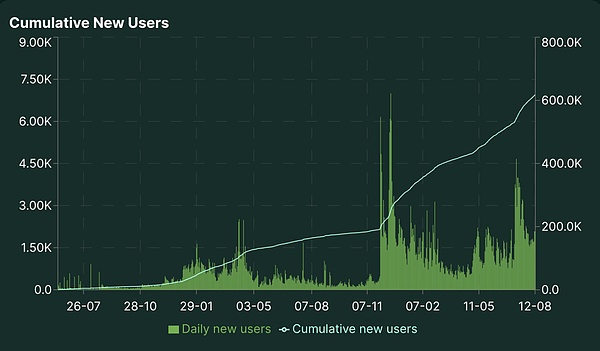
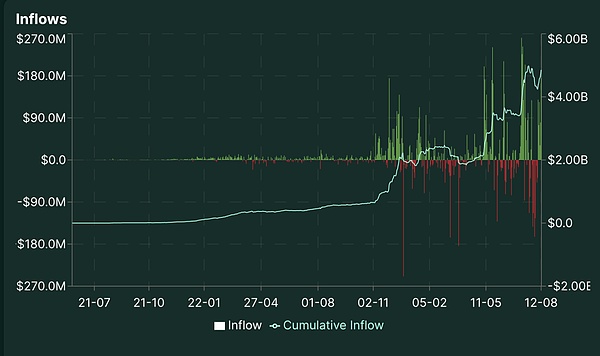
This empowers developers and the community by supporting a wider range of use cases. It allows the broad user base and liquidity aligned with Hyperliquid to further make their mark on the ecosystem. It also creates another avenue for Hyperliquid usage to flow back to participants by providing a composable, programmable layer to improve liquidity.
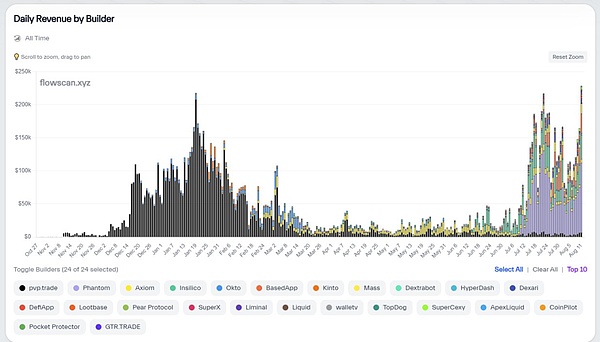
Notably, this also provides a path for projects outside the Hyperliquid ecosystem to join. For example, Pendle is now integrated with HyperBeat, as well as Kinetiq’s LST and LoopedHYPE’s WHLP & LHYPE (https://x.com/looping_col/status/1955645499970560311). EtherFi and HyperBeat are launching preHYPE (https://thedefiant.io/news/defi/etherfi-expands-to-hyperliquid-ecosystem-through-collaboration-with-hyperbeat). Morpho offers vaults on HyperBeat, with top curators including MEV Capital, Gauntlet, Re7 labs, and many others. HyperEVM's network effect isn't about cloning or EVM compatibility; it's about creating a programmable financial operating system where code, liquidity, and incentives are natively aligned and instantly accessible. Liquidity won't fragment; instead, it will grow exponentially as more use cases, yield streams, and protocols are integrated. As the entire tech stack grows, both users and developers benefit, making the Hyperliquid ecosystem the future of DeFi. What Now? Hyperliquid already has all the liquidity and infrastructure it needs within an ecosystem filled with financialized individuals—farmers, quants, developers, traders, and more. So, how do we scale outward from this foundation? Hyperliquid has launched Builder Codes (learn more: https://hyperliquid.gitbook.io/hyperliquid-docs/trading/builder-codes), which allow the platform to be integrated into any distribution channel and receive a share of the fees. For Phantom Wallet, which has 17 million users, this is undoubtedly a great opportunity to expand the wallet's use cases and increase revenue.
HIP Proposal Overview
Not only that, the Hyperliquid Improvement Proposal (HIP1, 2, 3) further promoted the vertical deepening of the technology stack.
HIP-1 is a standard for deploying native tokens and on-chain spot order books.
Learn more: https://hyperliquid.gitbook.io/hyperliquid-docs/hyperliquid-improvement-proposals-hips/hip-1-native-token-standard
HIP-2 aims to permanently inject liquidity into the spot order book of HIP-1 tokens.
Learn more: https://hyperliquid.gitbook.io/hyperliquid-docs/hyperliquid-improvement-proposals-hips/hip-2-hyperliquidity
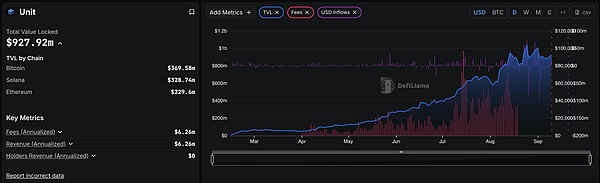
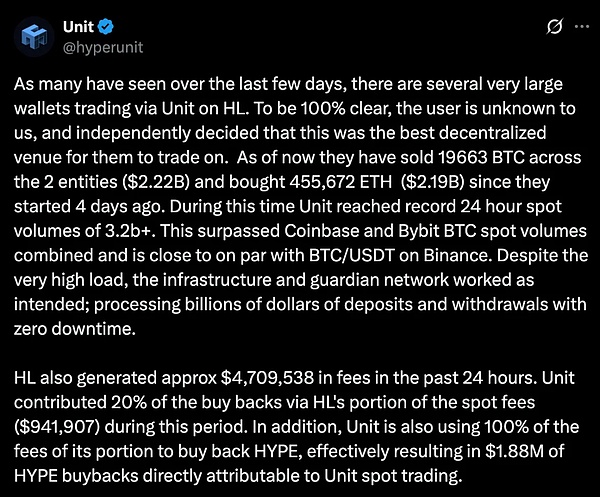
The Unit project has strongly promoted the adoption of HIP-2 by providing a more native spot trading experience. Essentially, Unit is a multi-signature wallet that allows traders to index native chains and conduct permissionless transactions on Hyperliquid. (Learn more: https://docs.hyperunit.xyz/)
But arguably the update that has caused the biggest stir is HIP-3: https://hyperliquid.gitbook.io/hyperliquid-docs/hyperliquid-improvement-proposals-hips/hip-3-builder-deployed-perpetuals HIP-3 introduces a permissionless, developer-deployed perpetual contract market on the core infrastructure. Before HIP-3, only the core team could launch perpetual contract markets, but now anyone with 1 million HYPE staked can deploy their own market directly on-chain. The process is as follows: Stake 1 million HYPE Define market details: market name and ticker (still purchased through an auction, similar to spot trading), choose collateral type, oracle source and fallback logic, leverage and margin parameters, contract specifications, and funding mechanism. Set the fee structure (set a base transaction fee and any additional custom fees), and decide the fee share for the market deployer (up to 50%).
Similar to the revenue-sharing relationship between Binance and Circle.
Deploy Markets
Market operators are required to bootstrap liquidity themselves, while Hyperliquid receives the remaining 50% of the fees (which will flow back into the HYPE token). It's important to note that these markets won't appear directly on the Hyperliquid interface, but anyone can choose which markets to connect to. This makes Hyperliquid's role less of a launchpad and more of an asset provider.
To date, Hyperliquid has successfully conquered the following core areas:
High-performance trading engine: Provides a trading experience for spot and perpetual contracts that effectively mimics the performance of centralized exchanges.
This includes leveraged trading and spot transfer capabilities.
Combined with a consumer-grade user experience across distribution channels.
EVM as a Programmable Execution Layer: A programmable layer (HyperEVM) is built on top of it, closely connected to the user experience and liquidity center.
Stablecoin Infrastructure: Successfully attracted $5.6 billion worth of USDH into its ecosystem.
For Hyperliquid itself and other projects in its ecosystem (based on HyperEVM), there are still vast opportunities to explore in the future:
Native Fiat On- and Off-Ramps: Building a more convenient and low-cost bridge for fiat-to-cryptocurrency conversions.
Payment Solutions: Leverage its high-speed, low-cost network to develop new payment applications.
Web2-Scale Consumer Applications: Develop sophisticated decentralized products with an experience comparable to traditional Web2 applications to attract a wider user base.
Risk Management Engine: Create better risk management and hedging tools for institutions and advanced traders.
Token/Liquidity Status
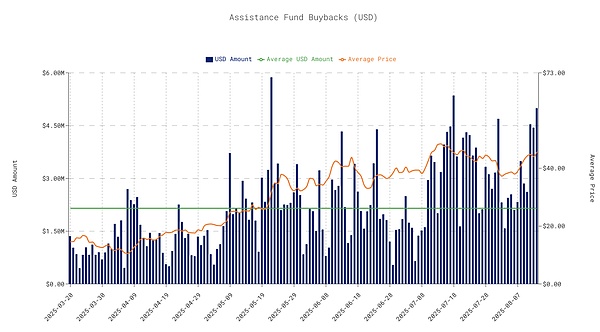
The buyback program led by the Assistance Fund shows that a total of 28 million HYPE has been repurchased to date, funded by 54% of total revenue (46% of perpetual contract fees are distributed to HLP depositors, meaning 92-97% of total revenue is returned to users), with an average daily repurchase amount of US$2.15 million.
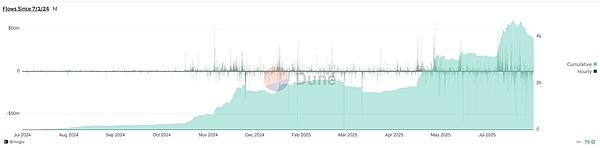
Currently, 38% of the total HYPE supply of 1 billion remains dedicated to airdrops and incentives, which has the potential to further drive ecosystem usage. However, this is a double-edged sword, as such a significant increase in circulating supply could generate significant selling pressure that far exceeds current buyback capacity. Hyperliquid continues to see growth in USDC inflows, with current holdings at approximately $4.4 billion. Surprisingly, this represents 71.11% of the total USDC locked on the Arbitrum network, funds that are being used to fund the Hyperliquid ecosystem.
We use non-HLP trading volume indicators (a cumulative total of US$4.3 trillion) for analysis. Since HLP is a passive liquidity provider/platform fund pool responsible for internalizing booking flow and hedging risks, non-HLP trading volume represents user-to-user (Peer-to-Peer) transaction flow. It’s important to note that this part of user-to-user transaction flow still includes:
market makers
roughly 20% of regular transaction mining accounts and vaults using systematic strategies (see Appendix)
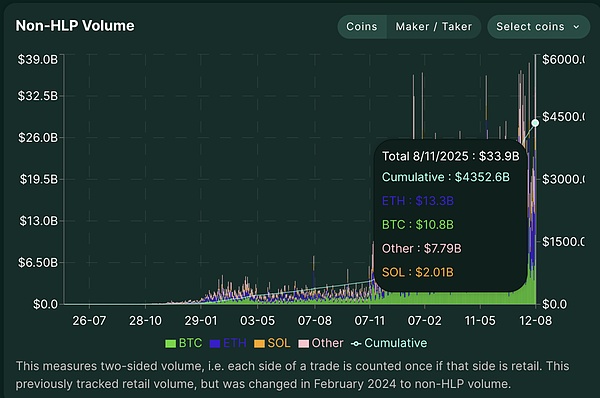
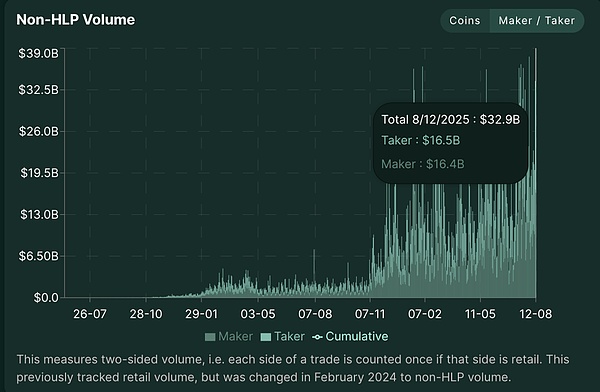
For an exchange, the increase in market makers is a “sweet trouble.” In fact, Jeff once mentioned that there are already “too many” market makers. As of the analysis date, the number of daily unique traders was 46,925. Statistics show that the percentage of currencies traded by users totals over 100%, as a single address trades multiple assets. This multi-currency overlap suggests that Hyperliquid is more than just a single-asset trading venue—traders are exposed to multiple assets per session, demonstrating extremely high platform stickiness and cross-currency speculation. Meanwhile, the number of traders on Hyperliquid is growing fairly steadily. So, what does this mean?
For now, everything seems heavily reliant on onboarding users to the HyperCore infrastructure and then returning value to the ecosystem in some way:
HyperEVM will bring more transaction volume + a stable financialization layer to hyperliquid.
Builder Codes help expand hyperliquid’s distribution channels, driving fees back into the HYPE token.
HIP-3 will enable permissionless marketplace creation and share fees with the HYPE token.
HYPE token inflation will benefit stakers and generally lead to higher returns for the HyperEVM.
Hyperliquid has fostered its own tight-knit, cult-like community, leveraging the HYPE token as a perfect marketing tool and the best way to coordinate community development. Ultimately, if leveraged trading is a valuable experience for consumers, Hyperliquid's flywheel effect will continue. What Next?
#Possibility of Tighter Regulation
Perpetual swaps provide end users with access to leveraged markets. Without robust KYC/AML measures, they pose a money laundering risk. Platforms may be forced to implement stricter compliance systems and report large trading activity. As with Polymarket, US users may eventually be required to undergo KYC before using the platform. 238M Core Contributor Tokens (23.8% of total supply) will vest linearly starting November 29, 2025. At current prices, this would generate approximately $17.3 million of equivalent selling pressure per day between 2027 and 2028. Insider ownership would surge from 15.9% currently to 45.8% on a fully diluted basis.
Why it’s important:
The current repurchase capacity of the bailout fund is only about $2 million per day
creating a selling pressure 8.6 times the repurchase capacity
The timing overlaps with the downward cycle after the Bitcoin halving in 2027-2028
Just to maintain price equilibrium, a 6-7 times increase in fee income is required
Bullish Case
#Growth Momentum
Attracting large amounts of capital inflows through EVM integration and better interoperability
HIP3 market brings in traditional financial funds from institutions and retail
The number of main site perpetual contract markets continues to increase
38.8% Tokens reserved to provide growth fuel for airdrops
#USDH Income Potential
With approximately $5 billion in USD deposits on the platform, the introduction of USDH could generate $150-200 million in annual income based on current US Treasury bond rates. If this revenue, previously retained by Circle, could be redirected to HYPE repurchases, it would be extremely beneficial to the ecosystem.
#Cross-Chain Expansion
One-click deposits from any LayerZero chain are possible through LayerZero. Initial assets include USDT0, USDe, PLUME, and COOK. Break the single-chain ceiling and take the lead in capturing L2 order flows.
#Fee advantage
The current fee rate is about 2.8 basis points, while competitors are about 1 basis point
Zero Gas order + on-chain matching provides a sustainable profit model
Still profitable even if the fee is halved
#CEX trust crisis opportunity
#Daily Volume (September 9, 2025)
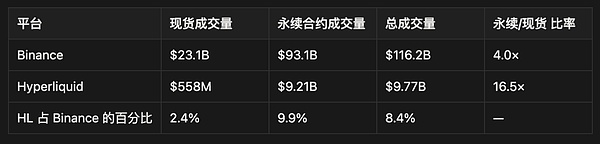
#30-day Volume
#User Base Analysis
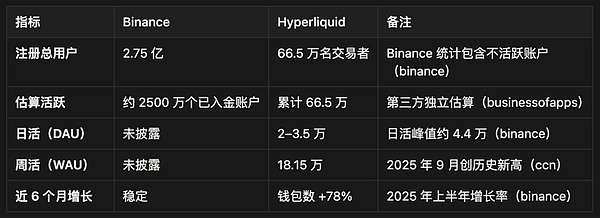
#Trading Intensity
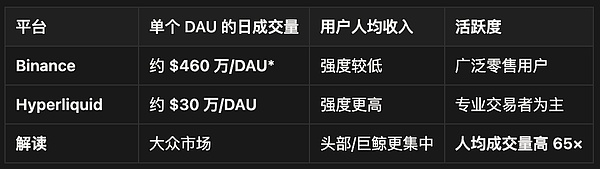
A rough estimate based on 25 million active users
For example:
Excellent trading interface (on-chain version of Robinhood): It can access on-chain liquidity while providing a seamless financial experience. If the crypto market wants to create a better financial structure, we also need a better interactive portal to abstract away confusing UI/UX.
Pre-IPO products: With $PUMP's ICO/TGE (token generation event), we see facilitated pre-markets on perpetual contract exchanges that allow users to speculate on it, while also providing a better price discovery mechanism for the underlying assets. If this were replicated for pre-IPO assets, it would be an intuitive way to provide real value arbitrage (this tweet explains it well: https://x.com/j0hnwang/status/1947330391590752532). Addressing Fragmentation: With the emergence of many new markets (HIP3, other CLOBs, etc.), we see a potential for increasing fragmentation in liquidity and user experience. Projects like https://superstack.xyz provide a great solution, much like 1inch does for DEXs, Jumper does for cross-bridges, and Beefy does for yield farming. Real World Assets (RWAs): HIP3 provides a way for off-chain assets like SPX to be accounted for on-chain. Other forms of RWAs will provide more sustainable, revenue-backed earnings and financial activity, which will help drive ecosystem growth.
In short, Hyperliquid takes a user-centric approach. From the core team's product decisions to the thousands of builders who share its vision, the entire ecosystem is designed so that the ultimate winners will be those who create value, not extract it. Newcomers now have an equal opportunity to prove their insights without the hassle of bad actors and access a rich and mature ecosystem. Whether any product can survive a bear market cycle is a mystery to anyone, but personally, I'm very optimistic about their ability to rebound and continue to attract more builders.
This isn't a bet on HYPE's price rising or that earnings will remain high—it's a bet that building real businesses with real users and real revenue will ultimately win, even if the path includes significant volatility and user churn. The market will likely give you multiple opportunities to accumulate this thematic asset at distressed prices. The question is whether you believe that business acumen and sustainable revenue models will ultimately outweigh short-term token plays in the long-term evolution of cryptocurrency. There is a lot of room for growth, but like any venture capital investment, I believe it's in the right hands.
The future of Hyperliquid lies in HIP-3, and the foundation of HIP-3 lies in HyperStone.
JinseFinanceHow did one platform make $41.5 million during the biggest liquidation wave in crypto history?
JinseFinanceCompared with Johnson & Johnson's record of "63 years of continuous dividend increases" or Apple's long-term and stable repurchase strategy, the operations of these two crypto platforms are more like "walking on a tightrope."
JinseFinanceThis generation of Perp DEX is fundamentally different from the "GMX, DYDX" generation of Perp DEX. Since it's still essentially Perp DEX, the title will still refer to Perp DEX. Starting as "Perp DEX," it quickly rose to prominence.
JinseFinanceBy redirecting the profits once monopolized by publishers to the ecosystem, can Hyperliquid complete the last piece of the puzzle in its closed ecological loop?
JinseFinanceHow USDH will allow Hyperliquid to address key vulnerabilities in its relationship with USDC.
JinseFinanceHyperEVM is to the entire financial field what AMM is to the entire trading field.
JinseFinanceThe rise of Hyperliquid is the result of multiple factors including technology, products, marketing, and economic models.
JinseFinanceSince the launch of HYPE, Hyperliquid has achieved tremendous growth in both trading volume and revenue.
JinseFinanceBuilding a cult around an image or slogan that has nothing to do with the underlying product is a replacement for the cult that should be around your product itself.
JinseFinance