CBN Lifts Crypto Ban: New Dawn for Nigeria’s Digital Economy
The CBN's decision to revoke its ban on cryptocurrency dealings is a landmark moment, expected to catalyze innovation and confidence in Nigeria’s digital finance sector.
 Alex
Alex

Author: David Christopher Source: Bankless Translation: Shan Ouba, Jinse Finance
Looking back at the growth trajectory of the cryptocurrency market in 2025, Hyperliquid remains a central and unavoidable topic.
This exchange successfully attracted the attention of many users on the cryptocurrency Twitter platform with its epic airdrop and impressive price performance at the end of 2024, prompting them to re-evaluate the product. By the end of 2025, it had undergone a magnificent transformation—ranking fourth in the cryptocurrency industry in terms of revenue, with annual revenue exceeding $650 million, and its perpetual contract trading volume once accounting for as much as 70%, becoming a truly phenomenal platform.
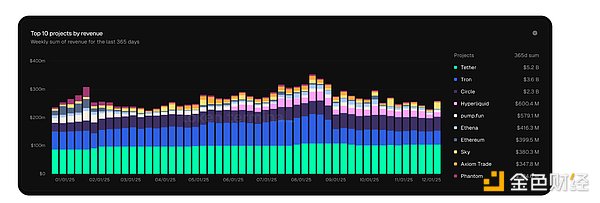
Data Source: Token Terminal
If you haven't been closely following Hyperliquid's developments, you might think its explosive success came suddenly. However, the rise of this public chain is actually the result of meticulously crafted product design, a unique growth strategy, and well-deserved external recognition.
The following will review Hyperliquid's rise in 2025 and analyze why 2026 will be its true test.
The following will review Hyperliquid's rise in 2025 and analyze why 2026 will be its real test.
Q1 2025: The First-Mover Advantage of Crypto Native Genes
Hyperliquid's year of rapid growth began with its accurate grasp of market trends.
In January, when Trump launched, Hyperliquid almost simultaneously launched perpetual contract trading for the token, preemptively positioning itself before other exchanges and establishing its position as a "first-to-market platform for newly issued tokens." Admittedly, Hyperliquid's ability to respond quickly to the market is due to its relatively less constraint from the so-called "user protection" corporate policies of large exchanges. But more crucially, its team is deeply rooted in the on-chain ecosystem, achieving "well-informed and insightful"—capturing opportunities through keen perception of on-chain dynamics and understanding the competitive advantage of being the first to list these tokens.
This move firmly established Hyperliquid's market reputation: before traditional leading exchanges could react, it was the preferred place to trade new assets. In February, HyperEVM officially launched. As a general-purpose smart contract layer built on top of Hyperliquid's core trading engine (HyperCore), its launch did not rely on any top-down incentive programs. This means that when it got on track in the second quarter, its core user base was not there to collect rewards, but rather because they genuinely identified with the public chain's vision and wanted to participate in the ecosystem through its unique features, such as synergy with HyperCore, rather than simply seeking incentive benefits. Second Quarter 2025: Strong Breakthrough Hyperliquid's growth rate far exceeded market expectations. Besides its platform token HYPE surging nearly fourfold from its April lows, the platform's on-chain perpetual contract trading volume accounted for a staggering 70% by May—a remarkable figure for a platform without venture capital backing or token incentives. With the strong recovery of the crypto market, Hyperliquid, leveraging its smooth user experience and ample liquidity, successfully captured a large volume of orders, pushing its total trading volume to $1.5 trillion. Simultaneously, HyperEVM also entered a period of rapid growth: as various projects launched, users explored new profit opportunities through protocols such as Kinetiq, Felix, and Liminal, resulting in a surge in its total value locked (TVL) from $350 million in April to $1.8 billion in mid-June. Throughout this process, the deflationary burning mechanism of the HYPE token continued to operate. During this explosive growth, Hyperliquid has maintained its high profile: it has been featured on national television, analyzed in a Bloomberg feature, and become a core topic of discussion at the U.S. Commodity Futures Trading Commission (CFTC) policy forum. This exchange has become an undeniable force in the crypto industry. Q3 2025: Peak and Market Divergence Emerges At the beginning of Q3, a landmark event occurred, signifying that Hyperliquid's infrastructure has become an essential component outside the ecosystem. Phantom Wallet bypassed a host of Solana-based perpetual contract platforms, choosing to integrate through Hyperliquid's developer code tools—the core mechanism of which allows external platforms to route orders to HyperCore and earn transaction fees. Following Phantom Wallet, major wallets such as Rabby and MetaMask have completed integration, and a large number of mobile trading applications have been officially launched based on the developer's code tool. According to statistics, through these integration collaborations, "partners" have earned nearly $50 million in transaction fees and facilitated a trading volume of up to $158 billion.
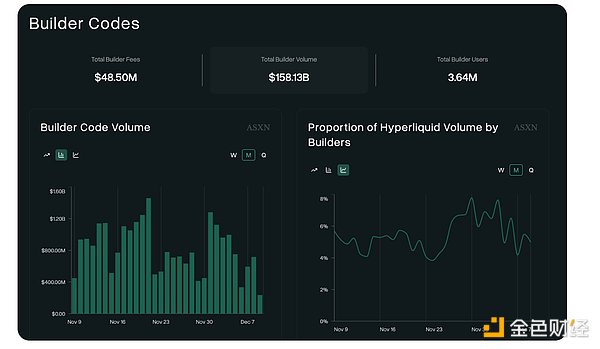
Data source: Hyperscreener
In September of the same year, a bidding war for the issuance rights of the native stablecoin USDH was launched. This battle also made the outside world see Hyperliquid's industry position and brand value. The cause of the incident is quite clear: Hyperliquid's cross-chain bridge holds approximately 8% of the supply of Circle's stablecoin USDC. This means the platform has to pay nearly $100 million annually to its direct competitor Coinbase in related fees, and this revenue cannot flow back into its own ecosystem. Clearly, issuing a native stablecoin would completely solve this pain point, and is expected to save Hyperliquid up to $200 million in revenue annually. Hyperliquid subsequently issued a tender notice, soliciting issuers for the USDH stablecoin, and many industry giants participated in the competition. Ethena offered a $75 million ecosystem development commitment and promised to bring massive institutional cooperation resources; Paxos used integration rights with PayPal and Venmo as leverage, even persuading PayPal to tweet in support of Hyperliquid. Ultimately, Native Markets emerged victorious. The team boasts a strong core lineup, including the highly respected HYPE ecosystem contributor Max Fiege, former Uniswap Labs COO MC Lader, and Paradigm researcher Anish Agnihotri. Why was this smaller, less financially well-funded team able to beat out industry giants? The answer lies in their shared philosophy with Hyperliquid: a commitment to self-reliance, alignment with ecosystem goals, and a dedication to building a truly organic ecosystem – much like Hyperliquid's own development path. The impact of this battle for the issuance rights of USDH has long since transcended the boundaries of the Hyperliquid ecosystem. Shortly afterward, MegaETH announced the launch of its native stablecoin plan; in November, the sui public chain followed suit with a similar solution. However, the birth of USDH also marked the moment when HYPE's price reached its historical peak in mid-September—and the pressure of market competition began to emerge from that point onward. Aster, an exchange backed by Binance founder Changpeng Zhao and based on the Binance ecosystem, and Lighter, an Ethereum Layer 2 perpetual contract platform, both entered the market aggressively with unprecedented airdrop campaigns. Market trading volume began to divert, and Hyperliquid's market share subsequently declined; as of this writing, its share of perpetual contract trading volume has dropped to 17.1%.
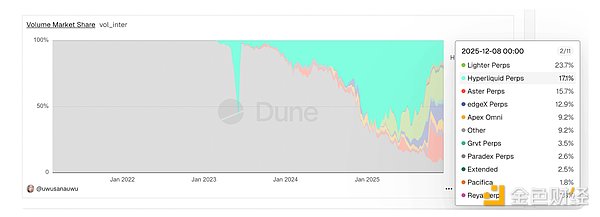
Data Source: @uwusanauwu | Dune Analytics
In October, the highly anticipated Hyperliquid Improvement Proposal 3 (HIP-3) officially came into effect. This proposal allows developers to launch trading markets on HyperCore without permission, which not only promotes the business expansion of exchanges but also accelerates their decentralization process.
Any user who stakes 500,000 HYPE tokens can independently launch a customized trading market, such as: Stock perpetual contracts based on the Unit Trade.xyz and Felix protocols; a perpetual contract market settled with interest-bearing collateral (sUSDE) based on the Ethena protocol; and a synthetic asset trading market based on the Ventuals protocol, tracking the stock prices of private companies such as SpaceX and Anthropic. However, despite the successful launch of HIP-3, the price of HYPE has still fallen by nearly 50% from its September peak. Besides the overall weak market environment and competition from rivals, two other events have become key turning points. Firstly, this quarter saw Hyperliquid's first auto-liquidation (ADL) event in over two years. During the market crash on October 10th, the margin depletion of highly leveraged positions far exceeded the capacity of the liquidation engine and Hyperliquid Liquidity Pools (HLP). The protocol triggered the auto-liquidation mechanism more than 40 times within 12 minutes, forcibly reducing some profitable positions to rebalance the trading ledger. While some argue that affected traders ultimately remained in a "profit-taking" state, others question whether the actual liquidation scale far exceeded what was needed to cover bad debts. Admittedly, the entire system ultimately remained solvent without requiring any external funding, but like the market, Hyperliquid may need some time to recover from this event. Secondly, the tokens held by the team began unlocking in November. Although the actual unlocked size was lower than market expectations, the selling pressure resulting from the token unlocking remains a significant factor contributing to HYPE's weak performance. Currently, the token sell-off is relatively limited – only 23% of the unlocked tokens flowed into the over-the-counter (OTC) market, and 40% were re-staking – but the future unlocking pace remains unclear. In my opinion, the core team may still be weighing the options, attempting to develop an unlocking plan that both protects contributors' rights and maintains a healthy ecosystem. However, for a platform that has built its reputation on transparency and honesty, this uncertainty undoubtedly triggers market anxiety. The Testing Ground for Perpetual Contracts While current market conditions and trading activity have declined, when analyzing the reasons for HYPE's weak performance, we cannot ignore an important background: the rise of Hyperliquid has coincided with a dramatic shift in the competitive landscape of the perpetual contract sector. Lighter and Aster are just a microcosm of the on-chain competitors. While their trading volumes may be inflated by "airdrop mining," they do offer users viable alternatives. In the off-chain market, following Coinbase, Robinhood is also about to enter the perpetual contract arena. As perpetual contracts continue to become mainstream, even more competitors will emerge. In other words, Hyperliquid is already at the center of the industry's "testing ground," and this test will intensify in 2026. The core issue isn't whether its performance in 2025 will be outstanding—the answer is obviously yes. The real key is whether Hyperliquid's development model—relying on integrated collaborations such as developer code tools and decentralized initiatives like HIP-3 to drive growth—will still maintain its leading edge as the number of players in the field increases and competition intensifies. Hyperliquid's success lies in its down-to-earth approach of refining superior products and building a more robust ecosystem, rejecting opportunistic tactics. Its continued industry leadership hinges on its unwavering commitment to this core principle.
The CBN's decision to revoke its ban on cryptocurrency dealings is a landmark moment, expected to catalyze innovation and confidence in Nigeria’s digital finance sector.
AlexJudge Rakoff's rulings present a complex scenario for Terraform Labs, with both favorable and adverse outcomes in their legal battle with the SEC.
 Kikyo
KikyoBounce Brand's pledge pools for the AMMX token have significantly exceeded expectations, indicating robust investor confidence and innovation in the DeFi sector.
 Brian
BrianJupiter Project revamps its JUP token strategy, emphasizing equitable community-focused distribution and governance.
AlexThe Indonesian government's push for crypto exchanges to register with the Commodity Future Exchange (CFX) signals a significant shift in the regulatory landscape for digital assets in the country.
 Joy
JoyGlobal adoption of CBDCs, with over 130 countries involved, poses a significant threat to the US dollar's dominance in international finance. As the BRICS alliance advances alongside CBDC developments, 2024 emerges as a pivotal year defining the dollar's future amidst escalating de-dollarization efforts.
JoyOn-chain data reveals that the victim lost a total of 275,700 LINK, currently valued at $4.33 million, in two rapid transactions within a minute of approving the transaction.
BrianSingapore Prime Minister Lee Hsien Loong issued a cautionary note to the public, unveiling a concerning deepfake video circulating online. The fabricated clip, supposedly featuring PM Lee in an interview with CGTN, endorses a crypto investment platform allegedly approved by the government.
JoyZachXBT accuses X user scaredofboobs of being none other than the alleged scammer behind NFT Machine. According to ZachXBT's Telegram channel on Dec. 28, he boldly asserts, "X/Twitter User scaredofboobs is a scammer known as NFT Machine."
JoyBitcoin Cats launches Genesis NFT collection on Bitcoin Ordinals, sale on BakerySwap.
Alex