The Hong Kong Stablecoin Ordinance (hereinafter referred to as the Ordinance) is Asia's first comprehensive regulatory framework for stablecoins. This law not only reshapes Hong Kong's virtual asset regulatory landscape, but also provides a unique "Eastern solution" in cross-border coordination, regulatory innovation and institutional design.

I. Cross-border supervision and international coordination: penetrating regulatory and compliance barriers
(I) Cross-border issuance supervision: "long-arm jurisdiction" of peg to Hong Kong dollar
The Ordinance innovatively creates a "cross-border regulatory trigger" - as long as the stablecoin is "partially or wholly" pegged to Hong Kong dollar (Article 5(1)(a)(ii)), it must be regulated by Hong Kong regardless of whether the issuer is in Hong Kong. This design directly hits the cross-border circulation characteristics of mainstream stablecoins such as USDT and USDC, avoiding regulatory arbitrage. Compared with Singapore's Payment Services Act (PSA), which only regulates domestic activities, Hong Kong has shown a stronger judicial aggressiveness.
(II) Designation of overseas entities: regulatory firewall
In order to manage offshore risks, Article 101 of the Ordinance authorizes the HKMA to "designate overseas stablecoin entities" and force them to comply with Hong Kong rules (Article 107). This complements the "passport system" of the EU's Markets in Crypto-Assets Act (MiCA) - MiCA allows compliant entities within the EU to conduct business freely, while Hong Kong sets active review thresholds for overseas institutions, which is closer to the strict access model of the "BitLicense" in New York State, USA. (III) Cross-border collaboration in anti-money laundering: information penetration mechanism The Regulations establish a three-layer defense network: On-chain tracking: requiring licensees to provide “data within the information system” (Article 127) to lay the foundation for on-chain analysis Mutual legal assistance: allowing the disclosure of encrypted transaction information to “authorized public officials” (Article 158) to open up cross-border intelligence sharing Joint sanctions leaf="">:Article 137 authorizes the imposition of penalties on senior personnel of overseas entities, echoing the FATF "Travel Rule"
For example:For scenarios similar to Tether, which is issued overseas but pegged to the Hong Kong dollar, the HKMA may invoke Article 5 to require it to apply for a license, and retrieve the reserve audit report in accordance with Article 110 to achieve cross-border regulatory penetration.
II. Future Development and Regulatory Innovation: Sandbox and Technology-Driven Compliance Revolution
(I) Hidden Space for Regulatory Sandbox
Although the Regulations do not explicitly mention “sandbox”, three major innovation interfaces are reserved:
Exemption: Article 13 authorizes the HKMA to exempt certain stablecoin activities from licensing and give the green light to experimental projects
Flexibility of the Guidelines:Article 99 allows for adjustment of the “minimum standards” and can provide differentiated supervision for new models such as algorithmic stablecoins
Designation power:Article 4(2) gives the HKMA the flexibility to define new categories of stablecoins to adapt to technological iterations
(II) Mandatory RegTech compliance monitoring
The Regulations upgrade technology compliance from an initiative to a statutory obligation:
Real-time reporting:Article 27 requires licensees to automatically report “significant changes” and promote API direct connection to the regulatory system
On-chain audit: Article 111 clearly states that the HKMA has the power to review “books and accounts”, including tools such as blockchain browsers. Reserve penetration: Article 17(2)(b) requires that reserve assets be “verifiable”, which presupposes the application of on-chain proof technology. (III) Three-stage picture of ecological evolution. alt="8EBYdkyc5XlC4AqccFp41bVkRrtVHVzjmmQrgmRE.png">
III. The significance of the Hong Kong model: global export of the Eastern regulatory paradigm
(I) Implementation of the principle of “same business, same risk, same regulation”
The Ordinance thoroughly implements this concept:
Business penetration
: “holding oneself out to be engaged in regulated activities” (Section 8(2)) is included in the regulation, covering DeFi platforms leaf="">Risk grading: Differentiated management is set according to the type of stablecoin anchored assets (single currency/basket of assets) (Article 4)
Unified supervision: Licensed banks and non-bank institutions are subject to the same set of "minimum standards" (Appendix 2) to eliminate arbitrage space
(II) Eastern model for global stablecoin regulation
The Hong Kong solution is different from the European and American paths:
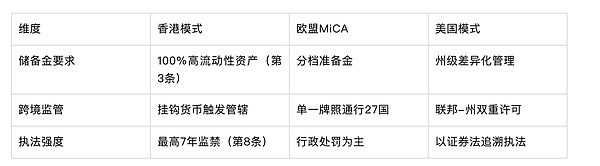
(III) Implications for digital RMB and regulation in the Mainland
Cross-border scenario docking: Hong Kong's licensed stablecoin can be used as an offshore circulation carrier for e-CNY, and a compliance channel can be established based on the "recognized provider" system in Article 9 of the Ordinance
Regulatory technology sharing: Hong Kong's on-chain analysis framework (investigation powers under Articles 116-129) can provide a cross-border funds monitoring template for the Mainland
leaf="">Legislative technology reference: Hong Kong’s legal definition of “distributed ledger” (Article 3(3)) eliminates regulatory ambiguity under the principle of technological neutrality
Fourth, finding the golden balance between innovation and order
The value of the Hong Kong Stablecoin Ordinance lies not only in its complete regulatory framework - from issuance license (Article 14), reserve fund management (Article 17) to crisis management (Article 80 statutory administrator) - but also in the regulatory philosophy it embodies: controlling systemic risks through strict access and unleashing innovative vitality through flexible rules.
Official link of the Ordinance: The Legislative Council of the Hong Kong Special Administrative Region of the People's Republic of China "Stablecoin Ordinance": https://www.legco.gov.hk/tc/legco-business/council/bills.html?bill_key=10009&session=2025


 Hui Xin


