Author: Will Ogden Moore, Grayscale; Translator: Tao Zhu, Golden Finance
Abstract
Blockchain technology can more efficiently direct capital to critical physical infrastructure projects than traditional alternatives. These projects, known as decentralized physical infrastructure networks (DePINs), include wireless connectivity platforms, AI-related resources (such as computing and data), and other applications.
DePIN assets represent non-speculative use cases for real-world cryptocurrency adoption, as networks use tokens as economic incentives to promote the sharing of these resources.
Solana is currently the leading blockchain for DePINs, as it hosts some of the top DePINs by market cap, usage, and adoption, including Helium, Render, and Grass. [1] Solana has become the preferred DePIN blockchain due to its speed, cost-effectiveness, and reliability. Grayscale offers Solana exposure to qualified accredited investors* through the Grayscale Solana Trust.
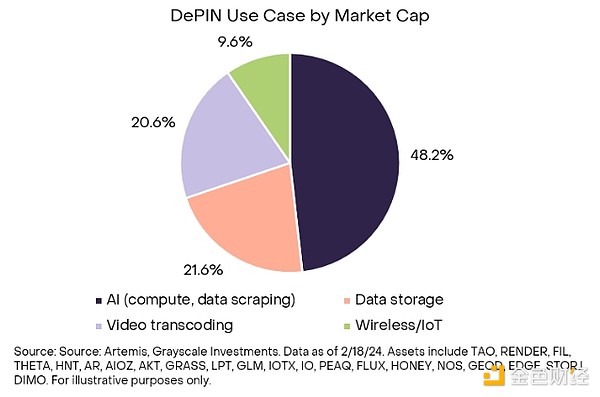
AI-related DePINs dominate the theme by market cap (48%). [2] These assets include decentralized AI model training, compute, data scraping, and storage, among other capabilities. Grayscale Research is particularly interested in emerging decentralized model training use cases. The Grayscale AI Fund offers a number of AI-related DePIN projects, including Bittensor (TAO), to qualified accredited investors.
Solana has recently attracted mainstream media attention after both President Trump and First Lady Melania Trump launched memecoins on the Solana chain in January. While Solana is currently the dominant blockchain for memecoin transactions[3], it is also home to a key non-speculative use case in cryptocurrency: the Decentralized Physical Infrastructure Network (DePIN).
What is DePIN?
DePIN represents a unique emerging field: connecting blockchain to the real world. These physical systems include hotspot devices, wireless routers, physical Internet of Things (IoT) sensors, car dashcams, and GPUs that meet needs such as internet connectivity and computing resources. These devices provide value through the network in exchange for crypto token rewards. Unlike the traditional model that relies on companies such as telecom providers and data centers, DePIN is decentralized, spreading ownership and management across different independent participants. In the Grayscale Research framework, DePIN assets belong to the utility and service crypto sector as an application layer protocol running on smart contract blockchains such as Ethereum or Solana.
DePIN Investment Outlook
Because DePIN distributes physical nodes among different participants, this helps eliminate single points of failure and enhances the resilience, efficiency, and sustainability of infrastructure. In this way, DePIN can promote innovation, promote fairness, and provide greater flexibility while reducing operating costs. In summary, DePINs may have several key advantages over traditional centralized models:
Eliminates the need for centralized intermediaries
Reduces single points of failure and improves the ability to respond to rapid demand
Eliminates administrative costs and can sometimes reduce prices for consumers
Aligns incentives across all participants, including resource suppliers and consumers
Due to these advantages, DePINs are particularly relevant to industries with high capital requirements, high barriers to entry, monopolistic dynamics, and underutilized resources. The DePIN model is particularly relevant to areas such as internet connectivity, data storage, and computing hardware for AI development. These industries are valued in the trillions of dollars and include some of the world’s largest companies, from AT&T to Amazon (AWS) and Nvidia.
As a result, we believe the opportunity is large; if DePINs capture even a small portion of these markets, the potential impact could be huge. Grayscale Research believes this outcome is feasible because 1) DePIN offers a more efficient business model than traditional alternatives and 2) there are already examples of DePIN successfully leveraging crypto incentives to bootstrap network supply at scale.
Today, we believe Solana is the best way to gain access to this early and growing thematic investment opportunity as the blockchain of choice for DePIN (more on this later). However, we also believe several DePIN projects have demonstrated impressive levels of adoption and are emerging as potential category winners.
The Current State of DePIN
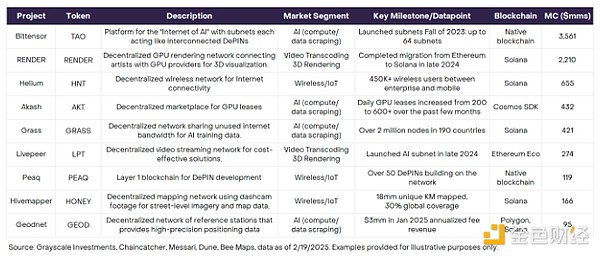
The use cases for DePIN assets range widely, including wireless connectivity and IoT (Helium), geospatial data collection (Hivemapper), decentralized video streaming (Render), and AI-related use cases such as computational networks (Akash). Today, AI-related DePIN projects dominate by market cap (Figure 1). In the following sections, we will highlight some of these emerging use cases and projects.
Figure 1: AI-related DePIN projects dominate by market cap
Helium — Wireless Connectivity and the Internet of Things
Helium, based in Solana, is one of the early pioneers of DePIN and a prime example of real-world cryptocurrency use. Helium enables individuals to monetize their unused network capacity in exchange for token rewards (HNT), creating a decentralized network of hotspots. Users access internet connectivity through this network of hotspots at a much cheaper price than traditional alternatives. Helium currently has over 129,000 mobile customers, offering unlimited data plans for $30 per month—well below the U.S. average of $144 per month. [4] Notably, Helium recently announced its free mobile plan, with limited data, text, and talk time. [5]
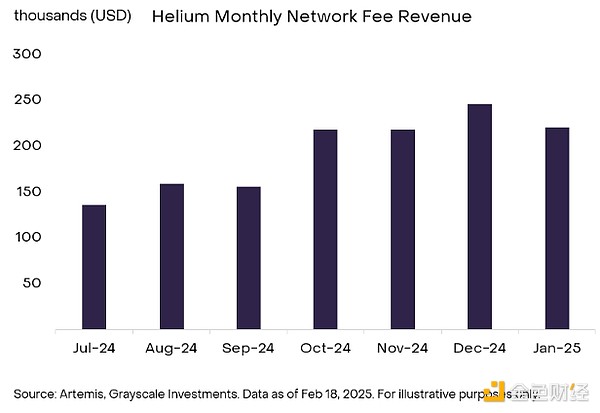
Helium has also partnered with telecom providers such as T-Mobile. Through this partnership, T-Mobile customers can seamlessly access Helium’s wireless connectivity in high-traffic areas, thereby reducing congestion and lowering costs. T-Mobile pays for Helium’s network based on usage, creating a deflationary effect on the supply of HNT. Thanks in large part to the company’s efforts, Helium has provided wireless internet access to approximately 450,000 people and has achieved an increase in overall network usage in the second half of 2025 (Exhibit 2). [6]
In addition to mobile connectivity, Helium also supports IoT devices, allowing sensors to transmit data over its decentralized network at a lower cost than traditional Wi-Fi solutions. Similar DePIN projects focused on IoT solutions include Geodnet, Hivemapper, and NATIX, which use IoT sensors in cars or homes to collect real-time geospatial data. This data is valuable for today’s navigation services and can be used to improve the accuracy of AI systems such as self-driving cars and robots. Geodnet, in particular, has seen impressive growth in annualized network fee revenues to $3 million in January 2025 (up approximately 518% year-over-year). [7]
Grayscale Research believes that Helium’s opportunity could be meaningful if it can 1) continue to expand its usage and geographic coverage in current partnerships with partners such as T-Mobile and Telefonica, and 2) gain broader consumer acceptance with its new free mobile plan.
Figure 2: Helium network usage increases by the second half of 2024
Data Scraping - Grass
DePIN has a large overlap with AI use cases; one example is data scraping. Large language models (LLMs) require large amounts of high-quality data. Existing AI services such as OpenAI and Gemini have a significant advantage over competitors due to their continuous access to real-time and multi-modal data through Bing and Google respectively. Grass aims to level the playing field by enabling new data scraping models driven by token incentives.
Through a simple desktop application, Grass allows anyone to share their unused internet bandwidth in exchange for GRASS tokens. This bandwidth is used to scrape online data, which is then sold to AI companies and developers for model training. Thus, individuals on the Grass network can monetize their bandwidth, and AI companies can access data that would otherwise be trapped in silos.
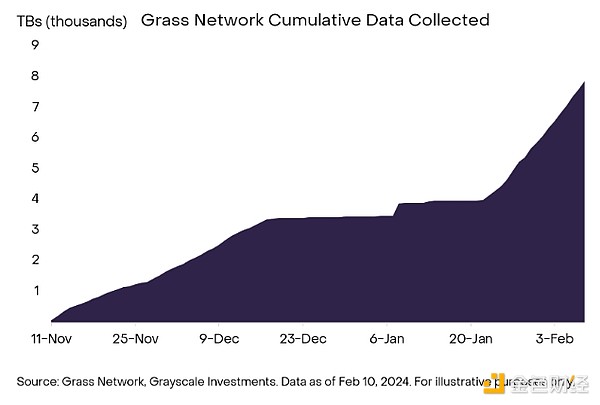
Grass is one of the DePIN success stories, using token incentives to bootstrap supply, growing its contributor base to 2.5 million nodes in 190 countries, more than any other DePIN project. [8] With so much bandwidth at its disposal, Grass has already scraped 20% of YouTube’s data, totaling over 7,000 TB of data (Exhibit 3). The Grass network currently provides data to AI labs such as Laion and Ontocord, and could have huge upside if it could partner with some of the larger AI labs.
Competitors in this topic include Masa, which provides similar decentralized data scraping services for the Bittensor ecosystem.
Chart 3: Total amount of data scraped by Grass since November
AI Model Training - Prime Intellect and Others
Once AI companies have access to high-quality data, they can use it to train LLMs (Large Language Models). One of DePIN's earliest use cases (but perhaps still one of the most promising) is decentralized training.
AI model training requires huge computing power, which is usually concentrated in centralized data centers. DePIN is changing this situation. By distributing workloads across a global network of GPUs, these projects unlock decentralized training. Last November, Prime Intellect successfully trained a 10 billion parameter language model on 1 trillion tokens across five countries and three continents. [9] Prime Intellect achieved this using their DiLoCo framework, which enables efficient training across loosely connected devices by significantly reducing communication requirements. [10] Competitors include Nous Research, which built the Hermes open source model and recently chose Solana as its blockchain. Another emerging player is Flock.io (FLOCK), which enables financial firms such as Animoca Brands and GSR, as well as healthcare companies, to train AI models in a privacy-preserving manner. While Prime Intellect and Nous Research have yet to launch tokens, Grayscale Research believes that some of these decentralized training protocols could reduce costs and improve access for AI developers.
AI Model Inference — Akash
Once an LLM is trained, it can be queried by consumer applications such as chatbots (e.g., ChatGPT). Each time a user asks ChatGPT a question, there is an inference cost associated with generating the output. This inference process requires sophisticated GPU hardware such as the NVIDIA H100 to perform the necessary computations. These in-demand resources are typically sold at high prices and with long-term contracts, making them unaffordable for startups, researchers, or organizations without deep pockets. At the same time, many data centers that own these GPUs have up to 30% underutilized capacity. [11]
Akash is a decentralized cloud computing GPU rental marketplace. It enables GPU vendors to monetize idle supply and gives consumers access to high-performance GPUs for flexible time periods, often at a lower cost than other options.
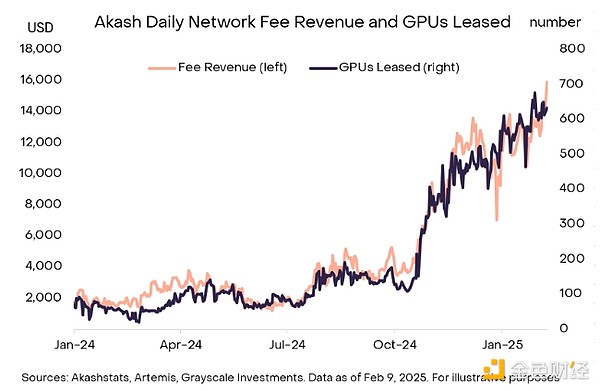
Akash has grown its GPU rentals from fewer than 200 before November 2024 to more than 600 in January 2025, including 398 NVIDIA H100s. [12] As a result, Akash increased its network fee revenue to an annualized $4.6 million in January of this year (Exhibit 4). [13] brev.dev (acquired by Nvidia), Venice.ai, ElizaOS (formerly ai16z), and UT Austin all use Akash GPUs. [14] While Akash and similar decentralized inference platforms may not compete directly with the major cloud providers, they have an opportunity to capture market share as they serve startups, decentralized AI projects, independent researchers, and universities. Akash competitors that offer similar services include io.net, Nosana, and Hyperbolic.
Figure 4: Akash Fee Revenue and GPU Rental Growth Acceleration in November 2024
The largest DePIN asset by market cap is Bittensor (Figure 5), an AI-related platform we have previously covered in depth. As a platform for the "AI Internet", it hosts subnets that specialize in tasks such as data crawling and model inference calculations (the two use cases mentioned earlier). Each subnet acts as an independent entity in the broader Bittensor ecosystem, which operates like an interconnected DePIN network. On February 13, Bittensor underwent a major upgrade called “Dynamic TAO”, making individual subnets investable for the first time.
Chart 5: Examples of DePIN by category, blockchain, and market cap
Solana as the leading DePIN blockchain
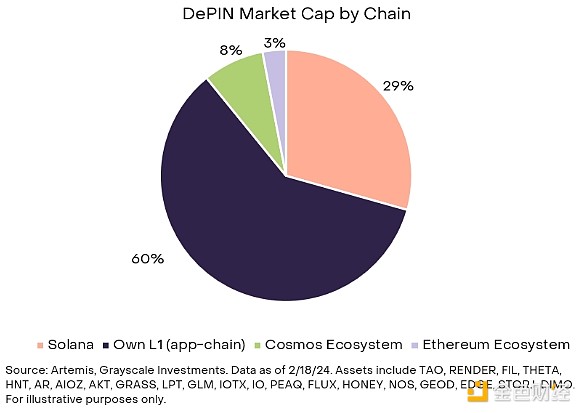
While many DePIN projects have chosen to build their own independent layer 1 blockchains (“app chains”), Solana has become the dominant blockchain for DePIN applications. Solana is the leading DePIN blockchain by market cap and the blockchain of choice for many top DePIN projects (Figure 6). A notable example is Helium, which was originally built on its own layer 1 and then moved to Solana. Similarly, Render, a video transcoding network and one of the larger DePIN assets by market cap, migrated from Ethereum to Solana in 2024. Other DePIN projects built on Solana include Grass, Hivemapper, io.net, Nosana, and others.
Grayscale Research believes Solana is the preferred DePIN chain for several reasons. First, Solana is a fast and low-cost chain that allows DePIN projects to transfer value and operate in an efficient manner for suppliers and consumers. Second, Solana provides the greatest network security, liquidity, and history among high-throughput and low-cost chains such as BASE and SUI. Finally, by building on Solana instead of an independent layer 1 application chain, DePIN project developers can focus on their core competencies at the application layer without having to allocate resources for expansion and infrastructure-level tooling and maintenance.
Figure 6: Solana is the leading blockchain for DePIN by market cap
Conclusion
DePIN may represent a promising frontier for blockchain technology, providing innovative solutions for global resource allocation. While some may claim that the crypto industry is limited to speculative or financial use cases, many DePIN projects provide compelling evidence to the contrary.
Most DePIN projects are less than five years old, but some are already showing encouraging signs of adoption, including working with and providing services to some of the world’s largest organizations (e.g., with T-Mobile and Nvidia via brev.dev). As such, we are particularly excited about certain use cases, including internet connectivity, decentralized training, and networks that collect social data or real-world physical video data for AI training. Additionally, DePIN's potential future growth could create incremental tailwinds for Solana. As the leading DePIN blockchain, Solana offers the speed, cost-effectiveness, and security these projects need to thrive.
Ultimately, we believe DePIN could represent a compelling investment opportunity. Investors interested in early-stage, high-beta DePIN investments could consider Helium or Bittensor for wireless/IoT and AI investments, respectively. For those who prefer large-cap options, we believe Solana is a prime investment choice to grow with DePIN.
Term Index
Internet of Things (IoT): The Internet of Things (IoT) refers to a network of interconnected physical devices, vehicles, appliances, and other objects embedded with sensors, software, and connectivity capabilities, enabling them to collect and exchange data over the internet.
DePIN: A decentralized physical infrastructure network that uses blockchain and token rewards to incentivize individuals to contribute physical infrastructure resources.
Blockchain: A distributed digital ledger that securely stores records across a network of computers in a transparent and tamper-proof manner.
Helium: A blockchain network designed to facilitate wireless communications for IoT devices around the world using a unique proof-of-coverage consensus mechanism.
Render: A utility token native to the Render Network that allows users to share GPU power to render visual projects.
Grass: A protocol on the Solana blockchain that allows users to share unused internet bandwidth for network data collection, supporting AI development.
Solana: A cryptographic computing platform designed to achieve high transaction speeds without sacrificing decentralization, using innovative approaches such as a “proof of history” mechanism.
Decentralized AI: The integration of AI algorithms and processes in a decentralized network, often leveraging blockchain technology to promote transparency, security, and collaboration
Data scraping: A technique whereby a computer program extracts data from the readable output of another program.
Bittensor: A platform that connects AI and blockchain, allowing users to create or participate in competition-based markets (called subnets)
Memecoin: A cryptocurrency created for entertainment or comedic purposes, often based on memes or humor, rather than serious technical development.
Ethereum: A decentralized blockchain platform with smart contract capabilities that uses Ether (ETH) as its native cryptocurrency.
Data storage: In the context of decentralized networks, a system where data is encrypted and stored across multiple locations or nodes run by individuals or organizations that share additional disk space.
Computing hardware: The physical components and devices that make up a computer system, enabling it to perform various tasks and run software.
Geospatial data collection: The physical components and devices that make up a computer system, enabling it to perform various tasks and run software.
Decentralized video streaming: A video platform that uses blockchain technology to distribute content storage and streaming across multiple nodes in a peer-to-peer network, reducing the risk of censorship and enhancing privacy.
Akash: A decentralized cloud computing marketplace that pools and redistributes idle computing processing power to customers who need it, using AKT as its native utility and governance token.
Market Cap: The total value of a cryptocurrency, calculated by multiplying the total number of coins in circulation by the current price of a single coin.
LLM: Large Language Model, an advanced AI system trained on large amounts of text data that can understand and generate human-like text.
Token Rewards: Rewards in the form of cryptocurrency tokens given to participants in a blockchain network in recognition of their contributions or activities.
Notes
[1] Artemis, Grayscale Investments, data as of Feb 18, 2025.
[2] Artemis, Grayscale Investments, data as of Feb 18, 2025.
[3] Artemis, as of Feb 18, 2025
[4] Blockworks
[5] Blockworks
[6] Messari
[7] Artemis, data as of Feb 18, 2025.
[8] Messari
[9] Prime Intellect
[10] Prime Intellect
[11] CBRE
[12] Akash Network
[13] Artemis
[14] Akash Network


 Aaron
Aaron


