In 1999, people thought that the internet era would make companies like Cisco, Lucent, and Nortel the most money, because they laid fiber optic cables, sold routers, and made switches; the larger the internet became, the more valuable they would be. However, that wasn't the case. The internet did indeed boom, but those once-leading companies either died or were crippled. The companies that made the most money were another group: Google, Meta, Amazon, and later WeChat, Douyin, and TikTok. The internet grew huge, but the money went to the application side, not the infrastructure side. On the surface, in 2026, the market views AI in almost the same way it viewed the internet in 1999. The most prominent names are all related to infrastructure: Nvidia, SK Hynix, Samsung, AMD, TSMC, Nebius, etc. Their market capitalization is soaring, orders are plentiful, production capacity is fully utilized, and supply remains tight. What is their role in the AI era? Will they be the next bubble? This time, no. Behind the bursting of the bubble in 2000 was excessive optimism about the future: investment went up, but demand didn't. Back then, WorldCom predicted that "internet traffic would double every 100 days," meaning a tenfold increase in a year. From Wall Street to the US government, and the expansion of the telecommunications industry, everyone followed this pace, borrowing money to frantically build infrastructure, creating a huge bubble. However, in reality, traffic didn't increase tenfold a year, but only doubled annually. As a result, 90% of the infrastructure became useless, and tariffs continued to decline. Coupled with the leverage and involution during the frenzied expansion, a collapse was inevitable. AI in 2026 will be different. On one hand, the same level of investment, with major giants pouring in nearly a trillion dollars; on the other hand, there will be phenomenal revenue growth. Anthropic went from $1 billion in annualized revenue to $30 billion in just a year and a half, and the limiting factors for its revenue growth are still insufficient computing power and power shortages. In the past, once humanity invented electricity, we could never go back to the days without it, because all of human civilization is built upon electricity. Today, humanity has invented AI, and we can never go back to the days without it either. AI is reshaping all industries and the future of human civilization. Humanity's demand for AI is real, robust, and enduring. Today's discussion isn't about whether there's a bubble, but rather about who the biggest and most enduring winners of this AI revolution are. This is a valuable question from a long-term perspective.
I. AI Industry Layering
The AI industry chain has approximately seven layers, ranked from highest to lowest based on "certainty of making money"—
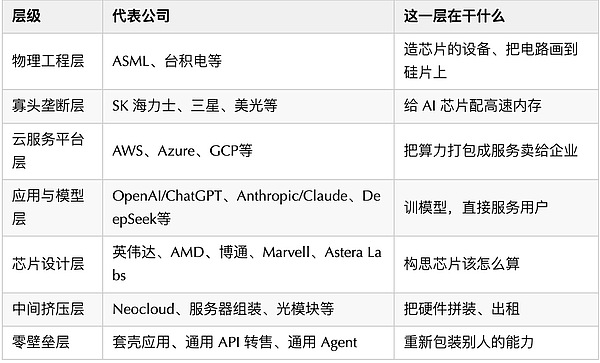
The relationships between these layers are vastly different from the infrastructure and applications of the past internet.
First, there's the lifespan of the infrastructure itself. Internet fiber optic cables laid years ago can last for twenty years, and Cisco switches can run for ten. AI GPUs become obsolete in three to five years, while next-generation chips offer several times the performance at the same price. Internet infrastructure is "built once and used for a long time," while AI infrastructure is "built once and burned through quickly." Second, there's the billing method. Internet applications generate revenue from advertising and subscriptions, with unit economics linked to user stickiness, and pricing power held by the platform. AI revenue comes from token-based billing, with completely transparent pricing that decreases by an order of magnitude annually, leaving no real pricing power. GPT-4 level capabilities have dropped from $30 per million tokens in 2023 to less than $1 per million tokens today—a thirty-fold decrease in three years. "Performance drops by an order of magnitude every year for equivalent results"—this pricing model is unprecedented in the software industry. Thirdly, there's the marginal cost. Once an internet application is developed, adding a user or an additional visit costs almost nothing; this is the fundamental reason why Google and Meta can achieve 80-90% gross margins. AI, however, burns through real money on electricity and GPUs for every inference. According to media reports, OpenAI's total revenue in 2025 was approximately $13 billion, with an annualized return of $20 billion by the end of the year, but it still suffered a net loss of approximately $9 billion for the year; internal projections for 2026 indicate a loss of over $14 billion. Although both are called "application layers," the structure of AI applications is completely different from that of internet applications. Fourthly, the customer and the competitor are the same entity. In the internet era, AWS customers were not AWS's competitors. In the AI era, CoreWeave and Nebius's largest customers, Microsoft and Meta, are also their biggest potential competitors, both of which are aggressively building their own data centers. Broadcom's largest ASIC customers, Google, Meta, and Microsoft, are also the largest investors in their self-developed chip teams. This business structure of customers being competitors is rare in the past thirty years of technological history. Fifthly, there is the pressure from open source. In the internet era, although Linux dominated the server market, it didn't eliminate the pricing power of closed-source software; Windows, Oracle, and SAP continued to raise prices. In the AI era, open-source models like DeepSeek and Llama have directly driven down the token prices of cutting-edge closed-source models, reducing the price difference between cutting-edge and open-source from a hundredfold to less than tenfold, and it continues to narrow. In the AI era, the squeezing between different levels will be faster and more intense than in the internet era. Profit distribution will no longer be a pyramid-shaped, even distribution; the middle tiers will be compressed much more rapidly—the industrial hierarchy restructuring that took twenty years to complete in the internet era may be finished in five to ten years in the AI era. II. Where are the good businesses hidden? Starting with the most certain level of profitability—those that are "highly likely to still be profitable ten years from now"—we'll examine each level one by one. 1. Physical Engineering Layer: Single-Point Monopoly, Even Harder to Replace in Ten Years This category is typically represented by ASML and TSMC. ASML builds the most difficult lithography machine on Earth; it's the only one in the world with EUV technology. TSMC makes the most difficult foundry services on Earth; no other company can match its large-scale, high-yield mass production at the 2nm node. This barrier isn't a commercial barrier, but a physical engineering barrier—decades of accumulated process technology, equipment calibration, and production line yield curves, each requiring a decade to replicate. The Internet era also had corresponding "bottom layers"—fiber optics, routers, and switches. However, those technological barriers were caught up with by Chinese manufacturers within five years. Cisco's dominance lasted only ten years, with emerging players like Huawei taking its market share. Cisco itself is still profitable and has a decent gross margin, but its growth narrative has been downgraded from that of a tech stock to that of a mature tech stock focused on cash flow. It took 25 years to reach its peak in 2000, only being surpassed at the end of 2025. The physical engineering layer in the AI era still serves the same purpose, but the process difficulty demanded by customers has shifted from 180nm to 2nm, reducing the number of players capable of operating it. Large-scale, high-yield mass production of leading nodes is highly concentrated in the hands of TSMC. Samsung and Intel are still involved, but they are no longer competing on the same scale. EUV lithography machines are even more extreme; only ASML can manufacture them globally. This convergence won't be reversed simply by someone investing heavily—Samsung has been investing for twenty years and hasn't caught up, while Intel has been investing for ten years and is still falling behind. The moat of underlying physical engineering is not new to the AI era, but the AI era has made it closer to "single-point monopoly" than ever before. Companies in this tier will likely be even more irreplaceable ten years from now than they are today. 2. Oligopoly Layer: A Few Players Share a Constantly Growing Pie. This tier revolves around HBM, and today SK Hynix, Samsung, and Micron hold over 95% of the global market share. Memory in the PC era was a typical short-cycle business: a cycle of two to three years, with prices plummeting to rock-bottom levels once supply became excessive. Therefore, in the traditional perception, memory stocks are cyclical stocks, and the market never gives them the valuation of technology stocks. However, HBM in the AI era is not a continuation of PC memory; it's a completely different business: First, the demand is structural, not cyclical. Every AI inference requires bandwidth, and the larger the number of parameters and the greater the inference volume, the more bandwidth it consumes. The demand growth of AI workloads is long-term, not like the cyclical nature of PC shipments. Second, the technological barriers are physical. HBM is not simply stacked DRAM—it's 1c/1d nm node DRAM + 12 layers stacked + TSV through-silicon vias + packaging collaboration closely attached to the logic chip. Each generation of HBM requires readjusting yield rates, and new players starting from scratch need at least five years. Third, the pace of new entrants catching up is far slower than the pace of market growth. This is the biggest difference from the chip design layer. While a large cloud provider can develop an ASIC and secure Broadcom's orders in two or three years, building a new DRAM wafer fab requires at least $20 billion, five years, and more than a decade of yield rate accumulation. China's Changxin Memory (CXMT) is the most realistic example of a new entrant, with mass production of HBM2 in 2024, planned mass production of HBM3 in 2026, and development of HBM3E in 2027—a technological pace 3-4 years slower than SK Hynix and Samsung. In terms of production capacity, Changxin's monthly HBM capacity is projected to reach approximately 10,000 wafers in 2026 and expand to 40,000 wafers in 2028, while the current global total capacity is 340,000 wafers per month. This means that even if Changxin catches up as planned, it will only account for slightly over 10% of the global HBM market in 2028, primarily supplying AI chips for the Chinese market. However, Changxin will definitely catch up, as long as the bottleneck issues on the equipment side are gradually alleviated, and there is no insurmountable physical gap in DRAM technology. But "catching up" is a matter of a decade, while the explosive demand of the AI inference era is a matter of the next five years. During these ten years, SK Hynix, Samsung, and Micron will continue to reap the majority of profits from the most advanced generation of HBM, while Changxin will focus on the next generation and catch up with the next. The overall market remains an oligopoly, and profits are still structurally generated. HBM's position is similar to TSMC's next tier: a few players, physical barriers to entry, and structural demand. The market may continue to underestimate their valuation multiples due to historical impressions of memory chips, but in essence, this is one of the few relatively certain positions from a ten-year perspective. 3. Cloud Service Platform Layer: Established players continue to hold their ground. This tier consists of cloud service giants. The US-based AWS, Azure, and GCP together account for approximately 65% of the global cloud market; while China's Alibaba Cloud, Huawei Cloud, and Tencent Cloud together hold over 60% of the domestic market. These two systems are largely incompatible, yet both are leveraging the AI boom to maintain their established positions in their respective markets. Microsoft sold Azure to enterprises using OpenAI, Google sold GCP to enterprises using Gemini, and AWS sold AWS to enterprises using Bedrock + Anthropic. They don't need to win in AI; they only need to get their existing hundreds of thousands of enterprise customers using AI in their clouds—something they could do with their eyes closed. Of course, "blindly" is a figure of speech; all three companies are investing heavily, developing their own chips, building their own data centers, and partnering with model companies, each with an annual budget in the hundreds of billions of dollars. But this investment is a defensive offensive, not an attempt to win a war where they lose without even fighting. Their foundation is the astronomical migration costs of their enterprise customers, making them so stable that they don't need AI to maintain their position. AI has not only failed to disrupt the cloud, but it has also deepened the cloud's moat. In the internet age, the cloud's moat is the cost of enterprise IT migration, primarily software lock-in. The AI era has added a layer of physical lock-in: which cloud's models should enterprise data be fed onto, where inference should occur, and which cloud should the toolchain invoked by the agent be on—each choice further embeds the enterprise into its chosen cloud. Over three to five years, AI has more deeply welded customers onto the cloud track. Another underestimated aspect is the structural cost advantage of massive cloud computing power in AI. New AI computing power clouds running AI computing power will always inevitably face the fate of paying Nvidia for the difference; it's fixed in their cost structure. Massive cloud computing power is different. Once AWS Trainium, Google TPU, and Microsoft Maia mature enough to handle major workloads, these three companies will design their own chips and have them manufactured by TSMC, avoiding Nvidia taking a cut of profits. This means that five years from now, the ultimate winners of the AI computing power price war will almost certainly be these three companies, selling AI services while simultaneously manufacturing their own chips for their own use. Neocloud may grow rapidly in the short term, but it cannot compete with rivals that have their own chip factories in the long run. 4. Application and Model Layer: Not yet determined, but the biggest odds are in this category. In the internet era, the companies that made the most money were not infrastructure companies, but application layer winners: Google, Meta, Amazon, and Tencent. Their users' attention and data are assets that snowball; once the flywheel starts spinning, it's unstoppable. The current phase of the AI era isn't fully settled yet, and two things need attention: The first is consumer branding. Consumer brands in the AI era are far harder to maintain than those in the internet era. ChatGPT did establish a strong mental brand identity in 2023-2024, equating "asking about AI" with "asking about ChatGPT," achieving in two years what Google took ten years to accomplish. But this mental brand is being diluted at an alarming rate. In January 2025, ChatGPT accounted for 87% of global AI web traffic, but by March 2026, this had plummeted to only 57%. Its daily active user share on US mobile apps dropped from 69% to 45%, and the latest data shows it has fallen below 40%. During the same period, Gemini, leveraging Google's distribution advantages (search, Android, Workspace, Chrome), increased its web traffic share from 6% to 25%, while Claude rose from 1.4% to 6%. Grok, through X's social distribution, increased its daily active user share on US mobile devices from 8% to 13-15%. The Chinese market is a completely separate system, with companies like Doubao, Kimi, DeepSeek, and Zhipu Qingyan. Google dominated search for fifteen years without a real competitor; OpenAI dominated "Ask AI" for only two years, and its market share dropped by 30 percentage points. In December 2025, Sam Altman sent an internal memo that the media dubbed a "red alert." This isn't just a problem for OpenAI; it's a structural problem within the business. The capability gap in LLM (Local Management Model) is narrowing; the switching cost is almost zero (users don't have data or social connections tied to them; they can try something new by opening a new webpage); and distribution advantages are more valuable than technological advantages. When Gemini is integrated into the Google search box, Apple Intelligence has Claude/Gemini built in, and X has Grok built in, the advantage of standalone apps is eroded. The second thing is the business model of the model itself. Once a leading model is created, the unit inference cost is extremely low, it can be reused infinitely, and every time a user uses it, it generates data to help you continue to improve the model. This is a typical high-margin flywheel business. If only one company can create the best model, its profitability can approach the ceiling of SaaS software. On the consumer brand side, it's a winner-takes-all situation. In the internet age, dozens of search engines were developed: Lycos, AltaVista, Yahoo, Ask Jeeves, Excite—all stars of their time, but in the end, only one won: Google. The consumer assistant market in the AI era will likely follow a similar pattern, converging into one or two companies capturing the vast majority of users and advertising value within three to five years. However, the model side is a red ocean. OpenAI, Anthropic, Google, xAI, Meta (open-source route), DeepSeek (open-source route), and various emerging open-source companies are all doing the same thing. The differences in model capabilities between each company are narrowing. Every time a cutting-edge model is released, the API price drops. In two years, the price of tokens with equivalent performance has dropped by one or two orders of magnitude; GPT-4-level capabilities have fallen from $30 per million tokens in 2023 to less than $1 per million tokens today. OpenAI, Anthropic, and Google each run two completely different businesses internally: One is selling APIs to developers, a highly competitive market with price wars and thin profit margins. The other is selling applications to consumers, a winner-takes-all market with strong brand moats and high profit margins. These two businesses will likely see a significant valuation gap in five to ten years. There's also a group easily overlooked—players like Meta and DeepSeek that follow the open-source route. Open-source models don't necessarily generate direct profits, but as a strategic weapon to undercut competitors' pricing power and win over developers' minds, they have a significant impact on the profit distribution across the entire application and model layer. While all three businesses are marketed as "model companies," the investment implications for consumer portals, enterprise APIs, and open-source ecosystems are completely different. The application layer also has another side: in the internet age, far more companies die at the application layer than at the infrastructure layer. Pets.com, Webvan, eToys, Excite@Home, and Geocities were all considered the future at the time. Ultimately, only a few companies emerged as winners. Betting on the right layer but choosing the wrong company resulted in nothing. This tier has very high odds, with winners taking all; however, it also has the lowest probability of success, making the competition extremely fierce. 5. Chip Design Layer: Today's Kings, Tomorrow Squeezed from Both Sides This tier includes Nvidia, AMD, Broadcom, Marvell, and Astera Labs. However, these five companies are not in the same business category. The first group: GPU sellers (Nvidia, AMD) Their characteristics: They have to race against their customers' in-house development teams. Nvidia accounts for over 90% of AI training chips, while AMD accounts for about 10%. Their customers (Google, AWS, Microsoft, Meta) are developing their own TPUs, Trainium, Maia, and MTIA to replace Nvidia GPUs; this is a substitution relationship. Nvidia's moat is its CUDA ecosystem. The vast majority of AI code written by developers runs on CUDA, and migrating to TPU/Trainium requires rewriting, retesting, and re-tuning. This moat should hold for 5-7 years, but its future is questionable over ten years, as the scale of customer-developed chips increases, AI software toolchains become more cross-platform (no longer solely reliant on Nvidia), and open-source models reduce the engineering difficulty of switching from CUDA year by year. The inference market has already started to move – Nvidia's market share in AI inference chips has dropped from over 95% to around 60-75% – AWS Trainium is running a large amount of inference on Anthropic, and Google TPUs are significantly diverting inference workloads; the training market still maintains over 90%, but its erosion is only a matter of time. Interestingly, however, a decline in market share does not necessarily mean a decline in revenue. The total AI training and inference market is still growing significantly every year, and even if Nvidia's market share falls from 90% to 70%, and then to 50%, its absolute revenue may still be increasing. Its real window of risk is the moment when "the growth rate of training demand slows down + the continued erosion of its self-developed market share" occurs simultaneously; before that moment, it is a money-making machine. Group Two: Custom ASIC Design Services (Broadcom, Marvell) Their characteristics: They make money from customer-developed ASICs, but will ultimately be eaten up by customer-developed ASICs. This group's situation is completely opposite to Nvidia's. Customer-developed ASICs are a threat to Nvidia, but a source of business for Broadcom and Marvell. Google's TPU, Meta MTIA, and OpenAI's self-developed chips all have Broadcom or Marvell providing design services, SerDes, HBM controllers, packaging, and other key IPs behind them. Therefore, Broadcom's AI business has experienced explosive growth in recent years, and the more its customers develop their own AI systems, the more money it makes. However, this is a time-limited process: after customers use Broadcom to build several generations of ASICs, their teams mature, and their internal IP is established, Broadcom's role will shrink from "lead designer" to "providing key IP," and then further to "providing peripheral chips." Google's TPU has already completed this curve, with Broadcom deeply dominating v1-v4, and Google increasingly dominating v5-v7. Meta MTIA, Microsoft Maia, and ByteDance's chips will most likely follow this path, just at a different time. Broadcom's most dangerous aspect isn't "customer-developed" technology, but rather its competitive moat – a moat maintained by leading in IP across generations of SerDes, PCIe, and HBM controllers. This moat differs from Qualcomm's Standard Essential Patents (SEPs): Qualcomm's IP is legally enforceable (products violating 5G standards don't pay), while Broadcom's IP is based on technological leadership (customers don't need to pay if they can develop equivalent performance themselves). As long as Broadcom's IP remains one generation ahead of its customers' internal teams, it can continue to generate revenue; once caught up, its moat disappears immediately. Group 3: Connectivity Chips (Astera Labs) This group is characterized by its niche focus and uncertain future. Astera Labs manufactures connectivity chips such as PCIe Switches, CXL, and Retimers, essential components for internal interconnection in current AI servers. Its competitive advantage is narrower than Broadcom's but more specialized; this group is betting on "how long PCIe/CXL can remain the mainstream interconnect standard." If NVLink Fusion, UALink, and CPO become widely adopted in the future, consuming its current market share, Astera Labs' growth trajectory will be disrupted. 6. The Middle Squeezing Layer: Fast-moving during the cycle, hard-hitting outside the cycle. This tier includes all players sandwiched between the underlying physical engineering and the upper-layer cloud/application, including AI computing cloud (i.e., Neocloud (CoreWeave, Nebius, IREN, Crusoe), GPU server assembly (Supermicro, Dell, HPE), and optical modules (InnoLight, Eoptolink, Coherent, Lumentum), etc. This tier is not all the same; it can be divided into three categories based on technological barriers and bargaining power, and their fates also fall into three tiers. Category 1: Purely Selling Production Capacity. This includes Neocloud and GPU server assembly. They lack irreplaceable technology; essentially, they borrow money to buy Nvidia GPUs for rental or resell Nvidia GPUs in chassis. According to third-party teardown estimates, a B200 costs approximately $40,000, with material costs around $6,000, leaving Nvidia with over $30,000. No matter how hard these companies try to reduce costs, they can't avoid this $30,000; their profit margins are forever capped by Nvidia. Meanwhile, their largest customers (Microsoft, Meta) are frantically building their own data centers and developing their own chips; once demand eases, their bargaining power disappears immediately. This category experiences the fastest cyclical changes and has the worst outcome. Category Two: Module Assembly. This category includes optical module manufacturers like InnoLight Technology and Eoptolink. They possess genuine technology; silicon photonics integration, high-speed packaging, and indium phosphide lasers are processes accumulated over decades. InnoLight Technology's net profit in 2025 was 10.8 billion yuan (a year-on-year increase of 109%), with a gross profit margin of 42.6% for its optical module business, making it very profitable. SuperCloud currently does not have its own self-developed optical modules; NVIDIA, Google, and Meta all purchase them from them. However, the fate of this type is determined by three things: Technology changes with each generation: Optical module speeds double every two years—from 100G to 400G to 800G to 1.6T to 3.2T. Each generation requires redesign, tape-out, and customer certification. In Q1 2026, InnoLight Technology's inventory rose to 15.6 billion yuan; even a slight delay could lead to a drop in value to zero. Aggressive Industry Capacity Expansion: Lightcounting predicts the combined market size for 800G and 1.6T will reach approximately $14.6 billion in 2026, but global optical module manufacturers' total planned capacity has already significantly exceeded demand. The current gross margin of 42-47% is a structural benefit from the increasing proportion of high-speed 800G/1.6T products. Once cloud vendors' capital expenditure growth slows, the gross margin may fall back to the historical average of 25-30%. **Potentially to be integrated into the technology roadmap itself:** CPO (Co-packaged Optics) will be deployed on a large scale between 2028 and 2030, directly packaging the optical engine next to the switch chip. The independent product form of "pluggable optical modules" may disappear. In the CPO era, the "module assembly" step will no longer be needed. The light source, silicon photonics, and modulator will be directly packaged into the ASIC. The value of this step will shift from module manufacturers to ASIC manufacturers (Broadcom, Nvidia) and packaging manufacturers (TSMC). **Third category: Upstream vertical technology stack**. Examples include Coherent and Lumentum. These components are positioned deeper than module assembly. Coherent manufactures its own indium phosphide lasers, silicon photonics, VCSELs, modulators, and external light sources, covering the entire vertical stack. In the CPO era, they are not the targets of disruption, but rather the core component suppliers for CPO. At OFC 2026, Coherent directly showcased its 6.4T CPO solution, estimating the serviceable market for CPO to be at least $15 billion. In other words, the winners in the optical module segment will change; pure assemblers will be squeezed out, while upstream companies with technology stacks will transition to the CPO era and continue selling. However, even the third category remains an intermediate layer. Their customers are Nvidia, Broadcom, and SuperCloud, each of which is vertically integrated (Nvidia does its own silicon photonics, Broadcom does its own CPO integration, and TSMC does COUPE packaging). Coherent and Lumentum sell components, and component suppliers are always racing against "customers making it themselves." They earn more in the short to medium term, but their bargaining power is unstable in the long term—this is the essence of the middle layer. Looking at these three types together, their common fate is clear: their bargaining power is either held back by upstream suppliers (by Nvidia controlling their profit margins), squeezed out by downstream suppliers (customers developing, building, and integrating their own systems), or abandoned by technological upgrades. The difference lies only in the rate of dilution: those purely selling production capacity are squeezed dry within a few years, those assembling modules are compressed within five to eight years, and those with upstream technology stacks can last for ten years, but their ceiling is already visible. The corresponding companies in the internet era were Cisco, Lucent, Akamai, Nortel, and Limelight. Their technological capabilities were truly impressive, and their orders were once overflowing. However, more than two decades later, none of them have returned to their original valuation multiples as independent companies with the same growth narrative. They either went bankrupt (Nortel), survived for over a decade after changing names but ultimately went through Chapter 11 and asset sales (Limelight changed its name to Edgio in 2022 and went bankrupt in 2024), were acquired (Lucent), relied on multiple transformations to recover half their market capitalization (Akamai), or took 25 years to return to their price peaks, but their valuation multiples had dropped from those of growth tech stocks to those of mature tech stocks (Cisco). Akamai serves as a valuable benchmark. It represents the best-equipped middleware layer in the internet era, selling software services with extremely low marginal costs (near-zero cost after cache hits). It had ample cash reserves during its transformation and boasted significantly higher customer loyalty than pure computing power rental companies. In 1999, it was the purest target in the CDN sector, and all the bullish logic from that time can be found in this middleware layer today. More than two decades later, Akamai is still alive and well, generating profits annually. Recently, it was reported to have secured an $1.8 billion AI computing power contract from Anthropic, and its stock price has rebounded to around $150 in the short term. Even including this wave, its market capitalization is still only 60% of its 1999 peak—its clients, including Netflix, AWS, Google, and Meta, have all built their own CDNs, permanently suppressing the growth narrative of its core CDN business. It successfully navigated that narrow path, proactively acquiring Guardicore for security and Linode for cloud computing, reducing CDN's share of revenue to less than half. However, the cost was that it took 25 years to transform from a growth stock with a PE ratio of 100 to a mature technology stock with a PE ratio of only a dozen. Akamai's successful 25-year journey along that narrow path serves as the best example of the intermediate layer. In the AI era, most Neocloud, optical module, and network chip manufacturers won't perform better than Akamai. They sell heavy assets with higher marginal costs (GPU depreciation, electricity, and maintenance all represent real money), have narrower transformation space, and shorter tolerance for failure. When Akamai is squeezed, its margin can slowly decline, giving it time to change its strategy; once their cycle reverses, fixed costs immediately crush them. The middle layer isn't unprofitable; it earns a lot in the short term. However, they earn money based on the cycle, not the structure. The faster they run during the cycle, the harder they will fall outside the cycle. 7. Zero-Barrier Layer: Mostly Inferior The bottom layer consists of shell applications, resale of generic APIs, homogenized agents, and tools that are simply wrappers around a large model. The biggest problem with this layer isn't low revenue today, but that others can do it too. Without proprietary data, embedded workflows, user migration costs, and genuine distribution advantages, all that's left is a price war. Looking at a ten-year timeframe, these companies will likely be squeezed by three forces: model vendors moving up to applications, platform software integrating AI functionality, and vertical industry players making AI part of their existing products. They are not core assets of the AI era, but rather a bubble layer in the early stages of model dividend diffusion. The vast majority will disappear, and the few that survive will evolve from "shells" into entry points, data layers, or workflow systems. After traversing seven layers, the overall diagram looks roughly like this: Physical Engineering Layer, Oligopoly Layer: Single-point monopoly, physical-level barriers, taking a decade to catch up, the two least likely squares to disappear from the map. Cloud Service Platform Layer: Using the existing moat of the Internet era + the new lock-in of the AI era, almost no risk of being disrupted. Application and Model Layer. leaf="">: Winner takes all, highest odds, lowest win rate, most like the "home run" level in the internet age
Chip design layer, intermediate squeezing layer, zero-barrier layer: All are being squeezed from both ends—technology iteration, customer self-development, and ecosystem consumption; the only difference is the rate of dilution
But this is only the part that can be drawn on the map. The real biggest winner in AI may not even be on this map.
But this is only the part that can be drawn on the map. The real biggest winner in AI may not be on this map at all.
III. Beyond the Map: That Might Be the Truth As you may have noticed, the first seven layers are what we can see now. However, AI represents a major upgrade on a human civilization level, far exceeding the emergence of the internet. It's only been a few years, and the most profitable and fastest-growing technologies of the future have likely not yet appeared. And that's where the truth of wealth lies. Those who drew the internet industry map in 1999 could only imagine AOL, Yahoo, Cisco, and Amazon. No one could have predicted in 1999 that: Mobile internet would be ten times larger than desktop internet; short videos would replace television; real-time dispatch businesses like Uber would emerge; local life platforms like Meituan would be worth hundreds of billions of dollars; and WeChat would become the "operating system" for Chinese people. By analogy, the biggest winner in the AI era may not yet have appeared: list-paddingleft-2">AI Native Operating System: iOS and Windows are for humans to use keyboards, mice, and touchscreens; an AI native OS is for humans to use language and intentions. OpenAI and Anthropic are both working on this.
AI Hardware Terminal: The iPhone replaced Nokia back then. What will be the hardware entry point in the AI era? Smart glasses? Brain-computer interfaces? Some new form? AI-native consumer goods categories: New forms that haven't appeared yet but will inevitably emerge in the next five to ten years. The world after AGI: If systems approaching AGI truly emerge in the next five to ten years, today's entire analytical framework will need to be rewritten. Beyond these more distant imaginings, the direction in which AI changes the world also includes AI penetrating every other industry: Biomedicine: AlphaFold Companies like Isomorphic Labs, Recursion, and Insilico are working on AI-driven drug development, reducing protein structure prediction from years to hours. If AI truly reduces the drug development cycle from ten years to three years and costs from two billion dollars to two hundred million, it will reshape the entire pharmaceutical industry. Robotics: Humanoid robots (Tesla Optimus, Figure, Unitree), autonomous driving (Waymo), and industrial robots. If robots truly enter homes and factories, this market could be larger than the entire cloud computing market today. Scientific Research: Materials discovery, nuclear fusion simulation, and climate modeling—AI is accelerating scientific discovery by orders of magnitude. Professional Services: Legal, accounting, consulting, financial analysis, and software development are all being transformed by AI tools. A Goldman Sachs report in March 2026 showed that companies already using AI saw a median productivity increase of approximately 30% in the specific scenarios of software development and customer support; other functions are still in the early stages. Defense and Space: Autonomous Systems, Intelligence Analytics (Anduril, Palantir), SpaceX, etc. Education, Energy, Agriculture, Retail: Every traditional industry will have its own beneficiaries of AI. Goldman Sachs previously predicted that AI would contribute approximately $7 trillion to global GDP and increase labor productivity by 1.5 percentage points within ten years. The vast majority of this increase will not be concentrated in the seven layers of the industrial chain, but will be absorbed by downstream industries that use AI. Standing at this juncture, as I write this article, I'm certain three things are valuable: First, the most effective method is often the most arduous. I will continue learning every day, and I will certainly not miss any major opportunities in the future, as long as I become the most thoroughly researched person in this industry. Second, curiosity is crucial. Embrace change, avoid prejudice, and maintain curiosity about new things. Be the kind of person who thinks, "That's so cool!", not the kind who thinks, "What's so special about that?" Third, be courageous in admitting ignorance. We cannot predict the future; the only thing we can do is hope that when it does appear, we can recognize it earlier than others.


 Joy
Joy


