Authors | Rodney J. Garratt, Maarten R.C. van Oordt Source | Journal of Corporate Finance Translated by | Ji Ruyu
In October 2025, the Journal of Corporate Finance published an article entitled "The Crypto Multiplier." The article focuses on the high volatility of the cryptocurrency market and proposes the concept of the "crypto multiplier" to measure the amplifying effect of net inflows or outflows of investor funds on the equilibrium market capitalization of cryptocurrencies. The article argues that the size of this multiplier depends on the proportion of cryptocurrency in circulation as a means of payment: the lower the proportion of tokens used for payment, the stronger the multiplier effect and the greater the price volatility. Through theoretical derivation and empirical analysis, the authors, combined with blockchain data, verified the positive correlation between the proportion of speculative holdings and future exchange rate fluctuations. The research results have important implications for market participants assessing the liquidity risk of large cryptocurrency holdings, especially in scenarios of collateralized financing and startup financing, where the significant gap between market capitalization and liquidation value needs to be noted.
Introduction
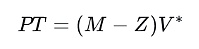
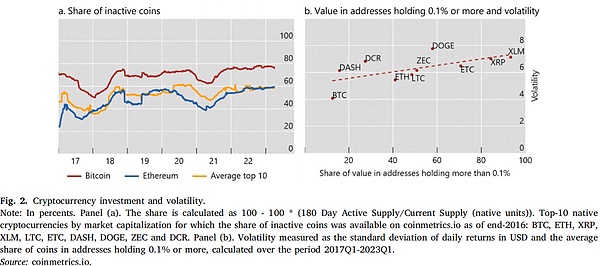
Since its inception, cryptocurrency price volatility has far exceeded that of traditional fiat currencies, becoming a focus of attention for both academia and industry. As shown in Figure 1, the daily standard deviation of returns for mainstream cryptocurrencies such as Bitcoin and Ethereum often exceeds 10%, while the volatility of major fiat currencies mostly remains below 1%. This extreme volatility not only affects investors' risk expectations but also prompts regulatory bodies such as the Basel Committee on Banking Supervision to impose the highest risk weights on cryptocurrency assets held by banks. Traditional research attributes volatility to the lack of elasticity in cryptocurrency supply or the ease of conversion between different currencies, but these perspectives fail to deeply reveal the intrinsic connection between holder motivations and market structure. Based on this, this paper proposes the core concept of the "crypto multiplier," aiming to characterize the systematic impact of investor fund flows on cryptocurrency market capitalization from an equilibrium perspective. The theory of the crypto multiplier is based on a key observation: while cryptocurrencies can be used as payment instruments, they are rarely used as units of account. In actual transactions, commodity prices are usually denominated in fiat currency, while the amount of cryptocurrency payments is adjusted in real time with the exchange rate. This characteristic makes the exchange rate formation mechanism of cryptocurrencies different from that of traditional currencies, and also provides fertile ground for the multiplier effect. The size of the crypto multiplier reflects the market's sensitivity to investment demand: when the vast majority of tokens are hoarded rather than used for payments, even small flows of funds can trigger dramatic changes in market capitalization. The article further uses blockchain data to verify this theory, pointing out that among the current mainstream cryptocurrencies, more than 75% of Bitcoin and 60% of Ethereum have not been used for payments in the past six months, suggesting that their multipliers may be extremely high. Related Literature The economics of cryptocurrency research has seen explosive growth in recent years, covering multiple dimensions such as price formation, platform token financing, and consensus mechanism design. Regarding price theory, scholars such as Athey et al. (2016) and Schilling & Uhlig (2019) have pointed out that the lack of a unit of account for cryptocurrencies is a key premise for understanding their price behavior. This assumption forms the basis for deriving the crypto multiplier in this paper. Furthermore, Bolt & Van Oordt (2020) established a theoretical link between cryptocurrency exchange rates and payment demand by extending the Fisher equation, providing important insights for this paper. In terms of token economics and financing models, Cong et al. (2021) and Garratt & Van Oordt (2022) studied how companies raise funds by issuing tokens. On the other hand, the economic incentives for consensus mechanisms and blockchain security are also hot research topics. Scholars such as Budish (2018) and Prat & Walter (2021) explored the stability of blockchains from the perspective of computing power competition and node behavior. It is worth noting that a concept similar to the crypto multiplier has recently appeared in asset pricing literature, such as the "demand multiplier" for stock and bond portfolios proposed by Gabaix & Koijen (2021), with estimates ranging from 3 to 8. However, the peculiarity of the cryptocurrency multiplier lies in its direct connection to payment functions: investment holdings crowd out the supply of tokens for payment purposes, thereby amplifying the price response to capital flows. In the simplified version of our model, the cryptocurrency multiplier is theoretically equal to the reciprocal of the proportion of payment tokens. Theoretical Derivation of Crypto Multipliers 1. The Non-Unit of Account Characteristics of Cryptocurrencies The derivation of crypto multipliers begins with a fundamental fact: cryptocurrencies are rarely used as a unit of account in reality. Prices for goods and services are typically denominated in fiat currencies such as the US dollar, and consumers convert the amount into a corresponding number of tokens based on the real-time exchange rate when paying. For example, a car priced at $60,000 can be paid for with 2 bitcoins when the Bitcoin exchange rate is $30,000; if the exchange rate drops to $20,000, it will require 3 bitcoins. This price flexibility stems from modern communication technologies that allow merchants to adjust the amount of tokens paid in real time, or rely on third-party payment service providers to complete the conversion and settlement. Therefore, cryptocurrencies primarily function as a medium of payment rather than a measure of value, a characteristic that profoundly impacts exchange rate formation mechanisms. 2. Establishing the Exchange Rate Equation To characterize the exchange rate determination mechanism of cryptocurrencies, the author introduces the classic quantitative equation: MV=PT. Here, P represents the average number of tokens per payment, T is the number of transactions, M is the total supply of tokens, and V represents the velocity of money. In the context of cryptocurrencies, tokens can be divided into an active portion used for payments and an inactive portion used as a store of value. Let Z represent the number of tokens not used for payments, with a velocity of zero; the remaining M−Z tokens have an average velocity of V*. Substituting into the quantitative equation, we get:
Telecommunications technology allows merchants to update the number of coins a customer needs to pay in near real-time when the customer checks out.
4. Multiplier and Endogenous Payment Demand
The basic multiplier model assumes that payment demand is not affected by speculative behavior, but in reality, speculative activities may have a lasting impact on payment usage through network effects or changes in transaction costs.
The basic multiplier model assumes that payment demand is not affected by speculative behavior, but in reality, speculative activities may have a lasting impact on payment usage through network effects or changes in transaction costs.
To capture this complexity, the authors extended the model to allow for endogenous responses in payment demand: The extended multiplier adds a term whose sign depends on the relationship between speculative holdings and payment demand in equilibrium. If the two are positively correlated (e.g., speculative activity increases cryptocurrency awareness), the multiplier will be further amplified; if negatively correlated (e.g., speculation drives up transaction fees), the multiplier may weaken. However, theoretical analysis shows that for the multiplier to fall below 1, a stringent condition must be met: a $1 inflow must cause a reduction in payment demand exceeding the Z/M ratio. Given the extremely high Z/M ratios of mainstream cryptocurrencies, the likelihood of a multiplier below 1 is low. 5. Applicable Scenarios of the Theoretical Model The effectiveness of the crypto multiplier model depends on the validity of the three core assumptions mentioned above, thus limiting its applicability. First, the model only applies to cryptocurrencies used as payment instruments in at least some transactions (satisfying assumption 2). Native tokens such as Bitcoin and Ethereum naturally meet this condition because they are used to pay transaction fees or execute smart contracts on the blockchain. Second, the model assumes that the total supply of tokens is inelastic (assumption 3), therefore it is not applicable to stablecoins, whose supply adjusts with demand to maintain exchange rate stability. Finally, if there are significant frictions in the payment process (such as exchange rate premiums or transaction fees), assumption 1 may be violated. The authors point out that if frictions are modeled as a fixed percentage of fees, the multiplier expression remains unchanged, but if the flow of funds causes continuous changes in fees, the actual multiplier may deviate from the theoretical value. Empirical Analysis of Speculative Holding and Volatility 1. Data and Methods To verify the real-world relevance of crypto multipliers, the authors selected 24 native blockchain tokens and collected quarterly data from 2014 to 2023, covering information such as price, blockchain transactions, and address balances. The explained variable is the annualized standard deviation of the future 180-day return. The core explanatory variables are proxy variables for three speculative holding ratios: the share of tokens held by addresses exceeding 0.1% of the total supply; the share of tokens held by the top 100 addresses; and principal component variables constructed based on the above variables and "the share of addresses with balances exceeding $1 million" and "the number of small-scale addresses." The control variables include on-chain transaction frequency, market capitalization, average transaction amount, and Google search index. All explanatory variables are lagged by one period to mitigate endogeneity issues. 2. Key Findings The regression results show that all speculative proxy variables are significantly positively correlated with future volatility. For example, the principal component variable has a coefficient of 0.683 in the fixed effects model, meaning that an increase in this variable from the 10th percentile to the 90th percentile will lead to an increase in daily volatility of approximately 3 percentage points over the next 180 days. This result remains robust even after changing the volatility metric (such as mean absolute deviation, value at risk), adjusting the forecast interval (90 days or 26 weeks), and converting proxy variables to multiplier form. Among the control variables, Google search index is positively correlated with volatility, echoing the literature finding that investor attention drives price fluctuations; market capitalization is negatively correlated with volatility, indicating that larger cryptocurrencies have lower volatility. 3. Impact on Valuation of Large Positions The core policy implication of the crypto multiplier is to warn market participants to carefully assess the liquidity risk of large cryptocurrency positions. Theory suggests that the liquidation of large speculative positions can have a significant impact on prices unless other speculators take over. This risk has been confirmed in real-world cases: In 2014, after Ripple co-founder McCaleb announced plans to sell 9% of his XRP tokens, the XRP exchange rate plummeted by over 40% after the announcement, despite a maximum supply increase of only 10%. Ripple ultimately extended its sale plan for more than seven years through a legal agreement to alleviate market pressure. Similarly, celebrity endorsements or regulatory developments (such as the SEC's approval of a Bitcoin spot ETF) can trigger large-scale capital inflows, driving up market capitalization. However, if the cryptocurrency lacks substantial payment demand, its high multiplier characteristic will cause its price to become overly sensitive to capital flows, thus amplifying volatility. Investors accepting large amounts of cryptocurrency as collateral or financing consideration must be aware of the potentially huge gap between market value and liquidation value. This paper systematically explains the structural causes of high volatility in cryptocurrencies by constructing a theoretical framework for crypto multipliers. The multiplier is directly related to the proportion of a token used for payments: the weaker the payment function, the higher the multiplier, and the more volatile the price response to capital flows. Empirical evidence further confirms that the proportion of speculative holdings has predictive power for future exchange rate fluctuations. The research suggests that the volatility of the cryptocurrency market is not accidental, but rather inherent to its nature as an investment asset rather than a payment instrument. High volatility is likely to persist unless the mainstream use of cryptocurrencies shifts from speculation to payments. For investors, it is crucial to be wary of the liquidity risks of high-multiplier cryptocurrencies and avoid simply equating market value with liquidation value. For regulators, understanding the multiplier mechanism helps in developing more prudent risk management standards. Future research could further explore the dynamic changes of the multiplier under different market cycles and policy environments, as well as the potential weakening effect of payment technology innovations on the multiplier effect.


 Jasper


