On November 14th, Bitcoin mining difficulty decreased by 9.13%, marking the largest drop since June. The market's initial reaction is often to attribute this to Bitcoin's price, but the data points to electricity prices in West Texas. Electricity costs exceed mining revenue. Mining rigs are only economically viable when mining revenue exceeds electricity costs. Energy hashrate is a metric used to measure this profitability; it reflects the mining revenue a rig can generate per megawatt-hour (MWh) of electricity consumed, and can be understood as the break-even electricity price for mining rigs. Taking a mining rig with an energy efficiency ratio of 25J/TH as an example, during the difficulty adjustment period from October 29th to November 14th, its average break-even electricity price was $54/MWh. However, electricity prices in West Texas surged and exceeded this threshold. From November 7th to 11th, the average daily electricity price reached $64 to $122/MWh. The sharp drop in wind power generation was the main reason: wind power output in West Texas plummeted from 12.6 gigawatts (GW) on November 4th to approximately 1 GW from November 7th to 9th, pushing the 345 kV transmission lines to their maximum capacity. This resulted in West Texas's electricity price being $47/MWh higher than other parts of the state on November 9th. The situation was worst in the evening: after sunset and the disappearance of solar power generation, the average electricity price from 5 pm to 11 pm reached $80 to $98/MWh. On November 11, the power shortage spread throughout the state, with wind power dropping to 2 to 4 gigawatts after sunset, and by around 9 pm, electricity prices in the north, south, and west regions soaring to $500 to $650/MWh. Comparison of Daily Real-Time Electricity Prices and 25J/TH Energy Hashrate Prices in ERCOT West From October 29 to November 14, West Texas experienced 45% of the time when electricity prices exceeded the mining revenue of 25J/TH energy efficiency ratio mining rigs (i.e., in a loss-making state), far higher than the 9% during the period from October 16 to 29. This percentage of loss-making periods is the highest in at least a year, and its duration even exceeds the level during the winter storm in late January of this year.
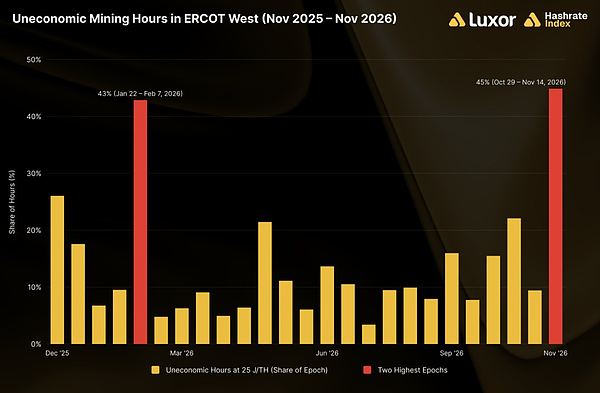
Percentage of Loss-Making Mining Periods in Western ERCOT During Difficulty Cycles from November 2025 to November 2026
Electricity Price (Not Cryptocurrency Price) Determines Hashrate Price
Since hashrate prices also declined during the same period, we conducted a separate analysis of electricity price and hashrate price. Data shows that the percentage of time local miners were operating at a loss jumped from 9% to 45%, a surge of 36 percentage points.
As hashrate prices also declined during the same period, we conducted a separate analysis of electricity price and hashrate price. Data shows that the percentage of time local miners were operating at a loss jumped from 9% to 45%, a surge of 36 percentage points.
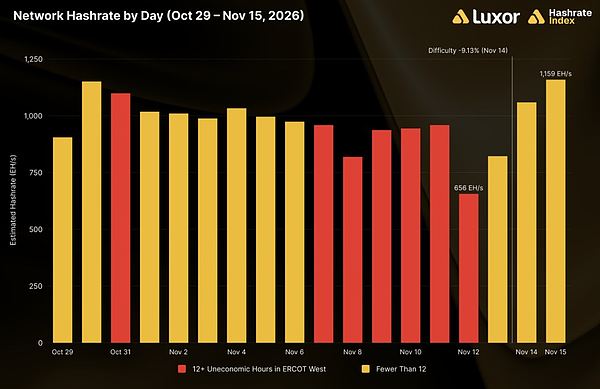
Estimated Bitcoin Network Hashrate
Next Step
Mining machines shut down due to high electricity prices will quickly restart once electricity prices drop. Since the last difficulty adjustment, the average block time across the network has shortened to 9.1 minutes. Based on this speed, even if the price of Bitcoin continues to decline, the mining difficulty will still increase significantly by about 10% in the next cycle adjustment. At that time, the hashrate price will be compressed from $30 to $27; and for mainstream 25J/TH energy efficiency mining machines, the break-even electricity price (energy hashrate cost line) will also drop to $45/MWh. However, only 538 of the 2,016 blocks in this cycle have been completed so far, and it is too early to draw conclusions—just on Monday afternoon (November 16), the electricity price in West Texas broke through the $120/MWh mark again. Looking ahead, Luxor's hashrate forward market pricing shows that the average hashrate price for the next six months will be $28.23, or 0.000437 BTC/PH/s/day. Miners can now lock in this revenue level in advance; while buyers can also use this opportunity to lock in their computing power procurement costs at the same level up to May 2027. [Image of Luxor computing power forward curve]


 YouQuan


