Author: Zhou, ChainCatcher
On October 28th, Predict.fun, a prediction market project on the BNB Chain, announced the tokenomics of its native token, PREDICT.
The most discussed aspect was the allocation method for the first quarter airdrop. A total of 70 million tokens were airdropped, and participants could only choose one of two options: receive 35% immediately or lock up their tokens for one year to receive the full 100%.
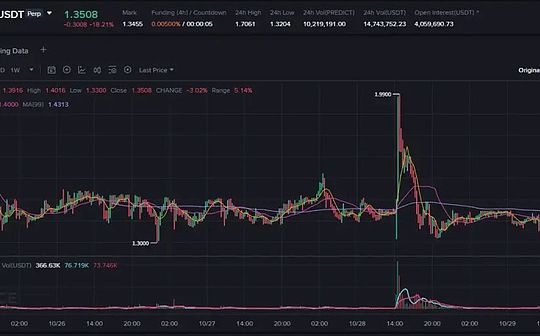
Binance Futures data shows that the pre-market price of PREDICT once surged to $1.99, but as of press time, it has fallen back to around $1.35, still nearly 5 times the Binance Wallet Prime Sale subscription price of $0.29, corresponding to a fully diluted valuation of approximately $1.35 billion.
From incubation and integration to token issuance, Predict.fun has been deeply integrated with Binance at almost every step. Whether PREDICT can maintain its pre-market momentum or peak immediately upon listing like most new coins will directly determine which method of obtaining it is more cost-effective. According to official data, the total supply of PREDICT is fixed at 1 billion tokens, with the ecosystem and community accounting for 51.95%, early supporters accounting for 26.05%, core contributors accounting for 10%, the treasury accounting for 8%, and liquidity accounting for 4%.
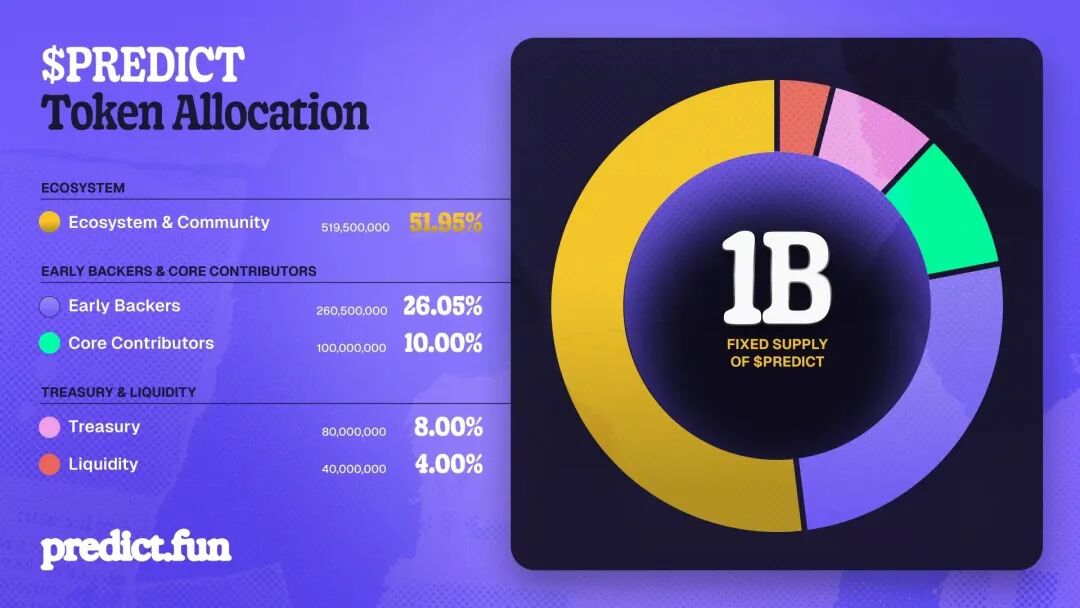
16% of the total supply will be unlocked upon listing. Looking at the release curve, this approximately 160 million circulating supply consists of liquidity shares and a portion of the ecosystem and community shares; shares allocated to the treasury, core contributors, and early supporters have not been released. Core contributors and early supporters will have their tokens locked for 24 months, followed by release over 36 months.
The 70 million tokens airdropped in the first quarter come from the ecosystem and community shares, accounting for approximately 7% of the total supply, allocated according to the first quarter's Predict Points. These points primarily come from trading, providing effective liquidity, holding positions, and early market participation.
There are only two ways to claim them.
Choosing immediate withdrawal will grant users 35% of their due amount, with the remaining 65% forfeited. Choosing 12-month vesting will allow users to receive the full amount. The official announcement states that users who choose vesting can still switch to immediate withdrawal within one month of the token's listing. After withdrawals open, eligible users have one month to make their choice; unclaimed tokens will be forfeited. The rules differ for users participating through Binance. Binance's announcement specifies that each Predict Points holder can only submit one form, which cannot be modified after submission. Those not submitted before 5 PM on November 26th will be automatically staking for one year, and will only be able to receive the full amount after one year. Users who want to receive tokens immediately on the launch day must submit their applications before 5 PM on October 29th. Applications submitted after this time will be distributed in four weekly batches on November 6th, 13th, 20th, and 27th. Binance also reminds users that the 65% that is forfeited cannot be recovered from the project team, and the official handling of these tokens is yet to be announced. In other words, assuming a user receives 35% and then sells immediately, it's more worthwhile to lock up the full 100% if the token price drops by no more than 65% a year later; otherwise, it's better to claim it immediately. Binance Prime Sale amplifies the community gap. Alongside the airdrop, Binance Wallet's Prime Sale is also underway. According to the Binance Wallet event page, a total of 20 million PREDICT tokens, representing 2% of the total supply, were sold at a price of $0.29 each, raising $5.8 million. Binance Alpha Points holders could participate, with a purchase limit of 6 BNB per person, allocated proportionally. At $0.29 each, PREDICT's fully diluted valuation is $290 million, approximately one-fifth of its current pre-market valuation. This further exacerbated community discontent. User 0xFEI pointed out that although the ecosystem and community account for 51.95% of the total supply, if all Q1 airdrops are claimed instantly, the community will only receive a maximum of 2.45% of the total supply when the token launches. A user blogger stated that many in the community previously expected each point to be worth $0.3 to $0.5, but based on the current pre-market price, each point is only worth about $0.1. He also admitted that most participants did not lose money, but their returns were far lower than expected. The transparency of the distribution is also questioned. The official statement does not specify the exact composition of the 16% allocation at token launch. Even if the Q1 airdrop is considered as 7% of the total, plus 4% for liquidity and 2% for Prime Sale, the use of approximately 3% remains unexplained. Some users questioned that Binance Alpha users could buy 2% of the tokens at a low price, which is almost the same as the amount allocated in community airdrops. In response, the Predict.fun community administrator stated that Binance decides how to allocate this portion to Alpha users, not the project team. Most new coins fall below their first-week listing price. Whether to lock up or claim immediately ultimately depends on the prediction of PREDICT's price one year from now. The general trend of new coins over the past two years can provide some reference. Blockchain data company Bitquery tracked 51 large airdrops since 2026 in September of this year. Of the 46 tokens that have been listed for a month, 35 are below their first-week price, with a median drop of 48%. In the median airdrop, 73% of recipients transferred their tokens within one day. After 30 days, only 23% still held at least half, and this figure dropped to 8% after 90 days. It's worth noting that Bitquery found that in the four airdrops distributed via Binance Wallet's reward contract, between 50% and 70% of recipients exchanged their tokens for the tokens within one day using the wallet's exchange function. Regarding valuation, research firm Memento Research analyzed 118 token creation events in 2025. By the end of that year, 84.7% of the tokens were priced lower than their initial valuation. Of the 28 projects with a fully diluted valuation exceeding $1 billion on their first day of trading, none were profitable. Besides industry trends, PREDICT's own release schedule is also noteworthy. According to the official release curve, a significant jump will occur in October 2027, 12 months after launch, with approximately 70-80 million new tokens entering circulation. This timing coincides with the expiration of the one-year lock-up period for the first quarter airdrop. For users choosing to wait, the month of arrival may coincide with a concentrated release of tokens. Further on, in October 2028, the lock-up period for core contributors and early supporters will end. The official announcement stated that this portion would be released monthly thereafter, and the release curve showed that the circulating supply would increase from approximately 260 million to approximately 500 million in the month the lock-up period ended, nearly doubling. After the points recede, Predict.fun's financial test truly begins. Besides price, another issue is whether Predict.fun can retain funds after the token's listing. According to DefiLlama data, its TVL has decreased from approximately $21.7 million in January of this year to approximately $10.17 million currently, a reduction of about half. However, its transaction fees followed the opposite trend. Since August, Predict.fun's daily transaction fees have been steadily climbing, reaching a record high in October, just before its token launch. In the past 30 days, its transaction fees totaled approximately $7.98 million, while protocol revenue was approximately $1.99 million. The peak in trading volume occurred even earlier in April, when Binance launched its prediction market feature within its app and covered the on-chain transaction and settlement fees for users. Predict.fun's trading volume subsequently reached its peak for the year. Whether these figures can be maintained after the token launch can be compared to the previous peer-to-peer project Opinion. Opinion, also backed by YZi Labs, had a TVL of approximately $155 million in January, about seven times that of Predict.fun at the time. After closing registration for the first quarter airdrop at the end of February and launching the token in early March, Opinion's funds quickly flowed out, and its TVL is now only about $3.01 million. In Bitquery's data on new tokens in their first week, OPN's price fell by 83%. A small number of relatively optimistic users believe that the community's expectations for Predict are higher than for Opinion, and its price may be more stable than OPN's. The snapshot of Predict.fun's first-quarter points has been completed. Whether the funds and transactions previously invested in for points will remain on the platform depends on the subsequent incentive design. According to the official announcement, second-quarter LP points will be calculated based on both order duration and actual transaction volume. Orders without transactions or with insufficient transaction value will not receive points for the transaction portion. Whether this rule, which only rewards actual transactions, can retain funds will be answered by data in the coming weeks. Previously, Opinion's TVL (TVL) declined sharply in the weeks following the end of the first-quarter airdrop registration and token launch. This observation period coincides with the user's selection window. The Binance channel selection form closes on November 26th. Users still considering this option should review the data from the first month after launch before making a decision.

 Kikyo


