Author: Jasper De Maere, Wintermute OTC Trader; Source: X, @wintermute_t; Translated by: Shaw Jinse Finance
Following news of several Bitcoin mining companies selling off reserves and shifting some funds to high-performance computing (HPC) and artificial intelligence, market concerns have intensified. Although data shows that this round of funding shortages differs from the cycles of 2018 and 2022, we believe this is a benign reshuffling, consistent with Bitcoin's underlying design logic, and will ultimately improve the efficiency of the entire mining industry.
In addition to strictly controlling costs and diversifying business towards more flexible computing power areas, we believe that proactive balance sheet management is a key tool that mining companies have not yet fully utilized.
Bitcoin Mining Dynamics Bitcoin's security model is simple yet sophisticated: miners invest real-world resources, energy, and computing power to ensure network security, and the protocol compensates them through block rewards and transaction fees. Mining difficulty is adjusted every two weeks, recalibrating the computing power threshold to maintain a stable block production rate, regardless of the number of competing miners. While this adjustment seems responsive, it is far less flexible in practice due to the longer capital expenditure cycle. Unlike Before While miners weathered the difficult periods of 2018 and 2022, this cycle is fundamentally different. Instead of simply comparing computing power and mining difficulty, we analyze from first principles: revenue (block rewards + transaction fees) and input costs (energy + computing power) indicate that the profit compression in previous cycles was cyclical, while now it seems more structural. Computing power and difficulty have expanded to a critical point, and the protocol's self-correcting mechanism can no longer offset economic headwinds. We are at a structural ceiling, not a cyclical trough. As shown in the diagram below, in the first half of this cycle, both revenue and costs were squeezed simultaneously, a phase that should typically be an industry expansion period: Revenue: For the first time in all cycles, Bitcoin failed to double its 4-year rolling returns, currently only at 1.15x – barely enough to offset the 50% reward reduction from the halving and maintain block reward revenue. Profit Margin: The peak gross margin in this cycle was only about 30%, a level that in previous cycles was merely the bottom line of a bear market.
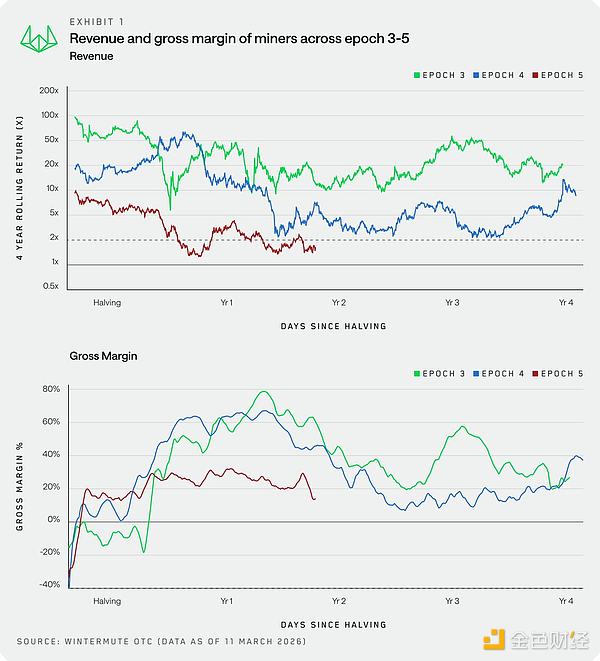
Therefore, we see that miners are expanding and transforming towards high-performance computing (HPC) for artificial intelligence applications. This shift is driven by several factors: ****Unit Economics:** Compared to Bitcoin mining, high-performance computing offers significantly higher revenue per gigawatt-hour, effectively improving profit margins in the face of structural pressures on profits; ****Market Revaluation:** Transitioning miners receive valuation reassessments in the public market, enabling them to obtain lower-cost funding through equity issuance and more favorable convertible bond terms; ****Flexibility:** High-performance computing infrastructure offers greater operational flexibility than mining equipment reliant on application-specific integrated circuits (ASICs), allowing operators to adapt to changing market conditions. Bitcoin mining is a structurally rigid business model, and the current profit environment is forcing practitioners to seek available adjustment tools. While the shift to artificial intelligence is highly attractive, it is also a radical and capital-intensive move. We believe that proactive balance sheet management is another often overlooked approach that miners can and should utilize concurrently. Revenue: The "Doubling Dilemma" By design, block rewards halve every four years. If the price of Bitcoin fails to at least double during the same period, miner revenue will experience a structural decline. The only compensation is transaction fees. In previous cycles, price increases made this not a problem. The third cycle yielded over 20x returns, the fourth over 10x, and the fifth cycle is currently only around 1.15x. Transaction fees have not yet provided structural support, leading to a revenue squeeze. This break is structural, not cyclical. Bitcoin is maturing. As institutional participation deepens, Bitcoin is increasingly resembling a macro-risk asset, with its volatility compressed. The approval of ETFs and corporate treasury holdings, signals of recognition that the industry once prided itself on, are essentially forces suppressing explosive return cycles. Assets with higher liquidity and greater institutional holdings can no longer achieve 20x returns in four years. For miners whose business models implicitly rely on price surges, this represents a significant structural paradigm shift, not just a poor quarterly performance. The chart above shows that network revenue in the same period this time was lower than in previous periods. The chart below clearly illustrates the significant compression of returns: the third and fourth periods saw returns of 5–20 times during the same phase, while the fifth period is currently only slightly above 1 time, not yet reaching the 2 times required to break even. A natural question is: can transaction fees fill this gap? Intuitively, as blockchain subsidies gradually approach zero, increased network usage should naturally drive up transaction fee revenue, thus replacing subsidies. However, the data presents a different picture.
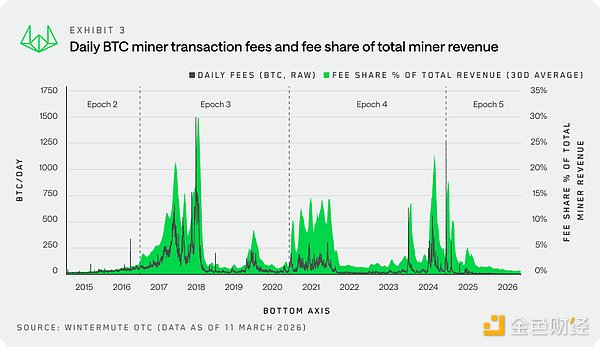
Transaction fee revenue is phased, not structured.. While the spikes caused by Ordinals activity and periodic mempool congestion are noticeable, they are only temporary phenomena.
Outside of these peak periods, transaction fees account for only a low single-digit percentage of miners' total revenue. No business model can rely on intermittent network congestion to survive.
The dashed line representing the profit margin, including transaction fees, remained almost entirely within the solid line across all three periods. In the fifth phase, where block reward profit margins were already meager, transaction fees did not provide any meaningful profit increase. The protocol's second revenue mechanism failed to provide structural support. The cost structure of Bitcoin mining is exceptionally simple. Unlike any other commodity, its input costs boil down to only two variables: energy and computing power. No raw materials, no logistics, and no large-scale labor-intensive investment are needed. However, this simplicity is precisely the trap: **There are too few adjustable means; once revenue shrinks, profit margins will compress accordingly.** Profit margins have been shrinking. The following chart, converted to gross margin percentage, clearly shows a long-term compressing trend. The peak gross margin in each subsequent cycle is lower than the previous cycle, while the trough in a bear market is even deeper. The peak gross margin in the fifth cycle was merely a trough level, not a peak, in previous cycles. The absence of a clear trend is also evident: in previous cycles, price increases in the years following the halving led to a clear mid-cycle profit margin recovery. This seasonal pattern was not observed in the fifth cycle. The recovery curve that once provided miners with breathing room for reinvestment, refinancing, and extending their cash flow runway has not materialized. A comparison of multiple cycles makes this profit compression undeniable. Miners in the third cycle maintained a gross profit margin of 70%–80% for an extended period. Even after experiencing a bear market trough, the fourth cycle can still achieve a considerable rebound before the next halving. The red line for the fifth cycle, however, is structurally lower than the previous cycles from the very beginning. The boom in AI infrastructure has opened up a completely new monetization path for assets deemed structurally problematic by the market. Hyperscale cloud providers and AI computing power operators are racing to acquire electricity on a massive scale, with demand far exceeding the construction cycle of traditional data centers. In many parts of the United States, grid connection queues are as long as 5 to 10 years. Approval, construction, and community resistance further exacerbate the difficulty of implementation. Bitcoin miners have already built large-scale power infrastructure in the low-cost energy market over the years. Now, what they hold in their hands is precisely the resource that the AI industry most urgently needs but is difficult to replicate quickly. The logical response was to shift to high-performance computing (HPC) hosting, and miners who made this transition immediately experienced a rapid revaluation in the market. Following the valuation logic of Bitcoin mining, mining farms that were originally valued at $1-7 per watt saw their transaction prices increase several times over after shifting to contracted AI computing power services. Taking HUT's partnership with Google and Anthropic as a benchmark, the value per watt has almost tripled since mid-2025, reaching approximately $18 per watt by December. They are no longer mining companies, but infrastructure companies. Therefore, we are seeing mining companies expanding and transforming into high-performance computing (HPC) businesses geared towards artificial intelligence applications. This transformation is driven by multiple factors: **Unit Economic Efficiency:** Compared to Bitcoin mining, high-performance computing (HPC) delivers significantly higher revenue per gigawatt-hour, effectively improving gross margins in the face of structural pressures on profits; **Market Revaluation:** Mining companies that have completed the transformation have received multiple rounds of valuation revaluation in the public market, enabling them to obtain lower-cost funding through equity issuance and convertible bonds with better terms; **Flexibility:** Compared to mining equipment that relies on application-specific integrated circuits (ASICs), HPC infrastructure offers greater operational flexibility, allowing operators to adjust their strategies in response to changes in the market environment. Bitcoin mining is a structurally rigid business model, and the current profit environment is forcing the industry to seek available adjustment tools. While the shift to artificial intelligence is highly attractive, it is also an extremely aggressive and capital-intensive move. We believe that **proactive balance sheet management** is currently the most underutilized tool for mining companies and deserves greater strategic attention. The Logic of Proactive Balance Sheet Management Bitcoin mining companies collectively hold nearly 1% of the total Bitcoin supply, a legacy of the long-standing era of "holding coins without moving." Although the industry is shifting towards proactive reduction, **complete fund management tools remain largely undeveloped**. Yield generation is a widely accepted concept in decentralized finance (DeFi), but its adoption in the Bitcoin industry has been slow. Given the large amount of idle Bitcoin on mining companies' balance sheets, this structural inefficiency is a problem the industry can no longer ignore. Currently, many mining companies have high leverage levels and face significant debt repayment pressure in the short term, especially debt incurred through convertible bonds. The sensitivity calculation table below shows how much return holding Bitcoin would need to generate to fully cover these debts under different spot price and treasury allocation scenarios. Debt repayment is only one part of overall liquidity needs; other factors include operating expenses, capital expenditures, and working capital requirements. However, the above analysis illustrates a more core issue: **Efficient Bitcoin treasury reserve management can significantly alleviate liquidity pressure, reduce operational vulnerability, and enhance a company's resilience throughout the entire cycle.** How to Generate Revenue? Among the mining companies we've contacted, relevant strategies can be broadly categorized into two types: **Active Management:** Monetizing market risk through derivative structures, including covered call options, cash-backed put options, and more complex combination strategies. This requires continuous management, market channels, and expertise in derivatives. **Passive Management:** Monetizing credit risk through decentralized lending, investing Bitcoin in lending protocols to earn interest, with terms clearly defined in advance. Compared to option strategies, this is a "set-up and hold" model. The WBTC market recently launched on Wildcat is a case in point. Mining companies should optimize revenue generation by combining proactive and passive treasury management, based on their own capabilities and risk appetite. In this increasingly competitive and declining profit industry, any marginal advantage can significantly improve the probability of survival. Conclusion: The fifth cycle is the first cycle in which the Bitcoin protocol's self-correcting mechanism is insufficient to support the industry. Difficulty will adjust, but it cannot solve these problems: a fee market that has not yet formed structural support, Bitcoin prices that have failed to reach the expected growth implied by the mining companies' business models, and an energy cost curve that continues to compress profit margins from the bottom. The shift to AI is a real trend, and the market is giving it high valuations. But this is only a solution for a few companies. Only teams with high-quality mining farms, balance sheets, and execution capabilities can complete this fundamental transformation. For other companies, survival depends on maximizing the use of existing resources. This means actively managing the balance sheet. Mining companies hold nearly 1% of the total Bitcoin supply. In previous cycles, holding Bitcoin long-term was a reasonable choice; however, in this cycle, keeping treasury funds idle is a cost. Tools such as covered calls, cash-backed options, and on-chain lending already exist. Mining companies that treat their Bitcoin holdings as operating assets rather than passive reserves will have a structural advantage before the next halving. The entire industry is being forced to mature. Only the fastest to adapt will survive to the sixth cycle.


 Edmund


