读懂Monad及其生态项目一览
EVM拥有大量资本,以太坊的TVL接近520亿美元,而Solana为70亿美元。L2如Arbitrum和Base各自持有约25-30亿美元的TVL。
 JinseFinance

Source: The DeFi Investor, Translated by: Shaw Jinse Finance
After years of development, Monad, the highly anticipated L1 blockchain, has finally launched and introduced its token, MON.
Monad is currently experiencing a surge in popularity, with its 24-hour attention even surpassing that of Bitcoin.
However, the question remains: what will happen next? Because in the long run, short-term hype is not very meaningful.
Here, I will share my thoughts on Monad, its unique features, and a study of some recent L1 launches.
Let's start with the basics.
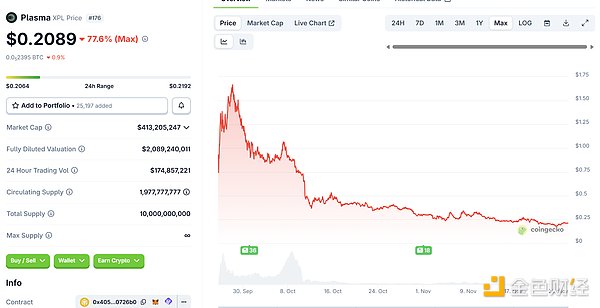
However, now, just two months after its launch, the price of XPL has dropped 87% from its all-time high, its TVL is also declining, and market sentiment surrounding Plasma has turned negative.
Earlier this year, Berachain experienced a similar situation.
I believe the reason for the failure in both cases is the same:
Both Plasma and Berachain initially offered high token incentives, attracting a large number of users and TVL.
However, none of them have truly produced any unique dApps that have achieved significant growth based on them. Therefore, once token incentives begin to diminish, users simply move their funds elsewhere because they have no reason to stay. In contrast, today's most successful L1 and L2 networks all have at least one killer dApp: Ethereum has AAVE, Uniswap, Pendle, and many other projects. Solana has Jupiter and Pump Fun. Base has Virtuals, Avantis, and Footbaldotfun. While this may sound harsh, I believe Monad's technology, speed, and incentive program are irrelevant to its long-term success. We already have many high-performance blockchains. However, I believe that if Monad can have a killer dApp built entirely on its platform and develop a very loyal community, then it can succeed. I think only then can it remain relevant in the long run. That said, one thing is clear: the L1 space is extremely competitive. Personally, I'm not interested in investing in other L1 tokens right now. You can certainly make a lot of money trading these tokens if you're good at narrative trading, but I don't think most of them are suitable as long-term investments. That being said, I still support Monad because I think they have a great team. However, successfully building a completely new L1 network by 2025 will be no easy feat.
EVM拥有大量资本,以太坊的TVL接近520亿美元,而Solana为70亿美元。L2如Arbitrum和Base各自持有约25-30亿美元的TVL。
JinseFinanceEthereum is the backbone of the new global financial system for L2 and L1 applications, and no other chain can compare.
JinseFinanceThis article will sort out the ins and outs of MegaETH vs Monad, and introduce and analyze them respectively as well as our opinions on them.
JinseFinanceAmid the rapid development of blockchain technology, Monad and MegaETH, as two emerging projects, are driving the evolution of the Ethereum ecosystem in their own unique ways.
JinseFinanceTransaction scalability has been a hot topic of discussion in the industry for a while now, and over the past few weeks we’ve been discussing how Monad can help increase transaction processing speed (TPS).
JinseFinanceMonad stands out with its goal to be a highly scalable single large L1 blockchain that is both EVM-compatible and capable of processing over 10,000 transactions per second with a block time of 1 second.
JinseFinanceParadigm is reportedly in talks to lead a funding round in excess of $200 million for Monad Labs. If this financing is successful, it will be the largest cryptocurrency financing so far in 2024.
JinseFinanceMonad, Bankless: Why does Monad have the potential to replace Ethereum? Golden Finance, Monad is one of the most powerful challengers to ETH.
JinseFinanceTPS reaches 10,000+, financing reaches 19 million US dollars: Will L1 dark horse Monad disappoint people after it goes online?
JinseFinanceAs the dominant standard for smart contracts, the EVM chain has (to date) the majority of TVL, the largest developer and research network, and an incredible community that has stood the test of time (and multiple bear markets).
JinseFinance