Author: Punk Source: @punk2898
Finally, Gate has launched US stocks, not RWA, not tokenization, but direct connection to brokerages.
Looking at the industry as a whole, the direction is clear: the RWA US stock market (basically an ondo solution) path is getting narrower and narrower; direct connection to brokerages is the ultimate goal. But Gate is taking a different path from most platforms on the market.
Outline of this article:
Why did Gate take a different path?
Why is US stock trading a prisoner's dilemma?
Why is US stock trading a prisoner's dilemma?
Three fatal flaws crushed RWA (Ondo mode)
The last straw that broke the camel's back: dividends
When one tiger falls, thousands rise up
I. Why did Gate take a different path?
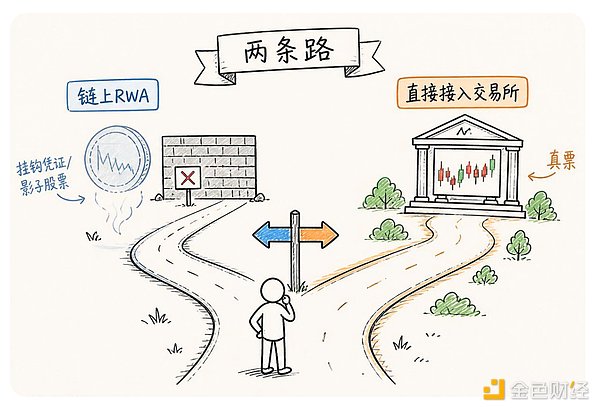
Most platforms on the market that deal with US stocks follow the on-chain approach—to tokenize US stocks, creating RWAs, where what you buy is essentially a certificate linked to the stock price.
Gate is different this time.
It didn't tokenize on-chain; instead, it directly connects to exchanges—specifically, compliant brokerages holding US broker-dealer licenses (Alpaca supports this, which deserves a separate article). You buy real stocks, not just on-chain shadows. Even with the same brokerage, the two completely different paths—one bringing US stocks onto the blockchain, the other directly connecting you to the exchange—lead to vastly different experiences. So the question arises: Wasn't RWA touted as a "trillion-dollar industry"? How come it's become universally condemned in less than two years? The answer is simpler than you think. Because anyone who's used it knows how terrible the RWA US stock trading experience is. II. The Prisoner's Dilemma: The more bustling the market, the more dangerous it is, but if it's not bustling, it's like waiting to die. Here's a cruel game: the more bustling you are with US stocks, the greater the policy risk. It's only a matter of time before regulators target you. How were Tiger Brokers and Futu restricted back then? It's just too crowded. But what if you don't participate? Users will just go elsewhere. You want to retain them? You can't. Crypto users have no loyalty; money flows to whoever offers the most investment opportunities, the lowest costs, and the best user experience. This is the prisoner's dilemma—everyone knows there are risks ahead, but nobody dares to stop. After Tiger Brokers and Futu were restricted, where will Chinese retail investors trade US stocks? This is a huge vacuum. Cryptocurrency exchanges saw this, and they have an advantage that traditional brokerages lack: a global user base + cryptocurrency deposits and withdrawals + 24/7 trading habits. To put it bluntly, the pit that led to the collapse of the "tigers" (referring to large financial institutions) is being filled by cryptocurrency exchanges. And they're filling it in a more ruthless way than the tigers—directly connecting with brokerages, not using RWA's secondhand solution. Three fatal flaws killed RWA (Ondo model). RWA didn't just die today. It was fatally flawed by three major weaknesses, each more devastating than the last. The first weakness: Liquidity. RWA's biggest lie was "on-chain US stocks." It sounds appealing, but in practice—where's the market depth? Where are the order books? None. A few hundred people trading on it is a drop in the ocean compared to the liquidity of the real US stock market. So what to do? Only contracts. RWA perpetual contracts do have players, but imagine this: you wanted to buy Tesla spot, but you're forced to open a contract. I just wanted to hold TSLA spot, but I ended up with a long contract. Moreover, there's the risk of service providers behind the contracts. Who is your counterparty? Is the liquidation reliable? Who decides the price anchor? Every step involves asking "Do you believe me?" Asking "Do you believe me?" in the crypto world is a joke in itself. The second fatal flaw: the number of assets. RWA can only manage a few hundred assets at most. Tesla, Apple, Nvidia, Microsoft, plus a few ETFs, that's about it. But what about direct connections to brokerages? Access to the five major exchanges—NYSE, Nasdaq, NYSE Arca, NYSE American, and BATS—over ten thousand stocks to choose from. A few hundred vs. over ten thousand—this isn't a difference in quantity, it's a difference in technology. Want to buy a niche stock? RWA doesn't have it. Want to do some sector rotation? RWA doesn't support that. Your strategy space is effectively limited by hundreds of underlying assets. The third fatal flaw: Holding costs. This is the most disgusting. RWA stock contracts charge fees regardless of whether you go long or short. Where does this fee come from? Because the underlying structure of the RWA contract is a derivative—essentially an "equity certificate" linked to a stock price. Holding it gives you neither real equity nor voting rights. The service provider needs to lock in your position, hedge, and charge you an "overnight fee." What about spot trading? You buy and hold, paying nothing. Going long incurs fees, and going short also incurs fees. The longer you use RWA, the more money you lose. Users aren't stupid; they can do the math. With these three fatal flaws, it would be strange if RWA were still alive. Fourth, the final straw: Dividends. While the first three issues were disgusting, at least they were tolerable. Dividends, however, directly impacted users' interests. Why are dividends RWA's fatal flaw? Going back to the previous point—what you're holding isn't real stock, it's a token. Real stock dividends are paid by the listed company to its shareholders, and you're not even on the shareholder register. How this money gets to you depends entirely on the service provider. How are dividends handled for RWA stock? Two options, both fail. Option 1: Add it to the price. After the dividend is credited to your account, the service provider adds the dividend amount to the stock price. Sounds reasonable, right? But the problem is—after adding it, your stock price is decoupled from the actual US market price. The same stock might be 180 outside, but 182 here. Who covers the price difference? Arbitrageurs. Who loses after arbitrage? It's all a mess! Option 2: The service provider distributes it to your account. This solution is theoretically the cleanest, but its implementation is a complete mess. The service provider has to reconcile accounts, distribute, and confirm with each exchange—if any link in the chain breaks, your dividends will be blocked. Some exchanges delay payment for one or two months, and when you contact customer service, they say, "We're communicating with the service provider." You paid for the stocks, and you can't get your dividends? Can you tolerate that? Direct connection to a brokerage firm solves this problem directly. You buy genuine stocks, the money is held in custody by a licensed brokerage firm and clearing institution, and the account is also protected by SIPC. Like Tiger Brokers and Futu – dividends go directly to your account, no service provider intermediaries, no reconciliation, no waiting. This is the only difference; RWA deserves to die. Fifth, when one Tiger Brokers falls, thousands rise. Looking back at the whole affair, the restrictions on Tiger Brokers and Futu have blocked the US stock market access for Chinese retail investors. Cryptocurrency exchanges saw this pitfall and jumped in. They first tested the waters with RWA, only to find it unworkable – poor liquidity, limited listings, high holding costs, and disputes over dividends. So they switched to a different approach – direct connections to brokerages, using the same underlying logic as Tiger Brokers and Futu. Tiger Brokers is backed by Interactive Brokers, and these exchanges are backed by licensed broker-dealers like Alpaca – essentially the same thing. Technically, it connects to five major exchanges, allowing direct access to over 10,000 stocks. In terms of user experience, spot trading doesn't incur holding fees, dividends are credited directly, and accounts are backed by SIPC – no different from traditional US stock platforms. Users have no reason not to choose it. The entire industry is declaring with concrete actions: RWA... The US stock market is dead; direct connections to brokerages are the only way to survive. The tiger may fall, but the demand for US stock trading will not. Gate isn't picking up the tiger's carcass; it's picking up the users the tiger dropped. That's all.


 Brian
Brian


