Long-termism: Backpack's IPO gamble
Backpack, IPO, Project, Long-Termism: Backpack's IPO Gamble - Golden Finance, Backpack is waiting for an IPO.
 JinseFinance

Author: Hu Tao, ChainCatcher
On March 23, Backpack officially launched its native token $BP and opened the points airdrop redemption channel. This event, originally considered a landmark event for the Solana ecosystem and carrying the hopes of countless token collectors, unexpectedly triggered a major earthquake in the community and plunged into a vortex of public opinion.
The core reason is the issue of airdrop token distribution. Well-known KOLs such as IceFrog, HeBi, TuAoDaShiXiong, FengWuXiangSuoJiao, MetaYuan, and anymose all stated that their accounts and those of their studios were judged as "witches" by the platform, resulting in airdrop returns far below expectations and significant losses.
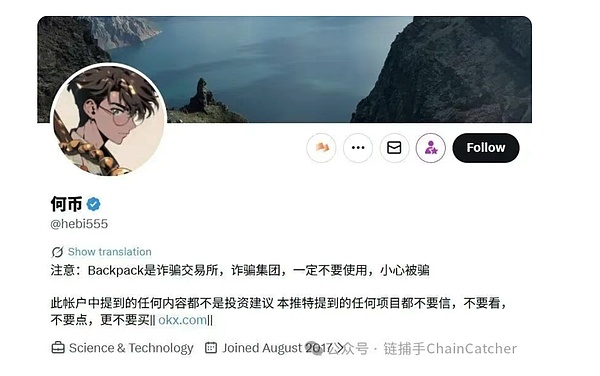
"Countless small investors and I came to Backpack with dreams and aspirations, believing you were a breath of fresh air, believing things would be different. But I'm sorry, we were wrong. We were at your mercy. This time, I'm truly heartbroken," said Little Bear Biscuit. Many projects have been criticized for their anti-fraud measures, but never has a project been so fiercely condemned, with so many KOLs joining the outcry. KOL He Bi even added this description to his profile: "Attention: Backpack is a fraudulent exchange, a scam group. Do not use it, beware of being scammed."
Backpack's rise was once considered a textbook marketing case. Founded by a former FTX executive, backed by the Mad Lads NFT community, and boasting "compliance" and "high performance," Backpack was basked in glory from its inception. According to RootData, Backpack secured $37 million in funding within two years of its founding, with investors including prominent firms such as Placeholder, Jump Crypto, Robot Ventures, Wintertermute, Multicoin Capital, Hashed, and Delphi Digital. In early 2024, when Backpack announced the launch of its first phase of the Pre-Season campaign, it adopted a "transaction volume equals points" logic. At that time, market sentiment was extremely high, and the KOL network greatly promoted Backpack's expansion. In the following year or two, numerous crypto KOLs released comprehensive tutorials on Backpack, covering topics such as registration and KYC completion, trading to increase points, leveraging multiple accounts to boost earnings, and using referral links to reduce costs. Many KOLs embedded exclusive referral links in their content, generating revenue through fee rebates and traffic sharing. This model had been proven effective in several previous projects and gradually evolved into a semi-industrialized traffic arbitrage strategy. In this hypothetical scenario, the higher a user's trading volume and corresponding fees, the more points they earned, and the more airdropped tokens they received. Under the strong promotion of KOLs, countless investors and studios, in order to obtain high airdrops, did not hesitate to pay exorbitant fees to engage in order-brushing. Under this propagation structure, Backpack's user growth exhibited a distinct characteristic: users did not enter based solely on product value, but rather with "airdrop expectations" as the core driving force. However, with the release of the Backpack airdrop quantity verification link, the expectations of all those seeking to profit from airdrops were immediately shattered. From the results, Backpack adopted a strict "one person, one account" judgment policy. If a single device or IP operated multiple accounts, all of these accounts were considered "witch" accounts, ultimately resulting in almost all those trying to profit from the scheme losing everything, especially the Chinese community. For example, anymose and his team, who participated in multiple points promotions and actively recruited new users, contributed over $4 billion in transaction volume to Backpack, yet all their accounts were judged as "witches." 0x雨曦 commented that this incident can be described as an "eight-nation coalition invasion of China" in the crypto world. While the Chinese community's contribution was arguably second to none, almost all of them were euphemistically labeled "witches." No one is afraid of losing money by fighting back, but this kind of pure provocation is intolerable. "Backpack is the project for which I've spent the most time, energy, and money in the crypto world. Yesterday, what should have been a celebration for supporters turned into an absurd farce, and I've been constantly redefining my understanding of the bottom line. From what I understand from my communication, the witches are mainly targeting the Chinese community, and their score is likely more than 60 million. Many large investors have been wrongly targeted. I cannot understand Backpack's choice to betray the Chinese community." KOL Lynn Linshan was also extremely dissatisfied. Meta Ape posted on X explaining his multi-account operation, stating that it was mainly for arbitrage trading. Multiple accounts are more efficient in utilizing funds and can avoid hitting the trading volume limit that restricts rebate ratios. He disdains playing this "cat and mouse game" with the project team, so he did not isolate his accounts and even proactively mentioned his multi-account operation to the project team. But the final result still left him extremely disappointed. "I don't blame the project teams at all for the price difference; after all, I've invested in plenty of garbage projects, one more won't make a difference, and I accept the consequences," Meta Ape said. "But the problem is, according to the rules of the game, if you can't create any economic value, shouldn't you at least consider the emotional value? Their choice is: no consideration, no concern, no respect. That makes me feel like a clown." Regarding the overwhelming dissatisfaction and criticism, Claire, head of Backpack's Chinese region, responded on the 24th, stating that the strict witchcraft determination policy was due to the European and American compliance teams' obsession with the rules. They will open an appeal channel, and users who operate 3 or fewer accounts on a single device and are deemed witches will have more than 50% of their points refunded after manual verification. Simultaneously, the team will launch a targeted token buyback in the secondary market in the coming days to specifically compensate eligible users. However, the impression of Backpack's " egregious" behavior has spread, and the price of its token BP has plummeted to below $0.20 since its launch, a single-day drop of over 33%, with a FDV of only $200 million, far below previous market expectations. Once trust is fundamentally fractured, the price Backpack will have to pay to repair it will likely be far more expensive than the profits it previously "harvested" through transaction fees.
Backpack, IPO, Project, Long-Termism: Backpack's IPO Gamble - Golden Finance, Backpack is waiting for an IPO.
JinseFinanceMyToken开启meme交易机器人公测活动,豪华奖池1200USDT等你来拿!
 XingChi
Kraken and Coinbase set up derivatives exchanges, Backpack promoted technological innovation, why is the derivatives market accelerating? History may give us some answers.
JinseFinanceSouth Korean prosecutors seized over $9.3 million in Bitcoin from a convicted scam operator who targeted elderly citizens and North Korean defectors. Despite his conviction, the scammer showed no remorse, stating he “did not regret” his actions if it benefited his family.
 Kikyo
KikyoIn my opinion, Backpack is a "super application" that integrates NFT + wallet + compliant exchange. It can even be understood as a "closed-loop ecosystem" of DApp mini-programs + wallet exchanges under the xNFT protocol to cultivate users in one stop.
JinseFinanceThe India-UAE oil trade in rupees signifies a major shift from dollar dominance, reflecting the BRICS nations' commitment to alternative trade currencies and the rising influence of emerging economies in global finance.
KikyoTaiwanese artist and JPEX former spokesperson Nine Chen is being shifted from witness to defendant.
 Olive
OliveBackpack, a well-known NFT wallet app operating on the Solana blockchain, made a significant announcement regarding its forthcoming crypto exchange, the Backpack Exchange, earlier this week.
 Jixu
JixuHong Kong police has issued an advisory to the public regarding a growing threat posed by scammers masquerading as representatives of Binance and disseminating deceptive messages.
Kikyo