Which is more suitable for you, OpenClaw or Hermes?
OpenClaw is for advanced users, while Hermes is more suitable for most people.
 JinseFinance

Author: Zhang Feng
In 2026, the global AI Agent track officially bid farewell to the conceptual bubble and entered the deep waters of the industry, focusing on framework competition and practical application....
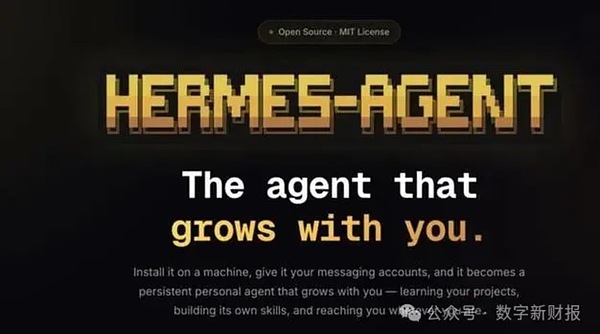
The widespread popularity of Hermes Agent is not a coincidence or a result of hype, but rather a result of technological breakthroughs combined with the resonance of industry pain points(iv) Ecosystem Value Closed Loop Underlying framework open source → developers co-create skills applications → users use it in diverse scenarios → user feedback feeds back into kernel iteration → more vendors connect to improve infrastructure → attract more developers to join, forming a positive cycle ecosystem, breaking away from dependence on a single project, and achieving self-growth of the ecosystem. VI. A Differentiated Showdown Between Two Industry Giants, with Clearly Differentiated Paths The current global open-source agent market has formed a dominant duopoly: Hermes Agent and OpenClaw. While benchmarking against closed intelligent agent products such as Claude Code and OpenAI Codex, each player exhibits significant differences in their underlying approaches, capability focuses, and applicable scenarios. A comprehensive horizontal comparison clearly reveals their respective positioning and value boundaries. (I) Core Competitors: Hermes Agent VS OpenClaw These two represent two completely different technological paths in the industry. They are not competing in a comprehensive manner, but rather complement each other in terms of capabilities. A detailed comparison is as follows: Hermes is a self-evolving intelligent engine, focusing on Agent self-growth, deep execution, and experience accumulation; OpenClaw is... The multi-channel gateway scheduling platform focuses on multi-terminal access, task distribution, and tool link management. In industry parlance: OpenClaw manages the entry channels, Hermes manages the intelligent brain. Memory System: Hermes uses a four-layer local persistent database for cross-month information retrieval and long-term user modeling; OpenClaw relies solely on file-based short-term memory, lacks native long-term storage, suffers from severe cross-session forgetting, and has no positive correlation between usage duration and capabilities. Skill Mechanism: Hermes features self-generated, automatically iterating private skills, accumulating abilities from tasks; OpenClaw relies on manually uploaded pre-set plugins, with all skills coming from the community marketplace, and carries significant security risks from malicious plugins. Model and Deployment: Hermes offers seamless full-model compatibility, strong private local deployment, and high data security; OpenClaw boasts a rich ecosystem of plugins and numerous access channels, but many rely on cloud operation, posing a high risk of data leakage and making it prone to crashing in complex tasks. Applicable Scenarios: Hermes is suitable for long-term personal digital partners, enterprise private processes, permanent automated operations and maintenance, and complex tasks that require continuous growth; OpenClaw is suitable for one-time lightweight tasks, multi-platform message scheduling, rapid prototyping development, and lightweight programming tool calls. (II) Comparison with Other Competitors Claude Code: A closed-system, dedicated intelligent agent with high execution efficiency but deeply bound to the Anthropic model, lacking model selection rights, long-term memory, and autonomous evolution capabilities. It only serves its own ecosystem and has extremely poor versatility. OpenAI Codex: A dedicated intelligent agent focused on the programming field, with strong system-level control capabilities, but limited to vertical scenarios, lacking general productivity capabilities, closed-source and fee-based, and with high commercialization barriers. Domestic native closed-source agents: Most rely on their own large models for closed development, resulting in closed ecosystems, poor compatibility, high customization costs, lack of open-source foundations, and difficulty in secondary expansion. In summary, Hermes leads in all dimensions: long-term memory, autonomous evolution, data security, model compatibility, and private deployment. OpenClaw has advantages in plugin ecosystem, number of channels, ease of use, and lightweight execution speed. Closed commercial intelligent agents are limited to their own ecosystems, and their versatility is far inferior to the two open-source giants. VII. The technology is not yet mature, and there are still many shortcomings in industrial implementation. Although Hermes Agent overcomes many fundamental pain points in the industry and has outstanding overall strength, as a new-generation framework that has only been online for two months, it still has obvious technical shortcomings, ecosystem defects, and difficulties in industrial implementation, significantly limiting its industry development. First, the project version is relatively new, and the overall technical maturity is insufficient. Currently, it's only updated to version v0.8, and the kernel is still in a rapid iteration phase. The stability of some complex, long-chain tasks is insufficient, planning logic is prone to deviations in extreme scenarios, and the collaborative capabilities of complex multi-agent clusters are not yet perfect. There is still room for optimization before reaching a large-scale enterprise-level highly reliable production environment. Secondly, the native plugin ecosystem lags far behind OpenClaw. OpenClaw has a very mature plugin market after long-term development, with abundant off-the-shelf tools and resources. The Hermes ecosystem is mainly based on community-developed skills, with fewer general-purpose off-the-shelf plugins, insufficient scenario coverage, and a lack of resources for beginners to use out of the box. Initial use requires a certain amount of secondary development costs. Third, the inference overhead is relatively high, resulting in a relatively slow execution speed. Influenced by the multi-layered memory system, the autonomous review and evolution module, and the security sandbox verification mechanism, the computational power consumption per task is higher, and the execution speed of simple, short tasks is slower than that of lightweight gateway frameworks, making it less efficient in lightweight scenarios. Fourth, there is the issue of skill library redundancy and retrieval burden. With prolonged use, the number of locally accumulated skills continues to increase, easily leading to issues such as skill redundancy, invocation conflicts, and decreased retrieval efficiency. The framework currently lacks a robust mechanism for intelligent skill simplification and automatic cleanup of expired skills, resulting in rising long-term operation and maintenance costs. Fifth, common industry-wide challenges have not been fully resolved. The framework still cannot completely eliminate industry-wide pain points such as the illusion of large-scale underlying models, the inexplicability of complex, long-chain decision-making processes, and limited adaptability to highly complex cross-industry businesses. Simultaneously, the overall global industrial-scale deployment rate of AI intelligent agents remains low, making it difficult for enterprises to realize ROI, and the widespread commercialization of the ecosystem is still constrained by the overall industry environment. Sixth, the risk of confusion caused by projects with the same name and the problem of abuse of application boundaries. There are crypto trading bots and on-chain protocol projects with the same name across the entire network, which can easily cause confusion for users; at the same time, some users abuse the framework's API capabilities to conduct virtual currency transactions, crossing regulatory red lines and posing application compliance risks. Combining technological iteration, ecosystem expansion, and industry trends, and leveraging its underlying architectural advantages, the Hermes Agent's future development path is clear. It will evolve along four major directions:Technology Improvement, Ecosystem Expansion, Scenario Deepening, and Industry Popularizationcontinuously expanding the value boundaries of general-purpose intelligent agents. First, the core technology will continue to iterate, addressing any shortcomings in maturity. Subsequent versions will focus on optimizing the stability of complex task planning, reducing inference computing power overhead, improving the intelligent skill management mechanism, strengthening multi-Agent cluster collaboration capabilities, and improving the fault tolerance and rollback mechanism for long-term task execution, gradually reaching enterprise-level high-reliability production standards and bridging the industry gap from "usable" to "reliable." Simultaneously, the security system will be deepened, improving full-process auditing, access control, and risk interception, adapting to the compliance requirements of highly sensitive industries such as finance and government. Secondly, the ecosystem will continue to expand, achieving dual improvement in community and localization. On the one hand, the official and community skill libraries will be enriched, supplementing out-of-the-box application resources and narrowing the gap with leading framework ecosystems; on the other hand, the adaptation to Chinese scenarios will be continuously deepened, deeply integrating with the domestic office ecosystem and enterprise digital systems, improving the full-link native compatibility of domestic large models, and completing comprehensive localization. Simultaneously, it deepens the cross-framework collaborative ecosystem, forming a complementary and collaborative industry system with frameworks such as OpenClaw, jointly promoting the overall development of the open-source agent industry. Third, application scenarios are expanding from personal productivity to enterprise-wide implementation. Initially, it focuses on personal digital assistants, developer tools, and lightweight operation and maintenance automation; in the mid-term, it comprehensively penetrates SME process automation, internal office digital employees, and business data processing; in the long term, it enters the deployment of private intelligent agents in large enterprises, undertaking internal system scheduling, autonomous execution of business processes, and cross-system data collaboration, becoming the underlying intelligent infrastructure for enterprise digital transformation. Fourth, the business model is deepened, constructing a complete open-source business closed loop. Building upon existing subscription, licensing, and customization services, we will improve the skills market revenue sharing system, expand new business models combining distributed computing power networks with the framework, and leverage our own model technology to create an integrated full-stack service of "large model + intelligent agent + computing power," forming a sustainable and high-growth business system. This will validate the commercialization feasibility of general-purpose open-source intelligent agents and provide a commercialization model for the entire industry. Fifth, we will move towards a distributed general-purpose intelligent infrastructure. In the long term, as multi-agent collaboration technology matures, Hermes will evolve from a single intelligent agent framework into a distributed personal and enterprise intelligent network kernel. With self-evolution and long-term memory capabilities at its core, it will connect various software, hardware, and business systems, becoming the general-purpose intelligent foundation for the next-generation digital world, undertaking the large-scale general collaboration needs in the early stages of AGI implementation. The competition in the AI intelligent agent field in 2026 is no longer a superficial contest of the number of tools and plugins, but a profound revolution in the field encompassing underlying architecture, memory capabilities, autonomous intelligence, data security, and the business ecosystem. Looking at the industry as a whole, the vast majority of general-purpose intelligent agents remain trapped in the fundamental dilemma of "being able to converse, but difficult to execute, lacking memory, unable to grow, and difficult to implement," merely completing a simple encapsulation of large-scale model capabilities without touching the true core value of intelligent agents. The rise of Hermes Agent is essentially a return to the value of architecture. It doesn't blindly pile up tools and interfaces, but precisely tackles the five core pain points of the industry: memory loss, inability to evolve, data insecurity, model binding, and unclear commercialization. With its self-evolving kernel, layered persistent memory, full model compatibility, private security, and a healthy open-source business ecosystem, it redefines the product standard for general-purpose intelligent agents. It doesn't just solve the tool needs of a single scenario, but rather the systemic problems of the entire industry's general-purpose intelligent agents: "execution without accumulation, dialogue without intelligence, framework without ecosystem, and product without commercial viability." Of course, the road to technological maturity is long and arduous, and the project still faces many unresolved challenges related to ecosystem, speed, and stability. However, from an industry development perspective, Hermes Agent has forged a new path for the development of general-purpose intelligent agents, distinct from the gateway scheduling route. With "growing together with users" as its core, it drives AI to transform from a one-off dialogue tool into a long-term, autonomously evolving, and deeply collaborative digital partner. This provides a new and feasible model for the large-scale deployment and widespread civilian application of AI intelligent agents globally, and lays a solid open-source foundation for the construction of next-generation general artificial intelligence infrastructure.(iv) Ecosystem Value Closed Loop
VIII. From Personal Digital Partner to Distributed General-Purpose Intelligent Infrastructure
OpenClaw is for advanced users, while Hermes is more suitable for most people.
JinseFinanceThe divergence between Hermes Agent and Rotifer Protocol reflects two fundamental paths in the evolution of intelligent agents. The coexistence and competition of these two paths is itself the most noteworthy evolutionary tension in the process of AI agents moving from "tools" to "life."
JinseFinanceUS SEC: Meme coin itself is not a security, but the issuance of Meme coin may involve fraud.
JinseFinanceThis article will conduct an in-depth analysis from multiple dimensions including the basic concepts of the track, four major classifications, potential projects and future prospects.
JinseFinanceMoney never sleeps, new stories are on the way, and I hope you can win this time.
JinseFinanceGOAT is the tokenized representation of Truth Termianl and is the strongest contender for the title of King of AI meme coins.
JinseFinanceInstitutional interest in meme coins is rising, with TON launching Memelandia, a new platform aimed at fostering meme coin growth by leveraging Telegram's large user base.
 Catherine
Enter SNEK, an explosive meme coin on the Cardano network that recently slithered its way into the animal meme coin kingdom. How will its unique memetic appeal shape the future landscape of crypto?
CatherineThis Shiba Inu-themed meme coin has risen rapidly over the past week but is it truly the saviour of SOL or will it join the ranks of the countless meme coins that have become obscure?
CatherineThe longer the cryptocurrency bear market wears on, the closer the valuations of Dogecoin and Shiba Inu have become.
 Bitcoinist