Source: YQ, Altlayer; Compiled by Golden Finance. The cryptocurrency market events of October 10th and 11th resulted in $19.3 billion in liquidations, setting a record for the largest single-day liquidation in history. While initial reports attributed this to market panic following the tariff announcement, a deeper dive into the data reveals some worrying patterns. Was this a coordinated attack targeting Binance and USDe holders? Let's analyze the evidence. Suspicious Patterns: Why These Assets? The most puzzling aspects of the crash centered on three specific assets that experienced catastrophic price drops—but only on Binance: USDe: plummeted to $0.6567 on Binance, while holding above $0.90 elsewhere wBETH: plummeted to $430 on Binance alone (88.7% below ETH’s value) BNSOL: plummeted to $34.9 on Binance, with minimal fluctuations elsewhere This venue-specific disruption immediately raised alarms. Market panics typically don’t vary across exchanges. Timing is where things get particularly interesting. On October 6th, Binance announced it would update the pricing mechanisms for these three assets, with the update scheduled for October 14th. The crash occurred between October 10th and 11th — falling squarely within the vulnerability window. Is it a coincidence that, out of thousands of trading pairs, only those that had announced updates experienced such extreme decoupling? This possibility seems extremely remote.
Testing the attack hypothesis
If this was indeed a coordinated attack, the timeline suggests it was well-planned:
5:00 AM: Markets began to fall after the tariff news - normal behavior;5:20 AM: Altcoin liquidations accelerated sharply - likely targeting market maker positions;5:43 AM: USDE, wBETH, and BNSOL crashed simultaneously on Binance;6:30 AM: Complete breakdown of market structure
5:00 AM (UTC+8): Initial market volatility began
BTC began to fall from $119,000
Trading volume was within normal range
Market makers maintained standard spreads
5:20 AM: First Cascading Liquidations
Altcoin Liquidations Accelerate Dramatically
Volume Surges: 10x Normal Volume
Market Maker Exit Mode Emerges
5:43 AM: Key Decoupling Event
USDe: $1.00 → $0.6567 (-34.33%)
wBETH: 3,813 USDT → Catastrophic Decline Begins
BNSOL: ~200 USDT → Accelerating Collapse
5:50 AM: Maximum Decoupling
wBETH Reaches 430.65 USDT (parity -88.7%)
BNSOL hit a low of 34.9 USDT (-82.5%)
Buyer liquidity is completely absent
6:30 AM: Market structure collapse is complete
Total liquidation exceeds $10 billion
Market makers withdraw completely
Binance-specific price anomaly is the largest
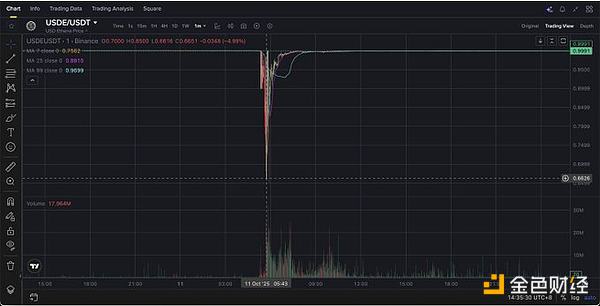
USDE/USDT crashed at 5:43am SGT.
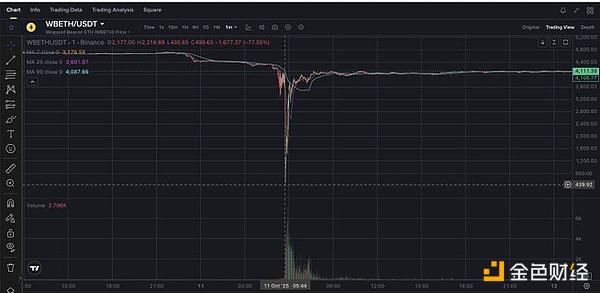
WBETH/USDT crashed at 5:44am SGT.
The 23-minute gap between the general liquidation and the crash in specific assets suggests this was a continuous execution, not a random panic.
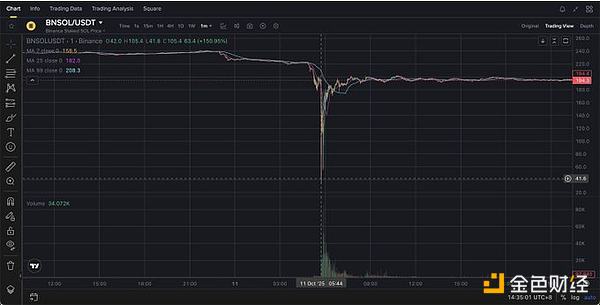
BNSOL/USDT crashed at 5:44am SGT.
USDe Factors
USDe is particularly vulnerable to attacks if someone wants to exploit the following factors:
1. Hidden leverage: Binance’s 12% yield plan encourages circular lending, creating up to 10 1. 2. Collateral Concentration: Many traders reportedly use USDe as margin collateral. 2. Order Book: Despite being a "stablecoin," USDe's liquidity is surprisingly thin. 3. When USDe plummeted to $0.6567, it not only caused immediate losses but also potentially triggered a chain reaction throughout the entire ecosystem. 4. Market Maker Perspective: A theory circulating among traders suggests that the first altcoin liquidations at 5:20 AM specifically targeted market makers. If true, this would explain the subsequent liquidity vacuum. When market makers are forced out, they remove orders from all order books simultaneously, leaving the market defenseless. 5. The evidence? Binance's altcoin prices are significantly lower than those on other exchanges—a pattern consistent with liquidations by major market makers.
Profit Assessment
If this was coordinated, someone would have made massive profits:
Potential short-term profit: $300-400 million
Accumulate assets at low prices: $400-600 million opportunity
Cross-exchange arbitrage: $100-200 million
Total potential profit: $800-1.2 billion
These are not normal trading profits - these are robbery-level returns.
Other Explanations
To be fair, several factors could explain the uncoordinated nature of these events:
1. Chain reaction: once liquidations begin, they naturally spiral upwards
2. Concentration risk: too many traders are using similar strategies
3. Infrastructure stress: the system collapses under unprecedented traffic
4. Panic psychology: fear creates self-fulfilling prophecies
However, the precision of which assets collapsed and where is difficult to believe.
What Makes This Suspicious
Several factors distinguish this from a typical market crash:
Platform Specificity: The price drop was almost entirely confined to Binance
Asset Selection: Only pre-announced, severely impacted, vulnerable assets were selected
Timing: Occurred within a precise vulnerability window
Sequentiality: Market makers were eliminated before the primary objective was achieved
Profit Pattern: Consistent with pre-set strategy
What If True
If this is indeed a coordinated attack, it represents a new evolution in cryptocurrency market manipulation. Instead of hacking into systems or stealing keys, attackers are weaponizing the market structure itself.
This means:
Every exchange announcement is a potential vulnerability
Transparency can actually reduce security
Market structure needs a fundamental redesign
Current risk models are inadequate
A disturbing possibility
While we cannot definitively prove coordinated behavior, the evidence is sufficient to raise reasonable suspicion. The precision, timing, location specificity, and profit model perfectly align with the hallmarks of a coordinated attack.
Whether through brilliant opportunism or meticulous planning, someone exploited Binance's transparency as a weakness and, in the process, extracted nearly $1 billion.
The crypto industry must now grapple with an unsettling question: In our 24/7 connected markets, has transparency itself become a weapon wielded by sophisticated actors?
Until we find definitive answers, traders should assume that all exchanges are subject to similar vulnerabilities. There may be many reasons for the events of October 10-11, but one thing is certain: it was not accidental.
The analysis is based on available market data, cross-platform price comparisons, and established patterns in market behavior. The opinions expressed in this article are my own and do not represent those of any entity.


 XingChi


