Author: Merlin Egalite, Co-founder of Morpho; Source: X, @MerlinEgalite; Translation: Shaw, Jinse Finance
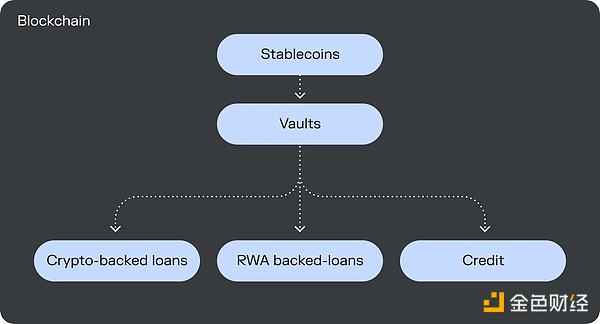
Vaults are non-custodial blockchain infrastructure that enables functions that traditional finance cannot.
In traditional finance, financial products are built on decentralized, isolated, and generally outdated infrastructure. Providing a single product requires coordinating multiple intermediaries, integrating proprietary systems, and managing manual processes. Even so, the "best" financial products still lack personalization, convenience, and transparency, while users still bear high costs.
Vaults change all of this.
What are Vaults?
Vaults are programmable, non-custodial strategies that users can choose to join, allocating their deposits across various investment opportunities without relying on any intermediaries. All operations take place in a single, atomic environment—the blockchain. Users can deposit and withdraw funds from their vaults at any time without anyone assisting (or preventing) the transactions. Users always maintain complete control over their assets. Vaults share a similar goal with traditional funds—to provide users with a simpler and more efficient way to deploy their funds—but they use automation and programmable code instead of intermediaries. For those familiar with traditional finance, vaults combine the size and accessibility of exchange-traded funds (ETFs) with the control and safeguards of privately managed accounts (SMAs). Vault achieves superior financial solutions through the following: **Composable Management:** Operating in a unified environment without intermediaries, rather than multiple siloed databases, ledgers, accounts, and systems, it enables more flexible, affordable, and personalized financial products. **Easy Access and Integration:** Interacting with Vault requires only a single wallet and digital assets, significantly lowering the barrier to entry. **Programmability:** Vault provides transparent and irrevocable security measures—advantages only available when built on-chain.
Vaults and Funds
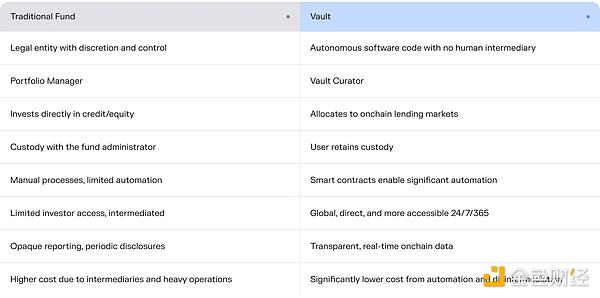
Vaults and funds share some characteristics, but also have some key differences.
Traditional Fund Structure: Users invest in funds. Funds own assets, and investors own fund units. Fund managers have complete custody and control. Funds are legally bound and usually have lock-up periods, redemption windows, and minimum investment amounts. Users can only deposit and withdraw assets with the participation of the fund manager.
Vault Structure: Users deposit their assets into an immutable smart contract that is not controlled by any individual or entity. Users have complete custody—the assets are always under your control and are not subject to any traditional restrictions. The vault automatically allocates deposits according to preset rules. Users can withdraw their assets instantly at any time without any permission or reliance on a counterparty.
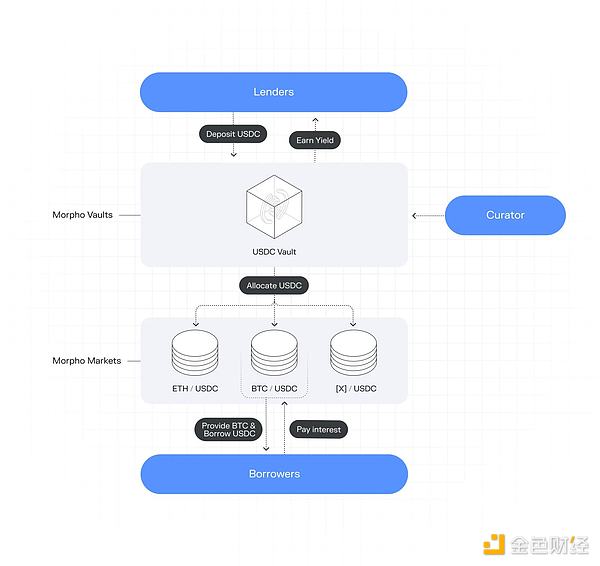
How does the Morpho Vault work?
Depositor Protection
The vault is designed to provide strong protection for depositors:
They are completely non-custodial: the administrator can never directly hold users' deposits.
Distributions can only be made within the vault's pre-set limits and restrictions.
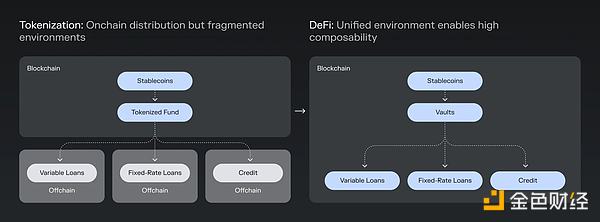
Any changes that alter the vault's risk will be subject to a time lock-in—an execution delay—giving depositors time to react and withdraw funds if necessary. An optional "sentinel" role can be configured, allowing depositors to veto allocation changes. Even if the vault is illiquid, depositors can redeem their asset shares at any time. Vaults and Tokenization Tokenization brings traditional off-chain assets to the blockchain. Its value lies in connecting traditional finance (TradFi) and decentralized finance (DeFi): enabling traditional financial instruments to be held and transferred on-chain. **Tokenization improves asset allocation, but it does not create inherently better financial products.** Tokenized assets still:
require operation across decentralized environments, systems, and databases, making it costly and difficult to provide highly personalized products.
inherit legacy off-chain reporting, processes, and accounting practices, which reduce efficiency and increase costs.
lack the transparent and non-removable security guarantees that smart contracts can provide.
Vaults provide the infrastructure for the distributed development and fully on-chain construction of financial products. Instead of depositing all funds into tokenized funds invested off-chain, users deposit them into vaults, and all funds are allocated on-chain.
Tokenization is a useful transitional tool, but vaults are the ultimate goal.
Not all vaults are the same
Vault infrastructure exists in a continuous spectrum. At one end are vaults that are entirely on-chain, such as Morpho Vault, where immutable smart contracts ensure strong security: users retain control of assets, asset allocation is transparent and verifiable, and all changes are made through time locks. At the other end are vault "wrappers," which maintain more traditional custody arrangements, where the vault operator controls the assets and has complete decision-making power over how the assets are used.
Understanding what safeguards your vault infrastructure provides and how those safeguards are implemented is crucial.


 Kikyo
Kikyo


