Golden Web3.0 Daily | Bitwise Registers Aptos ETF in Delaware
Golden Finance launches "Golden Web3.0 Daily" to provide you with the latest and fastest MEME, DeFi, DAO, NFT and Metaverse industry news.
 JinseFinance

Author: Luo Luo; Source: Hive Tec
March17, the crypto asset trading platformOKXgave the reason for suspending itsWeb3 DEXaggregator service - it was discovered that North Korea'sLazarushacker group abused itsDeFi
service, and took the initiative to suspend the service after consulting the regulator.The next day, another head platform Binanceupgraded the early project "discoverer" in its Web3wallet productAlphato2.0, and directly integrated it intoCEXmain site, allowing users to purchase directly using encrypted assets.
"Up and down", the actions of the two giants in the crypto asset industry on their respective Web3products have once again opened up discussions on core issues such as whether Web3products should introduce KYC, DEXand DeFiand how to deal with mainstream country supervision.
In the battlefield of Webchain asset infrastructure, the strategies of the two giants not only reflect their grasp of market trends, but also reveal the deep game between regulation and technology in the encryption industry.
March11On Bloomberg reported that European cryptocurrency regulators are reviewing whetherOKXwas used by hackers to launder funds from
March11 lang="EN-US">Bybitstolen funds. AlthoughOKXquickly responded that it was not under investigation and emphasized its technical neutrality as aDEXaggregator, the impact of the incident is still fermenting.
On March 17, OKXannounced that, after consulting with regulators, it had proactively decided to suspend its
Web3 DEXaggregator services due to the discovery that the North KoreanLazarushacker group was abusing itsDeFiservices. OKX said that the move was to implement technology upgrades and prevent further abuse, and reiterated that its Web3 service is not a custodian of customer assets. As soon as the news came out, many crypto users cried out for justice for OKX, believing that the regulatory authorities were blocking North Korean hackers, and OKX, as a third-party technology provider, became a "scapegoat" for hackers, just like "anti-virus software mistakenly deleting system files."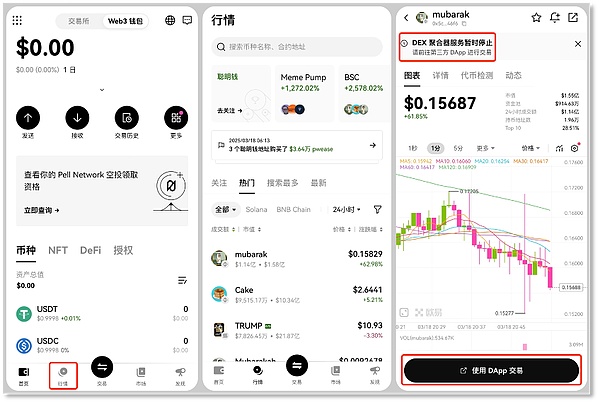
OKX Web3DEX aggregation service suspended
Indeed, OKX'sWeb3 DEXaggregator is essentially a technical tool, not a contract or agreement, nor an asset custodian. As a provider of Web3 products and services, OKX may now be facing a dilemma between compliance and technology.
On the one hand, as the first global exchange to obtain pre-authorization from the European Union's MiCA (Regulations on the Market for Crypto Assets), OKXis trying to set an industry benchmark through compliance; on the other hand, although its Web3wallet and related functions strive to maintain the "decentralized" industry tradition, including non-custodial attributes, users can directly use it to enter the chain without applying for OKXexchange, etc., this technology-neutral positioning makes it slightly passive when dealing with hacker attacks.
However, regulators are clearly not satisfied with this "technology-neutral" interpretation.
Take the EU'sMiCAas an example, the regulation covers all "crypto assets" and their related services. AlthoughDeFiandDEXare known for their decentralized characteristics,MiCAhas not yet clarified the boundaries between "full decentralization" and "partial decentralization", but the regulation does not seem to intend to make a lenient connection with them.
According to the definition of MiCA, MiCAwill regard any entity that provides crypto-asset related services as a CASP(Crypto-Asset Service Provider), including DEXand DeFiprotocols. MiCA emphasizes that no matter what the form of technology is (centralized or decentralized), as long as it involves the issuance or trading of encrypted assets, relevant regulations must be complied with. The suspension of OKX's service is also a reflection of the vulnerability of decentralized Web3 products under the existing regulatory framework. Although OKX emphasizes that its Web3 wallet is not an asset custodian, the regulators in mainstream countries where crypto assets are currently circulating have been emphasizing that "any platform involved in the flow of funds should assume the responsibility of anti-money laundering (AML) and counter-terrorism financing (CFT)". This regulatory logic is in direct conflict with the decentralized concept of Web3.
Some comments believe that OKXis like a "canal company without an X-ray machine installed", and has to suspend services and upgrade products under regulatory pressure. This adjustment not only affects the user experience, but may also have an adverse impact on the market competition of its Web3ecosystem.
Market analysts predict that under regulatory requirements, OKXmay have two choices: one is to add KYCas a mandatory option to the product usage threshold; the other is to split the wallet and the exchange. The former can keep up with regulatory requirements and stabilize the situation, but the Web3ecosystem may be limited; the latter isolates regulatory risks and maintains decentralization, but requires re-downloading the application, which not only reduces the convenience of the experience, but also virtually isolates the exchange traffic from the wallet, which is easy to lose users.
No matter which path is chosen,OKXwill need to make a trade-off between user experience and compliance requirements in the future.
Just whenOKXsuspendedDEXaggregator services, another crypto asset giant platform that is applying for MiCA authorization
Just whenOKXsuspendedDEXaggregator services, leaf="">Binancehas started active layout in theWeb3product layer.
On March 18, Binanceannounced the official launch of its
Alpha 2.0version, and integrated it directly into the
Binancetrading platform main site. Users can directly leaf="">USDT and other assets can be used on the platform to purchase on-chain tokens without withdrawing assets to external wallets.
Binance said that this extension aims to bridge the experience gap between centralized exchanges (CEX) and decentralized exchanges (DEX), simplifying the transaction process while improving users' capital efficiency and accessibility to decentralized exchanges.
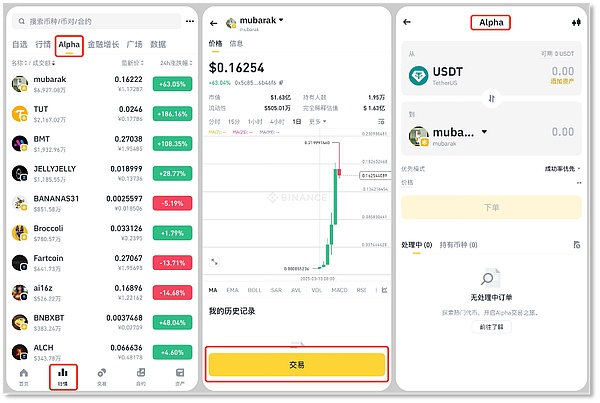
Binance Alpha enters CEX main site
Binance Alphais a platform product originally placed in theBinance Web3wallet, focusing on exploring early encryption projects with growth potential on the chain.
The launch ofBinance Alpha 2.0marksBinancestrategic upgrade inWeb3field.In the middle of last year,Binance'sWeb3wallet was widely commented as "invincibleOKX" in the Bitcoin inscription market boom. Later, even Binance co-founder He Yi admitted that their Web3 wallet and its market products had not yet reached the optimal state. Today, Alpha 2.0's approach of connecting CEX and DEX is stimulating user interest. Some users believe that by introducing small-cap projects on the chain (such as meme coins) into the main site, it will not only enhance the wealth effect of Binance's main site, but also consolidate BNBChain's dominant position in the Web3 ecosystem.
More importantly, Binanceprovides a more controllable trading environment for regulators by seamlessly combining on-chain asset transactions with CEX. It should be noted that Binance's Web3wallet is a crypto asset custody wallet. To use this wallet, users need to pass KYC (Know Your Customer) test.
Binance's strategy is, to some extent, to "trade compliance for innovation" by incorporating on-chain asset transactions into the CEXframework to better meet the regulatory requirements of mainstream countries, such as KYCandAML. After the suspension of OKX's DEX services, Binance's "centralized + decentralized" hybrid model may become the mainstream development direction of future Web3 products.
However, although the direct main site of Binance Alpha 2.0 can make its Web3 products attractive in the short term, it also faces potential regulatory risks - the volatility and compliance risks of small-cap projects may become a hidden danger for its future development. In addition, as global regulators continue to pay more attention to the encryption industry, Binancestill needs to continue to adjust its balance between innovation and compliance.
One provides custodial services, the other provides non-custodial services; one requiresKYC, the other provides optionality inKYC. From the practices of Binance and OKX, it can be seen that for Web3 products, the use of custody and non-custody, and the introduction of KYC is essentially a game between decentralization and compliance, and it is necessary to consider the regulatory attitude of mainstream countries towards Web3 products. The different product strategies of OKX and Binance have also triggered heated discussions on whether Web3 products should introduce KYC. KYC (Know Your Customer) as a core compliance requirement in the traditional financial sector is gradually penetrating into the crypto industry. However, for Web3 wallets, the introduction of KYC means a compromise on the concept of decentralization.
supportKYCviewpoint believes that "compliance is the prerequisite for survival", because under the regulatory framework of mainstream countries, KYCisa necessary condition forWeb3wallets to obtain legal status. From the standpoint of "user protection", KYCcan effectively prevent hacker attacks and abuse of funds and protect the security of user assets. In addition, at the level of "market trust", KYCiscan enhance the trust of institutional investors and ordinary users in Web3wallets and promote the mainstreaming of the industry.
Opponents believe that KYC"deviates from decentralization", meaning that users need to submit personal information to centralized institutions, which runs counter to the decentralized concept of Web3, and "technical complexity" makes it more difficult to implement KYCin an on-chain environment, and may also affect user experience; as for "privacy risks", KYCrequires users to submit sensitive information, which may increase the risk of data leakage and privacy infringement.
However, the regulatory frameworks represented by mainstream countries are gradually bringing DEXandDeFiinto the regulatory scope. The core demands of major regulatory agencies include Anti-Money Laundering (AML) and Counter-Terrorist Financing (CFT, both of which require platforms to verify user identities and monitor fund flows; they must also assume asset custody responsibilities, and even non-custodial platforms may be required to assume part of the asset custody responsibilities; they must maintain transparency requirements, that is, they require platforms to submit transaction data and compliance reports regularly.
The strategic differences between the two giant platforms in Web3products are a microcosm of the entire crypto industry's search for a balance between compliance and innovation. In this game, the introduction of KYCand the compliance path of DEXandDeFiwill become the key factors in determining the fate of Web3products.
The battle line is long and the outcome is yet to be determined. For industry participants, how to wield the "double-edged sword" of compliance and "treat supervision as a bulletproof vest rather than a shackle" is also a real test of survival wisdom. Achieving technological innovation within the compliance framework will become the core competitiveness of industry builders.
Golden Finance launches "Golden Web3.0 Daily" to provide you with the latest and fastest MEME, DeFi, DAO, NFT and Metaverse industry news.
JinseFinanceBlink allows developers to create “Actions” that allow users to convert various Solana interactions (such as voting, donating, minting tokens, redeeming tokens, and paying) into actionable buttons on Platform X through simple URL links.
JinseFinanceNotcoin was launched as a Telegram mini-program in January this year. In just three months, it attracted more than 35 million users, with daily active users reaching 6 million. Its tokens were also listed on major exchanges such as Binance and OKX.
JinseFinancePayments will be made in WLD tokens.
 Alex
AlexThis is the last phase before the public launch in early August that will aim to amass more builders.
 cryptopotato
Whether or not crypto builders want to admit it, Mark Zuckerberg's famous motto of "move fast and break things" has become a defining ethos in the industry.
 decrypt
One natural response to the risks of builder centralization is to try to constrain the power that builders have.
 Others
 Cointelegraph
What the central bank directly adjusts is the policy interest rate (such as the interest rate of MLF), which indirectly affects rather than directly determines the market interest rate (such as LPR). It should be avoided to say that the increase or decrease of LPR is "the central bank raises or lowers the benchmark lending rate".
 Ftftx
FtftxThe Ocean State’s legislature is looking to tackle the housing shortage and ensure new projects are going green by incentivizing builders with crypto rewards.
Cointelegraph