I. Introduction
This week, the crypto market ushered in two major catalysts - the legislative offensive of Washington's "Cryptocurrency Week" and the intensive outbreak of Ethereum institutional layout, which together constitute the "policy turning point" and "capital turning point" of the crypto industry in the second half of 2025. The deep logic of this round of crypto cycle is shifting from Bitcoin to Ethereum, stablecoins and on-chain financial infrastructure. We believe that the clarification of US policies + the institutional expansion of Ethereum indicate that the crypto industry is entering a structural positive stage, and the focus of market allocation should also gradually transition from "price game" to "rules + infrastructure institutional dividend capture".
II. US "Cryptocurrency Week": Three major bills send signals, and compliant assets will usher in a revaluation
In July 2025, the US Congress officially opened "Cryptocurrency Week", which was the first time in US history that the comprehensive governance of crypto assets was systematically promoted in the form of a legislative agenda. Against the backdrop of dramatic changes in the global digital financial landscape and the constant challenges to the traditional regulatory model, the introduction of this series of bills is not only a response to market risks, but also a signal that the United States is trying to dominate the next round of financial infrastructure competition.

The most milestone is the GENIUS Act, which establishes a complete regulatory framework for stablecoins, covering key elements such as custody requirements, audit disclosures, asset reserves and liquidation processes. This means that the stablecoin system, which has long been outside of traditional financial supervision and relies on "market trust" to operate, will be incorporated into the U.S. sovereign legal structure for the first time. The high vote in the Senate (68 votes in favor and 30 votes against) also shows the strong bipartisan support for the bill, which is an institutional "reassurance" for the entire crypto industry. Once the House of Representatives passes it and sends it to the President for signature, the bill will officially take effect, marking that the United States will become the world's first major economy to establish a unified financial regulatory framework for stablecoins.
Another key bill, the CLARITY Act, focuses on the division of securities and commodity attributes of crypto assets. Its core intention is to clarify "which crypto assets are securities and which are not", and to clarify the regulatory boundaries of the SEC and CFTC. In the past few years, disputes over whether tokens such as ETH and SOL should be recognized as securities have led to a large number of companies and project parties moving out of the US market. If the bill is successfully passed, it will end the long-standing pending state of the "regulatory gray area" of crypto assets, provide predictable legal basis for project parties, exchanges and fund managers, and greatly release the vitality of compliance innovation.
More politically symbolic is the Anti-CBDC Surveillance State Act. The bill prohibits the Federal Reserve from issuing central bank digital currencies (CBDCs) and prevents the government from establishing real-time monitoring capabilities for personal financial activities through the digital dollar architecture. Although the bill has not yet been passed by the Senate, it reflects the importance that the U.S. Congress attaches to financial privacy and market freedom. It actually sends another signal: the United States does not intend to dominate digital financial changes in a state-monopolized manner, but chooses to support a market-driven, technology-neutral, open and interconnected crypto asset ecosystem.
On the whole, these three bills point to "regulation-driven innovation" in terms of direction, and emphasize "clarifying boundaries and reducing uncertainty" in terms of means. Their core appeal is no longer "restriction" but "guidance." Once the legislation enters the implementation stage, it is expected to bring several direct consequences: first, the obstacles that have prevented institutional investors from entering on a large scale due to compliance risk concerns will be gradually removed, including pension funds, sovereign wealth funds and insurance companies will be able to legally deploy crypto positions; second, the role of stablecoins as "on-chain dollars" will be confirmed by policies, and their efficiency in cross-border settlement, decentralized finance and RWA scenarios will be exponentially amplified; third, compliant exchanges and custodian banks will receive policy endorsements to reshape the trust structure of the global crypto market.
From a deeper perspective, this series of legislation is a strategic response to the United States in a new round of reshaping of the financial order. Just as the US dollar became a global settlement currency based on the Bretton Woods system after World War II, stablecoins are becoming a carrier for the digital expansion of the US dollar's influence, and the US Congress is trying to inject institutional legitimacy into it through regulatory means. This is a layout game of financial geopolitical power, and it is also a direct response to the Chinese central bank's digital currency (e-CNY) and the EU's MiCA regulatory framework. Whoever completes the construction of the regulatory system first will set standards and have the right to speak in the future global financial network.
Therefore, "Cryptocurrency Week" is not only a moment for the market to re-evaluate the valuation logic of crypto assets, but also an institutional confirmation of the policy on the technology trend. This institutional pricing signal will inject a more stable expectation anchor into the market, and also provide investors with a path to identify "regulatable and sustainable" assets. We believe that this rule certainty will gradually transform into valuation certainty, and compliant assets, especially stablecoins, ETH and its surrounding infrastructure, will become the core beneficiaries of the next round of structural revaluation.
Third, ETH Institutional Arms Race: ETF Entry, Pledge Mechanism Transformation, Asset Structure Upgrade Three Fronts
Recently, with the strong rebound in ETH prices, market confidence has gradually recovered, and behind this, a new round of "capital arms race" around Ethereum has quietly unfolded. From the continuous increase in positions of Wall Street financial giants through ETF channels to more and more listed companies incorporating ETH into their balance sheets, Ethereum is undergoing a deep market structure reshaping. This not only means that the recognition of ETH by traditional capital has entered a new stage, but also indicates that Ethereum is accelerating its evolution from a highly volatile, high-tech decentralized asset to a mainstream financial asset with institutional-level configuration logic.
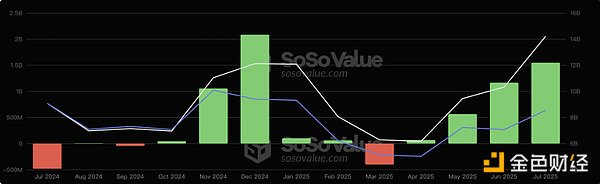
Since its official launch in July 2024, the Ethereum spot ETF has been regarded as an important catalyst for ETH's price breakthrough, but its actual performance has disappointed the market. The combination of negative factors such as the ETH/BTC exchange rate drop, sluggish prices, and the continued reduction of holdings by the foundation has prevented ETH from immediately releasing its upward momentum after the ETF was listed, but instead it has fallen into a deep correction. Especially against the backdrop of the great success of the Bitcoin ETF, ETH seems quite lonely.
However, in mid-2025, this situation began to reverse quietly. Judging from the on-chain data and ETF fund inflows, the institutional fund-raising process of ETH is proceeding in a low-key and firm manner. According to SoSoValue statistics, since the launch of the ETF, the Ethereum spot ETF has attracted a net inflow of US$5.76 billion, accounting for nearly 4% of its market value. Although the price fell back at one point, the inflow of funds continued to be stable, showing that long-term institutional funds recognized the value of ETH allocation. This trend has begun to accelerate in the past two months, with multiple Ethereum ETF products recording monthly net inflows of more than $1 billion, and traditional financial players such as Bitwise, ARK, and BlackRock significantly increasing their holdings.
At the same time, a more symbolic change comes from the rise of the wave of "strategic Ethereum reserves" by listed companies. SharpLink Gaming, Siebert Financial, Bit Digital, BitMine and many other public market companies have announced that they will include ETH in their balance sheets, marking a new narrative turning point in which ETH is transforming from a "hype asset" to a "strategic reserve asset." It is particularly noteworthy that SharpLink currently holds more than 280,000 ETH, exceeding the current 242,500 ETH of the Ethereum Foundation, making it the world's largest single institutional ETH holder. This fact has, to some extent, completed a partial transfer of "voice" at the symbolic level of capital.
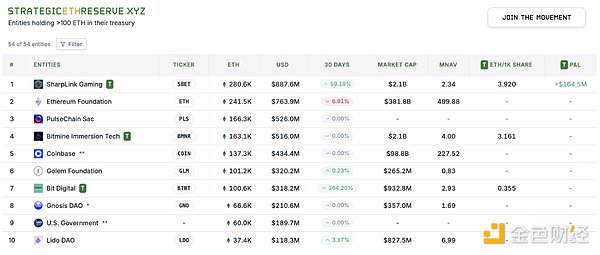
From the current institutional participation structure, it can be clearly divided into two camps: one is the "Ethereum native camp" represented by SharpLink, which gathers early Ethereum ecosystem participants such as ConsenSys and Electric Capital; the other is the "Wall Street approach" represented by BitMine, which directly replicates the logic of Bitcoin reserves and forms a capital amplification effect with the help of leverage, financial operations and financial report disclosure. This north-south pinch-type institutional position-building model has caused ETH's value anchor and price support system to move away from traditional retail investor speculation and move toward an institutionalized, long-term, and structured mainstream capital framework.
The far-reaching impact of this trend is not only at the price level, but also that the governance, discourse and ecological dominance of the Ethereum network itself may face reconstruction. In the future, if companies like SharpLink or BitMine, which are heavily invested in ETH, continue to expand their holdings, their potential influence on the development direction of Ethereum will not be ignored. Although most of these companies are still facing financial pressure, and their allocation of ETH is more out of considerations of speculative hedging and capital operation, and they have not fully demonstrated their willingness to deeply bind to the construction of the Ethereum ecosystem, their entry has already produced an amplifying effect in the capital market: ETH has been revalued, and the market narrative has switched from the crowded track of DeFi and L2 to the new space of "reserve assets + ETF + governance rights".
It is worth noting that unlike the "spiritual leader" Michael Saylor (MicroStrategy CEO) in the Bitcoin reserve story who constantly strengthens cognition and preaches to increase positions, Ethereum has not yet seen such a representative figure with both a faith background and the appeal of traditional capital. Although the emergence of Tom Lee and others has triggered market associations, they have not yet formed sufficient narrative penetration. The lack of endorsements from such figures has also slowed down the path of trust conversion in the minds of institutional investors.
However, this does not mean that Ethereum lacks response at the institutional level. Vitalik Buterin and the Ethereum Foundation have recently frequently spoken out, emphasizing Ethereum's technical resilience, security mechanisms and decentralized principles, and at the same time began to strengthen the "dual-track" structure of the ecological governance mechanism, intending to embrace institutional capital while avoiding the control of governance rights by a single force. In a recent public article, Vitalik proposed that user interests, developer dominance and institutional compliance must be balanced, and decentralization must be "operable" rather than just a slogan.
In short, ETH is undergoing a comprehensive capital structure change: from an open market dominated by retail investors to an institutionalized market structure driven by ETFs, listed companies and institutional nodes. The impact of this transformation will be far-reaching. It will not only determine the future construction path of the ETH price center, but may also reshape the governance structure and development rhythm of the Ethereum ecosystem. In this arms race, ETH is no longer just a representative of the technology stack, but is becoming a key target in the wave of digital capitalism. It is not only a value-bearing tool, but also a focus of power struggle.
Fourth, market strategy: BTC builds a high-level platform, ETH and medium- and high-quality application chains usher in a logic of compensatory growth
As Bitcoin successfully breaks through the $120,000 mark and gradually enters the platform period, the structural rotation pattern of the crypto market becomes clearer. With BTC occupying the dominant logic, Ethereum and high-quality application chain assets are beginning to usher in their own valuation repair period. From the flow of funds to market performance, the current market shows a typical "large market value platform shock + medium market value rotation up" structure, while ETH and a group of L1/L2 protocols with both narrative and technical support have become the most valuable direction for gaming after Bitcoin.
1. BTC enters the high-level platform construction stage: there is support downward, but it is weak upward
As the main driving asset of this round of market, Bitcoin has basically completed the main rising trend driven by the triple narratives of spot ETF, halving cycle and institutional reserves. The current trend has entered the sideways construction stage. Although it is still in the technical upward channel, the upward momentum tends to weaken in the short term. From the on-chain data, the number of active addresses and trading volume of BTC have both fallen to a certain extent, while the implied volatility of options in the derivatives market has continued to decline, indicating that the market's expectations for its short-term breakthrough have declined.
At the same time, the enthusiasm of traditional institutional allocation has not weakened significantly. According to the latest report of CoinShares, BTC ETF still maintains a small net inflow, indicating that the bottom fund support is still there, but because the expectations have been fully realized, the subsequent rise of BTC is likely to slow down or even go sideways in stages. For institutions, Bitcoin has entered the "core configuration" stage, rather than continuing to pursue the main battlefield of short-term profiteering.
This also means that the market's attention is gradually shifting from Bitcoin to other crypto assets with growth potential.
2. The logic of ETH's rebound is formed: revaluation from "lost leader" to "value depression"
Compared with Bitcoin, Ethereum's performance since the second half of 2024 was once regarded as "disappointing", with a large price correction and a three-year low in its ratio to BTC. But it was during the downturn that ETH gradually completed the valuation repricing and position structure optimization. At present, institutional funds have rapidly increased their recognition of ETH. Not only has the spot ETF continued to net inflow, but the trend of listed companies reserving ETH has become a trend, and even the situation of Ethereum holdings surpassing the foundation has occurred.
From a technical perspective, ETH prices have broken through the previous downward trend line, started to establish an upward channel, and continuously recovered multiple key technical moving averages. Combining the capital side and sentiment indicators, ETH has entered a new round of market sentiment switching cycle. During the sideways trading of BTC, the configuration cost-effectiveness of ETH as a sub-mainstream asset has gradually increased. Combined with multiple factors such as the expansion of the L2 ecosystem, stable staking income, and improved security, the market is re-examining its long-term value foundation.
From the perspective of asset allocation, ETH not only has the advantage of "valuation depression" at the current stage, but also begins to have institutional recognition and narrative completeness similar to BTC. It has both technical and institutional advantages and has become the preferred target for capital rotation.
3. The rise of medium- and high-quality application chains: Solana, TON, Tanssi and other chains usher in structural opportunities
In addition to BTC and ETH, the market is accelerating the transfer of medium- and high-quality application chain assets "supported by real narratives". Solana, TON, Tanssi, Sui and other chains have gained rapid capital concentration in this round of rebound due to their multiple advantages of "high performance + strong ecology + clear positioning".
Take Solana as an example. The current ecological activity has rebounded significantly, and multiple on-chain applications have returned to the user's field of vision. Emerging narratives such as DePIN, AI, and SocialFi have gradually landed in the Solana ecosystem. As an emerging infrastructure protocol in the Polkadot ecosystem, Tanssi has gained wide attention from institutions and developers by solving long-term problems such as "complex application chain deployment, high operating costs, and fragmented infrastructure" with the ContainerChain model. Its launch in cooperation with platforms such as Huobi HTX also shows that its marketization process has accelerated.
In addition, as Ethereum turns to a more modular and data availability optimized path, middle-layer protocols (such as EigenLayer, Celestia) and L2 Rollup solutions (such as Base, ZkSync) are also gradually releasing value and becoming an important "valuation hub" between the public chain and the application layer. These protocols or platforms have both scalability, security and innovation, and have become a new frontier for concentrated breakthroughs in funds.
4. Market strategy outlook: Focus on "value rotation" and "narrative forward movement"
Overall, the logic of capital rotation in this round of crypto market has become clear: BTC peaks - ETH rebounds - application chain rotation rhythm gradually unfolds. The current stage of the strategy focus should be on the following points:
(1) BTC configuration is reserved as a bottom, not the main direction: the core position remains unchanged, but it is not advisable to continue to chase highs, and pay attention to potential policy or macro-disturbance risks.
(2) ETH as the core configuration target of rotation: technical repair + institutional narrative strengthening, suitable for mid-term configuration, if ETF funds accelerate inflow, there may be further upside space.
(3) Focus on medium- and high-quality public chains and modular protocols: Chains with technological innovation, strong ecological foundation and capital supporters (such as SOL, TON, Tanssi, Base, Celestia) have the potential for continued growth.
Narrative forward, actively looking for new marginal opportunities: Pay attention to early layout targets in the direction of DePIN, RWA, AI chain, and ZK. These narratives are in the stage of capital pre-positioning and may become the core of the next stage of rotation.
The final conclusion is that the current market has entered the stage of structural rotation from the single asset driven stage. The main upward wave of BTC has stopped temporarily, and the rotation of ETH and high-quality new public chains will become the key driving force of the second half of the market. In terms of strategy, we should abandon the inertial thinking of "chasing high leaders" and turn to the mid-term trend layout of "valuation rebalancing + narrative diffusion".
V. Conclusion: Clear regulation + ETH rises, the market enters an institutional cycle
With the advancement of the three key bills of the US "Cryptocurrency Week", the industry has ushered in an unprecedented period of policy clarity. This clarification of the regulatory environment not only eliminates the compliance uncertainty that has been pending for many years, but also lays a solid foundation for the institutionalization and formalization of the crypto asset market. With the acceleration of the strategic reserve arms race of core assets such as Ethereum, the market is gradually entering a new cycle dominated by institutions.
In the past, the volatility and uncertainty of the crypto market were largely due to regulatory ambiguity and policy swings. Crises such as the FTX collapse and the Luna incident have exposed the deep risks of the lack of industry supervision and have also cast a shadow in the hearts of investors. Today, with the implementation of regulations such as the GENIUS Act, the CLARITY Act, and the Anti-CBDC Act, the market's expectations for compliance have been significantly improved, the entry threshold for institutional capital has been steadily lowered, and the trust and liquidity of assets have been greatly enhanced. This not only helps reduce systemic risks, but also provides a "bridge" for crypto assets to connect with traditional financial markets, and realizes the legalization and standardization of the identities and behaviors of market participants.
Under the catalysis of this institutional environment, Ethereum, as a leader in smart contract platforms, is ushering in a key window for its main uptrend. Ethereum not only has a clear technical roadmap and active ecological innovation, but also continuously optimizes its network security and decentralized governance structure, making it one of the preferred digital assets for institutions. The superposition of the strategic reserve tide and ETF funds marks that the value of Ethereum has begun to be re-evaluated by the capital market. It can be foreseen that Ethereum will maintain a long-term and healthy value growth trend in the future driven by the dual growth of on-chain applications and capital support.
More broadly, the linkage effect of this clear supervision and the revival of mainstream asset value is prompting the crypto market to gradually get rid of the previous "bull-bear cycle trap" and evolve towards a more stable and sustainable institutional cycle. The notable feature of the institutional cycle is that market fluctuations are more guided by fundamentals and policy expectations. Asset price fluctuations are no longer dominated by scattered emotions and regulatory news, but are reflected in the benign interaction and steady growth of capital and technology. The deep involvement of institutional capital will also promote the improvement of market liquidity structure and prompt investment strategies to shift from short-term speculation to medium- and long-term value investment.
In addition, the opening of the institutional cycle also means the diversification of market structure and the multi-dimensional upgrading of ecology. The technological innovation and governance reform of the Ethereum ecosystem will continue to promote the diversification of on-chain applications and enhance network utility, while the clarity of supervision will accelerate the compliance development of more high-quality projects and give birth to the deep integration of on-chain finance and traditional finance. This development pattern will reshape the investment logic of crypto assets and enable the market to enter a new normal of "technology-driven + capital rationality + regulatory support".
Of course, the institutional cycle does not mean that market fluctuations disappear, but that fluctuations will be more endogenous and predictable, and investors need to pay more attention to the continuous tracking of fundamentals and policies. At the same time, the market governance mechanism and the game between decentralized and centralized forces will also become important variables in promoting ecological evolution.
To sum up, the regulatory breakthrough of the US "Cryptocurrency Week" and the capital trend of Ethereum are opening an important chapter for the crypto market to mature. The market is shifting from a scattered and disorderly "barbaric growth" stage to an institutionalized and standardized "rational development" stage. This not only enhances the investment value of assets, but will also promote the overall upgrading of the crypto industry ecology and shape the core foundation of the future digital economy. Investors should seize the institutional dividends and growth opportunities of core assets, actively deploy Ethereum and high-quality application chains, and embrace a healthier and more sustainable new era of encryption.


 Wilfred
