StakeStone Innovates Staking with Liquid Staking Token (LST) Protocol
StakeStone, a leader in Omnichain liquidity, offers a decentralized Liquid Staking Token (LST) protocol, aiming to revolutionize staking with innovative solutions.
 Brian
Brian

Author: Vaidik Mandloi Translator: Shan Ouba, Jinse Finance
The real business value is focused on stablecoins, payment systems, and identity authentication. Last month, Tejaswini wrote an article about crypto banks, analyzing why such platforms are now successfully implemented. She explained three major trends: the improvement of the stablecoin regulatory framework, the lowering of the barriers to entry for bank card infrastructure, and the increasing number of people storing a considerable proportion of their assets on-chain. With these multiple factors combined, the user experience of making payments through on-chain wallets is far superior to that of traditional bank accounts.
This article clearly points out that the underlying conditions for building banking services on-chain are fully mature, and related models are no longer just theoretical. But now that the infrastructure is operating smoothly, new questions arise: Where does the real value flow in this market? The answer is obviously not as simple as issuing a bank card or supporting users to spend USDC—these functions have already become industry standard.
Some digital banks generate revenue through interest-bearing businesses and savings services, while others profit from payment transaction volume and stablecoin circulation. Still others choose to move towards the infrastructure layer, thereby obtaining entirely different profit margins. This article will delve into the next stage of development in the digital banking sector, analyzing how the industry is gradually differentiating itself based on the distribution logic of commercial value. Where does the core value of digital banks ultimately flow? Looking at leading global digital banks, the platform's valuation is not necessarily proportional to the number of users, but rather depends on the actual revenue contributed by each user. Revolut is a prime example: although its user base is smaller than Nubank's, its valuation is higher because its revenue sources span multiple sectors, including foreign exchange trading, securities trading, wealth management, and high-end membership services. In contrast, Nubank has built its vast business empire through lending and interest income, rather than relying on bank card fees. WeBank's model is different; through extreme cost control and deep integration into the Tencent ecosystem, it has carved out a differentiated path. Currently, encrypted digital banks are also facing this crucial turning point. A wallet linked to a bank card is far from a complete business model—any institution can easily launch such a product. The core competitiveness of a platform lies in choosing which business segment to focus on as its main profit driver: some platforms focus on interest income from user deposits, some on transaction fees from stablecoin payments, and a few pin their growth potential on the issuance and management of stablecoins—because this is the most lucrative and predictable area. This also explains why the stablecoin sector is becoming increasingly strategically important. For reserve-backed stablecoins, the real profit comes from the interest income generated by their reserve assets (such as short-term government bonds or cash equivalents). This income belongs to the stablecoin issuer, not just the digital bank that provides users with stablecoin holding and spending functions. This differentiation in profit models is not unique to the crypto industry: in traditional finance, digital banks also cannot earn interest from user deposits; the real recipients of this income are the partner banks that actually hold the user funds. The emergence of stablecoins simply makes this fragmented profit distribution more explicit and centralized—the entity holding reserve assets such as short-term government bonds earns interest, while consumer-facing application platforms are mainly responsible for user acquisition and product experience optimization. As the application scale of stablecoins continues to expand, a contradiction has gradually emerged: front-end applications responsible for user registration, facilitating transaction flow, and building user trust often fail to profit from the underlying reserve assets. This value gap is forcing related companies to transform towards vertical integration—no longer content with being mere traffic entry points, but moving towards controlling the core aspects of fund custody and management. This is also why companies like Stripe and Circle continue to deeply invest in stablecoin infrastructure. They are no longer limited to the user reach layer, but extend into the areas of settlement, clearing, and reserve asset management, thereby controlling the core profit links of the industry chain. Stripe launched a new blockchain, Tempo, a network specifically designed for low-cost, instant transfers of stablecoins. Instead of choosing existing public chains like Ethereum and Solana, Stripe built its own dedicated trading channel, achieving complete control over the settlement process, fee pricing, and transaction throughput—these aspects directly determine the platform's profitability. Circle has adopted a similar strategy, creating a dedicated settlement network, Arc, for USDC. Through Arc, USDC transfers between institutional users can be completed instantly, without causing congestion on the public blockchain network or incurring high transaction fees. Essentially, Circle has built a USDC "backend operating system" that does not rely on external infrastructure. Privacy protection is another core driving force behind the construction of stablecoin infrastructure. As Prathik explained in his article "Reinventing the Core Advantages of Blockchain," public blockchains record every stablecoin transfer on a transparent ledger. While this feature aligns with the needs of open financial systems, it has significant drawbacks in scenarios such as corporate payroll, supplier payments, and fund management—transaction amounts, counterparties, and payment methods are all sensitive corporate information. In practical applications, the transparency of public blockchains allows third parties to easily reconstruct a company's internal financial situation through block explorers and on-chain data analysis tools. The Arc network, by settling USDC transfers between institutions outside the public blockchain, retains the high-speed clearing advantage of stablecoins while ensuring the confidentiality of transaction information. Stablecoins are disrupting the traditional payment system. Since stablecoins are the core value of the industry chain, the traditional payment system appears increasingly outdated and obsolete. Current traditional payment processes involve multiple intermediaries: the payment gateway collects funds, the payment processor routes transactions, the card organization authorizes the transaction, and the banks of both parties ultimately clear the transaction—each step incurs additional costs and causes transaction delays. Stablecoins, however, can bypass this lengthy process. A stablecoin transfer can be done directly, peer-to-peer, without relying on card organizations or acquiring institutions, or waiting for bulk clearing windows. This characteristic is crucial for the development of digital banks because it fundamentally changes user expectations: if users can transfer funds instantly on other platforms, they will not tolerate the cumbersome and expensive transfer processes within digital banks. Digital banks must either deeply integrate stablecoin payment channels or become the least efficient bottleneck in the entire payment chain. This transformation also reshapes the business model of digital banks. In the traditional payment system, bank card transaction fees are a stable source of profit for digital banks—because the payment network monopolizes the core links in the transaction flow. However, under the new system dominated by stablecoins, this profit margin is significantly compressed: peer-to-peer stablecoin transfers do not have a card transaction fee revenue item. As a result, digital banks that rely solely on bank card transaction fees for profit will have to compete with completely fee-free stablecoin payment channels. Ultimately, the role of digital banks will shift from "bank card issuers" to "payment routing hubs." Stablecoins are driving the shift in payment methods from bank cards to peer-to-peer transfers, therefore digital banks must become the core nodes in stablecoin transaction flows. Digital banks capable of efficiently handling stablecoin payment traffic will hold an absolute advantage in the market—once users regard a particular digital bank as their default choice for fund transfers, their user stickiness will increase significantly, making it difficult for other platforms to replace them. Identity authentication is becoming the next generation of "bank accounts." As stablecoins make payments faster and cheaper, another equally important constraint has emerged—identity authentication. In the traditional financial system, identity authentication is a relatively independent process: banks collect and store user identification information, completing compliance reviews in the background. However, in scenarios where funds can be transferred instantly across platforms via wallets, the secure completion of each transaction depends on a reliable identity authentication system. Without this foundation, compliance reviews, anti-fraud controls, and even basic access management become impossible. Therefore, identity authentication and payment functions are rapidly merging. The market is abandoning the past KYC verification model where each platform operates independently, and instead building a portable real-name authentication system that can be used across service providers, countries, and platforms. This transformative trend is fully embodied in the European Digital Identity Wallet (EUDIW) project in Europe. Instead of allowing banks, applications, and service providers to redundantly build their own identity verification systems, the EU has created a unified identity wallet backed by the government. All EU residents and businesses can use this wallet, which not only stores identity information but also carries various authentication credentials such as age, proof of residence, professional qualifications, and tax information. It supports users signing electronic documents and has built-in payment functionality. Users only need to verify their identity once and selectively share necessary information to complete the payment process in one stop.
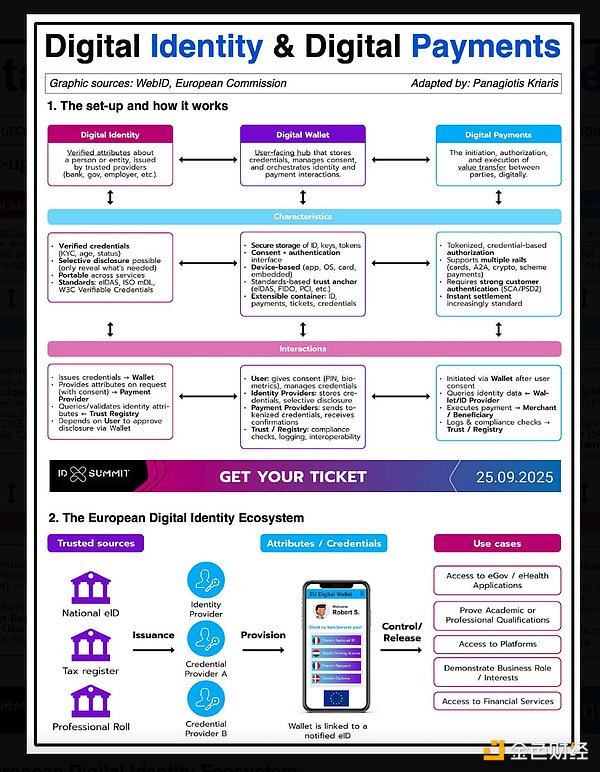
Data source: @Panagiotis Kriais
If the European Digital Identity Wallet (EUDIW) is successfully implemented, the entire European banking architecture will be reshaped—user identity authentication will replace bank accounts as the core entry point for financial services. This will make identity authentication a public infrastructure, and the roles of banks and digital banks will become interchangeable unless they can build differentiated services based on this trusted identity system.
The crypto industry is also moving in the same direction.
Exploration of on-chain identity authentication has been ongoing for years. Although there is no perfect solution yet, the underlying logic of all projects is highly consistent: Worldcoin: Dedicated to building a globally universal identity verification system to verify a user's true and independent identity without compromising user privacy. Gitcoin Passport: Integrates various user reputation and identity verification information to reduce Sybil attacks during governance voting and reward distribution. Polygon ID, zkPass, and zero-knowledge proof frameworks: Support users in proving specific facts (such as "I am an adult," "I live in Germany," "I have completed KYC verification") without revealing underlying data. ENS domain + off-chain credentials: Allow wallet addresses to not only represent asset balances but also link users' social identities and various qualification certificates. Most identity verification projects in the crypto space aim to solve the same core problem: enabling users to prove "who I am" or "what attributes I possess," while preventing identity information from being monopolized by a single platform. This aligns perfectly with the EU's vision for the European Digital Identity Wallet (EUDIW)—users can carry their identity verification information with them, seamlessly switching between different applications without repeated identity verification. Once this model becomes the industry norm, the operational logic of digital banks will also change. Currently, digital banks consider identity verification a core control element: user registration, platform verification, and ultimately, an "account" belonging to the platform. When identity verification becomes a user's own "passport," the role of digital banks transforms into that of a service provider connecting to this trusted identity system. This not only simplifies the user account opening process, reduces compliance costs, and minimizes redundant verification work, but also allows wallets to replace digital bank accounts as the core carrier of user assets and identity. Future Development Trends and Outlook Based on the above analysis, we can conclude that the factors that once determined the competitiveness of digital banks are no longer important. User scale is no longer a moat, the right to issue bank cards is not a core barrier, and even a simple and aesthetically pleasing interface design cannot be a unique advantage for a platform. The real differentiating competitive points lie in the profitable products, fund transfer channels, and identity authentication systems of digital banks—other functions will eventually become easily replaceable, homogenized modules. Successful digital banks of the future will not be "lightweight versions" of traditional banks. They will build a completely new financial service system centered on the wallet and anchor themselves to a core profit engine—because this is the key to determining the platform's profit margin and risk resistance. In general, these core profit engines can be divided into three main types: 1. Interest-Bearing Digital Banks: The core competitiveness of these platforms lies in becoming the preferred wallet for users to store stablecoins. As long as they can attract a large number of user deposits, the platform can earn profits through reserve-backed stablecoin interest, on-chain financial returns, staking mining, or re-staking, without relying on a large user base. Their profit advantage lies in the fact that the efficiency of fund custody is far higher than the commission earned from fund transfers. These digital banks are positioned more like modern savings platforms disguised as wallets than simple consumer applications; their core competitiveness is providing users with a smooth "deposit and earn interest" experience. 2. Payment Flow Transformation Digital Banks: The value of these platforms comes from the transaction volume of stablecoins. These will become the primary channels for users to send, receive, and spend stablecoins, and will establish deep partnerships with payment processors, merchants, fiat-to-cryptocurrency exchange channels, and cross-border payment networks. Their profit model is similar to that of global payment giants; while the profit margin per transaction is low, once they become users' preferred payment channel, they can achieve considerable revenue through massive transaction volumes. The platform's competitive advantage lies in user habits and service reliability, making it the default choice for users when transferring funds.
This is the deepest and most promising segment in the industry chain. These digital banks are not satisfied with simply providing stablecoin circulation services; instead, they are committed to controlling core aspects such as stablecoin issuance, redemption, reserve management, and clearing and settlement. This area boasts the highest profit margins because the returns generated by reserve assets are the largest source of profit in the entire industry chain. These digital banks combine consumer-end functions with infrastructure layout, aiming to become a complete financial network, rather than being limited to a single application product. In short: Interest-bearing digital banks earn money by having users "deposit" money; payment flow-based digital banks earn money by having users "transfer" money; infrastructure-based digital banks, however, can generate profits regardless of the user's actions. The market is expected to diverge into two camps in the future: the first camp focuses on user-facing application platforms, primarily integrating existing infrastructure, characterized by ease of use, familiarity, and extremely low user switching costs; the second camp moves towards the core value links of the industry chain, focusing on stablecoin issuance, transaction routing, clearing and settlement, and identity authentication integration. These platforms will be closer to infrastructure than simple applications—they simply have a consumer-facing interface on the front end. Their user stickiness is extremely strong because they will subtly become the operating system for funds flowing in and out of the on-chain ecosystem.
StakeStone, a leader in Omnichain liquidity, offers a decentralized Liquid Staking Token (LST) protocol, aiming to revolutionize staking with innovative solutions.
BrianDespite legal troubles, KuCoin's CEO asserts the exchange has sufficient reserves and separates user funds, unlike FTX. Market sentiment remains positive.
 Alex
AlexThe Ethereum network has reached one million validators, staking 32 million Ether. Community concerns arise over potential security issues and decentralization.
AlexTornado Cash’s co-founder, Roman Storm, is challenging accusations made by US authorities, asserting that the service is not intended for facilitating money laundering.
 Catherine
The decentralised borrowing protocol has disclosed that 14 accounts have yet to retract the affected smart contract, which led to the exploitation of $11.6 million last week.
 Kikyo
KikyoHe contends that existing meme coins are characterised by volatile price fluctuations and lack intrinsic value.
CatherinePendle Finance rallied the community and collaborated with Twitter officials to reclaim control of their compromised Twitter account.
KikyoHe contends that existing meme coins are characterised by volatile price fluctuations and lack intrinsic value.
CatherineCriminals have escalated their tactics in preying on the elderly through intricate crypto scams.
CatherineAs stipulated in the settlement, Google has already commenced the process of enhancing its disclosures regarding the data collected during "private" browsing.
Catherine