Author: Cooper Duschang, Assistant Researcher at Coin Metrics; Translated by: Shaw, Jinse Finance
Key Takeaways
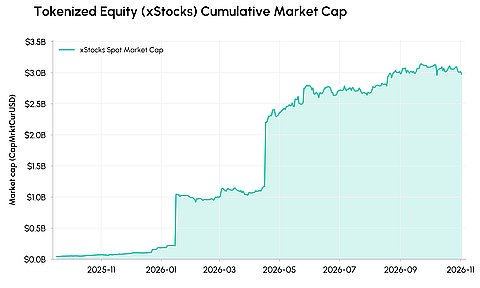
The total market capitalization of tokenized stocks has surpassed $3 billion. Investors can obtain stock price exposure on-chain through multiple issuers, including xStocks, Ondo tokenized stocks, and bStocks.
Introduction
From October 27th to November 2nd, the trading volume of tokenized stocks on various exchanges exceeded $2 billion. With the increasing demand for on-chain asset allocation, custodians continued to acquire and issue more tokenized stocks, driving the total market capitalization of tokenized stocks to over $3 billion.
Source: Talos CM Network Data Pro
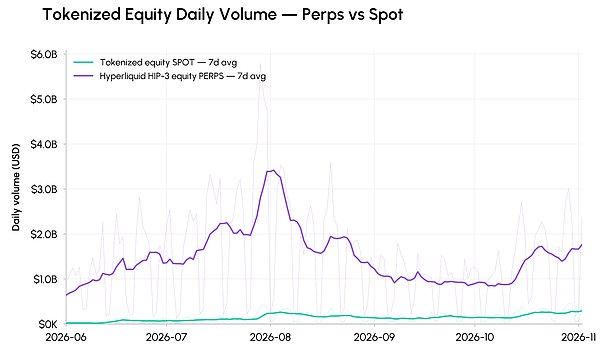
Despite the steady growth of the total market capitalization of tokenized stocks to approximately $3 billion, their spot trading volume remains relatively small compared to perpetual stock futures. In the past week, the trading volume of perpetual stock futures on the Hyperliquid platform was approximately $12.3 billion, six times the $2 billion trading volume of the tokenized stock spot market.
Source: Talos CM Market Data Pro
In this article, we break down and analyze the trading performance of tokenized stocks relative to the underlying stocks, their pricing during pre-market and after-market hours, and the market fragmentation problem of this type of asset.
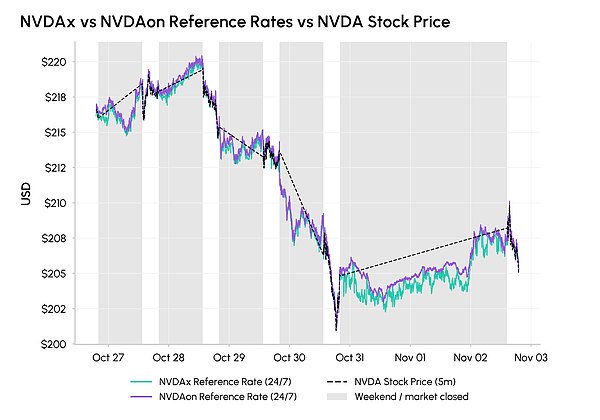
Tokenized Stocks and Underlying Shares Tokenized stocks primarily target non-US investors, providing users with on-chain price exposure to US stocks, with trading hours covering periods outside of regular US stock trading hours. Tokenized stocks are issued by entities holding the underlying shares, and the shares are typically held in custody by a custodian institution. The tokenized stock market operates 24/7, continuing to generate prices even during traditional market closures.
Source: Talos CM Market Data Pro, Yahoo Finance
Only whitelisted users have the right to mint new tokens and redeem the underlying shares. This poses a redemption risk to holders who do not have this permission.
Between October 27 and November 2, NVDAx, issued by xStocks, traded at a premium for 58.6% of the time during the US stock market opening hours, with an average premium of 3.1 basis points; NVDAon, issued by Ondo Stocks, traded at a premium for 88.9% of the opening hours, with an average premium of 14.1 basis points. During a widespread sell-off, the price of tokenized Nvidia stock fell below Friday's closing price.
Source: Talos CM Market Data Pro
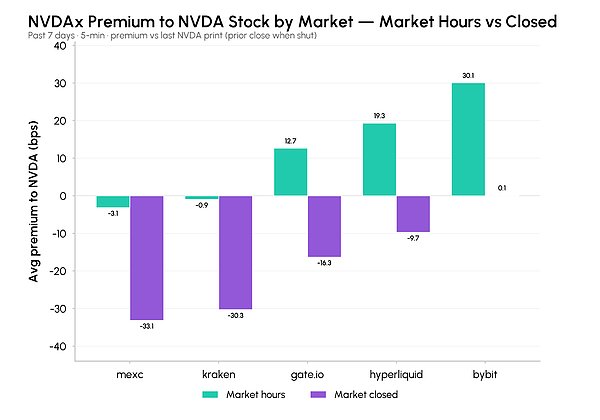
Market fragmentation on trading platforms results in the same tokenized stock exhibiting different prices on different platforms during opening and closing hours. On the Kraken platform, NVDAx trades at an average discount of 0.9 basis points relative to Nvidia's underlying stock during the US stock market opening hours.
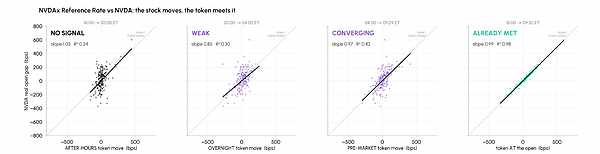
Source: Talos CM Market Data Pro, Yahoo Finance
Tokenized stocks are highly sensitive to price fluctuations, especially during traditional market closures. When US stock markets are closed, liquidity on Bybit and the MEXC platform NVDAx decreases by an average of 19% within a 1% spread above and below the midpoint; Hyperliquid's order book depth decreases by approximately 33% within the same range.
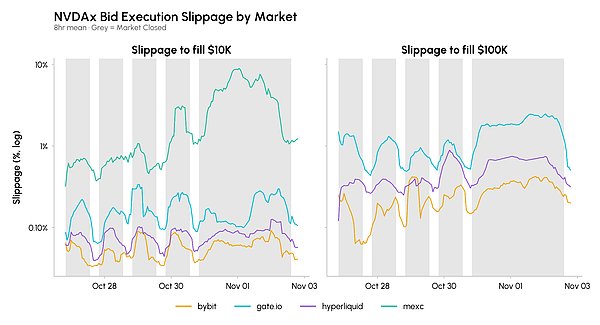
Source: Talos CM Market Data Pro
When do tokenized stocks typically trade?
Tokenized stocks allow non-US investors to gain price exposure to the underlying US stock market.
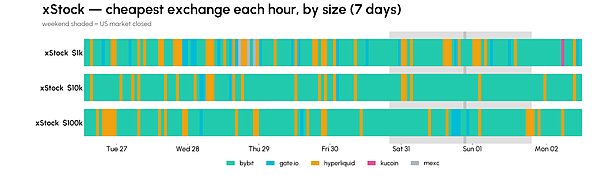
Studying the intraday trading sessions of tokenized stocks helps determine whether investors will continue to trade these tokens even when traditional markets are closed and liquidity is low. NVDA xStocks trading is concentrated during the US stock market opening and closing hours. On weekdays, between 9:00 AM and 10:00 AM Eastern Time, the average trading volume of NVDAx is $225,000. Some trading also occurred before and after the market opened, with motivations including anticipating opening prices and digesting news released after the market closed. However, this data does not clearly identify the geographical location of the trading users. Offshore exchanges offering this product indicate that most participants in tokenized asset trading are overseas users, although their trading time is still concentrated during US stock trading hours. Cross-platform trading: The price of the same tokenized stock differs across different trading venues; therefore, the cost of establishing price exposure depends on which platform the order is ultimately executed on.
Source: Talos CM Market Data Pro
Smaller orders have more trading platforms to choose from. In the sample period from October 27th to November 2nd, for orders of $1000, Bybit and Hyperliquid had the lowest slippage in 58% and 23% of the time periods, respectively.
Source: Talos CM Market Data Pro
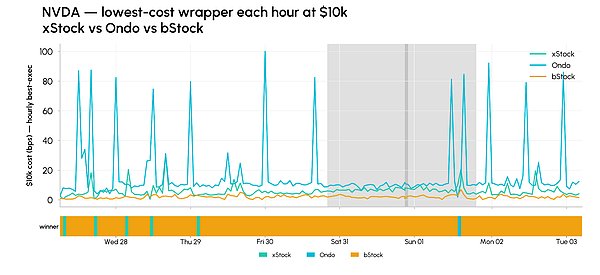
Comparing different versions of tokenized assets reveals that trading costs also vary depending on the issuer.
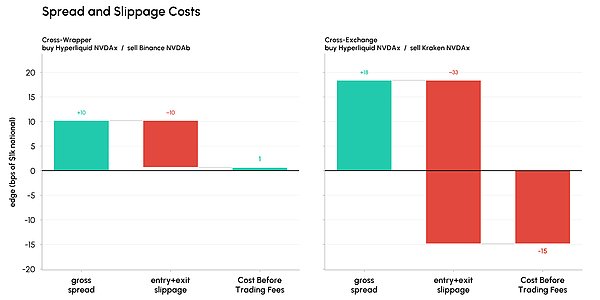
Between October 27th and November 2nd, for orders of $10,000, Binance's NVDAb had the lowest slippage among all Nvidia tokenized products in 96% of the observed samples. Can the price difference cover transaction costs? Different platforms and versions of tokenized stocks have different prices, seemingly presenting arbitrage opportunities, but liquidity and transaction costs must be considered when trading. Data from June to November 2nd, 2026 shows that even for small orders of $1,000, excluding fees, the sum of the average bid-ask spread and slippage already exceeds the observable price deviation.
Source: Talos CM Market Data Pro
Conclusion
Tokenized stocks allow non-US investors to obtain 24/7 price quotes for assets traded during traditional trading hours. Currently, trading of these tokenized assets is still concentrated during the US stock market opening hours, making them susceptible to liquidity shocks during market closures. Collecting market depth, slippage, and reference quote data for tokenized assets helps compare transaction costs across different tokenized stocks and trading platforms.


 JinseFinance


