Deng Tong, Golden Finance
On March 7, 2025, the U.S. Office of the Comptroller of the Currency (OCC) issued a new letter announcing the revocation of Interpretive Letter No. 1179, issued on November 18, 2021, and reiterating that the crypto asset custody, distributed ledger, and stablecoin activities discussed in the previous letter are permitted. The OCC confirmed in the letter that "federal banks and federal savings associations may engage in crypto asset custody, certain stablecoin activities, and participate in independent node verification networks."
On August 18, the OCC issued another tweet: "Community banks may partner with stablecoin developers to promote innovation and develop new financial products. The OCC will review and update the relevant regulatory framework as appropriate to support banking innovation and ensure the viability of community banks."
Since then, industry giants, including several stablecoin issuers, have applied for national trust bank charters in the United States, which are summarized below.
1. Circle
On June 30th, Circle applied to the OCC for a national trust bank charter, proposing to establish "First National Digital Currency Bank, N.A.". If approved by the Office of the Comptroller of the Currency, Circle would be able to serve as custodian of its own reserves and hold crypto assets on behalf of institutional clients. Unlike traditional banks, this charter does not allow Circle to accept cash deposits or make loans.
The new entity will be used to manage Circle's USDC reserves. Currently, Circle's reserve assets—short-term U.S. Treasury bills, overnight U.S. Treasury bill repurchase agreements, and cash—are held in custody at The Bank of New York (BK.N) and managed by BlackRock (BLK.N).
The license will also allow Circle to provide digital asset custody services on behalf of institutional clients. Circle CEO Allaire stated that the company will focus on providing custody services for assets such as stocks and bonds. "Now, as a public company, if we can successfully obtain national trust approval from the Office of the Comptroller of the Currency (OCC), it will lay a foundation for us that world-leading institutions can build on with confidence."
2. Ripple
On July 3, Ripple CEO Brad Garlinghouse confirmed on X that Ripple is applying for a license from the U.S. Office of the Comptroller of the Currency (OCC). Ripple has applied to establish Ripple National Trust Bank, a federal trust institution that can custody assets and seek access to central bank payment rails, subject to the sole decision of the Federal Reserve. Garlinghouse said that if the license is approved, it will become a "new (and unique!) benchmark" for trust in the stablecoin market because the company will be subject to federal and state regulation - the New York Department of Financial Services already regulates its Ripple USD (RLUSD) stablecoin. Ripple is also seeking a Federal Reserve master account to give it access to the Fed's payment infrastructure and allow it to hold its stablecoin reserves directly at the central bank.
Third, Paxos
On August 11th, Paxos Trust Company, the cryptocurrency company behind PayPal's stablecoin, announced it was applying to create a national trust bank in the United States, joining a growing list of digital asset companies seeking a greater foothold in the traditional financial system.
If licensed by the Office of the Comptroller of the Currency, Paxos would be able to manage and hold assets on behalf of clients and settle payments more quickly. Unlike traditional banks, this license would not allow Paxos to accept cash deposits or make loans.
If approved, Paxos would convert its limited purpose trust charter with the New York Department of Financial Services to a federal charter under the OCC. According to sources familiar with the matter, this charter would not change Paxos's business model but would provide "the highest level of regulatory oversight...with greater reach in the United States and globally."
Paxos previously applied for a national trust bank charter in 2020 and received preliminary conditional approval from the Office of the Comptroller of the Currency (OCC) in 2021. However, its application stalled and ultimately expired in 2023.
Fourth, Coinbase
On October 3rd, Coinbase applied to the U.S. Office of the Comptroller of the Currency for a national trust company charter.
Greg Tusar, Vice President of Institutional Products at Coinbase, said in a statement: "This OCC charter will simplify oversight of new products and foster continued innovation in integrating digital assets into traditional finance. We are not the first cryptocurrency company to seek a federal charter, nor will we be the last."
If approved, Coinbase could offer custody and related banking services nationwide, as well as payment and related services, driving greater institutional adoption. However, Coinbase does not intend to become a bank. Tusar stated, "We firmly believe that clear rules and the trust of regulators and customers enable Coinbase to innovate confidently while ensuring appropriate oversight and security." 5. Bridge On October 15th, Bridge, acquired by payments giant Stripe, applied to the U.S. OCC for a national bank trust charter to provide regulated stablecoin services. If approved, this move would bring the company under federal oversight. Bridge co-founder Zach Abrams stated that the company will provide services including custody, stablecoin issuance, and stablecoin reserve management through the bank.
Abrams wrote in an X article: "We have always believed that stablecoins will become the cornerstone of regulated core finance. This regulatory infrastructure will enable us to tokenize trillions of dollars and make this future possible."
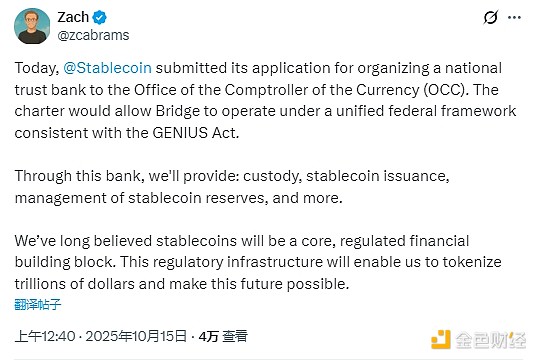
Stripe launched its open issuance service earlier this month to help companies use Bridge's infrastructure to issue their own stablecoins. Crypto wallet Phantom's CASH, MetaMask's mUSD, and Hyperliquid's USDH stablecoin all rely on Bridge as an issuance partner. Stripe acquired Bridge for $1.1 billion last year.
VI. Anchorage Digital
In January 2021, Anchorage received conditional approval for its national trust charter from the U.S. Office of the Comptroller of the Currency (OCC), becoming the first national "digital asset bank" in the United States, providing institutions with custody, trading, settlement, governance, and other regulated services.
Founded in San Francisco in 2017, Anchorage primarily provides digital asset services, covering custody, staking, trading, governance, and other areas. In 2019, Anchorage received investment from Visa. In December 2021, Anchorage completed a $350 million financing round led by KKR, with participation from Goldman Sachs and Andreessen Horowitz. In 2022, Anchorage partnered with various institutions, including BankProv to launch an ETH-backed lending service and six other partners, including FBG and IOSG, to expand its Asian business. In 2024, Anchorage received a major payment institution license from the Monetary Authority of Singapore.
VII. Why Are So Many Giants Crowding to Apply for National Trust Bank Licenses in the US?
As mentioned above, since Circle applied to the OCC for a national trust bank license on June 30th, many industry giants have begun to apply for licenses. The core reason is the introduction of the US GENIUS Act.
The GENIUS Act clearly stipulates:
Permitted Payment Stablecoin Issuer (PPSI): As the primary regulatory entity under the Act, entities can become PPSIs through three pathways, all requiring application and regulatory approval: 1) Insured depository institutions can issue through subsidiaries approved by the federal payment stablecoin regulator; 2) Non-bank institutions, uninsured national banks, and federal branches of foreign banks can apply to the Office of the Comptroller of the Currency (OCC); 3) Non-bank institutions with a total issuance volume of less than US$10 billion can apply to state regulators. For more details, please see "GENIUS Act: Key Implementation Timelines and Core Content Analysis."
Logan Payne, an attorney at Winston & Strawn, noted that the GENIUS Act incentivizes stablecoin issuers to seek banking charters. While the new stablecoin license under the Act limits a company's activities to "pure stablecoin issuance," most stablecoin issuers go beyond this. "Currently, nearly all stablecoin issuers issued in the United States under U.S. law engage in activities outside the scope of this license." Therefore, even if an issuer obtains a license approved by the GENIUS Act, they still need a state-level money transmitter license to operate nationwide. This will incentivize stablecoin issuers to apply for a national trust bank charter from the Office of the Comptroller of the Currency. Of course, in addition to mandatory regulations, factors such as the broader trend of corporate compliance, business expansion, and enhancing corporate image are also driving the surge in license applications. The move by the giants to apply for licenses is not only a positive response from crypto companies to regulation, but also a reflection of the integration of crypto finance and traditional finance. A small step by a giant company will eventually help the industry take a big step forward.


 Kikyo
Kikyo


