Written by: @100y_eth Translated by: Saoirse, Foresight News
Most experiments in crypto idealism have come to an end
"Decentralization," readable-writable-ownable, Web3, community ownership, do not be evil, cyber nation, code is law, trustless verification only, creator economy, pluralism, future governance…
These concepts are no longer just technical terms. They have attracted a large number of idealistic practitioners to the blockchain industry, who believe they can build a more open, free, and fair digital world.
Everyone has different visions for the future, but there is a consensus within the industry: blockchain has the ability to reshape the existing order.
Countless practitioners have dedicated themselves to this field, putting their ideals into practice, giving rise to a large number of experiments, protocols, and services, and continuously expanding the boundaries of the ecosystem: DAO, fan tokens, ve (3,3), NFT, intellectual property NFT, music NFT, Bitcoin inscriptions and runes, Bitcoin Layer 2 network, Play-2-Earn, Move-2-Earn, metaverse, on-chain games, game guilds, decentralized social networking, decentralized identity DID, on-chain reputation, soul-bound token SBT, algorithmic stablecoins, restaking, InfoFi, Ethereum killer, application chain, modular blockchain, zkEVM, Rollup-as-a-Service, intent transaction, chain abstraction, DePIN, decentralized energy, regenerative finance ReFi, decentralized scientific research DeSci, data market, decentralized AI computing power... However, regrettably, the vast majority of these experiments have failed. Numerous projects have failed; some representative examples are listed below. This chart shows the Bitcoin network transaction fee trend from 2023 to 2026. Transaction fees surged multiple times during the inscription craze, then declined after 2025, and the network congestion caused by inscriptions largely subsided. Inscriptions, ordinal NFTs, and runes store arbitrary data using Bitcoin's Segregated Witness and OP-RETURN transaction fields. At the time, the market touted the possibility of issuing tokens and NFTs with Bitcoin, and related hype remained high. In 2023, inscriptions drove up Bitcoin network transaction fees, with some even arguing that these fees could offset the shortfall caused by the Bitcoin block reward halving. However, today, their impact on Bitcoin network fees is almost negligible. Ordinal Maxi Biz, once a leading ordinal NFT project, reached a peak price of 1.5 Bitcoins, but recently traded for only about 0.018 Bitcoins. Magic Eden, once the largest Bitcoin NFT exchange, ceased its Bitcoin NFT trading operations in March of this year. Bitcoin Layer 2 Networks: Technologies like Taproot and BitVM led the market to believe that programmable, scalable Layer 2 networks could be built on top of Bitcoin's high security, attracting numerous projects to secure funding from leading venture capital firms. However, the overall ecosystem is currently performing poorly. BOB, the Bitcoin Layer 2 project with the highest locked value, has seen its total locked value plummet by 96.6% from its peak, leaving only $9.24 million. Corn, BEVM, and Lorenzo have completed their complete transformations, while Botanix has shut down entirely. A comparison of the TVL (Total Value Locked) ratios of Ethereum and other public chains from 2021 to 2026 shows that despite the rise of many competing public chains, Ethereum still maintains the highest share of total value locked in DeFi, and its dominant position in the industry remains unbroken. Many emerging public chains and Layer 2 networks claim to surpass Ethereum in scalability, incentive mechanisms, contract security, and market operation strategies. However, many projects have failed to find a product-market fit, becoming "ghost chains" without real users. Aside from Binance Chain, Tron, Solana, and Base, which have accumulated real users and established a viable business model, the vast majority of other public blockchains have failed to gain a significant market share from Ethereum. The infrastructure sector was the hottest infrastructure sector in 2022-2023. Starting with the Data Availability Layer (DA), the market saw the emergence of shared sorters, Rollup as a Service (Rollup as a Service), and various Rollup solutions. The design philosophy of modularity itself is not flawed; Arbitrum, Base, and Robinhood Chain are still operating stably. However, most of the modular startups that gained significant popularity back then either chose to transform their business models or went bankrupt. That wave of modularity can be considered a failed industry experiment. The chart shows the total value locked (TVL) in the restaking sector from 2024 to 2026. This sector's TVL peaked at nearly $30 billion before experiencing a significant pullback, a more drastic decline compared to other DeFi sectors. Restaking refers to the reuse of tokens already staked on a PoS public chain to provide economic security for other protocols. EigenLayer pioneered this sector, followed by Symbiotic, Karak, and other public chain ecosystems like Babylon and Solayer. The total value locked in this sector peaked at $30 billion, but has now fallen back to approximately $8 billion. While the total value locked (TVL) remains substantial, the narrative surrounding it has cooled significantly: the market possesses abundant reusable security resources, but the business demand for such security is extremely scarce. EigenLayer has undergone a soft transformation, focusing on EigenCloud, an AI agent-oriented platform; Symbiotic has shifted towards high-performance public chains, and Karak has transformed into a collateral trading platform. This chart shows the market capitalization trend of Terra UST from 2021 to 2026. UST's market capitalization once surged to nearly $20 billion before completely collapsing to zero, an event that made algorithmic stablecoins almost taboo in the crypto industry. The goal of algorithmic stablecoins is to move away from full asset collateralization and create more capital-efficient decentralized on-chain currencies. UST (now USTC) in the Terra ecosystem is the most well-known example, with a peak circulating supply exceeding $18 billion, ranking among the top ten crypto assets. However, external attacks combined with design flaws in the underlying mechanism caused the token price to plummet to zero, leading to the collapse of the entire Terra ecosystem. Other algorithmic stablecoin projects such as FEI, Iron, and ESD also all failed. FRAX initially used an algorithmic mechanism but later switched to a fiat-collateralized model.
NFT, Blockchain Games, and the Metaverse Ecosystem
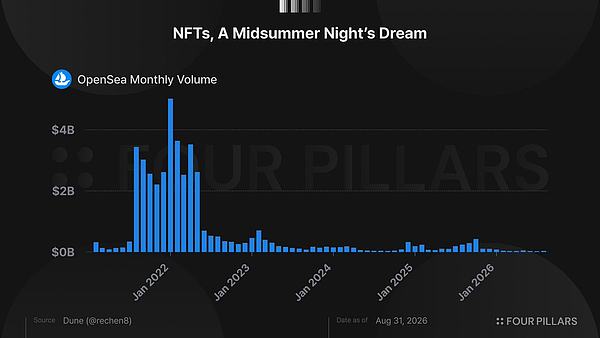
The bar chart shows the monthly transaction volume trend of OpenSea. During the NFT boom in 2022, the platform's monthly transaction volume once surged to nearly $5 billion. After the boom subsided, the transaction volume remained at a low level for a long time, symbolizing that the NFT bull market was like a short-lived dream.
NFTs once broke out of their niche and entered the mainstream. They emerged on Ethereum in 2021 and then spread to the Solana and Klaytn ecosystems. The prices of top collectibles skyrocketed, followed by a collective collapse.
NFTs once broke out of their niche and entered the mainstream. They emerged on Ethereum in 2021 and then spread to the Solana and Klaytn ecosystems. The prices of top collectibles skyrocketed, followed by a collective collapse.
CryptoPunks fell from 125 ETH to 32 ETH; BAYC from 150 ETH to 8 ETH; Pudgy Penguins from 35 ETH to 3.8 ETH; and Azuki from 30 ETH to 0.8 ETH. Leading NFT platform OpenSea saw its monthly transaction volume shrink from a peak of $5 billion to approximately $30 million. The core concept of P2E (Play-to-Earn) is that players own an in-game economy, earning crypto assets and sharing in the ecosystem's value by participating. However, for the model to be sustainable, the game must create real economic value or generate voluntary player payments. Neither of these has been achieved, leading to the collapse of the vast majority of projects. Axie Infinity, which popularized P2E, reached a peak of 6.5 million monthly active wallets and $103.8 million in transaction fees; now, it has fewer than 100,000 monthly active users and less than $50,000 in monthly transaction fees. Alongside the P2E boom, land NFT metaverse projects like Sandbox and Decentraland experienced a period of immense popularity. However, Sandbox land NFT prices plummeted by 99%, from a peak of approximately $15,000 to just $50. Projects like StepN and Sweat, which allowed users to earn money while playing, quickly lost their luster. AAA blockchain games like Star Atlas and Otherside never officially launched; the concept of fully blockchain-based gaming also failed to attract a large number of ordinary users. The blockchain gaming sector, once considered the future of the gaming industry, has largely failed in its implementation. Decentralized Social Networking and Information Finance
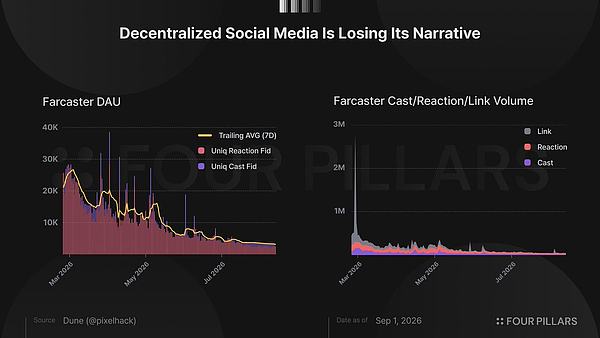
The chart shows the changes in Farcaster's daily active users, posting/interaction/linking volume. After peaking in March 2026, the platform's daily active users and on-chain interaction scale continued to decline, and the market enthusiasm for decentralized social networking gradually cooled down.
Decentralized social networking is the most direct practical application of the "user-owned internet" concept. It promises users control over their own social relationship graph, permissionless access, and censorship resistance, giving rise to projects such as Farcaster, Lens, and DeSo. However, apart from the users brought in by token incentives in the short term, projects find it difficult to retain real users, and overall activity has declined significantly. InfoFi, pioneered by Kaito, links online attention, content creation, and economic rewards. While it initially produced a significant amount of high-quality content, subsequent rampant practice of artificially inflating traffic for profit led to a proliferation of spam. After the X platform shut down its related interfaces, Kaito's Yaps, Cookie DAO's Snaps, and Wallchain's Quacks all ceased operations. The vision envisioned by crypto idealists has not materialized in the short term. However, Bitcoin has already been regarded as digital gold by some in the market; the traditional financial industry has also begun to actively adopt blockchain as the next-generation financial infrastructure. Blockchain has finally found its own product-market fit. The Era of On-Chain Experimentation Ends: Crypto Projects Shutting Down or Transforming in 2026
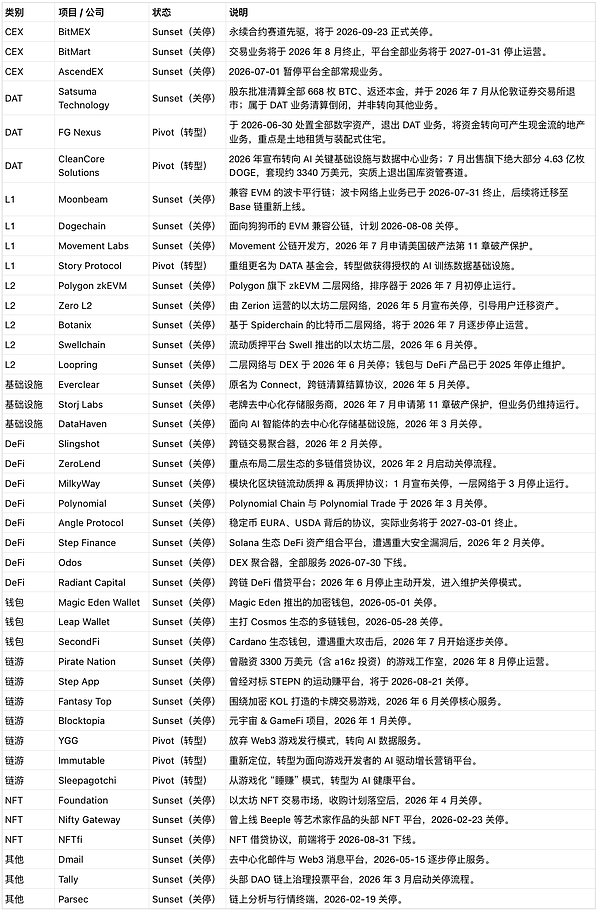
The industry previously generally believed that the various idealistic experiments would have largely ended by 2024-2025. The market shifted from grand narratives to tracks like stablecoins and asset tokenization, where business models were easier to implement, and the ideals of the previous cycle gradually faded from public view.
However, the reality continued to deteriorate: innovation had stagnated, capital and traffic began to withdraw, but older projects could still barely keep operating by relying on remaining funding and business inertia. Recently, however, these older projects have truly reached their end, with many initiating transformations or shutting down altogether.
As the table shows, in 2026, centralized exchanges, data tools, public chains, layer 2 networks, infrastructure, DeFi, games, and NFTs—almost the entire crypto space—experienced a wave of closures and transformations. The idealistic experiments of the crypto world have truly come to an end. The digital world envisioned by idealists has ultimately failed to materialize. The market has formed a barbell-shaped bipolar structure, with sectors converging. This scatter plot shows the year-on-year changes in key indicators, with the market moving towards both ends: speculative and traditional financial RWA sectors saw significant data surges, while traditional crypto sectors such as native on-chain DeFi, NFTs, and restaking experienced substantial data contractions, indicating a decline in the middle sectors. After countless on-chain experiments failed, the crypto industry evolved into a polarized barbell structure. One end caters to users' speculative demands; the other end supports the stable business needs of the real economy. Those native on-chain businesses in the middle, with unclear risk-return characteristics, have performed poorly in various operating data, due to three core reasons: **Lack of Product-Market Fit:** As mentioned earlier, the vast majority of on-chain products have not successfully implemented Proof-of-Function (PMF). Some seemingly successful cases, upon closer examination, were merely a false boom fueled by early airdrop activities. Products that can truly create value and continuously provide utility to users are extremely rare. **Risk-Reward Ratio Continues to Deteriorate:** With the crypto market weakening, users are gradually distinguishing which models are feasible and which are merely pseudo-demands. Expected returns from ordinary DeFi mining have declined significantly. Previously, stablecoin mining could achieve annualized returns of 15-20%; now, even 5-10% annualized returns are extremely difficult to obtain. The appeal of the middle-ground sector has completely disappeared. Users are divided into two groups: either turning to RWA, accepting low-risk returns of 3-7%; or flocking to Meme Coin, perpetual contracts, and prediction markets, taking on high risks to seek excess returns. **Increased Risk of Hacking:** With the iterative upgrades of large-scale AI models, on-chain hacking incidents are becoming increasingly frequent. The already shrunken expected returns, coupled with the risk of principal theft, further weaken the appeal of ordinary on-chain products. Data from two extreme sectors bucked the trend and rose, as if the bear market had never arrived. Some businesses are highly tied to crypto market conditions; others have built independent business models, unaffected by token price fluctuations. This has created a barbell-shaped development pattern for the entire industry. Speculative Demand: Speculation is not unique to the crypto industry. While speculative targets constantly change, human nature remains constant. From tulip mania and land speculation to stocks and cryptocurrencies, speculative demand has always existed. The characteristics of smart contracts, on-chain transparency, and instant settlement make blockchain a prime vehicle for speculative behavior. After the decline in the appeal of traditional DeFi, a large number of traditional DeFi users have flocked to speculative sectors, with representative categories including Meme coins, prediction markets, and decentralized perpetual contract (DEX) contracts. The market demand for Meme Coin has continued since Dogecoin in 2013: DOGE→SHIB→BONK→PEPE. In 2024, the Solana ecosystem's WIF, POPCAT, MEW, GOAT, and FARTCOIN sparked a Meme Coin craze. What truly reshaped the industry landscape was shturl.c, launched in 2024, which allows anyone to issue Meme Coins with a single click. The bar chart shows the revenue trend of the shturl.c platform. Even with market fluctuations, the revenue of this Meme coin issuing platform has remained high for a long time. In August and September 2026, revenue even surged to over $2 million, demonstrating the continued popularity of the Meme sector. While spot DEX trading volume has plummeted by nearly 80% in the past year, shturl.c's revenue has shown remarkable resilience, more than doubling from its low point in the past month. The platform has implemented a "graduation" mechanism: once a token's market capitalization reaches a threshold, it migrates from the glue curve to the AMM liquidity pool. The percentage of tokens that successfully graduate has increased from an average of less than 1% to over 3%. The image shows the daily spot trading volume breakdown for July. Meme Coin (bright yellow) initially had a very high share, and although it gradually declined, it remains the most traded asset on the chain, exceeding the trading volume of ETH (stablecoins) and tokenized assets. The newly launched Robinhood Chain was initially positioned as a public chain for tokenizing real-world assets. However, the vast majority of its trading volume comes from Meme Coin. Blockworks statistics show that more than half of the spot trading volume after launch was contributed by Meme Coin. Ironically, Meme Coin has become the growth engine of this RWA-focused public chain. The chart shows the net revenue trend of the Fomo platform. Starting in June 2025, revenue surged in the second half of 2026, confirming the rapid expansion of the Meme trading platform. Also noteworthy is the Fomo platform, created by former dYdX employees. It has a low barrier to entry, allows for quick discovery of Meme coin projects, features a social news feed, and supports Apple Pay. The platform's daily revenue exceeds $400,000. shturl.c, Robinhood Chain, and Fomo all confirm one thing: regardless of market fluctuations, the market demand for Meme coins remains strong. Previously, participating in Meme Coin had a high barrier to entry: it required discovering opportunities in X and Telegram communities, using Dexscreener to query data, connecting your wallet to a DEX, and then executing trades. Participants were primarily users within the DeFi community. Now, with TikTok spreading Meme culture and the app supporting direct token purchases via Apple Pay, ordinary users outside the DeFi community can easily enter the market. The decline in traditional DeFi yields, coupled with the lowered entry barrier, has allowed Meme Coin to grow into a relatively independent sector less affected by overall market conditions. The image shows the monthly trading volume of prediction markets. Platforms like Kalshi and Polymarket drove the market to surge from almost negligible in 2024 to the $50 billion level by mid-2026, marking an explosive growth for the sector. Prediction markets were among the fastest-growing sectors in the past year: trading volume surged by 3032% year-on-year and 320% within the year, showing no signs of slowing down. Valuations of leading platforms continue to rise: Kalshi, valued at $750,000 in 2019, has reached $22 billion in May 2026 after multiple rounds of financing, with its next round of financing targeting $40 billion. Polymarket's valuation rose from $18.58 million in 2020 to $15 billion, with its new round of financing targeting over $20 billion. A comparison of the transaction structures of Polymarket and Kalshi using a dual-ring chart shows that sports are the largest transaction category in both platforms; Polymarket has a higher proportion of crypto and political themes, while Kalshi's sports themes account for 74.48%. When discussing market prediction in the industry, its ability to discover information and hedge risks is often mentioned, but currently, the actual demand for these two types of services is very limited. Kalshi's trading volume mainly comes from sports events and crypto market data; Polymarket has a wider range of categories, but its main trading focus remains on sports, crypto assets, and political events. Comparing the accumulated open interest of sports and weather contracts with different timeframes, weather contracts see large-scale position building early on, while sports contracts mostly accumulate positions rapidly closer to expiration. A comparison of weather and sports contracts reveals their differences: weather contract users open positions early, leaning towards hedging; sports contracts see large-scale trading concentrated closer to the event, essentially a speculative activity. The rapid expansion of prediction markets during bear markets is largely due to the influx of new users from outside the crypto space. Statistics show that 56.1% of wallet addresses on Polymarket have never interacted with a DEX. While this doesn't mean all users are complete newcomers to crypto, a large number use prediction markets as their first blockchain experience. Sports and political events help platforms transcend the crypto cycle and acquire new users from outside. [Image of perpetual contract decentralized exchanges] Comparing the trading volumes of the two types of DEXs, after 2025, the trading volume of perpetual DEXs (blue) has consistently exceeded that of spot DEXs (red), indicating significantly stronger demand for derivatives trading compared to spot trading. While perpetual contract DEXs haven't experienced the explosive growth of Meme Coin or prediction markets, their resilience in a bear market, compared to other on-chain data, is remarkably strong. The decline in trading volume for perpetual DEXs is far less than that for spot DEXs, indicating that speculative demand for contracts is stronger than that for spot trading. This is primarily driven by two factors: New perpetual contract protocols continue to emerge: Following the success of Hyperliquid, new projects such as Lighter, Aster, Variational, Grvt, and edgeX have launched one after another. Even companies that didn't previously focus on the contract market, like Jito, Jupiter, and Ondo Finance, have added perpetual contract products. The market has developed a "use new protocols to get airdrops" strategy, continuously attracting users to the sector. The Rise of Real-World Asset Perpetual Contracts (RWA-Perps): Previously, only BTC and ETH were available as underlying assets. Driven by geopolitical conflicts and the AI sector, major platforms are now offering commodities and US stock-related contracts. For example, while it's difficult for ordinary investors outside of South Korea to trade SK Hynix stock, they can trade perpetual contracts for that stock on Hyperliquid, which once enjoyed extremely high trading volume. The concept of perpetual contracts originated with BitMEX. Although BitMEX itself declined and faced closure, the perpetual contract market continued to expand. Coinbase, Robinhood, Kalshi, and traditional compliant exchanges like the Singapore Exchange (SGX) and the US CME have all begun to develop similar trading products. Connecting to the Real Economy: Market growth is not entirely driven by speculation. On the other end of the barbell lies a sector with a somewhat rigid model but steady development, deeply integrated with the real world. Stablecoins, RWA (Real-World Asset Tokenization), and Vaults (asset treasuries) have maintained growth despite overall declines in token prices and on-chain staking. Venture capital investment in native on-chain projects has seen a significant contraction in both the number of projects and the scale of funding; however, blockchain projects integrated with the real economy are seeing increasingly larger single-round funding amounts. Examples include Rain's $250 million Series C funding, Airwallex's $320 million Series H funding, Gauntlet's $125 million funding, and OpenFX's $94 million funding. This demonstrates that this sector has successfully established independent product-market fit, unaffected by the cycles of crypto bull and bear markets.
Stablecoins
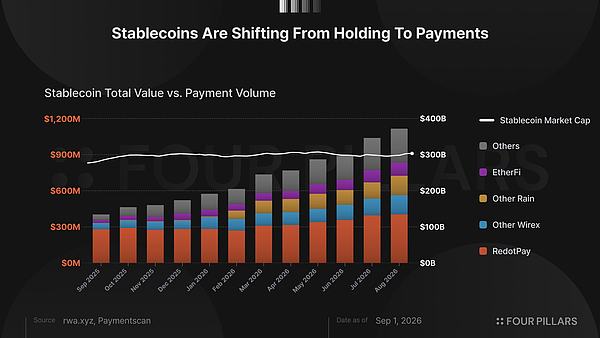
The white line represents the total market capitalization of stablecoins, which has remained relatively stable. However, the stacked bars represent the stablecoin payment transaction volume, which has continued to rise sharply, reflecting the shift in the focus of stablecoin applications towards actual payments.
Contrary to popular belief, the total supply of stablecoins has only increased by about 11% in the past year and has remained relatively flat since October 2025. The rapid expansion of government bond tokenization and private lending tokenization has slowed the growth rate of stablecoin supply.
But this does not mean that the sector is facing obstacles. In the context of a market crash, maintaining the existing size is an achievement in itself. More importantly, payment scenarios are experiencing explosive growth.
Crypto payment cards like RedotPay, KAST, EtherFi, and Plasma One saw their monthly payment volume nearly triple from $438.1 million in July 2025 to $1.32 billion in July 2026. Stablecoins, initially just intermediaries in crypto transactions, are increasingly being implemented in real-world payment scenarios. They will also serve as the core currency for on-chain settlement within the RWA real-world asset tokenization system. The total scale of real-world asset tokenization continues to rise, with traditional assets such as US Treasury bonds and commodities being the main contributors to growth. This expansion is independent of the cryptocurrency market cycle itself. 2025-2026 is expected to be a breakout year for RWA. The market anticipates blockchain technology transforming outdated traditional financial infrastructure, with various real-world assets being put on-chain. Early targets primarily consisted of US Treasury bonds and money market funds, with simple product forms and on-chain logic; later, this expanded to private lending, and recently further extended to stocks and equity. The value logic of RWA's underlying assets is independent of cryptocurrency market trends. Leveraging its advantages of increased efficiency and lower barriers to entry, it can grow independently of the crypto cycle. Four Pillars has already provided in-depth analysis of the RWA sector in previous reports, so this article will not repeat that. The line chart shows the TVL (Total Value Limit) trend of selected vaults. After a round of correction, it has rebounded again, approaching its previous historical peak, indicating that the popularity of institutional custody vaults has returned to a high level. Unlike RWA, which directly connects to real-world assets, Vaults are attracting significant industry attention as a next-generation on-chain asset management module. Vaults lend funds to lending markets that accept RWA as collateral, thereby indirectly linking with the real economy. As of August 28, the price of Bitcoin had fallen 35% from its peak; however, the total value locked in Select Vaults was only 4% lower than its all-time high, proving that the Vault ecosystem is also exhibiting independent market trends. Early RWA focused on "asset issuance on-chain"; now, as the industry enters the asset application stage, the rise of RWA-backed lending will further drive market demand for Vaults. Why are cryptocurrency companies no longer popular? The table summarizes the business layout of mainstream crypto platforms. △ represents ongoing development, ○ represents mature products, and - represents no involvement, reflecting the industry's expansion into emerging tracks such as perpetual contracts, prediction markets, RWA, and stablecoins. This has led to an intriguing business phenomenon in the crypto world: blockchain companies with completely different backgrounds and initial business focuses are now developing almost identical products and competing fiercely with each other. Various platforms are launching perpetual contracts, prediction markets, supporting Meme coin trading, and developing stablecoins, RWA trading, and asset vaults. The underlying logic is quite straightforward: as analyzed above, only a few tracks can both significantly mitigate market volatility and generate substantial revenue. Even with the recent market recovery, the overall direction of the industry hasn't changed, and many crypto companies are flocking to these counter-cyclical tracks. However, this doesn't mean that native on-chain projects have completely failed. While many experiments have disappeared as mentioned earlier, a few projects still survive and have successfully established a product-market fit. EigenLayer continues to see significant ETH re-staking; many are pessimistic about the blockchain gaming sector, but MapleStory Universe continues to deliver impressive data. The on-chain ecosystem is forming a barbell pattern. From a negative perspective: only a handful of sectors remain with growth potential; from a positive perspective: it represents the maturation of some crypto businesses, finding their own business models. We look forward to more sectors reaching this stage in the future.


 Weatherly
