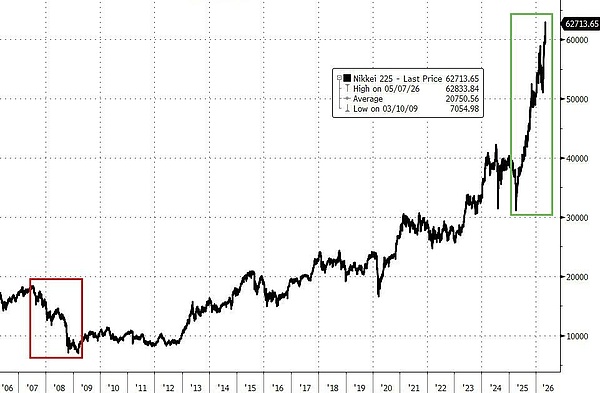
Amidst the market frenzy, the debate over bubbles is quietly intensifying. Tony Pasquariello, head of hedge fund operations at Goldman Sachs, recently admitted that the current trading environment is "almost intoxicating," and frankly stated that he has spent an entire week comparing the current market to the late 1990s. This statement echoes the latest warning from Michael Burry, the inspiration for the "Big Short"—Burry explicitly wrote on social media that the current market "feels like the last few months of the 1999-2000 bubble." These two market figures from different perspectives, coincidentally citing the same historical period, reflect a shared concern deep within investors: Is this AI-driven bull market a revolutionary industrial shift, or just a euphoria nearing its end? Burry's warning points directly to the distortion of the market structure. He points out that the stock market no longer reacts rationally to economic data such as employment reports or consumer confidence. "Stocks rise not because of employment or consumer sentiment, but because they keep rising—based on a two-letter argument that everyone thinks they understand (AI)." Meanwhile, hedge fund legend Paul Tudor Jones also stated that the current environment is highly similar to 1999, but he believes the bull market may still have one to two years of room to continue, although once valuations continue to inflate, the final correction will be "suffocating." This debate quickly spread to social media platforms, with bulls and bears each holding their own views and engaging in fierce arguments about the nature of AI-driven market movements, becoming a true reflection of recent market sentiment. Goldman Sachs' "Optimistic Caution": Frenzy, but Not Yet Completely Out of Control. The current market trading intensity has reached an extremely high level. Tony Pasquariello, head of hedge fund business at Goldman Sachs, described it as "almost intoxicating." He pointed out that this is by no means a long-term stagnation, and global AI concept stocks remain extremely popular. Data shows that the Philadelphia Semiconductor Index rose for 24 out of the past 28 days, with a surge of 63%. This fervor is not limited to the United States; global markets are showing a strong interconnected effect. In South Korea, the KOSPI index, after achieving a total return of 79% last year, has risen again by 79% this year, and Samsung's market capitalization has exceeded $1 trillion. Expert Tim Moe predicts that its profits will grow by 300% this year, and the index is expected to reach 9,000 points. The Japanese stock market has also performed strongly, with the NKY index rising another 25% this year on top of a 29% increase last year.
Regarding the S&P 500's doubling in value since the end of 2022, Pasquariello frankly admits that he finds himself constantly comparing the present with the late 1990s. Just as the Nasdaq 100 (NDX) doubled in 1999 after its consecutive rise from 1991 to 1998.
He acknowledged that there were clear signs of chasing the rally in the market this week—S&P 500 call option trading volume hit a record high—but he believes the market has not yet reached the tipping point of "full-blown frenzy." He uses the speculative positioning at the market peak in 2021 as a benchmark, setting it at "+10," while his current estimate is "+7." Looking ahead, Pasquariello remains optimistic. He believes that the market may be preparing for a period dominated by "reflation" trades, driven by an AI capital expenditure supercycle, increased defense spending, and supply chain diversification. 
Burry's Warning: Stocks Rise Just Because They Rise
“The Big Short”Michael Burry's latest statement comes from his own Substack. He described an experience listening to a financial radio broadcast during a long drive: "It was all AI the whole time; nobody was talking about anything else." Burry directly compared the current trend of the SOX index to the trajectory before the tech stock crash in March 2000. His core judgment is: "The market has deviated from its anchor in fundamentals and entered a self-reinforcing upward logic—'Stocks rise because they keep rising.'" He specifically pointed out that the S&P 500 hit a new high on the day the April non-farm payroll data slightly exceeded expectations, while at the same time, the consumer confidence index recorded a historic low, a discrepancy that is intriguing. Paul Tudor Jones's assessment overlapped somewhat with Burry's, but his conclusion was more moderate. Jones stated that the current environment is similar to that of 1999, but he estimated that the bull market could continue for another one to two years. He also warned that if the stock market rises another 40%, the ratio of stock market capitalization to GDP will reach 300% to 350%, and the subsequent correction will be "suffocating."

Social Media Debate: The Debate on the Definition of a Bubble
Burry's warning quickly sparked widespread discussion on social media platforms, with bulls and bears engaging in a definitional debate surrounding "whether this is a bubble or not."
Bearish SideUsing historical analogies, their logic is direct.
The bears Marcos Crypto listed three "fatal signs" of the 2000 bubble: Cisco, with a P/E ratio of 196, was hailed as a "buy forever" stock; the company raised hundreds of millions of dollars based solely on user growth and a compelling narrative, with actual profits virtually zero; and retail investors flocked to a few star stocks until the Federal Reserve tightened liquidity. He believes that all three signs have reappeared in 2026. Geiger Capital, using a chart, points out that AI-related stocks currently account for approximately 40% of the overall market capitalization. Netizen Helene Meisler's statement was even more direct: "If you didn't experience 1999-2000, you're lucky—now you can experience it firsthand." Citrini, however, questions the very definition of a "bubble." He offers a more rigorous framework: the essence of a bubble is "a reflexive interaction between a mainstream trend and a mainstream misunderstanding of that trend, reinforcing each other until the gap between perception and reality becomes unsustainable." The current surge in AI infrastructure is fundamentally driven by the reality that "we simply don't have enough computing power," rather than by fantasies about the future—every earnings season, companies consistently confirm that supply remains insufficient. His conclusion is that to determine the top of a bubble, what's needed isn't valuation judgment, but a clearer answer to "what the misunderstanding is, and what negative catalysts will force the market to recognize reality." Quantitative analyst Quantian proposed a set of "napkin math": categorizing AI-related sectors by laboratories, hyperscale cloud providers, chips, memory, computing power, etc., and comparing the valuation increases of each basket since ChatGPT's release with the expected increases in long-term EBITDA, to determine whether the premium is reasonable. The core of the debate: Will history repeat itself, or will this time be different? The deeper tension in this debate lies in the drastically different interpretations of the same period of history by both sides. Bears argue that the internet of 1999 and AI of 2026 are highly isomorphic in their market behavior: narrative-driven, valuations decoupled, retail investors chasing rallies, and media bombarding a single theme around the clock. Bulls maintain that AI's capital expenditure needs are real and verifiable, fundamentally different from the massive cash burn of internet companies in the past without a viable business model. Pasquariello also touched upon this divergence in its report. He cited client opinions, stating that the scale of AI infrastructure construction should be larger and more sustainable than that of the internet; however, he also acknowledged that whether certain market trends reflect "excessive speculation" is a question worth serious consideration. Currently, this debate remains unresolved. But what is certain is that when Goldman Sachs' hedge fund manager, the archetype of the "Big Short," and a hedge fund legend all begin citing 1999 as a reference point, the market's anxiety about its own position needs no further explanation.


 Joy
Joy


