Tao Zhu, Jinse Finance
Summary
On May 6, 2026, Strategy reported a net loss of $12.54 billion for the first quarter of 2026. Executive Chairman Michael Saylor proposed potentially selling Bitcoin to pay dividends, rewriting the previously stated strategy of never selling Bitcoin.
I. Why would Strategy sell Bitcoin?
On May 5, Strategy released its financial results for the first quarter of 2026, and the data was not optimistic, mainly due to the sharp drop in Bitcoin prices at the beginning of the year.
According to the financial report, Strategy's net loss for the first quarter of 2026 was $12.54 billion, or a diluted loss of $38.25 per ordinary share, while the net loss for the first quarter of 2025 was $4.22 billion, or a diluted loss of $16.49 per ordinary share.
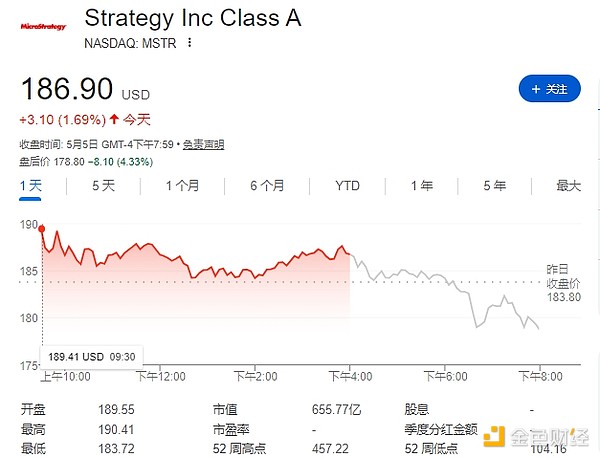
The net loss attributable to common shareholders in the first quarter of 2026 was $12.77 billion, compared to a net loss attributable to common shareholders of $4.23 billion in the first quarter of 2025. As of 2026, Strategy's Bitcoin holdings have reached 818,334, a 22% year-over-year increase; the year-to-date Bitcoin yield is 9.4%; and $11.68 billion has been raised year-to-date. Strategy also highlights that its Bitcoin yield is approximately 9% since the beginning of the year. This metric measures the growth per Bitcoin—the ratio of the amount of cryptocurrency held by a company to its number of shares—over time. The Bitcoin yield measures the efficiency with which Strategy converts capital into shareholder Bitcoin exposure. During the earnings call on May 5th, Michael Saylor likened Strategy to a real estate development company, stating, "If you buy land for $10,000 per acre and then sell it for $100,000 per acre, and use the profits to buy more land… or if you sell land for $100,000 per acre to pay the interest on the debt you used to buy more land, nobody would say that's bad for real estate prices, and nobody would say that this business model doesn't work. Real estate development companies are essentially about buying land low and selling it high. Strategy is like a Bitcoin development company." Strategy President and CEO Phong Le similarly stated during the earnings call, "If we sell Bitcoin to get dollars, or sell Bitcoin to get debt, and doing so increases the value per Bitcoin, then we'll consider doing that in the future." This marks a subtle but significant shift in Strategy's attitude towards Bitcoin: no longer passively accumulating Bitcoin, but actively managing its balance sheet to maximize the value per Bitcoin. According to data from Polymarket, the probability that Strategy will sell BTC before December 31st this year has risen to 42%; the probability that Strategy will sell BTC before May 31st this year is 15%; and the probability that Strategy will sell BTC before June 30th this year is 29%. Affected by the "selling BTC" news, Strategy's stock price fell by more than 4% in after-hours trading.
II. What does Strategy's "selling" mean?
Previously, Strategy had been a staunch buyer of BTC, consistently adding to its holdings regardless of bull or bear markets, and expanding its position through bonds and other means, forming a deeply intertwined relationship with BTC. But now, even this most steadfast bullish investor has expressed the possibility of selling BTC.
First, market sentiment has changed. When Strategy and its founder Michael Saylor continuously reinforced their buy-only-and-hold-no-BTC strategy, many retail and institutional investors dared to enter the market. But now, people can't help but wonder: if even a staunch bullish investor is selling, is the long-term value of BTC questionable?
Secondly, regarding the impact on the market. In the short term, the news directly caused Strategy's stock price to fall by 4%. However, it did not directly impact the BTC market; as of press time, BTC even surged to over $81,000, reversing its previous downward trend. From a medium- to long-term perspective, if Strategy sells its coins through over-the-counter (OTC) transactions, the impact on the market will be relatively small; if it sells in batches on the open market, it will bring continuous selling pressure to the crypto market. However, Strategy's sale of coins is not entirely negative. As a super whale holding 818,334 BTC, Strategy's ability to sell will directly boost market liquidity. Third, Strategy is shifting from a coin-hoarding model to an asset management allocation model, signifying an upgrade in institutional investor investment logic. Previously, Strategy continuously increased its holdings, actively accumulating coins. Now, Strategy will adjust its BTC holdings based on market conditions, selling a portion of BTC when necessary to maximize the value of each Bitcoin. This is closer to the asset management allocation model of the mainstream financial system. Third, can the STRC digital credit model be sustained? In Strategy's financial reports, STRC is a key focus, exploring the origins of its coin-selling behavior. Strategy President and CEO Phong Le stated, “Bitcoin adoption will continue to grow in 2026. Digital lending, exemplified by STRC, has achieved tremendous success. STRC has demonstrated strong demand, high liquidity, and low volatility. Year-to-date, we have raised $5.6 billion in total proceeds through STRC, with daily trading volume increasing to $375 million, while reducing volatility to 3%, all during a Bitcoin bear market. We have also seen traditional financial institutions and major banks, including Morgan Stanley, Goldman Sachs, and Citigroup, announce the launch of Bitcoin ETFs, trading, custody, and lending services.” CFO Andrew Kang stated, “Strategy is a leading global digital lending issuer with over $13.5 billion in outstanding preferred stock and a strong Bitcoin balance sheet. We have a proven track record of timely and full dividend payments, having made 23 consecutive timely and full payments since the launch of our preferred stock product in early 2025, totaling over $693 million. Strong market demand for our digital lending instrument, STRC, has driven its Bitcoin yield to 9.4% in the first four months of this year, with Bitcoin's market capitalization increasing by approximately $5 billion.” Founder and Executive Chairman Michael Saylor stated, “STRC’s market capitalization has grown to $8.5 billion in just nine months, making it the world’s largest preferred stock by market capitalization. By leveraging Bitcoin’s performance and building price stability, we have created a credit instrument with a Sharpe ratio of 2.53. This has spurred a broader digital credit ecosystem, with $150 million of STRC currently held by companies such as Prevalon, Strive, and Anchorage, and over $270 million held by DeFi protocols such as Apyx and Saturn. We have also proposed a shareholder vote to double the frequency of STRC dividends to every two months, which we believe will further enhance STRC’s appeal by increasing liquidity and improving price stability.” Company executives currently position STRC as a core pillar of the company’s “digital lending” model. STRC has a target price of $100 and offers a near 11.5% annualized floating dividend, but its asymmetric design has attracted analyst attention. STRC shareholder returns are tied to Strategy’s balance sheet, but shareholders still face downside risks if Bitcoin prices fall or stock demand weakens. In the current sluggish crypto market, Strategy needs to consider whether it needs more cash flow. This directly leads to the decision of whether to sell its cryptocurrency holdings. Strategy can reduce debt pressure, improve cash flow, and pay preferred stock dividends by selling tokens. To date, Strategy has paid over $693 million in dividends to its preferred stock offerings (including STRC, STRK, STRF, and STRD). However, market disagreements surrounding the STRC model are widening. Critics argue that it relies on a “circular” issuance, with some even calling it a Ponzi scheme. Others argue that it’s a way to translate yield requirements into Strategy’s Bitcoin exposure. Last month, Bitwise CIO Matt Hougan described STRC as “a perpetual preferred stock that trades like a stock but offers bond-like dividend yields,” adding that Strategy could “raise billions of dollars” through this tool to fund the purchase of more Bitcoin. Others, including analysts at Grayscale, argue that spot Bitcoin ETFs remain the "simplest" way to gain exposure to Bitcoin, avoiding the complexities of preferred stock structures. The root of the controversy lies in the fact that the STRC model relies on a dynamic balance between Bitcoin price, funding capacity, and market demand; fluctuations in any of these elements will test its sustainability. IV. Has Strategy sold BTC before? The answer is yes. Strategy's only publicly disclosed large-scale BTC sale occurred in December 2022, when it sold approximately 704 BTC. The official disclosure stated the purpose was not bearish, but rather tax optimization—selling assets at a paper loss to offset taxes on other income. After selling 704 BTC and realizing a loss, the company used the tax deduction. However, two days later, Strategy repurchased 810 BTC. This action did not reduce Strategy's BTC holdings; in fact, it increased them. At the time, the market interpreted his selling action as a technical maneuver, and therefore it didn't cause much of a stir. However, in this current selling scenario, the BTC sold may be used for dividends or debt optimization, marking a fundamental turning point in the "buy-only" strategy. The selling three years ago was for the purpose of buying more, while the selling event this year is for the purpose of optimizing capital structure; the two are fundamentally different. Conclusion Strategy is shifting from being a staunch buyer to actively managing BTC. As the crypto market matures, BTC is becoming more of a configurable financial instrument. When even the most steadfast long-term holders are adjusting their strategies, the rules of the game in the crypto market have changed.


 Alex
Alex


