Author: c4lvin Source: X, @c4lvin Translation: Shan Ouba, Jinse Finance
Robinhood released its third-quarter earnings report yesterday, with revenue and earnings per share slightly below expectations. The stock price fell more than 8% in the day following the earnings call, but the crypto industry was more concerned with what was said on the call than the earnings figures. After Vlad stated that the company would significantly increase its investment in Robinhood Chain, major ecosystem tokens such as Pons, AI, and Orbio generally surged, with gains ranging from approximately 10% to 30%.
The direct trigger for this surge was Vlad's statement. He acknowledged that the ecosystem built around Robinhood Chain and its wallet was growing faster than the company had anticipated.
He also mentioned that developers have consistently complained about insufficient support, and explicitly stated that Robinhood will form a new team and increase investment. The market interpreted this as a signal that Robinhood will directly support on-chain native projects.
However, looking at the entire earnings call as a whole, there is a significant gap between what Robinhood wants to develop on-chain and the ecosystem tokens that have driven this round of price increases. This article summarizes the priorities Robinhood revealed during the call and compares them with market expectations for ecosystem tokens.
I. Priorities Revealed in the Earnings Call
1.1 Stock Token TVL Takes Priority Over Sequencer Fees
Vlad stated that he doesn't want to be in a business that makes money by charging high fees for on-chain activity and listed the stock token TVL as an indicator of the chain's long-term sustainability. In his view, the differentiator for Robinhood Chain is RWA. CFO Shiv Verma also revealed that gross on-chain fee revenue in the third quarter was approximately $50 million, and net revenue was approximately $25 million. However, he added that the on-chain team's goal is not revenue, but rather the growth of TVL, developers, and stock tokens.
These words reveal how the Robinhood team views the September fee feast.
As 100y pointed out in a previous article, Robinhood Chain's daily network fees peaked at approximately $8.27 million on September 4th, and by mid-October had fallen by over 99%, dropping to the $30,000 to $40,000 range. During the same period, spot trading volume remained above $600 million to $700 million per day. Because Robinhood Chain is built on Arbitrum, its fees depend on the congestion level of the block space. After the congestion caused by the Memecoin issuance boom subsided, fees also fell. Robinhood also proactively increased the gas cap to improve throughput, which further reduced fees. This means that Robinhood views the fee revenue from the Memecoin boom more as a drag on user experience than as sustainable revenue.
1.2 Applications Beyond Launchpads
Vlad describes the applications currently appearing on the chain as relatively simple, such as launchpads and liquidity pools. His next phase is to make stock tokens programmable like software, enabling the creation of products that don't yet exist, such as tokenized options contracts. Robinhood's own roadmap points in the same direction. The company plans to move as many assets tradable on Robinhood in the US market as possible onto the blockchain, making them available to overseas customers and creating basic modules that developers can combine. DeFi perpetual contracts, with daily trading volume exceeding $1 billion, are also listed as an achievement. Lighter and Arcus, which are leading this business, are protocols that Robinhood has strategically invested in.
In other words, Vlad's promise of developer support can be more reasonably understood as focusing not on expanding the current launchpad ecosystem, but on encouraging more complex financial applications built on top of stock tokens.
1.3 Attracting US Users
The biggest limitation of Robinhood Chain is that its stock tokens cannot be used in the United States, which is precisely where Robinhood's core customer base is located. Currently, Robinhood App users only account for 1% to 2% of all transactions on this chain. The main product for US customers is basically Earn, where users can deposit USDG. The Steakhouse USDG vault behind this product has a size of approximately $540 million, close to half of the chain's TVL. Vlad is positive about the innovation exemption recently announced by the SEC, but said that long-term certainty still requires rule-making or legislation. He also said that the company will announce more US tokenization plans soon.
II. Projects Aligned with Robinhood's Direction
That being said, it's difficult to conclude that Robinhood wants to distance itself from the Memecoin ecosystem. At least for now, Memecoin is the most effective way to create demand for stock tokens. Blockworks previously demonstrated that the growth in LONG trading volume is highly correlated with the TVL of stock tokens, with a correlation coefficient of 0.86. The conclusion is that RWA-related metrics still rely on Memecoin transactions.
From this perspective, if Robinhood does support the Memecoin ecosystem, its motivation is likely not on-chain fees, but rather increasing the issuance and circulation of stock tokens. However, I doubt whether Robinhood is willing to allow this model to continue in the long term.
Even though Memecoin is currently the most effective source of demand, Robinhood has made the healthy growth of its stock token's TVL a core metric. This means that in the long term, it will likely try to broaden the uses of its stock token and reduce its reliance on Memecoin trading.
If so, Robinhood's support for different ecosystem projects may vary. It is more likely to support projects that directly use stock tokens as margin, collateral, or underlying assets, regardless of the activity level of Memecoin trading.
1) Lighter
Source: Lighter
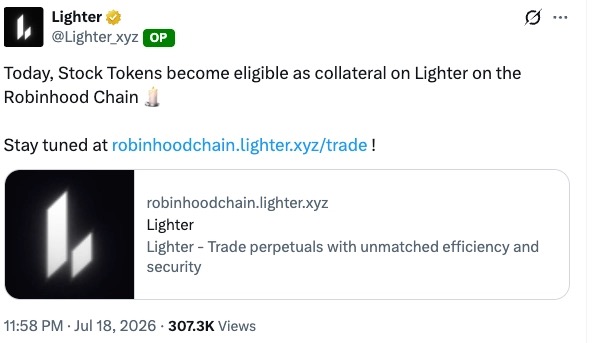
Robinhood made a strategic investment in Lighter and completed its integration when Robinhood Chain launched, allowing users to trade directly within Robinhood Wallet. Furthermore, since July, Lighter has accepted equity tokens on the Robinhood Chain as margin for perpetual contract holdings. This is a leading example of a more advanced use of equity tokens and aligns with Robinhood's goals. Lighter recently stated in an investor call that it plans to apply for a US derivatives license in November. If approved, I believe Lighter will become the biggest channel for attracting more US users.
2) Priors
2) Priors
Source: Robinhood Crypto
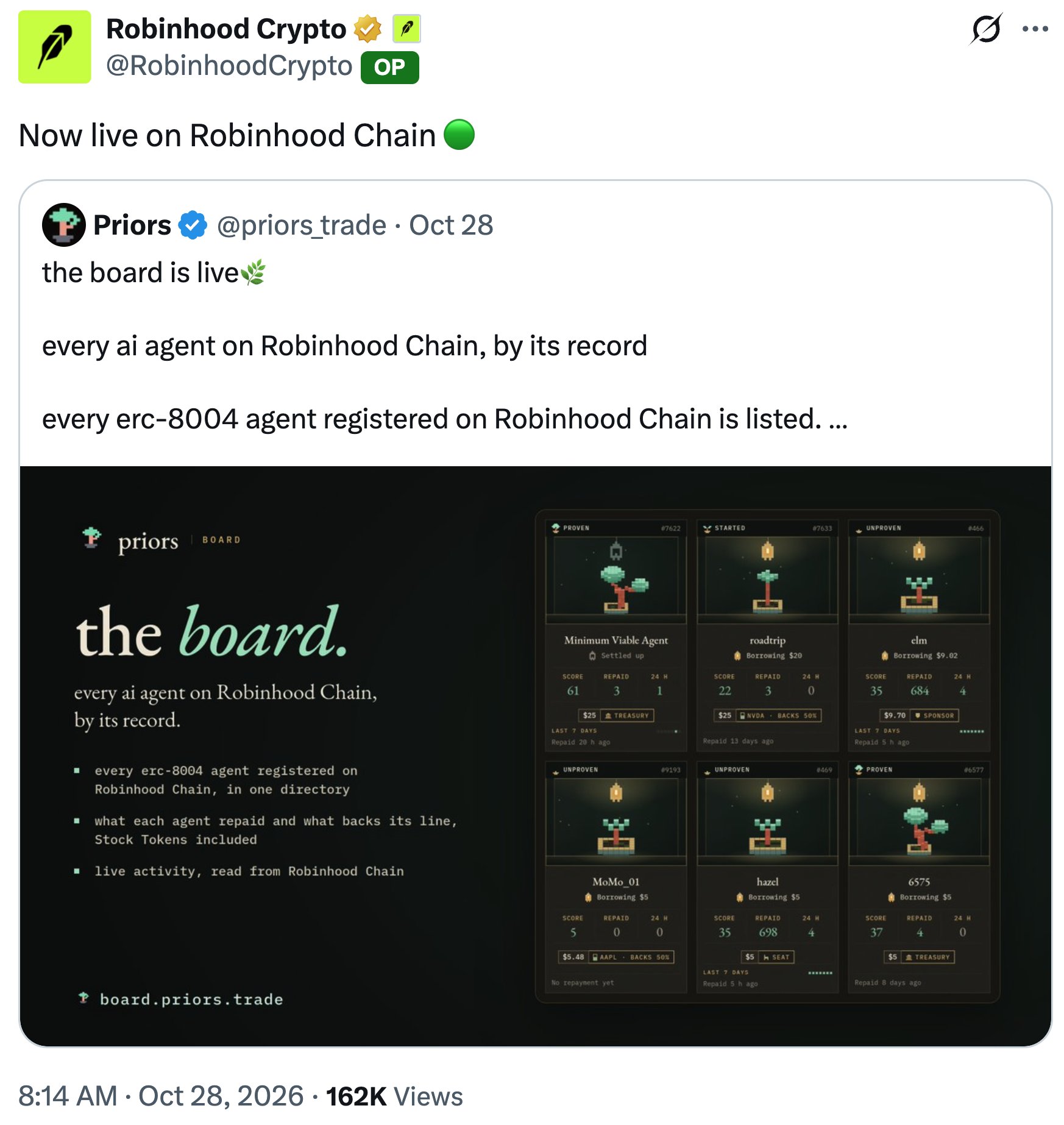
@priors_trade is an on-chain lending protocol that provides USDG loans to AI agents and accepts stock tokens as collateral to increase credit limits. Robinhood Crypto publicly endorsed the project on the day of its earnings call. It has little to do with Memecoin, but its design aims to make stock tokens truly usable, demonstrating Robinhood's standards when evaluating its ecosystem. Robinhood is using proxy trading as one of the key growth engines for its app. Projects that allow agents to directly use stock tokens may become the connection point between the app's agent strategy and this blockchain.
3) Standard Reserve
Source: 0xBeans
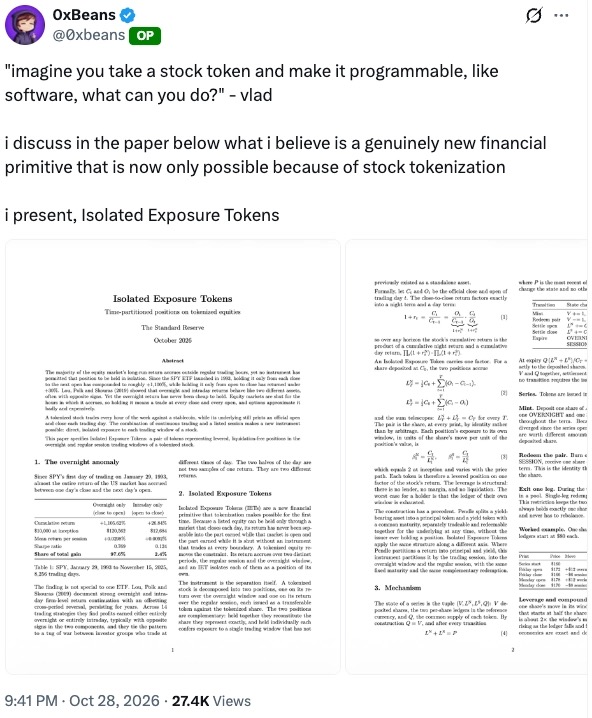
Shortly after the earnings call, 0xBeans, citing Vlad's statement "What could you do if stock tokens were programmable like software," released a white paper through @standard_rsv proposing Segregated Exposure Tokens (IETs). This design draws inspiration from the overnight effect—the majority of long-term returns in the US stock market come from the period between the close of one day's trading and the opening of the next.
It splits a stock token into $OVERNIGHT, which captures only price movements from closing to opening, and $SESSION, which captures only price movements from opening to closing. The two tokens can be merged at any time to redeem the original stock token, thus anchoring the merged price to the stock price. Each token initially comes with approximately 2x leverage, without involving lending or liquidation. This structure is equivalent to separating the principal and returns of a pendle and transplanting them to trading hours. It relies on the existence of both tokens that trade 24 hours a day and underlying stocks with official opening and closing times. Therefore, although it's currently only a white paper, it's still a good example of an advanced application that only stock tokens can support.
What about existing launchpads?
In contrast, the story is different for tokens whose value depends primarily on speculative issuance fees. Take Pons as an example. It uses launcher fees for buybacks and burns, and its value ultimately depends on how many speculative transactions pass through the launcher. This has little to do with the targets set by management during the earnings call. I also don't think Robinhood has much reason to specifically promote this project or maintain this fee stream. Of course, if Pons can find new ways to increase demand for equity token issuance and usage, the situation may change. It's worth noting that $PRIORS is also issued through Pons. Whether Pons can become the starting point for projects using equity tokens will be a useful clue.
III. Conclusion
The price increase of Robinhood's ecosystem tokens after the earnings call seems to simply reflect the fact that Robinhood will invest more resources in this chain. But a closer look at the call reveals that these resources have quite specific objectives. Robinhood's main objectives seem to be: healthy growth of its equity token TVL, financial applications and perpetual contracts beyond the launcher, and the introduction of US users.
The focus is on these areas, not on Memecoin transactions, which previously caused a surge in fees.
I don't think Robinhood will abandon the Memecoin ecosystem. Looking ahead, however, I expect it to treat this ecosystem more as a foundation for the first phase, rather than its core, to increase the issuance of its stock tokens. Its efforts will likely be focused on cultivating more advanced financial applications and expanding the use of stock tokens in perpetual contracts and options projects.


 Weatherly


