Insights4.vc: Is ConsenSys ready to go public?
As the Web3 user base continues to grow, ConsenSys is poised to capture value on multiple levels while consolidating the open ecosystem that underpins its long-term success.
 JinseFinance


Author: insights4vc Source: Substack Translation: Shan Ouba, Jinse Finance
Revolut confirmed a $115 billion valuation on November 4th.
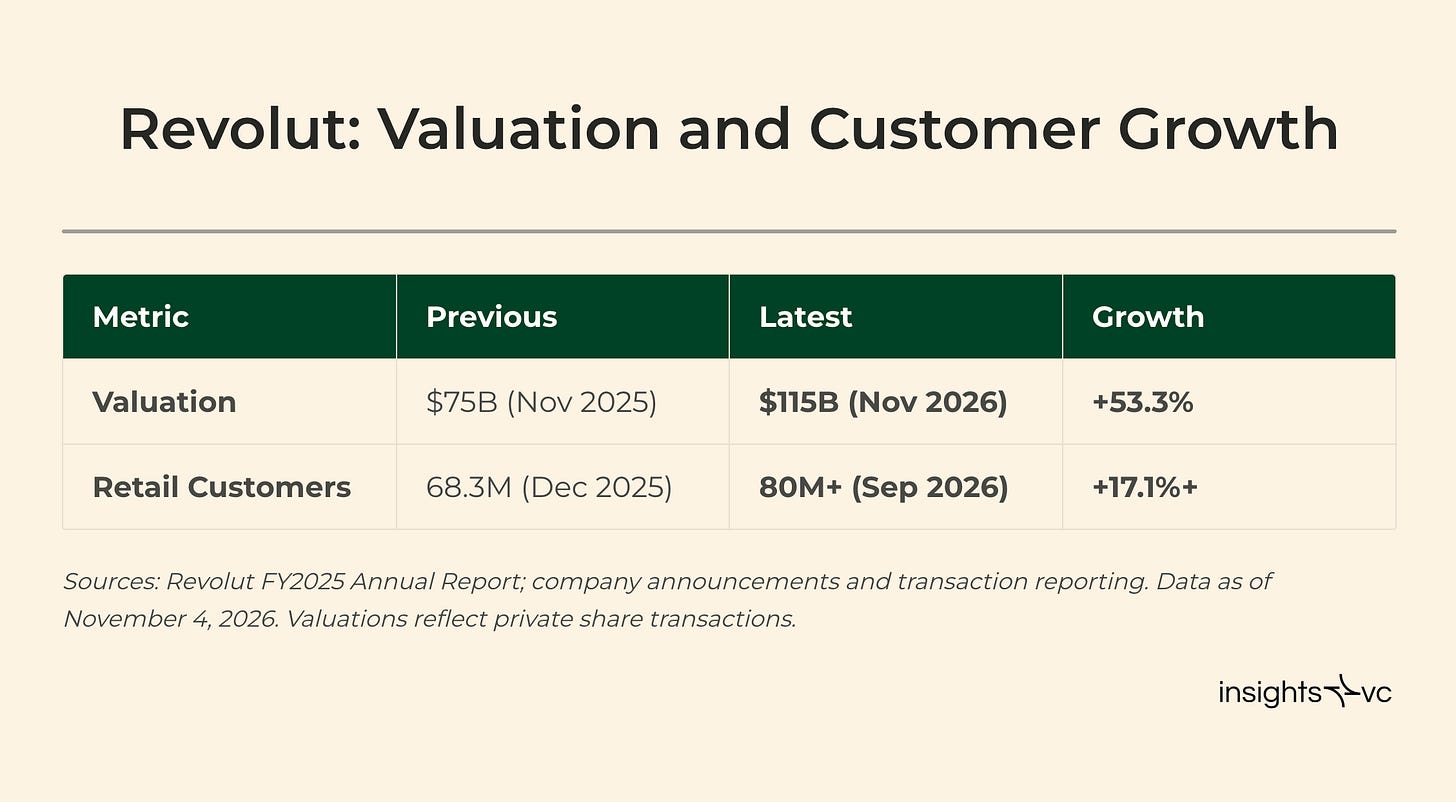
Image source: insights4vc
More than half a year has passed since our Revolut report in March, and significant changes have occurred. The company has expanded its banking business into new markets, obtained more regulatory approvals, and increased its user base from 68.3 million at the end of 2025 to over 80 million.
Image source: insights4vc
Few privately held fintech companies have achieved the scale, growth, and profitability that Revolut has simultaneously reached. With over 70 million users, a continuously expanding balance sheet, and an increasingly diversified revenue structure, this company is increasingly resembling a global digital bank rather than a traditional challenger fintech company. The latest audited financial statements covering 2025 also demonstrate its profitability. Revenue increased by 46% to £4.52 billion (approximately $6 billion), pre-tax profit was £1.71 billion ($2.3 billion), and net profit was £1.31 billion ($1.7 billion). These growth rates are calculated in pounds sterling. In fiscal year 2025, card payment revenue was approximately $1.3 billion, subscriptions $936 million, wealth management $876 million, and foreign exchange $800 million. Wealth management includes non-crypto services; attributing its entire contribution to digital asset monetization would overestimate crypto revenue. Interest income was £974 million, approximately $1.3 billion – this corrects the dollar figure from a previous insight4vc article. Fee revenue accounted for approximately 76% of consolidated revenue in pounds sterling. On a segment basis, Revolut Business contributed 16% of revenue. Based on the pound sterling figures, fee income accounts for approximately 76% of consolidated revenue. On a segment basis, Revolut Business contributes 16% of revenue. Subscriptions provide recurring income, while card, foreign exchange, and wealth management income are more directly dependent on user activity. Interest income is affected by deposit interest payments and asset yields. Banks therefore have multiple revenue streams, but diversification does not mean each segment is equally sustainable. Based on unrounded pound sterling figures, the net profit margin for fiscal year 2025 was 28.9%, lower than the more commonly cited 37.9% pre-tax profit margin. Both describe full-year performance, not the profitability of newly established banks. Based on unrounded sterling data, the net profit margin for fiscal year 2025 was 28.9%, lower than the more commonly cited 37.9% pre-tax profit margin. Both describe full-year performance, not the profitability of newly opened banks. The $67.5 billion customer balance encompasses various legal arrangements. Its basis is £50.183 billion, of which £36.143 billion is on-balance-sheet fiat currency balance and £14.04 billion is partner savings and Flexible Cash Funds. Of the former, £27.194 billion is customer bank accounts and £8.949 billion is electronic money. This total measures the distribution within the Revolut ecosystem, not a pool of held deposits available for lending. The disclosed loan-to-deposit ratio of 6.2% uses total loans and on-balance-sheet customer deposits, excluding the aforementioned partner savings and funds. The base figure is £50.183 billion, of which £36.143 billion is on-balance-sheet fiat currency balance and £14.04 billion is partner savings and Flexible Cash Funds. Of the former, £27.194 billion is in customer bank accounts and £8.949 billion is in electronic money. This total measures the distribution within the Revolut ecosystem, not a pool of held deposits available for lending. The disclosed 6.2% loan-to-deposit ratio uses the total loan amount and on-balance-sheet customer deposits, excluding the aforementioned partner savings and funds. As of December 2025, Revolut disclosed a loan portfolio of approximately $2.9 billion, with cash and government bond investments accounting for about 90% of its assets. This explains why it can generate substantial profits despite limited exposure to consumer credit, while also making its earnings more sensitive to interest rate changes, transaction activity, and customer acquisition expenses. Its capital resources amount to £4.9 billion, all of which is Common Equity Tier 1 capital at the group level. This figure should not be directly compared to the capital adequacy ratio of a particular Brazilian subsidiary. There is another correction that could affect the interpretation of user stickiness. In 2025, the number of users who considered Revolut their primary bank increased by 45%. Revolut did not state that 45% of all users considered it their primary bank—this was a misinterpretation in our March report. The distinction is crucial: the growth in primary banking relationships is commendable, but penetration rate and revenue contribution cannot be inferred from this growth rate. A banking license is underpinning this goal. A November announcement outlined plans to launch banking services in the UK, Mexico, Australia, and New Zealand by 2026. New Zealand regulators confirmed registration completion on November 3rd, and Revolut launched its banking products that same day. Switzerland is still in the application stage: a September 16th announcement pledged over 150 million Swiss francs over five years, but the license has not yet been granted. Revolut has also obtained full banking licenses in France and Colombia. The French approval in August allows it to establish its second European banking hub outside of Lithuania, with plans to gradually migrate Western European customers. Colombia followed suit in September, with a waiting list of approximately 200,000 people, and is expected to begin operations in 2027. Both approvals expand potential coverage, but neither equates to an operational, revenue-generating banking business. In the United States, the OCC's decision was dated September 2nd, and Revolut announced it on September 3rd. This is a conditional preliminary approval; subsequent approvals and operational requirements are still pending. Argentina's announcement on September 24th concerns the license to acquire Banco Cetelem, clearly distinguishing between the three stages of acquisition approval, transaction completion, and subsequent customer onboarding. Treating all these jurisdictions as operating banks would exaggerate current distribution capabilities. The expansion has simultaneously increased the burden on internal controls. On October 27, Reuters, citing a Financial Times report, stated that the UK Prudential Regulation Authority (PRA) reviewed product approvals and stated that it could not independently verify them; another report mentioned Article 166, the requirement for skilled persons to review products. An earlier Financial Times report mentioned that the European Central Bank imposed restrictions in 2025 due to deficiencies in product approvals. These are reported regulatory interventions, not new fines or established violations. The economic implication is that product launch controls will limit the speed at which licenses are converted into revenue. These are reported regulatory interventions, not new fines or confirmed violations. The economic implication is that product launch controls limit the speed at which licenses are converted into revenue. Crypto business licenses are also territorial. On October 19th, when Revolut's Gibraltar entity received its DLT license, the company stated it had over 16 million crypto users. Its European Economic Area operations are conducted through Revolut Digital Assets Europe under MiCA. Gibraltar provides another operating entity for international expansion, not a universal license to serve all countries.
Revolut: EURR is just the beginning. Stablecoins pegged to other currencies are under development, and wider availability of EURR is expected to follow later this year.Nubank's 2026 Profit Engine
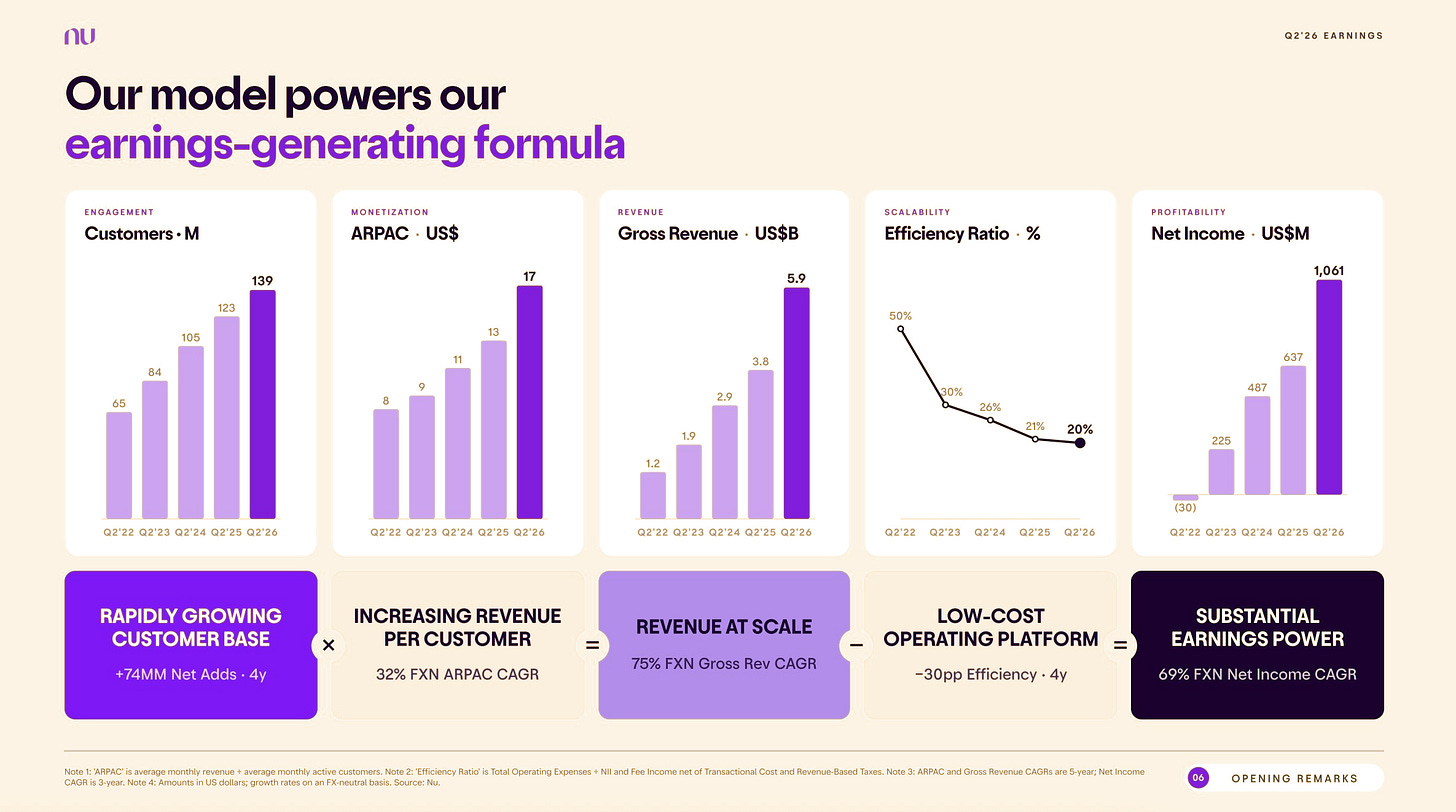
Source: Nubank Q2 2026 Financial Results
As of the data cutoff date, Nubank's 2026 Profit Engine
Source: Nubank Q2 2026 Financial Results
As of the data cutoff date, Nubank's 2026 Profit Engine
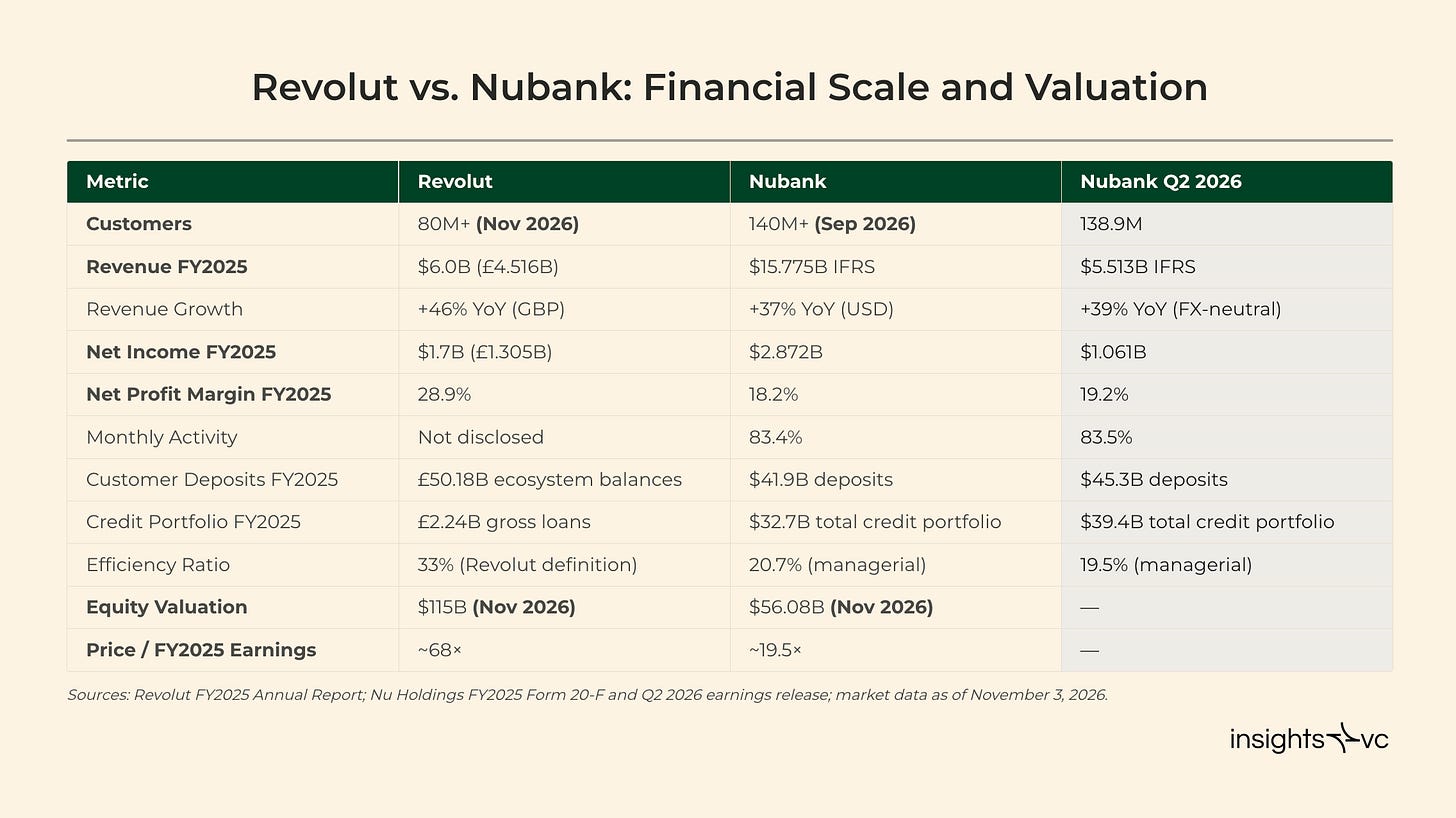
Source: insights4vc
In the second quarter, management-based revenue reached $5.876 billion, representing a year-over-year increase of 39% and a quarter-over-quarter increase of 6% on a constant NUD exchange rate basis.
Source: insights4vc
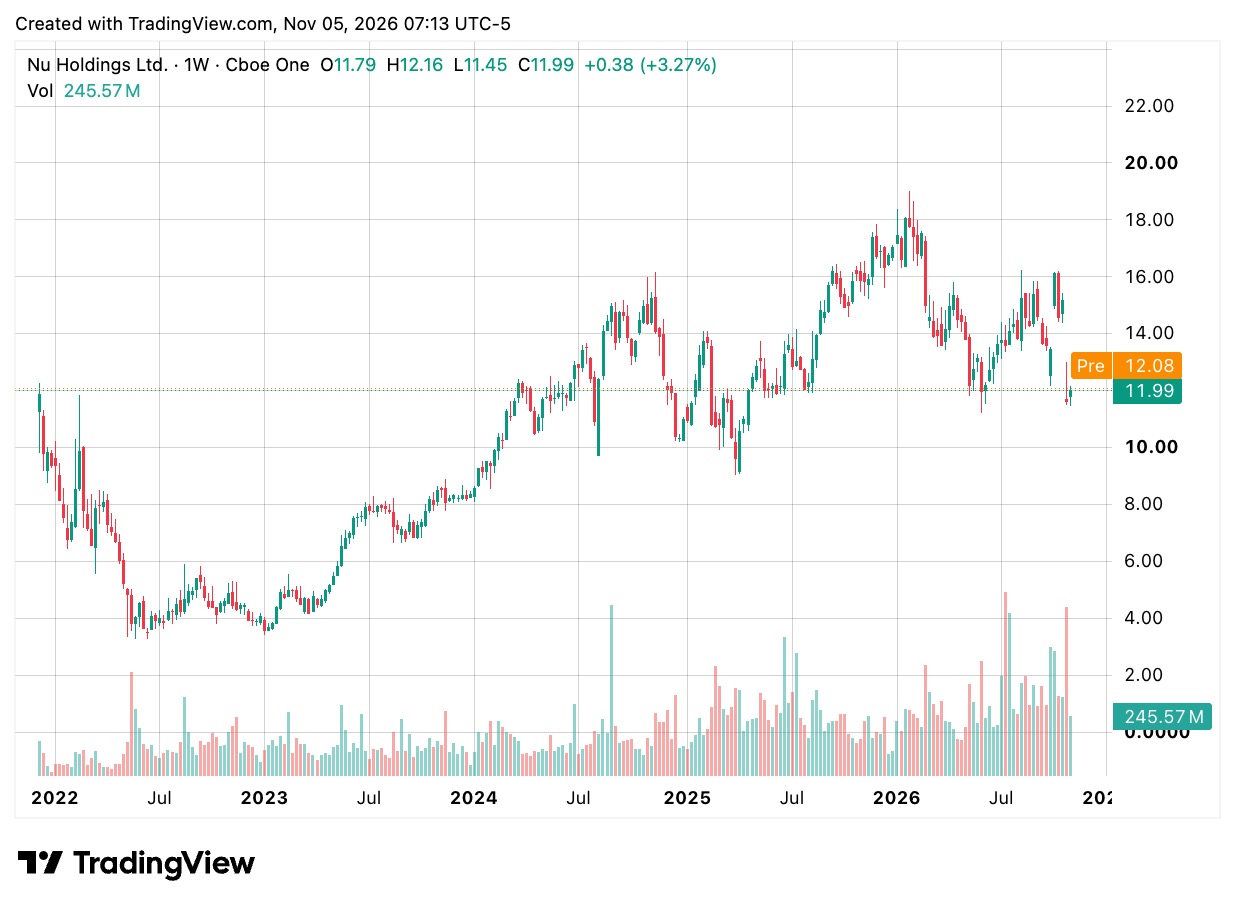
Source: TradingView
What exactly has revenue bridging changed?
Nu's IFRS revenue was $5.5132 billion: $4.7606 billion in interest income and net gains from financial instruments, plus $752.6 million in fees. Management revised the revenue figure to $5.8757 billion. The bridging statement reported $362.4 million in adjustments, leaving a $100,000 discrepancy from the reported total. Adjustments for credit, float, and fee income were $64.9 million, $233.8 million, and $63.8 million, respectively. The changes extend beyond the revenue line. Funding costs shifted from $1.5567 billion to $1.3721 billion; credit costs increased from $1.4822 billion to $1.6908 billion; transaction fees rose from $127.8 million to $130.8 million; and $240.9 million in revenue-based taxes were added to direct costs. Gross profit consequently increased from $2.3465 billion to $2.4411 billion. Operating expenses decreased from $1.1056 billion to $806.2 million, and pre-tax profit rose from $1.2363 billion to $1.6303 billion. Income tax increased accordingly from $175.2 million to $569.2 million, while net income remained unchanged at $1.0611 billion. These reclassification and tax equivalence adjustments are precisely why management-reported total revenue, IFRS revenue, and net interest income are not interchangeable. Cost of capital shifted from $1.5567 billion to $1.3721 billion; credit costs increased from $1.4822 billion to $1.6908 billion; transaction fees rose from $127.8 million to $130.8 million; and $240.9 million in revenue-based taxes were included in direct costs. Gross profit consequently increased from $2.3465 billion to $2.4411 billion. Operating expenses decreased from $1.1056 billion to $806.2 million, and pre-tax profit rose from $1.2363 billion to $1.6303 billion. Income tax increased accordingly from $175.2 million to $569.2 million, while net income remained unchanged at $1.0611 billion. These reclassification and tax equivalence adjustments are precisely why management-reported total revenue, IFRS revenue, and net interest income cannot be used interchangeably. Nu disclosed net interest income of approximately $3.7 billion, with a net interest margin of 22.9% and a risk-adjusted net interest margin of 12.4%. Of management's gross profit, credit contributed 41%, float 34%, and fees 25%. This is the gross profit percentage, not the revenue percentage. Float and fees combined account for more than half, but credit still dominates a large portion of profit fluctuations. Of the $39.4 billion credit portfolio, approximately $26 billion is in credit cards, $10.3 billion in unsecured loans, and $3.1 billion in secured credit. Deposits total $45.3 billion, with funding costs at 88% of the interbank lending rate. This relative benchmark cost differs from the absolute interest rate: higher local interest rates can support float income but also increase funding costs and borrowers' repayment pressure. Credit metrics need to be viewed more cautiously than a 33% annualized ROE. Nu disclosed a divergence in consumer finance delinquency rates: the 15-90 day delinquency rate improved to 4.8%, while the delinquency rate for loans over 90 days rose to 6.9%. Management largely attributed the previous improvement to seasonality and acknowledged an intention to expand into higher-risk customer groups. For example, if the management-reported credit costs of $1.691 billion in the second quarter increased by 10%, assuming revenue and other costs remain unchanged, it would wipe out approximately $169 million in pre-tax profit, about 10% of management's pre-tax profit. This is a sensitivity assessment, not a forecast or an estimate of losses implied by the delinquency rate. Management largely attributed the earlier improvements to seasonality and acknowledged a willingness to expand into higher-risk customer segments. For example, if management-reported credit costs of $1.691 billion in the second quarter were to rise by 10%, it would wipe out approximately $169 million in pre-tax profit, or about 10% of management's pre-tax profit, assuming revenue and other costs remain unchanged. This is a sensitivity assessment, not a forecast or an estimate of losses implied by the non-performing loan ratio. Capital is another constraint. Brazil's prudent consolidated CET1 ratio in June was 11.9%, and the total capital adequacy ratio was 15.7%, lower than December's 13.0% and 16.6%, respectively. The group stated that it meets applicable requirements. The increase in risk-weighted assets indicates that lending growth is consuming capital space: maintaining high returns does not eliminate the need for retained earnings or capital allocation across countries. These Brazilian-reported ratios do not describe Nu Holdings as a whole. Brazil's prudent consolidated CET1 ratio was 11.9% and total capital adequacy ratio was 15.7% in June, down from 13.0% and 16.6% in December. The group stated that it meets the applicable requirements. The increase in risk-weighted assets indicates that lending growth is consuming capital space: maintaining high returns does not eliminate the need for retained earnings or capital allocation across countries. These Brazilian-based ratios do not describe Nu Holdings as a whole. Brazil's growth is increasingly reliant on existing customers. Ultravioleta targets high-income earners, while Croma, launched in July, targets a segment between the mass market and high-income earners. Bundling subscriptions, savings, and card benefits aims to solidify relationships. Nu defines a main bank as one where at least half of a customer's after-tax monthly income flows through NuAccount; penetration is calculated among qualified active customers who have had an account for more than 12 months. This is also an indicator that cannot be directly equated with the growth rate of main accounts disclosed by Revolut. This is also an indicator that cannot be directly equated with the growth rate of main accounts disclosed by Revolut. Mexico is the market with the clearest competitive overlap. Nu had 16 million customers in July and launched its banking service on August 6th; Revolut launched its banking service on January 27th and surpassed 500,000 customers by June 8th. The figures at these two different points in time show Nu's clear advantage in existing customers, rather than a precise market share ratio. Colombia had over 5 million customers and approximately $3.3 billion in deposits in June, forming a third market, but customer distribution is still dominated by Brazil. Colombia had over 5 million customers and approximately $3.3 billion in deposits in June, forming a third market, but customer distribution remains dominated by Brazil. NuFormer may simultaneously impact risk control and service costs. Nu claims the model has been used for credit cards in Brazil and Mexico, unsecured loans in Brazil, and is still being tested for SMEs and Colombian credit cards. The company also claims its AI agents handle over 60% of customer service conversations in Brazil. These are the company's self-reported operational data, not independently calculated profit contributions. Better forecasting can support safer approvals or higher loan amounts, but losses from newly approved loans will only become apparent later. The real evidence will be performance by loan year and risk stratification, as well as service quality and costs. The service cost of approximately $1 is higher than the $0.8 disclosed a year ago, which in itself does not prove that AI has led to a decrease in costs. The company also claims that its AI agents handle over 60% of customer service conversations in Brazil. These are self-reported operational data, not independently calculated profit contributions. Better forecasting may support safer approvals or higher loan amounts, but losses on newly approved loans will only become apparent later. The real evidence will be performance by loan year and risk stratification, as well as service quality and cost. The service cost of approximately $1 is already higher than the $0.8 disclosed a year ago, which in itself does not prove that AI has led to a decrease in costs. Nu Global has changed its distribution model. Nubank Crypto announced in March that it has over 7 million customers, offering buying, selling, custody, and USDC exchange. Earn Crypto, launched on March 17th, supports SOL staking and offers a promotional interest rate of 6%. Brazil's previously launched USDC rewards program is a separate product, and its launch rate in January 2025 should not be considered a verified yield in November 2026. Nu Global, launched on September 10th, allows users to hold USD and EUR balances in USDC and EURC. October documentation advertises variable yields of up to 3.50% and 2.20%, accruing interest daily with no lock-up period. The account supports transfers to over 35 countries, comes with a virtual Mastercard, and has a 0.8% digital asset transaction fee. Nu advertises no management or transfer fees, although receiving institutions may charge additional fees. Single transfer limits are $1 to $10,000. Deductions are made from USDC; EURC must be exchanged first, and cash withdrawals are not supported. Availability remains subject to eligibility and account opening progress. This account supports transfers to over 35 countries, comes with a virtual Mastercard, and has a digital asset transaction fee rate of 0.8%. Nu advertises no management or transfer fees; however, receiving institutions may charge additional fees. Single transfer limits are $1 to $10,000. Card payments are deducted from USDC; EURC must be exchanged first, and cash withdrawals are not supported. Availability remains subject to eligibility and account opening progress. The provider of this infrastructure is clearly defined. Sygnum provides exchange, trading, custody, and Swiss bank guarantees. However, Nu Global's clients contract with Nu Global AG, not directly with a traditional deposit bank. The terms grant clients a contractual right to claim repayment, not ownership of specific segregated tokens; in bankruptcy proceedings, they are repaid as unsecured creditors of Nu Global, with an additional claim based on a bank guarantee. Recovery follows the guarantee terms, including currency conversion regulations and potential compliance fees. Sygnum offers exchange, trading, custody, and Swiss bank guarantees. However, Nu Global's clients contract with Nu Global AG, not directly with a traditional deposit bank. The terms grant clients a contractual right to claim repayment, not ownership of specific segregated tokens; in bankruptcy proceedings, they are repaid as unsecured creditors of Nu Global, with an additional right based on a bank guarantee. Recovery follows the guarantee terms, including currency conversion rules and potential compliance fees. Nu Global AG's anti-money laundering regulation is handled by the VQF. Its terms explicitly state that it is not directly regulated by FINMA, and its accounts are not within the deposit insurance system. Therefore, this guarantee cannot be considered Swiss deposit insurance or FDIC protection. Nu's U.S. accounts are a separate matter legally. Deposits are held at FDIC member bank Lead Bank, which advertises a variable annual yield of 3.50% under the terms of September 10, with no minimum balance requirement to obtain this rate. Nu's own national bank received conditional approval from the OCC in January; the September launch used a partner bank structure. Nu Global's adoption and revenue contribution are not separately disclosed in the reviewed materials, and there are no publicly available figures to demonstrate its substantial contribution to consolidated earnings. Nu Global's adoption and revenue contribution were not separately disclosed in the reviewed materials, and there are no publicly available figures to demonstrate its substantial contribution to consolidated earnings. Revolut has demonstrated that it can achieve substantial profitability even with relatively limited lending. Nu's much larger consumer credit ledger makes risk control more decisive, and transaction data and relationships with major banks support lending decisions. Assessing its operational efficiency must take this risk into account. Local inflation and interest rates affect borrower affordability and spreads, and dollar investors also bear the cost of currency conversion. Revolut's wider fee structure reduces its reliance on credit but remains exposed to payments, transaction activity, and customer acquisition costs. Assessing its operational efficiency must take this risk into account. Local inflation and interest rates affect borrowers' affordability and interest rate spreads, while dollar investors also bear the burden of currency conversion. Revolut's wider fee structure reduces its reliance on credit, but it remains exposed to payments, transaction activity, and customer acquisition costs. Image source: insights4vc Stablecoins can scale distribution without replicating every local banking system. Revolut's proprietary EURR brand allows it to control product design on the client side while still relying on Bridge as the issuer. Nu uses the mature Circle coin and Sygnum infrastructure. Neither structure establishes a claim to reserve revenue. Commercial returns may come from transactions, card spending, or negotiated distribution arrangements; these undisclosed agreements make reliable profit margin comparisons impossible. Free transfers also mean that increased payment volume does not necessarily lead to increased fees. Revolut's proprietary EURR brand allows it to control product design on the client side while still relying on Bridge as the issuer. Nu uses the mature Circle currency and Sygnum infrastructure. Neither structure establishes a claim to reserve revenue. Business returns may come from transactions, card spending, or negotiated distribution arrangements; these undisclosed agreements make reliable profit margin comparisons impossible. Free transfers also mean that increased payment volume does not necessarily lead to increased direct fees. Nu's distribution advantage lies most deeply in its existing relationships in Latin America. Revolut's cards, foreign exchange, corporate accounts, and European customer base represent another customer acquisition path. Stablecoins make their international products more similar, but they do not automatically migrate domestic risk control data, payroll relationships, or merchant usage habits across borders. Mexico is a direct sample to test these advantages; most existing customers are still distributed across different markets. Revolut's cards, foreign exchange, corporate accounts, and European customer base represent another customer acquisition path. Stablecoins make their international products more similar, but they don't automatically migrate domestic risk control data, payroll relationships, or merchant usage habits across borders. Mexico is a direct example of these advantages; most existing customers are still distributed across different markets. Revolut's next challenge is converting its expanding customer base into deeper banking relationships. The company claims that 80% of adults in Ireland have a Revolut account, but a Reuters analysis on November 4th found that its per-customer income and deposit balances are still relatively low compared to traditional banks. Alex Immerman of a16z listed main account penetration rate and customer balance as key indicators. The company claims that 80% of adults in Ireland have a Revolut account, but a Reuters analysis on November 4 found that its per-customer income and deposit balances are still relatively low compared to traditional banks. Alex Immerman of a16z listed main account penetration and customer balances as key indicators to watch. Based on the closing price on November 3, Nu's market capitalization of approximately $56.08 billion is about half that of Revolut's trading valuation. Nu's four verified quarterly profits—$782.7 million, $894.8 million, $871.4 million, and $1.0611 billion—total $3.61 billion for the fiscal year ending June 2026, corresponding to approximately 15.5 times reported earnings. If we use Nu's rounded net profit of $2.9 billion for fiscal year 2025, it would be approximately 19 times. Its management-reported revenue of $16.3 billion for fiscal year 2025 is still not suitable for direct price-to-sales ratio comparison. Revolut The ratio of approximately 68 times Nu's fiscal year 2025 net profit in US dollars is used, rounded up. Even if the period is consistent, differences in exchange rates, provisions, taxes, liquidity, and trading rights still exist. These disclosed profits are not representative of future earnings. At the closing price on November 3, Nu's market capitalization of approximately $56.08 billion was about half the valuation of Revolut's transaction. Nu's four verified quarterly profits—$782.7 million, $894.8 million, $871.4 million, and $1.0611 billion—totaled $3.61 billion for the year ending June 2026, corresponding to approximately 15.5 times disclosed earnings. If Nu's fiscal year 2025 net profit of $2.9 billion is used instead, the ratio would be approximately 19 times. Its fiscal year 2025 revenue of $16.3 billion (management-reported) is still not suitable for direct price-to-sales ratio comparison. Revolut's ratio of approximately 68 times uses its fiscal year 2025 net profit in US dollars, rounded up. Even if the timeframe remains consistent, differences in exchange rates, provisions, taxes, liquidity, and trading rights still exist. These disclosed profits are not representative of future earnings. For example, if Revolut's valuation remains unchanged at $115 billion, achieving a P/E ratio of 30 would require approximately $3.8 billion in annual recurring net income, and $5.75 billion at 20, while its reported net income for fiscal year 2025 was $1.7 billion. These are valuation scenario projections, not guidance. They illustrate how much future earnings have already been priced in and do not assume that current profit margins, tax rates, or capital requirements will remain unchanged during expansion. These indicate how much future profit has already been priced in, and do not assume that current profit margins, tax rates, or capital requirements will remain unchanged during expansion. Revolut's current schedule is a mix of established operations and pending approvals. The New Zealand bank is already open, and savings products launched on November 3rd. Switzerland has an application under review, backed by a announced five-year investment, but no commitment has been made regarding approval timelines. Argentina received acquisition approval; closing and public launch are separate steps. Bank of America received conditional approval and plans to launch in 2027, still subject to remaining regulatory requirements. Revolut stated in September that it aimed to reach 100 million customers by mid-2027; later statements about having 100 million active customers in over 100 countries should not be equated with a commitment to a specific timeline. New Zealand banks have opened, with savings products launched on November 3rd. Switzerland's application is under review, backed by a announced five-year investment, but no approval timeline has been committed. Argentina received acquisition approval; closing and public launch are separate steps. Bank of America received conditional approval and plans to launch in 2027, still subject to remaining regulatory requirements. Revolut stated in September that it aimed to reach 100 million customers by mid-2027; later statements about having 100 million active customers in over 100 countries should not be equated with a commitment to a clear timeline. According to verified announcements, EURR is still being rolled out in phases, with wider availability planned for later in 2026. Other cryptocurrency stablecoins are announced as being under development with no confirmed release date. The Gibraltar license has been secured, but the company states that the markets and services supported by the entity will be explained later. These are distribution plans, not disclosed revenue projections. Nu's Mexican bank is operational; the next test is deeper utilization and funding costs. Its US partner banking services and Nu Global are now online, with phased account opening. A September announcement planned to complete the integration of Global with Brazil, Colombia, Mexico, and the US within the following months, but no specific completion date was given. The announcement also mentioned an upcoming launch of a 4.50% annualized yield on savings balances up to $10,000, provided the account holder holds both an account and a credit card and completes three qualifying transactions within 34 days. Nu's own US bank remains under conditional approval; the OCC requires capital injection within 12 months of the January decision and opening within 18 months, otherwise an extension must be applied for. In August, the company was also working on obtaining a full banking license in Brazil, again without a confirmed completion time. The September announcement outlined plans to integrate Global with Brazil, Colombia, Mexico, and the United States within the coming months, but no specific completion date was set. The announcement also mentioned an upcoming launch of a 4.50% annualized return on savings balances up to $10,000, provided the account and credit card are held simultaneously and three qualifying transactions are completed within 34 days. Nu's own US bank remains under conditional approval; the OCC requires capital injection within 12 months of the January decision and commencement of operations within 18 months, otherwise an extension must be applied for. In August, the company was also working towards a full banking license in Brazil, again without a confirmed completion date.
Marcel van Oost: Santander Bank is expanding with Openbank, directly competing with Nubank and Revolut. CEO Ana Botín said the digital bank will enter Colombia and Peru, and Brazil may follow suit. Similar monetary and payment functions, now built on different balance sheets and customer obligations. Nu's profitability still heavily relies on lending, float, and deeper local relationships. Revolut's valuation, on the other hand, pre-empts greater profits from international distribution. Stablecoins offer another path to serving these customers, but neither company has disclosed sufficient product economics to justify their valuations.
As the Web3 user base continues to grow, ConsenSys is poised to capture value on multiple levels while consolidating the open ecosystem that underpins its long-term success.
JinseFinanceCrypto Market, Market, CEX, DEX, Insights4.vc: Inside the $19 Billion Flash Crash, Golden Finance, the worst crash in cryptocurrency history.
JinseFinanceBlockchain has progressed from the proof-of-concept stage to the actual production stage of money flow, collateralization, and fund allocation.
JinseFinanceCircle, Coinbase, IPO, Insights4.vc: Disclosing the Current State of the Crypto Equity Market Golden Finance, now is the time to act.
JinseFinanceRobinhood targets a market of 400 million people: 24-hour stock trading arrives in the EU.
JinseFinanceInvestment, BTC, Insights4.vc: The Evolution of Crypto Venture Capital Golden Finance, The origins of modern venture capital can be traced back to the period after World War II.
JinseFinanceStablecoins, Venture Capital, Crypto Market, Insights4.vc: The State of Venture Capital and Stablecoins in 2025 Golden Finance, Reasonably price risks and keep the market running.
JinseFinanceRegulation, United States, Crypto Market, Insights4.vc: Global Crypto Asset Regulation Outlook (May 2025) Golden Finance, Cryptocurrency regulation has reached a critical moment in 2025.
JinseFinancePrivacy, privacy protection, fully homomorphic encryption, zero-knowledge proof, Hack VC: A detailed overview of the four blockchain privacy solutions and related projects Golden Finance, Privacy is a basic human right. Without privacy, there is no freedom and democracy.
JinseFinanceSome jurisdictions are introducing digital assets as a tax option, while others impose high taxes on crypto gains.
 Cointelegraph