The Dark Side of Binance Alpha
Alpha is not a positive sign for sustainable growth.
 JinseFinance

Author: 0xjacobzhao @ IOSG
Imagine a sudden, terrifying alarm in the early morning of a certain day in 203X: a batch of early BTC addresses, dormant for over a decade, begin to ghost-like transfer assets. There are no hacking incidents, no private key leaks, only "legitimate" signatures generated out of thin air. As high-value dormant UTXOs are successively cleared out, the market finally awakens: an unknown quantum computing entity can now directly deduce private keys from historically exposed public keys. Panic instantly engulfs the market. Deep within the dark web, public key repositories, accumulated over ten years with a "harvest first, decrypt later" approach, are being frantically auctioned off, awaiting the realization of wealth through computing power. The Bitcoin community is plunged into an unprecedented crisis of faith: faced with dormant coins being plundered by quantum computing power, should they uphold the immutable principle of "code is law," or forcibly freeze legacy assets through a soft fork? The clash between the narrative of property rights and the law of survival ignites a complete governance deadlock.
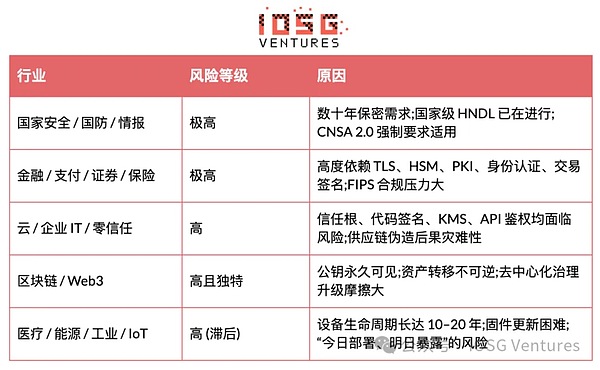
Q-Day refers to the point in time when a quantum computer first possesses the ability to practically crack mainstream public-key cryptography. It is not a fixed date, but rather a probabilistic range influenced by hardware advancements, error correction capabilities, algorithm optimization, and the confidentiality of national projects.
Current research and implementation of PQC mainly focus on the following major mathematical camps:
Lattice-based cryptography:Security is built on high-dimensional lattice problems (such as Module-LWE), combining efficiency and security. It is the core direction for current standardization and engineering implementation, with representative algorithms being ML-KEM and ML-DSA.
In addition to the core algorithm, the construction of the quantum-resistant security system also relies on multi-layered engineering strategies:
Hybrid Deployment: Adopting a parallel signature/encryption mode of "traditional algorithms (such as ECC/RSA) + PQC" as a risk hedging means in the early stage of migration, ensuring that even if the new algorithm has unknown vulnerabilities, the traditional algorithm can still provide bottom-line security.
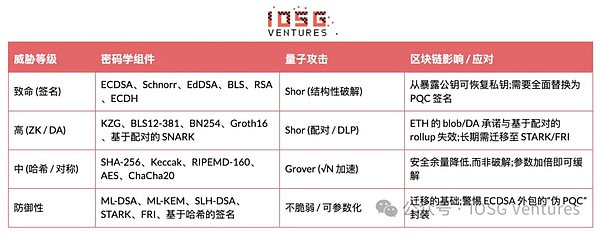
Threat Map of Cryptographic Components in Blockchain Systems
For the blockchain industry, the core issue is not dealing with immediate hackers, but rather initiating a "migration countdown" in a race against time. Quantum computing will not instantly destroy the blockchain, but it will force the industry to undergo a more difficult underlying cryptographic reconstruction than Web2.
For the blockchain industry, the core issue is not dealing with immediate hackers, but initiating a "migration countdown" in a race against time. Quantum computing will not instantly destroy the blockchain, but it will force the industry to undergo a more difficult underlying cryptographic reconstruction than Web2.
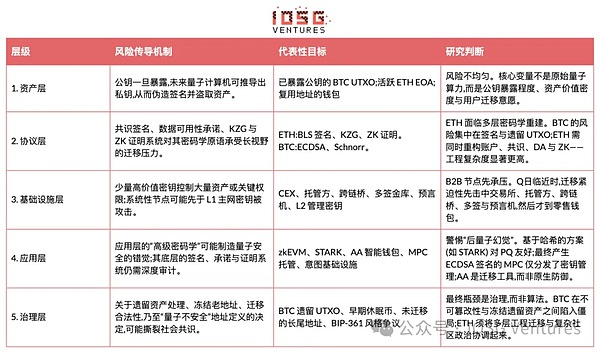
Bitcoin's quantum risk is not evenly distributed across all BTC, but rather highly dependent on whether the public key has been exposed on-chain
. The real high risk lies not in all UTXOs across the network, but rather in early legacy outputs, addresses with exposed public keys and still holding balances, and long-dormant high-value UTXOs. Bitcoin's hash components (SHA-256, SHA256d, and RIPEMD-160) primarily face a decrease in security margin due to the Grover algorithm, rather than being structurally breached by Shor's algorithm like ECDSA/Schnorr. High Risk: UTXOs with Statically Exposed Public Keys: Early P2PK and Taproot (P2TR) outputs, and P2PKH/P2WPKH addresses that have been spent, reused, and still hold balances. Their complete public keys are permanently on-chain, and once CRQC is introduced, they will be the first to be directly breached by Shor's algorithm. Medium Risk: UTXOs whose public keys have not yet been exposed but will be exposed in the future: Unspent and unreused P2PKH/P2WPKH addresses. Only the public key hash is exposed on-chain, and the risk exists only within the brief "quantum pre-race window" from transaction broadcast to confirmation. Low Risk: Assets Already Migrated to Quantum-Safe Addresses: Assets that will migrate to Quantum-resistant (PQ) addresses via soft forks in the future will have significantly reduced risk, but this highly depends on long-term collaborative upgrades across the entire ecosystem. Engineering Challenges: Signature Inflation and the "Soft Fork Priority" Path. Under Bitcoin's governance structure, the political cost of a one-time hard fork to remove ECDSA/Schnorr is extremely high. Introducing new quantum-safe output types through soft forks is one of the more realistic, gradual paths. Current discussions include draft directions such as BIP-360/P2MR (Pay-to-Merkle-Root), but there is still a long way to go before network-wide consensus and activation. This move incurs a hefty "engineering tax": the current ECDSA/Schnorr signature is only about 64–72 bytes, while the candidate ML-DSA (2.4–4.6 KB) and SLH-DSA (7–49 KB) are dozens of times larger. This order-of-magnitude expansion will trigger a systemic chain reaction: directly increasing block weight and transaction fees, exacerbating the storage and bandwidth burden on nodes, leading to a significant deterioration in UTXO sets and wallet UX, ultimately creating a negative feedback loop that further increases the network's resistance to quantum migration. More importantly, Bitcoin lacks the ability to quickly switch algorithms. Unlike centralized systems where certificates can be upgraded or algorithms replaced by a single entity, it requires consensus rules, address formats, wallets, mining pools, exchanges, custodians, and hardware wallets to adapt synchronously. Therefore, quantum migration resistance is not a single-point technological upgrade, but a long-term coordinated project across the entire ecosystem. Governance Game: The "Value Dilemma" of Legacy UTXOs Even if the PQ address is successfully launched, how to deal with long-term unmigrated legacy UTXOs, including the early dormant BTC generally considered to belong to the Satoshi Nakamoto era, remains the ultimate problem. Both extreme solutions conflict with Bitcoin's core values: Inaction: Legacy coins will become a "free lunch" for the first attacker with CRQC capabilities, triggering market panic. Forced freezing/cancellation directly violates the "Not your keys, not your coins" principle of property rights and the narrative of immutability, easily tearing apart community consensus and even triggering chain forks. A pragmatic compromise is the "Legacy Sunset" mechanism, which has been implemented for many years: through long-term issuance of abandonment warnings and a gradual increase in the cost of old outputs as a relay strategy, friction is created, ultimately imposing constraints through a soft fork under multi-party coordination. Discussions on legacy signature sunsets like BIP-361 are essentially exploring this path. Therefore, Bitcoin migration is fundamentally not a cryptographic issue. The PQ algorithm already exists and can be integrated; the real bottleneck lies in the social consensus surrounding issues such as immutability, property rights, and the legitimacy of "declaring assets quantum insecure." In other words, the quantum risk of Bitcoin is not a doomsday scenario where it suddenly goes to zero, but a gradual process from theoretical feasibility and economic cost to practical feasibility; what the industry really needs to strive for is to complete the migration coordination before the economics of attacking it become possible. Figure 5: Bitcoin's Quantum-Resistant Migration: A Long-Term Governance Process. Ethereum's Quantum-Resistant Migration—Full-Stack Restructuring and the "Lean" Roadmap. Ethereum is proactively addressing the quantum threat. Led by the Ethereum Foundation (EF) Post-Quantum team (https://pq.ethereum.org/), research is progressing steadily through open governance processes such as All Core Devs. Its core strategy is not a "one-time bet on a single quantum-resistant (PQ) algorithm," but rather a comprehensive enhancement of the network's cryptographic agility—ensuring that account authentication, consensus signatures, proof systems, and data layer commitments are long-term replaceable, upgradeable, and verifiable. Ethereum's quantum risk is highly concentrated in four cryptographic components: EOA accounts (ECDSA/secp256k1), validator consensus (BLS signatures), data availability (KZG commitments), and parts of the ZK proof system. To address this, EF has designed a "Lean" roadmap that advances in parallel along three tracks: execution, consensus, and data.Execution Layer (User Accounts): AA Buffer and L2 Testbed
Faced with massive EOAs, a direct hard fork faces enormous resistance. Ethereum, relying on account abstractions (such as ERC-4337 and EIP-7702), endows smart contract wallets with "signature agility," supports hybrid signatures and gradual migration, and avoids forced coordination across the entire network. At the same time, L2, with its flexible governance, becomes a natural testbed for PQ deployment;
Consensus Layer (Validator Signatures): The "Combination Punch" of leanXMSS and leanVM
Aims to completely replace BLS signatures that rely on elliptic curve pairing.
The core strategy is to use hash-based leanXMSS and combine it with the minimalist zkVM (leanVM) for SNARK aggregation. Key engineering breakthrough: leanVM is expected to compress massive hash signature data by approximately 250 times, offsetting the expansion of PQ signature size and retaining the scalability advantage of "multi-signature integration" while entering the post-quantum era. Data Layer (Blob, DA, and KZG): Long-Term Reconstruction of Underlying Commitments Under CRQC conditions, the underlying security assumptions of KZG still need to be re-evaluated and migrated to a more PQ-friendly commitment or proof system in the long term. The ultimate direction is to evolve towards hash-based STARK or lattice-based commitment schemes. This is a multi-year, protocol-level underlying reconstruction, not an immediate failure. Furthermore, Ethereum's quantum risk is not evenly distributed. EOA is the largest value pool; exchanges, bridges, custodial hot wallets, governance/upgrade keys, L2 sequencers, and admin keys are high-value operational keys that may be pressured before the protocol itself. Overall, Ethereum's resistance to quantum migration is not a single-point signature replacement, but a multi-year, full-stack engineering effort involving accounts, consensus, DA, ZK, L2, bridges, custody, and formal verification. Figure 6: Ethereum Post-Quantum Migration: Execution (User Accounts), Consensus (Validator Signatures), and Data (Commitments and Proofs).
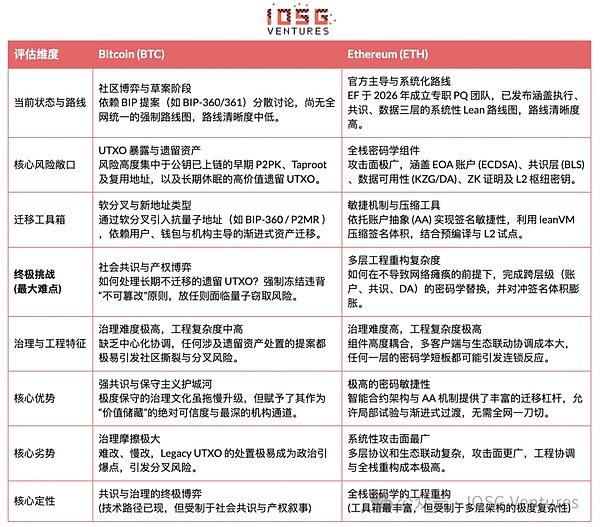
A panoramic comparison of the post-quantum migration profiles of Bitcoin and Ethereum
Theoretically, all public blockchains relying on traditional public-key cryptography face quantum risks. However, the ones that truly constitute a systemic resistance to quantum migration are mainly Bitcoin and Ethereum: the former involves legacy UTXO, immutability, and property rights governance, while the latter involves a full-stack reconstruction of accounts, consensus, DA, ZK, and L2. Other public chains are more suitable as supplementary references for technical paths and risk scenarios. Solana represents a high-throughput chain's engineering exploration of PQ signature verification costs. Its community has already discussed Falcon-512 / FN-DSA verification syscalls, but this solution is still an exploratory supplement and does not replace the existing Ed25519, nor does it represent an official migration route for Solana. Starknet / STARK represents a more PQ-friendly ZK route for hash-based proof systems. Compared to SNARK systems that rely on pairing/KZG, STARK's underlying proof mechanism is more suitable as a post-quantum ZK direction; however, this does not mean that the entire Starknet network is quantum secure. Wallet signatures, hash parameters, bridging mechanisms, and Ethereum L1 settlement still need to be migrated synchronously. Native or quasi-native PQ chains such as QRL, Quantus, and Abelian provide technical references for clean-slate post-quantum design: QRL represents the early hash-based signature route, Quantus represents the native PQ L1 of the new generation NIST PQC narrative, and Abelian leans towards lattice-based privacy-preserving L1. They represent a feasible path to "build quantum-resistant chains from day one," but their network effects, liquidity, and application ecosystem are still far weaker than BTC/ETH, making them more suitable as technical examples. Conclusion: Security Debt Maturity and the Countdown to "Q-Day" for the Entire Ecosystem Quantum computing is not the "doomsday weapon" that will end blockchain, but rather a systemic reset of the modern public-key cryptography system. The core threat lies in the future large-scale fault-tolerant quantum computers (CRQC) with strategic-level cracking capabilities. The real risk to the industry is not the lack of post-quantum algorithms (PQC), but whether the entire Web3 ecosystem can complete a coordinated migration across the entire chain before Q-Day (the quantum cracking tipping point). In the short to medium term, the risk of failure of the existing signature system and the high cost of full-stack upgrades constitute a heavy "security debt"; in the long term, survival pressure will transform into an industry catalyst, directly giving rise to new security infrastructure tracks such as PQ hybrid wallets, quantum-resistant institutional custody, quantum risk radar, and PQ signature aggregation. While the macro-level preparation period may last 5–15 years, the truly comfortable "engineering window" is only 5–8 years. This requires a high degree of coordination across the entire chain (from BIP/EIP proposals, node implementation, wallet adaptation to compliance upgrades for exchanges and custodians). More importantly, market repricing may occur earlier than Q-Day itself: once quantum resource estimates continue to decline, hardware roadmaps are significantly accelerated, or regulatory agencies and large custodians take the lead in proposing PQC compliance requirements, the market may examine the cryptographic security model of blockchain assets ahead of time. During this window, the two core ecosystems will face drastically different ultimate tests: Bitcoin: The core challenge is not cryptography, but global social consensus and property rights governance. How to handle long-dormant Legacy UTXOs with exposed public keys is a political game concerning the bottom line of the "immutability" narrative. Ethereum: The core challenge lies in the engineering complexity of its multi-layered protocols and full-stack ecosystem. How to complete cross-layered cryptographic replacements of accounts, consensus, DA, and ZK layers without causing network paralysis, and hedging against signature volume expansion. In long-term asset allocation, post-quantum governance friction constitutes a "structural tail risk" for BTC, but it is by no means a reason to be bearish at present. Its "unchangeable" extremely conservative governance presents a double-edged sword effect: it is both the biggest obstacle to quantum migration and the core moat for maintaining its value store narrative and resisting centralized intervention. This requires investors to abandon the static belief that "BTC will never need major upgrades." In the future, if any of the following scenarios occur: the Q-Day timeline is substantially brought forward, the community refuses to proceed with the PQ migration while the surrounding ecosystem has already taken action, high-value exposed public key UTXOs trigger panic selling, or the disposal of Legacy assets leads to a complete split, the market will revalue BTC's security model and underlying consensus.
Alpha is not a positive sign for sustainable growth.
JinseFinanceDivide the world into two paradigms - the fundamentals paradigm and the cyclical mania paradigm.
JinseFinanceThis article takes a deep dive into the tokens that actually make money and aren’t plagued by looming unlocks.
JinseFinanceAI is used as a weapon in recent years, but can it also be a shield?
 Wilfred
The crux of the matter is the tricks the Fed is playing under the table. The Fed's overt public operations and statements are a cover-up, while the real actions are behind the scenes. The combination of blindfolding and behind-the-scenes movements creates a complete magic effect.
JinseFinanceCrypto markets rebound, South Korea regulator to discuss spot Bitcoin ETFs with SEC's Gensler. El Salvador election favors Bukele's pro-Bitcoin stance. Spain targets crypto for tax payments. South Korea's FSC recommends vetting crypto executives.
 Edmund
New markets take time to mature, and cryptocurrencies are no exception. Michael Nadeau, founder of The DeFi Report, said that the next phase will focus more on fundamental indicators, and better data will drive this change.
JinseFinanceAs more charities and non-profit organisations accept cryptocurrencies, it is important to consider how this new form of giving will impact the philanthropic landscape.
 Catherine
The Coinfessions Twitter account shows something that’s not easily accessible. Their tagline says it all: “anonymous crypto confessions.” The little ...
 Bitcoinist
With the U.K. never having been particularly crypto-friendly, could new regulations and Her Majesty's Treasury’s recent announcements be a game changer?
 Cointelegraph