The Crypto Asset Reporting Framework (CARF), developed by the Organization for Economic Cooperation and Development (OECD), aims to combat cryptocurrency tax evasion globally. Scheduled to take effect in 2027, the framework has already been committed to implementation by 48 jurisdictions, including the United States, the United Kingdom, Germany, Japan, Singapore, and several EU countries. The core requirement of CARF is that cryptocurrency service providers (such as exchanges and brokers) collect and automatically exchange user transaction information, covering cryptocurrencies, stablecoins, and some NFTs. Reportable information includes customer identity, transaction amount, and asset type. This framework complements the OECD's Common Reporting Standard (CRS), building a comprehensive system for exchanging tax-related information on financial accounts. This move marks the beginning of a standardized and collaborative phase in global crypto tax regulation, which is expected to significantly improve tax transparency and compel investors to file compliant reports. Countries are gradually revising their domestic laws to adapt to CARF, and cross-border tax cooperation will become the norm in the future. I. Basic Information on the Crypto Asset Reporting Framework (CARF) II. Core Background and Objectives of the Crypto Asset Reporting Framework (CARF) The Standard for Automatic Exchange of Financial Account Information (including the Common Reporting Standard, CRS) was introduced and implemented in over 100 jurisdictions as of 2023. However, with the continuous evolution of financial markets and the rise of new financial products such as crypto assets, traditional CRS is insufficient to cover related tax compliance risks. Because the crypto asset market is decentralized and relies on new intermediaries (such as crypto asset exchanges and wallet providers), the visibility of related tax activities by tax authorities is reduced, potentially undermining global tax transparency achievements. The CARF was developed to regulate the automatic exchange of tax-related information concerning crypto asset transactions, filling the gap in tax transparency in the crypto asset sector. The CRS was revised to include new digital financial products and strengthen due diligence and reporting requirements, ensuring that international tax information exchange standards remain up-to-date. III. Core Contents of the Crypto Asset Reporting Framework (CARF) (I) CARF Structure and Scope Three core components. First, rules and related commentary, which can be translated into domestic law and used to collect information from “reporting crypto asset service providers” that meet jurisdictional requirements. It is designed around four core modules: the scope of crypto assets covered, the entities required to fulfill data collection and reporting obligations, the transactions and information to be reported, and the due diligence procedures for identifying users and determining the reporting tax jurisdiction. Second, the Multilateral Competent Authority Agreement (CARF MCAA) and related commentary, based on Article 6 of the Convention on Mutual Administrative Assistance in Tax Matters, provides a legal basis for the automatic exchange of information collected under CARF between jurisdictions, and can also be replaced by bilateral agreements. Third, the electronic format (XML schema), used by competent authorities to exchange CARF information, and also allows reporting crypto asset service providers to report to tax authorities as required by domestic law; this schema is published separately. Crypto asset coverage. Crypto assets refer to digital representations of value that rely on cryptographically secure distributed ledgers or similar technologies to verify and secure transactions. This includes tradable or transferable fungible tokens (such as stablecoins), non-fungible tokens (NFTs, if usable for payments or investments), and derivatives in the form of crypto assets. However, it excludes central bank digital currencies (CBDCs), certain electronic money products (digital representations of a single fiat currency redeemable at face value), and crypto assets that, according to sufficient determination by reporting service providers, cannot be used for payments or investments. (ii) Reporting Entities and Transaction Reporting Requirements (ii) Reporting Entities and Transaction Reporting Requirements) (ii) Reporting cryptocurrency service providers refers to individuals or entities that provide cryptocurrency exchange and trading services to clients in a commercial capacity, including cryptocurrency exchanges, brokers, ATM operators, decentralized exchanges (compliant with FATF October 2021 guidance), etc. Jurisdiction Affiliation Criteria: A business is subject to CARF if it meets any of the following conditions: tax resident, incorporated under local law and legally registered/taxable, place of management, fixed place of business, or conducts transactions through a local branch. Avoiding Duplicate Reporting: Avoid duplicate reporting by the same service provider in multiple jurisdictions through association priority rules (e.g., tax residency over fixed place of business) and notification mechanisms. Reportable Transactions (Related Transactions). The three main categories of transactions include: exchanges of crypto assets to fiat currency, exchanges between different crypto assets, and transfers of crypto assets (including "reportable retail payment transactions," i.e., payments for goods/services exceeding $50,000). Reporting requirements include: summarizing reports by crypto asset type, distinguishing between inflow and outflow transactions, including transaction amount (fiat currency amount or fair market value), quantity, and number of transactions; for transactions between crypto assets, "asset disposal" and "asset acquisition" must be reported separately at fair market value; and transfer information to wallets associated with non-virtual asset service providers/financial institutions must be reported. (III) Due Diligence Procedures Individual Crypto Asset Users. Within 12 months of establishing a relationship or after the rule takes effect (for existing users), obtain self-certification to determine tax residency, and verify its reasonableness in conjunction with documents collected during anti-money laundering (AML/KYC) procedures. If changes in the user's circumstances render the original self-certification unreliable, a new valid certificate or reasonable explanation and supporting documents must be obtained. Physical Crypto Asset Users. Similar to the above, obtain self-certification to determine tax residency. If the entity does not provide proof of tax residency, it can be determined based on its place of actual administration or principal place of business. For non-"exempt entities" (such as publicly listed entities, government entities, etc.) and "active entities" (such as those with low passive income or primarily serving subsidiaries within the group), it is necessary to identify the controlling person (according to FATF 2012 recommendations and the June 2019 updated standards) and confirm whether the controlling person is a "reportable person." Self-certification validity requirements. Individuals must include their name, address, tax residency jurisdiction, taxpayer identification number (TIN), and date of birth, and must sign or confirm and indicate the date; Entities must include their legal name, address, tax residency jurisdiction, and TIN. Inactive/exempt entities must also provide information on the controller and their control role. TIN exemptions include situations where the reporting jurisdiction does not issue TINs, or where local law does not require the collection of TINs; and reporting the place of birth only when required by domestic law and electronically verifiable. (iv) Effective Implementation and Information Exchange Jurisdiction must establish rules and administrative procedures to ensure compliant implementation of CARF, including identifying reporting service providers, verifying their compliance, and conducting compliance advocacy and enforcement (such as penalty mechanisms). Information exchange time and method: Automatic exchange annually. Information must be submitted within 9 months after the end of the reporting year, transmitted through the OECD Common Transmission System or a security-compliant alternative, using a unified XML schema.
Confidentiality and Data Security,The exchange of information is subject to the confidentiality rules of the Convention on Mutual Administrative Assistance in Tax Matters. Jurisdictions must establish data security safeguards, and any leaks must be immediately notified to the secretariat of the coordinating body and the relevant jurisdiction.
Exclusion and Exemption Adjustments,A new "Capital Contribution Account" is added as an exempted account (funds are frozen until company establishment/capital increase is completed, up to 12 months); A new "Qualified Nonprofit Entity" is added as an optional exemption category (must be verified by the tax authorities, meet the requirements for religious, charitable, or other nonprofit purposes, and assets cannot be used for private interests).
(II) Strengthening Reporting and Due Diligence Requirements
Expanded Reporting Information.
The newly added reporting requirements include the controlling person's role in the entity, account type (existing/new, joint accounts and number of people), whether valid self-certification has been obtained, and the role of the equity holder in the investment entity. Due diligence optimization. The AML/KYC procedures for new entity accounts must comply with FATF 2012 recommendations; if not, a substantially similar procedure must be adopted. Reliance on "government verification services" (such as API interfaces) to confirm the identity and tax residency of account holders/controllers is permitted; verification results can serve as a TIN equivalent. For exceptional cases where new accounts cannot obtain self-verification in a timely manner, a temporary due diligence procedure for existing accounts will be applied, requiring the verification to be completed within a maximum of 90 days. (III) Coordination between CRS and CARF Avoid duplicate reporting. The "Total Returns" report related to crypto assets in CRS is exempt if this information has already been reported via CARF. Define consistency. The CRS and CARF maintain consistency in their definitions of "crypto assets," "related crypto assets," and "fiat currency," reducing the compliance burden on reporting entities (e.g., institutions bound by both can share due diligence results). V. Implementation and Supervision of International Standards The Role of the OECD and Global Forums. The OECD will continue to monitor the crypto asset market, update CARF rules and guidelines (such as those related to decentralized finance development), and publish XML schemas and implementation guidelines. The Global Forum for Information Technology and Industry (GFTEI) is responsible for monitoring the implementation of international standards, identifying the jurisdictions associated with crypto asset service providers, and determining the recipients of CARF information (primarily for tax administration purposes, but subject to confidentiality and data security requirements). Jurisdictional obligations are required. International standards must be translated into domestic law, follow the latest interpretations, establish confidentiality and data security safeguards, support capacity building in developing countries, and ensure the consistent global implementation of standards.
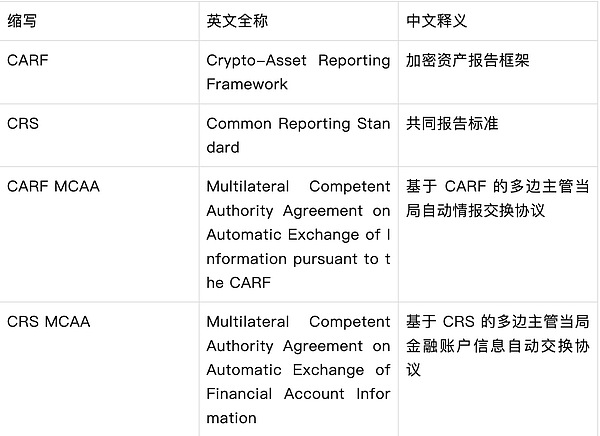
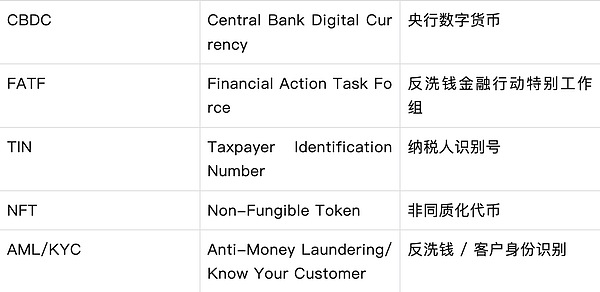
VI. Key Terminology List (Core Abbreviations and Definitions)


 Kikyo
Kikyo


