Source: Bitwise NEAR Research Report "NEAR in Plain English"; Compiled by: Jinse Finance
1. Problems NEAR Solves
Cryptocurrencies suffer from usability issues.
There are currently hundreds of blockchains, each with its own assets, applications, and rules. Transferring funds between them has historically been costly, cumbersome, and risky. For cryptocurrencies to serve billions of people, this fragmented system must feel like a seamless, single network.
Artificial intelligence faces another problem: centralization. A few companies control the world's most powerful AI models, as well as the data shared with them by users and businesses.
Artificial intelligence faces another problem: centralization.
When AI systems begin to act on our behalf—managing funds, booking trips, negotiating purchases—they will need an infrastructure that can securely complete transactions without broadcasting all our data and decisions to a few large companies. NEAR stands at the intersection of these two issues. Founded in 2018 by Alex Skidanov and Illia Polosukhin, co-author of the groundbreaking Transformer research paper that outlined the architecture behind ChatGPT, Claude, and Gemini, NEAR's team is working to build a blockchain that is fast enough, inexpensive enough, and simple enough to use, serving not just millions of users, but billions of AI agents that are transacting on behalf of humans. These efforts are now paying off. NEAR's flagship product, NEAR Intents, launching in late 2024 and scaling in 2025, simplifies asset transactions across different blockchains into a single step. To exchange $1,000 of stablecoins for Ethereum, a user simply selects the asset and amount, and a network of professional bots ("Solver") competes to complete the transaction at the best price. The user experience is seamless, and the product supports over 35 blockchains. Without NEAR Intents, executing the same transaction typically requires multiple steps, cross-chain bridges, and layers of fees. NEAR Intents has processed over $30 billion in transactions, including $4 billion in the past 30 days. NEAR recently added perpetual contracts ("perps") to Hyperliquid, giving Intents users access to the world's largest on-chain derivatives exchange. They have also partnered with Ondo Finance, a leader in tokenized stocks, allowing users to buy, sell, and hold tokenized stocks and ETFs in their crypto wallets. NEAR has also built a confidential AI cloud. This allows individuals and businesses using leading AI models like Claude, ChatGPT, Gemini, or DeepSeek to strip away sensitive information before requests reach the model provider, thus gaining additional privacy protection. The highest level of privacy is built on leading open-source weighted models like DeepSeek, ensuring that no one can see a user's prompts, conversations, or messages—not cloud operators, not NEAR, and not model providers. In short, NEAR's AI cloud allows users to use AI without surrendering sensitive or proprietary data.
In the remainder of this article, we will explain how these components work together, why the NEAR token is designed to capture the value it creates, and what this means for investors.
2. NEAR Ecosystem Overview
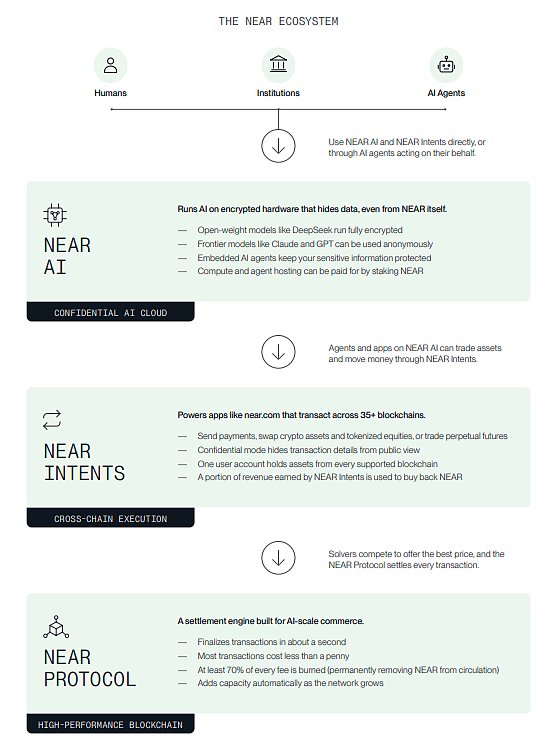
The NEAR platform consists of three overlapping layers: a high-performance blockchain, a cross-chain execution layer, and confidential AI infrastructure.
NEAR's High-Performance Blockchain: NEAR Protocol
Every blockchain faces the same bottleneck: how to process more transactions without compromising security and decentralization. Ethereum's answer is Rollup (packaging transactions and sending them back to Ethereum's independent network), while Solana is a massive and ultra-fast chain. NEAR takes a third approach, known as "sharding"—breaking the network into channels that can process transactions in parallel. With "dynamic resharding" going live in 2026, the NEAR network will automatically add channels as traffic increases, much like a highway that automatically expands its lanes during peak hours.
Its achievements are among the best in the crypto space. In 2025, NEAR demonstrated its ability to process 1 million transactions per second in a public test, far exceeding the processing capabilities of today's leading blockchains. The network settles transactions in about one second, with fees typically less than one cent, and has operated virtually without interruption since its launch in 2020.
The protocol also addresses future risks: it was one of the first mainstream L1 protocols to adopt quantum-resistant signatures in July 2026, boosting confidence in its long-term positioning. NEAR's Cross-Chain Execution Layer: NEAR Intents Most economic activity on the NEAR network is related to its flagship product, NEAR Intents. It's a smart contract platform built on the NEAR protocol, allowing users to exchange assets and trade perpetual contracts across more than 35 blockchains by invoking a "Solver" to find the optimal offer. In February 2026, NEAR launched NEAR.com, a consumer-grade application that allows users to access Intents through a single account. That same month, NEAR also launched Confidential Intents, which hides transaction details—such as the assets traded, the amount, and the counterparty—from public view before settlement, while maintaining verifiable and auditable execution processes. In September 2026, NEAR Intents integrated with Hyperliquid's perpetual contracts, enabling users to access the world's largest on-chain derivatives exchange with built-in confidentiality. NEAR Confidential Intents, designed for traders and institutions that need to trade without disclosing their strategies, currently account for 50.6% of the total value held in Intents. Importantly, NEAR Intents showed significant growth in the latter part of the recent crypto winter, with demand surging in the third quarter as the market recovered. This suggests that if the crypto market strengthens in 2027 and beyond, there is still room for further demand growth. NEAR's Privacy AI Infrastructure: NEAR AI Cloud The third layer is where NEAR's founding vision rests. NEAR AI runs AI models and agents in a Trusted Execution Environment (TEE). The TEE is like a cryptographic vault inside a computer chip, its interior inaccessible even to the machine's owner. Building on this foundation, NEAR launched NEAR AI Cloud, enabling enterprises to access AI models privately, from leading open-source weighted models like DeepSeek to cutting-edge models such as GPT, Claude, and Gemini. NEAR has also built an embedded agent experience on NEAR.com, allowing AI agents to run 24/7 without exposing credentials or confidential user data (such as names, passwords, and API keys); in addition, there is a confidential GPU marketplace for enterprises and governments to rent computing power to handle sensitive AI workloads. Starting in July 2026, customers can pay for NEAR AI Cloud and hosted embedded agents by staking NEAR tokens, with available funds increasing in tandem with the amount of NEAR staked. These three layers together form a highly valuable technology stack. NEAR Protocol is the foundation, providing a fast, inexpensive, and AI-scale commercial settlement engine. NEAR Intents are built on this foundation, enabling individuals and institutions to transact across dozens of blockchains. Confidential Intents leverage the same trusted hardware NEAR uses to confidentially run AI models, adding privacy protection to these functionalities. NEAR AI enables individuals and AI agents to confidentially access leading AI models and provides agents with a pathway to transact via Intents, allowing them to complete payments across dozens of blockchains. Each layer is designed to support the layer below it. More AI agents mean more Intents transactions, and more Intents transactions mean more settlements on the NEAR Protocol. This is the infrastructure built for humans, institutions, and AI agents to do business on-chain. NEAR AI Cloud offers two levels of privacy. Open-source weighted models like DeepSeek run entirely within TEE, and NEAR can generate cryptographic proofs that the intended model did indeed run, and that the data is invisible to anyone, including NEAR. Cutting-edge models like GPT, Claude, and Gemini are proprietary and therefore cannot be accessed in the same completely private and encrypted manner as open-source weighted models. For this type of model, NEAR runs a gateway within the TEE to strip user identities before forwarding requests, thus achieving anonymity for the model provider, but this is not a completely confidential use case.
Diagram of the NEAR Ecosystem
Source: Bitwise Asset Management
3. Why is the NEAR Token Valuable?
NEAR's native token, NEAR, is the economic engine of the entire ecosystem. The NEAR token is designed to benefit from network growth in three ways.
Transaction Fees and Token Burning
Every transaction processed on the NEAR blockchain incurs a fee denominated in NEAR. For simple transactions, such as sending NEAR from one wallet to another, the fee is burned in full—meaning an equivalent amount of NEAR tokens is permanently removed from circulation. For applications involving lending or trading on DeFi applications, or using NEAR Intents, 30% of the fee is allocated to the application, and the remaining 70% is burned. NEAR recently approved an upgrade that eliminates this 30% cut; once effective, NEAR will burn 100% of transaction fees, thereby strengthening the token's value accumulation and simplifying the protocol's economic model.
Staking
Approximately 45% of NEAR is staked. This refers to holders staking NEAR with validators who process NEAR transactions and help maintain network security.
Staking
Approximately 45% of NEAR is staked. This refers to holders staking NEAR with validators who process NEAR transactions and help maintain network security.
As a reward for staking NEAR, holders currently receive an annualized reward of 4.5%. Staking commits nearly half of the supply to the network, reducing the amount in circulation. By the end of 2025, the NEAR community will halve the protocol's inflation rate from 5% to 2.5% annually, improving the supply dynamics of the NEAR token, and related proposals may further depress this rate. While this change will reduce the returns for stakers, the net effect is lower NEAR token inflation and a more reasonable token economy.
Revenue-Driven Buybacks
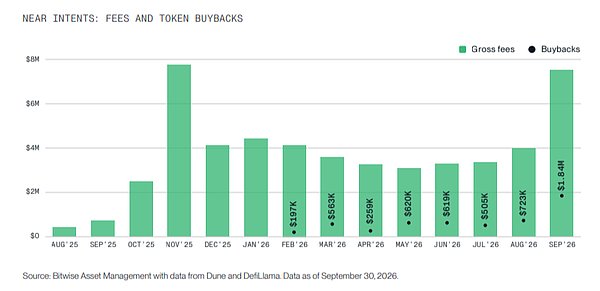
In addition to transaction fees on the NEAR blockchain, NEAR also generates revenue from cross-chain exchanges facilitated by NEAR Intents. Crucially to the long-term investment logic of NEAR, in February 2026, a "fee switch" was launched, beginning to use NEAR's share of these fees (after payments to its partners and applications utilizing Intents) to buy back NEAR tokens on the open market. Since the fee switch was turned on, NEAR Intents users have paid over $29 million in fees, corresponding to $5.3 million in NEAR token buybacks. Overall, the logic of value accumulation is clear. As more activity flows through NEAR's infrastructure, its revenue grows, and so does the buyback. Furthermore, increased activity means more fees are burned, further reducing supply. Staking, on the other hand, locks up more supply and puts it into the network. If NEAR's infrastructure becomes the default home for the AI agent economy, NEAR fees and demand for its token should expand along with this economy.
NEAR INTENTS —— Fees and Token Buybacks
4. NEAR's Industry Positioning
As cryptocurrencies go mainstream, more and more activities involve transferring assets across blockchains, and this is increasingly being done by AI agents. NEAR's services are at the bottom of some of the most important growth stories in the market.
Stablecoins, Bitcoin, altcoins, and tokenized real-world assets (such as stocks and ETFs) exist on different networks, and the demand for moving and checking them is likely to grow.
Stablecoins, Bitcoin, altcoins, and tokenized real-world assets (such as stocks and ETFs) exist on different networks, and the demand for moving and checking them is likely to grow.
Stablecoins, Bitcoin, altcoins, and tokenized real-world assets (such as stocks and ETFs) exist on different networks, and the demand for moving and checking them is likely to grow.
Stablecoins, Bitcoin, altcoins, and tokenized real-world assets (such as stocks and ETFs) are all on different networks, and the demand for moving and checking them is likely to grow.
Intents are already routing billions of dollars between chains every month. Institutions need confidentiality. Confidential Intents bring private execution to public chains. For an agent to manage your funds or data, it needs verifiable, confidential, and tamper-proof access to AI infrastructure. This is precisely what NEAR's hardware-secured AI technology stack provides. It's worth acknowledging NEAR's current position. While Intents have made measurable progress in cross-chain transactions, the AI business is still in its early stages. NEAR AI has real products and trusted partners, but reported revenue to date is still limited. This makes NEAR a two-part story: an execution layer that is already functioning well and growing rapidly, and a "moonshot" bet built on top of it. If AI agents become major users of digital infrastructure—as many tech experts expect—and NEAR becomes the settlement layer for their transactions, the value unlocking will be enormous. NEAR doesn't need this "moonshot" bet to come true to function. But if it does, everything will change. 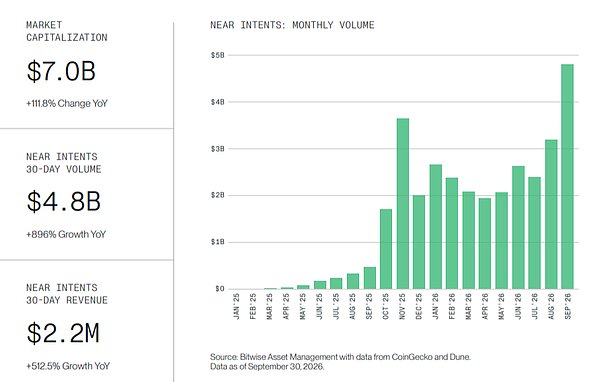 The collaboration between NEAR and Brave. Brave is a privacy-focused web browser with 126 million monthly users, featuring a built-in crypto wallet and AI assistant. When Brave users trade one crypto asset for another, such as exchanging Bitcoin for Ethereum, NEAR's network processes the transaction in the background, hiding the details from the public. Brave is also piloting NEAR AI Cloud for its Leo AI assistant, allowing users to converse with leading AI models like DeepSeek and verify that their conversations remain private. 5. Risks and Considerations, and the Bitwise NEAR ETF (NRR) Like any early-stage technology, NEAR's future is fraught with risk. The biggest risk is execution. NEAR's AI ambitions are a gamble of "hitting the home run" in a still-forming market. Centralized AI platforms may keep users in their own walled gardens, the development of intelligent agent businesses may be slower than expected, or it may fall off track outside of NEAR. Investors should consider this duality when deciding on position size: the upside potential for AI is enormous, but not guaranteed. Competition is real on every front. In a sense, NEAR competes with Ethereum, Solana, and other Layer 1 blockchains in terms of developers and applications (although it also supports these ecosystems by improving cross-chain functionality). In terms of cross-chain activity, it certainly competes with a crowded field of interoperability providers; and in terms of the future of the smart agent economy, it competes with well-funded centralized AI companies. NEAR's usage metrics are also likely to fluctuate. In early 2026, activity on the NEAR mainchain declined sharply when activity from a single large consumer application plummeted. Currently, the growth engine, NEAR Intents, is primarily based on stablecoins and transaction flows, and its fee and buyback mechanisms have been online for less than a year. Finally, NEAR's token economy is still evolving. Inflation reduction, fee on/off, and the buyback program were all recently introduced, and future governance decisions may adjust or reshape how NEAR tokens accumulate value. Regulation is also a variable. While the US regulatory environment has become more constructive, the rules governing the core elements upon which NEAR's success depends—from DeFi to privacy tools to AI—are still being developed. Bitwise NEAR ETF (NRR) is an exchange-traded product that allows investors to gain exposure to NEAR at a low cost—a blockchain network that is building infrastructure for confidentiality, cross-chain commerce, and AI agents. NEAR is poised to benefit from the growing adoption of cross-chain transactions, private execution, and AI agents. With NRR, investors can participate in NEAR's upside potential and potential staking rewards through an ETP backed by crypto experts. By choosing NRR, investors gain access to a team of crypto experts with the tools, insights, and expertise to help them navigate the space with confidence.
| Project | Content |
|---|
| Code | NRR |
| Exchange | NYSE ARCA |
| Inception Date | 2026/09/28 |
| Management Fee | 0.75% |
Staking rewards are earned by the Trust and accrue to shareholders as an increase in the Trust's Net Asset Value (NAV) per share. Rewards are not guaranteed and are subject to change.
Disclaimer
Bitwise NEAR ETF (NRR) is not suitable for all investors. Investing in NRR involves a high degree of risk and may result in significant volatility and potentially substantial losses or total loss of investment.
Disclaimer
Bitwise NEAR ETF (NRR) is not suitable for all investors. Investing in NRR involves significant risk and may result in substantial volatility and potentially total loss of investment.
NRR is not an investment company registered under the Investment Company Act of 1940 ("the 1940 Act") as amended, and therefore does not enjoy the same protections as ETFs and mutual funds registered under the 1940 Act. Investing in NRR is not the same as directly investing in NEAR tokens.

 Joy


