Behind the surge in MicroStrategy: the unknown “2X MSTR ETF”
The launch of the leveraged MicroStrategy ETF has accelerated the trend of MicroStrategy's stock price
 JinseFinance

The price-to-book ratio measures a company's market capitalization relative to its book value (assets minus liabilities). It shows how much investors are paying for each dollar of net assets.
It's refreshing to see many investors question why we pay a premium for the underlying Bitcoin asset, rather than blindly accepting it as they do with many aspects of traditional finance. We should question why things are priced the way they are. I think this is a huge advantage for the average Bitcoin investor: the ability to question widely accepted views simply because "that's how it's always been done."
Trust in Growth Plans - Companies will find ways to grow their portfolios faster than individuals. Access to cheap capital—something the average investor will never be able to access. Operating leverage—using structures like convertible bonds or equity financing to expand faster. Could you get a loan at around 0% interest to accumulate more Bitcoin? Hardly. This is where the best Bitcoin reserve companies—especially larger and more committed ones like MSTR (MSTR)—come in. Specifically, companies like MSTR utilize convertible bonds, where lenders accept lower interest rates in exchange for the right to convert to equity. This effectively subsidizes Bitcoin accumulation. In traditional finance, this is similar to how tech growth companies use leverage to scale without immediate dilution. But if a 15% annual growth rate in free cash flow per share for traditional financial stocks is considered "exceptional," why do we value companies like MSTR that hold Bitcoin at a 1.5x premium (or even a 4x to 5x premium), given that Bitcoin has grown at a compound annual growth rate of 60% to 80% over the past 5 to 10 years? I believe this is a key concept that the broader investment community still doesn't understand: Bitcoin is a top-five asset class globally and is steadily consuming global capitalization. This is a key reason why I'm bullish on companies like MSTR long-term. mNAV Discounts: Pitfalls and Real Signals So, can a company trade at an mNAV below 1? Absolutely. According to Bitcoin Treasuries, 21 of 167 publicly traded companies (approximately 13%) trade at a discount to their mNAV. This is very similar to the reason some stocks trade at extremely low price-to-earnings ratios, such as 5x. Many traditional financial investors fall into this "value trap," believing they've bought a bargain because the stock price is low. However, in reality, most of the time, the low stock price stems from the company failing to deliver on the performance promises investors expected. I believe this concept of a value trap also applies to Bitcoin Reserve. For companies trading at a discount to their mNAV, this suggests market skepticism, perhaps related to:
weak governance;
fragile financing models;
operational risks in the current business.
In fact, it may also indicate investor confidence in the ability of these companies to hold Bitcoin. Mathematically, when mNAV is below 1, it's actually in a company's shareholders' interest to sell Bitcoin to repurchase shares.
But companies like MSTR resisted this temptation. Even during the 2022 bear market, when their mNAV fell below 1, they restructured their debt to retain their entire Bitcoin holdings. That's why I'm fairly certain MSTR doesn't fall into this category. I have no doubt they'll continue to hold all their Bitcoin, even under less favorable circumstances. This long-term holding philosophy stems from Michael Saylor's vision of Bitcoin as pure collateral. I'm not quite as confident about the other 166 publicly traded companies. The only company I'd put in the "HODL" category is Japan's Metaplanet. Therefore, mNAV isn't a simple buy or sell signal—it's a perspective. A premium can indicate confidence or hype, while a discount can reflect distress or value. The key lies in the context: How much has the company's per-bitcoin earnings increased? Does it have other revenue streams to support its valuation? How resilient is its funding model across market cycles? MSTR's Financial Wizardry What truly distinguishes MSTR from many other Bitcoin reserve companies is its diversified fiat funding capabilities, enabling it to efficiently purchase its Bitcoin holdings. Its low-cost financing tools, such as convertible bonds and a growing list of preferred stock offerings, allow it to rapidly expand its Bitcoin holdings without diluting ordinary MSTR shareholders. For example, convertible bonds allow for borrowing at a near-zero effective interest rate when converted into equity during a bull market. This creates a flywheel: More Bitcoin increases the value of the collateral, enabling it to borrow even more. In my view, this financial wizardry deserves a substantial premium, much like how, in traditional finance, Nvidia commands a reasonable P/E multiple because its free cash flow per share growth far outpaces that of almost every other company. For most people, this is a completely new concept. Bitcoin Reserve wants to increase the number of Bitcoins per share as quickly as possible, while traditional financial companies want to increase free cash flow per share as quickly as possible. It's the same concept. One is simply trying to grow pure capital that will appreciate by at least 30% to 50% annually for the foreseeable future, while the other is trying to accumulate their favorite fiat currency, which is depreciating by 8% to 10% annually. I know which company is more likely to create greater shareholder value over the next decade, based on their respective strategies. Finally, let's take a quick look at some charts to identify some potential value opportunities. 200-Day Chart Signals Strength: MSTR is poised to show a green signal dot on its 200-day chart for the second time in this cycle, trading at its 200-day moving average of $353. This level serves as key support for bulls, marking the beginning of this rally. A breakout at this level could signal strong upside potential. Z-score Probability Wave: MSTR's stock price has fallen to -2 standard deviations, which happens to be $353. Historically, during this bull market, a drop below -1 standard deviation has often signaled significant price volatility, and if macroeconomic conditions remain positive, a reversion to the mean is likely. Oversold Conditions: My mean reversion oscillator (which uses a similar logic to the RSI) suggests that the MSTR is in deeply oversold territory. Past sessions at these levels have often led to short-term rallies, sometimes even significant gains.
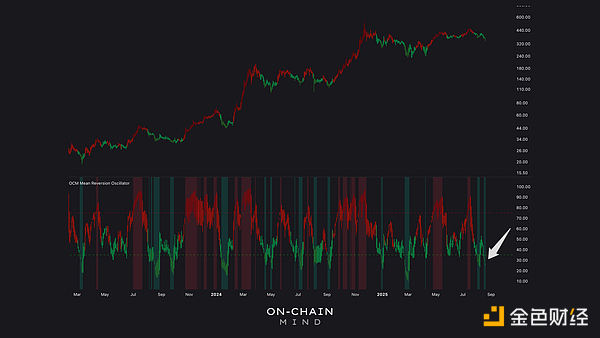
MSTR Investment Opportunity Priced in Bitcoin: When priced in Bitcoin, MSTR's risk oscillator is at one of its lowest values, which is a strong signal for investors in a low-tax environment to shift investment from Bitcoin to MSTR. Historically, this lag in MSTR's stock price relative to Bitcoin is often quickly made up. So, with all of this said, am I concerned that MSTR's stock price is lagging behind Bitcoin's current gains? Not at all. Its mNAV may have compressed to around 1.5, but the true measure of its Bitcoin strategy remains intact: the number of Bitcoins per share is still increasing week-over-week. And that, for the most part, is all I care about.
Like traditional stocks, their free cash flow per share may increase year after year, but their stock price may fluctuate wildly. That's the magic of irrational investor psychology. But if fundamentals continue to improve (such as the number of Bitcoins per share continuing to increase), I would be eager to seize the opportunity to buy this company at a discount. Because as we all know, when investor sentiment turns and the P/E ratio eventually expands again, this stock has the potential to generate huge profits.
The launch of the leveraged MicroStrategy ETF has accelerated the trend of MicroStrategy's stock price
JinseFinanceThe difference between Based Rollup and traditional Rollup.
JinseFinanceETC, the full name of which is “Ethereum Classic”, can be translated into Chinese as “Ethereum Classic”. It is an open source blockchain platform that can be used to write decentralized applications (DApp) run and driven by smart contracts.
JinseFinanceAOVM is an AI layer protocol built on top of @aoTheComputer, combining AO's hyper-parallelism with AI large models.
JinseFinanceAdam Back opposes Defiance 2X Short MSTR ETF, citing its potential negative impact due to high Bitcoin correlation. Back warns against risks in volatile trading environment and expresses doubts about effectiveness.
 Xu Lin
Dencun includes 9 EIPs that enhance everything from security to the staking experience.
JinseFinanceAs a product of its times, Dogecoin has its own set of problems. DogeLayer is here to fix just that.
 Max Ng
Is Michael Saylor’s side of the story the reality of the situation? Or is he on a damage control tour? ...
 Bitcoinist
 Cointelegraph
As MicroStrategy stock slumps, Michael Saylor remains confident Bitcoin holdings will cover a potential margin-call on BTC-backed loans.
Cointelegraph