Sam and Outpog: Talking about AO and AI
The release of AO marks the transformation of the Arweave ecosystem from decentralized storage to a full-stack application ecosystem that supports decentralized computing.
 JinseFinance


Masayoshi Son has borrowed money again.
This time it's $10 billion plus €1 billion, all to buy OpenAI.
On September 21, Reuters unearthed SoftBank's latest bond issuance documents. Citigroup and JPMorgan Chase are listed side-by-side in the bookrunner section, ready to market these high-risk bonds on the open market. SoftBank's issuer credit rating remains at BB+, and these high-yield bonds are essentially junk bonds.
More subtle is September.
On September 9th, SoftBank announced that it would prepay $25.9 billion of the outstanding balance by September 15th. This loan was not settled, and there was still a tail of about $4.1 billion on the books; as for the source of funds to fill the $20 billion balance, the official announcement made no mention of it.
The replacement was not a hasty move.
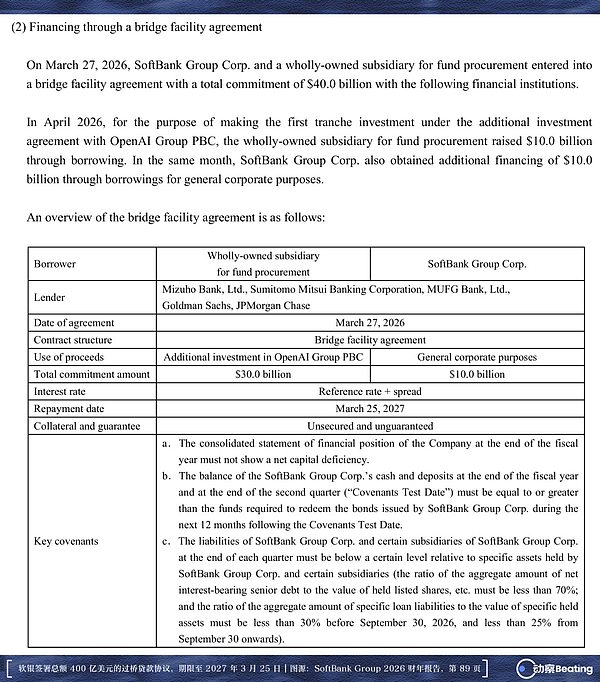
As early as February 27th, in its initial investment announcement, SoftBank stated that the funds would first be advanced by bridge loans, and then replaced using existing assets and long-term financing. At the end of August, market rumors circulated that Mizuho Bank was leading a $10 billion two-year loan with an interest rate spread of approximately 275 basis points, directly used to take over the bridge loans. CFO Yoshimitsu Goto stated in a conference call that SoftBank had no reason to delay the disposal until near maturity, and the replacement would only be brought forward. What SoftBank was doing was replacing one-year short-term debt with three-and-a-half-year or even seven-and-a-half-year publicly issued bonds. The sole purpose was to postpone the repayment date. Masayoshi Son subscribes to cutting-edge equity investments that may not materialize for ten years or even longer, but what he uses to pay off debts that will be liquidated in a year. This is his signature style: using massive amounts of capital to suppress probability and create miracles. He once compared his investment style to fishing with a large net rather than fishing with a rod. But even large nets can have their limits. The Vision Fund's $11 billion investment in WeWork ultimately led to its liquidation, and SoftBank suffered losses exceeding $32 billion in fiscal year 2023. Even at a heavy cost, what was ultimately consumed was its own capital and fund shares; there were no debt-collecting syndicates outside the door. The real catalyst connecting the long-term technological vision with the immediate cash pressure was the loan signed on August 5th. This deal had been a behind-the-scenes tug-of-war since the beginning of spring. SoftBank's initial goal was to borrow the full $10 billion, but investors had many concerns. Pricing equity in a company that wasn't yet publicly listed, or even whose business model wasn't yet closed, was extremely risky. Negotiations stalled, and the loan amount was forced down to $6 billion. Until July, when Masayoshi Son personally increased the amount, deciding that SoftBank Group would provide full corporate guarantees, the syndicate finally relented and pushed the amount back up to $10 billion. The deal was officially finalized on August 5th. The borrower is SVF II TSUBAKI (DE) LLC, registered in Delaware, a wholly-owned subsidiary of Vision Fund II, with a two-year term, maturing in August 2028. The leading syndicate boasts a formidable lineup, including Goldman Sachs, JPMorgan Chase, Mizuho Securities, Apollo, and Sumitomo Mitsui. The interest rate spread quoted during the negotiation phase reached as high as 425 basis points, a full 150 basis points higher than ordinary loans used to underwrite bridge loans during the same period. This was a risk premium offered by Wall Street for illiquid private equity. The contract specified that the funds were not for direct capital injection, but for general corporate purposes of SoftBank Group and Vision Fund II, for daily working capital. When the outside world reported on this transaction, it was mostly habitually summarized as SoftBank pledging OpenAI stock to borrow billions. However, the financial statements record a completely different structure. The legal collateral under the agreement was, from beginning to end, merely a cash guarantee account under the borrower's name; OpenAI's shares were never actually pledged. That locked-in equity acted as a tightly controlled cursor within the entire structure. The contract explicitly stipulated that a significant decline in the fair value of the OpenAI preferred stock referenced in the agreement would trigger the cash guarantee gap provision and the mandatory prepayment clause. The shares weren't delivered to the bank, but the share price tag became a target. Whenever the valuation shrank, the creditor had the right to demand that SoftBank quickly allocate real money to fill the guarantee account, or directly recover the loan principal and interest. At that critical juncture, SoftBank's locked-up preferred shares still lacked any legal means of liquidation. The shares hadn't been handed over, but the valuation had become a trigger point for banks to manipulate at any time. This was extremely dangerous. In 2000, when the dot-com bubble burst, SoftBank's stock price plummeted by 90%. Afterwards, Masayoshi Son himself used SoftBank shares as collateral to borrow money from banks, but these were shares under his personal name, so the losses were only recorded in his personal account and didn't affect the group. This time was completely different. Not a single share was pledged, but SoftBank's stock price became the benchmark for banks to assess the safety of this loan. In the past, a drop in stock price only resulted in a decrease in the numbers on financial statements; now, if the stock price falls too far, it will directly force SoftBank to come up with cash to cover the losses. This is even clearer when compared to another SoftBank loan secured by Arm stock. That loan had no recourse against the group; if the bank lost money, it could only seek redress from Arm stock. However, with the OpenAI loan, SBG is the guarantor, and Goto's exact words in the conference call were "recourse against SBG." When calculating the LTV (loan-to-value ratio), this debt is fully included in SoftBank Group's debt without any adjustment. In other words, for the same $10 billion loan, this time the bank is demanding SoftBank Group's entire balance sheet as a guarantee. Goto said in the conference call that he believed the safety cushion was "more than enough." However, contract terms don't follow gut feeling; if the stock price falls below the agreed level, SoftBank will either have to add margin or repay the loan early. Even more troublesome is that liquidity will be immediately locked up. When the day comes to add margin, SoftBank must transfer real money into the collateral account, which is instantly frozen and cannot be used for new investments or to repay other debts. Waiting requires payment. Margin calls due to stock price drops are a problem that only arises when something goes wrong. The more common cost is interest; as long as this money remains in the account, interest increases every quarter. In the three months from April to June 2026, SoftBank Group, together with its financing subsidiaries, incurred interest expenses of 281.65 billion yen, 147.3 billion yen more than the same period last year. Converted at an exchange rate of 150, this is approximately US$1.88 billion. SoftBank had been hoping that OpenAI would go public as soon as possible, allowing them to monetize their equity and thus cover this rigid debt. The $11.5 billion Arm collateral loan borrowed in December 2025, the $20 billion bridge loan drawn down in April 2026, the rising corporate bond balance, and the increasing global interest rates all combined to create a massive influx of new debt, causing interest rates to jump significantly. However, Sam Altman told Fortune in September that the timing of the IPO was "inappropriate" due to concerns about AI security. These four words, "inappropriate timing," translate directly into real money for SoftBank. The bridge loan is due in March 2027, and the valuation-linked loan is stuck in August 2028. Just the extra year of debt—$10 billion—at an 8% interest rate, amounts to $800 million in interest. What's even more difficult is that OpenAI itself can't stop. The accumulated cash flow hole of $278 billion over five years translates to over $55 billion annually. OpenAI's spending spree requires round after round of financing to sustain itself. SoftBank is the biggest investor, and its own profitability depends entirely on whether OpenAI can reach an IPO. If OpenAI runs out of funding in its next round, SoftBank's previous investments will be wiped out. So it had no choice but to help. On one hand, it had to continue paying interest on the money already lent, and on the other hand, it had to raise the next round of funding so that its investment could survive until the IPO. Given such a large debt, why would Wall Street lend it tens of billions of dollars? The answer is Arm. This chip architecture design company, headquartered in Cambridge, UK, almost monopolizes 99% of the global smartphone processor architecture. In 2016, Masayoshi Son raised $32 billion in cash by significantly reducing his stake in Alibaba, privatizing the company. When Arm relisted on the US stock market in the fall of 2023, coinciding with the fervent demand for AI chips for high-efficiency computing power, Arm's stock price surged by approximately 270% that year, briefly pushing its market capitalization above $300 billion. SoftBank still firmly holds a 90% stake in Arm, and the unrealized gains from this asset exceed $220 billion. Banks don't care how complex the big models are; they only care about the hard currency in SoftBank's hands. SoftBank's management likes to show the market a metric: LTV (Net Debt Divided by Equity Value), used to measure the ratio of debt to assets. From March to June this year, this figure dropped from 17% to 13%, seemingly indicating a reduction in leverage. But this is just a numbers game. During the same period, SoftBank's net debt actually rose from 8.2 trillion yen to 10.8 trillion yen. The borrowed money not only didn't decrease, but actually increased by a full 2.6 trillion yen; the so-called reduction in leverage was purely due to Arm's soaring stock price, which increased the denominator in the calculation formula. However, asset appreciation does not equate to cash inflow. SoftBank's cash and cash equivalents not only did not increase, but actually declined from 3.5 trillion yen to 2.3 trillion yen, with money flowing out in large quantities to make timely payments for OpenAI investments and to repay old debts. Relying on this passively inflated denominator, SoftBank painted a respectable picture of security in its financial statements; the 13% level was far from the group's internal red line of 25%, and S&P also took the opportunity to upgrade its rating outlook from "negative" to "stable." But this cannot conceal the approaching repayment peak. In the next two years, SoftBank has approximately 1.5 trillion yen in corporate bonds awaiting redemption, equivalent to about $9 billion, one payment next year and another the year after. Private equity giant Apollo is also negotiating to expand a NAV loan from its Vision Fund II from $5.4 billion to $9 billion. Wall Street still loves to focus on SoftBank because at the very bottom of its balance sheet lies Arm, a potentially liquid asset. Back then, British and EU regulators halted the merger between Arm and Nvidia, leaving Masayoshi Son with only a $1.25 billion breakup fee. Ironically, this chip company has become the last pillar supporting his entire credit chain. On September 24th, the final interest rate for this $10 billion high-risk bond will be determined. This figure is the market's explicit price tag for how long Son will have to wait for OpenAI; the higher the price, the more dangerous Wall Street perceives the wait. Settlement will be on September 29th, and payment will be made on October 1st. Then, the clock continues to tick. He's waiting for OpenAI to ring the bell, and his creditors are waiting for him to repay their debts with interest in March 2027. Money waits for no one.
The release of AO marks the transformation of the Arweave ecosystem from decentralized storage to a full-stack application ecosystem that supports decentralized computing.
JinseFinanceThe alleged fraudster's latest blog post shows a man completely divorced from reality.
 Coindesk
FTX founder SBF faces eight criminal charges, ranging from fraud to conspiracy to commit money laundering, in connection with the collapse of his once-dominant exchange.
 decrypt
FTX founder Sam Bankman-Fried pleaded not guilty to a series of financial crimes on Tuesday, appearing before a federal court in New York as part of his arraignment.
decryptIn an exchange with YouTuber Coffeezilla, the former CEO disclosed that client funds weren’t segregated as promised.
CoindeskMichael Saylor addresses the leveraged borrowing between FTX and Alameda Research.
 Beincrypto
Here’s what happened during the New York Times exclusive interview with Sam Bankman-Fried on FTX’s collapse.
 Others
Sam Bankman-Fried is still listed to speak at this year's New York Times DealBook Summit, despite being axed as FTX CEO.
BeincryptoThe fallen crypto CEO on what went wrong, why he did what he did, and what lies he told along the way.
 Vox
He has not offered any explanation on the matter, and the crypto community has begun speculating.
Beincrypto