Author: Crypto_Painter; Source: X, @CryptoPainter
I've been thinking about this for a while now, and I really want to do a systematic analysis of the current market structure. Why has BTC and the entire cryptocurrency market shown counter-cyclical phenomena? And how can we use a complete narrative to connect AI, the US-China rivalry, and the abnormal performance of BTC and gold?
Let's first discuss some market phenomena we've observed: BTC has broken out of a bear market structure among global risk assets, with its weekly chart falling below the MA50. Market liquidity has significantly decreased, and the bull market structure is shaky. Even the start of this bull market differs from previous ones (BTC's current bull market began during the interest rate hike cycle)... Gold continues to reach new highs, with silver following closely behind. The precious metals market is behaving like the era of massive monetary easing after 2020. Even so, buying continues unabated... US stocks are neither particularly strong nor weak. Led by AI stocks, they have achieved an epic surge comparable to the pre-2000 dot-com bubble. People are simultaneously fearing bubbles and creating them... The rivalry between China and the US is constantly evolving across trade, technology, AI, geopolitics, and even public opinion. The intermittent nature of this conflict has sown the seeds of an expectation that a full-blown conflict between the two countries will eventually erupt...
The above describes the phenomenon; the following is a preliminary analysis:
What stage is BTC currently in?
Many say the market has clearly entered a bear market, while others, focusing on macroeconomic policies, believe a bear market is still far off. The main controversy in the market currently stems from the contradiction between technical and macroeconomic factors;
First, let's discuss the technical aspects. BTC's bull market structure typically follows a continuous, rhythmic upward trend. Pullbacks may occur, but the depth and strength of these pullbacks will not disrupt the existing structure of gradually rising highs and lows.
Taking BTC's weekly MA50 as an example: [Image of chart from Coinbase: BTCUSD spot trading pair] The landmark signals of the end of the bull markets in 2017 and 2021 were significant drops below the MA50 on the weekly chart. The drop in 2020 due to the pandemic was immediately recovered, so it can be temporarily disregarded. The current weekly chart for BTC has broken below the MA50 again. According to standard technical analysis, there will likely be at most one rebound to the MA50, after which the main downward wave of the bear market will begin... From this perspective, my ASR weekly channel indicator and super trend indicator both reflect similar trend-breaking structures. Anyone who believes in the "efficient market hypothesis" would consider this an early sign of a bear market... "Outside of this market, there must be some long-term negative news that hasn't been widely reported; otherwise, there's no reason for the market to commit suicide before dawn..." This is the view of most technical analysts, and I personally agree with this. At this point, dissenting opinions arise: Macro analysts will say, "The interest rate cut cycle has begun, and the release of liquidity will come sooner or later. Don't forget that the Fed's QT just ended!" If we base our conclusion on the correlation between past cyclical changes and macroeconomic policies, we can easily deduce that as long as the macroeconomy is in an easing cycle, the market won't truly enter a bear market... But the question is, "Is the correlation between macroeconomic cycles and BTC bull/bear cycles a constant and unchanging relationship?" What if the fact that the Federal Reserve can control global liquidity solely through monetary policy becomes less effective? What if the fact that the US dollar is currently the sole reserve currency for international trade becomes less convincing? Then, will the correlation between macroeconomic cycles and cryptocurrencies also become less robust? Theoretically, there is no answer to this question; we can only judge after the market provides the answer. However, the purpose of this article is still to find clues linking to future possibilities from subtle clues, so the best approach is to gather more information! Thus, the discussion about gold began... Is gold gradually becoming a new monetary anchor? To answer the questions above, I think starting with gold is the best approach. Simply put, the People's Bank of China's frenzied gold purchases reveal a starkly different direction for future monetary anchoring strategies between China and the US.
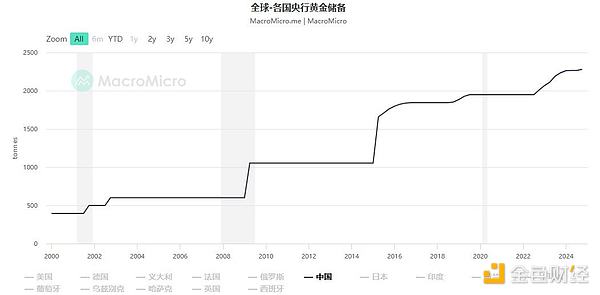
China's Central Bank Gold Reserve Curve
What China is currently doing is to one day peg the RMB to gold, and at the appropriate time, to take over the current status of the US dollar. Unlike the Bretton Woods system, China has adopted a "decentralized" gold corridor architecture in practice. The globally distributed gold vault system can realize a distributed ledger network similar to BTC miners.
This provides the new system with a perfect monetary credit foundation, which is precisely the monetary attribute that the US dollar is gradually losing. You can view the article via the link above for details. Here, we mainly need to discuss: Does this, to some extent, diminish the status of the US dollar? Incidentally, does this also reduce the Federal Reserve's actual control? To answer this question, we must first ask, "What is the monetary foundation of the US dollar?" In the last century, it was gold, hence the name "US dollar" (美金), but that ultimately failed... Later, it was oil, hence the name "petrodollar" (石油丸), but with the development of new energy sources and the gradual changes in the oil settlement system, this monetary foundation has also been loosening... Then came America's technological, military, and cultural leadership, and its immense power. But as time went on, we gradually discovered that its cultural leadership became increasingly strange; the LGBT movement seems to have destroyed this advantage, and its military leadership has long been drained by the military-industrial complex. Today, almost no one believes that the US can win a local war with China on its doorstep... This isn't my opinion; it's what the Pentagon itself said... So, what is left of the US dollar's foundation? It seems that only technological leadership remains, and this technological leadership mainly refers to AI... If technological leadership is also gradually lost, the US dollar will gradually lose its current status as a reserve currency. Consequently, the influence of the Federal Reserve's monetary policy on the outside world may decline. In other words, the Federal Reserve's position does not come from its governmental authority, but from the dollar itself. To give an extreme example, when other countries in the world no longer use the dollar, all of the Federal Reserve's policies can only affect the domestic economy, and will have almost no substantial impact on the outside world, except for exchange rates. Therefore, following this logical chain, we find that the macroeconomic cycle brought about by the Federal Reserve requires the stability of the US dollar, which in turn requires the stability of the US's international standing. Currently, the stability of the US's international standing depends on its leading position in technology, which in turn relies entirely on the US's advantage in the AI industry... The question then arises: "Is the leading position in AI currently stable?" Is there a bubble in AI? Is its leading position stable? You see, we in the crypto world love to make connections. To determine whether BTC has entered a bear market, we even bring up whether there's a bubble in the US AI industry?! Before writing this article, I specifically conducted a poll, asking everyone to intuitively judge, without overthinking, which has a bigger bubble: NVDA or BTC? The results show a 4:6 split, with nearly 60% of respondents believing that AI, or rather NVDA, has a bigger bubble... Why this intuitive judgment? We can start with the data: You can find detailed information by searching "US AI cyclical financing". I'll briefly describe the process, as shown in the image above: NVDA invests in OpenAI, causing the latter's valuation to skyrocket; OpenAI signs cloud service contracts with other giants, causing the latter's valuation to soar because the contracts are so large... To fulfill these contracts, cloud service companies need to place even larger orders with NVDA to purchase chips, causing NVDA's valuation to skyrocket again... completing the closed loop... Currently, all companies in the AI sector are participating in this cycle to varying degrees, which has led to the prosperity of the US stock market and indirectly the prosperity of the US economy. Ordinary investors see no problem with this cycle, but those who have been involved in the cryptocurrency and DeFi markets for years should have already noticed something amiss... If this cyclical financing structure were based on real demand—for example, if someone genuinely needed a factory to produce a large number of drones for war—then logically there would be no problem. However, all cyclical financing in the AI sector is currently based on "future demand"... If there really is such huge demand in the future, then AI certainly doesn't have a bubble. The problem is, what if there isn't such a large demand? Or what if the demand is far less than expected? Remember the classic case of factories dumping milk during the Great Depression? To understand the future demand for AI, I subscribed to most mainstream products and have recently been using Cursor for Vibe coding... I can sense that this is a huge market, but compared to the overall valuation of the US AI sector, the market size seems to be several zeros smaller... Of course, this is just my personal feeling; some might think that expectations and valuations are perfectly matched. Having discussed the bubble, let's talk about whether this position is stable. My view is that the leading position is currently relatively stable. There is a generational gap between the first and second place, but this gap is slowly narrowing. The biggest lead is not necessarily at the technological level, but rather at the capital level. The US government has been doing everything in its power to maintain this dominant position, as evidenced by Trump's actions. Sam's public statements also confirm this, indicating that the AI industry's capital assessment suggests the market has reached a "too big to fail" stage. Therefore, the conclusion is: the bubble is huge, but the leading position is relatively stable. This stability itself stems from the large bubble, because the US government absolutely cannot allow China to surpass it technologically. You see, this is another cycle: the bubble is huge, so the government will always bail it out, allowing for continued cyclical financing, leading to an even bigger bubble, which the government then tries to protect even more. This explains why the emergence of low-cost DeepSeek had such a devastating impact on the US AI stock market. You might ask, what does this have to do with BTC and cryptocurrencies? Next comes the final stage: Liquidity Transfer Under the US-China Game The logic is as follows, let's break it down step by step: The US-China game has reached this stage and has become a potential currency war; The US dollar is on the defensive, while China is building a new currency settlement network behind the scenes (gold prices surge). The most crucial defensive stronghold for the US dollar lies in AI and technology; The AI industry has a clear bubble, and it's a bubble that cannot be burst, otherwise the US may lose this currency war; Therefore, a large amount of liquidity in the entire financial market will flow into the AI and technology sectors; the fiscal bull market that started in 2023 released a large amount of liquidity, and the crypto market and AI both benefited, because at that time everyone's market capitalization was not high; this liquidity was gradually consumed against the backdrop of interest rates still being at a high level, until 2025, when the exponentially growing demand for liquidity began to expand and gradually could no longer sustain the continuous growth of market valuations. The Fed's slow rate cuts are gradually revealing the costs of high interest rates; liquidity is becoming scarce, causing the most liquidity-sensitive "canaries" to fall first—that's right, BTC... Technical indicators are showing bear market signals even before the macro environment has turned bearish; this has triggered an ongoing "technical bear market." In summary, the current predicament of cryptocurrencies actually stems from the liquidity needs of the US stock market to maintain its prosperity... To put it bluntly, cryptocurrencies and AI are like sons of a wealthy landowner in the US, but AI is the biological son, while cryptocurrencies are the adopted son. So when there's plenty of food, both sons are well-fed; when there's little, the adopted son goes hungry first... The biological son's grades are better than the neighbor's son's, but the neighbor has many sons, and right now, the only thing they can boast about is the biological son's report card... But what the landowner doesn't realize is that although the grades are good now, the biological son might not earn more than the neighbor's son in the future. All this pampering now is for the biological son's future success... The neighbor's son attended two days of tutoring recently, and his monthly quiz score was the same as his own son's! This really broke the landlord's nerves, so he decided to step up his efforts! To help his own son improve faster, the landlord cut off the stray son's food rations and fully funded his son's education... The abandoned child, hoping to get some food at the neighbor's house, found a sign on the door: "Outcasts Not Allowed!!" Now the child had to rely on himself... Okay, that's the general outline of this article. It's essentially a record of my thought process, so the views expressed are my personal opinions and not verifiable. It's for reference only.


 Kikyo
Kikyo

