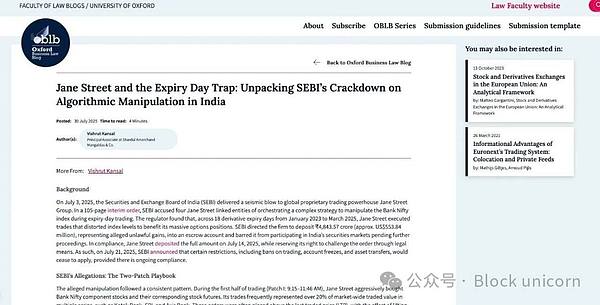
This powerful trading firm, which you may have never heard of, has been caught red-handed. And twice, on two different continents. This is precisely why Bitcoin has finally gained its freedom. Let me explain: Jane Street Group is a New York-based quantitative trading firm. They don't have a CEO. According to their own description, they operate like an "anarchist commune." In the first nine months of 2025 alone, their net trading revenue reached $24 billion, surpassing their total revenue of $20.5 billion for the entire year of 2024. In the second quarter of 2025 alone, their revenue reached $10.1 billion, the highest quarterly trading revenue ever recorded by any Wall Street firm. From any perspective, they are the most profitable trading firm in the world. This week, the bankruptcy administrator of Terraform Labs filed a lawsuit in Manhattan federal court, accusing Jane Street of using insider information to manipulate the Terra Luna crash in May 2022. This crash wiped out $40 billion in market capitalization and triggered a chain reaction, ultimately leading to the collapse of companies such as Celsius, Three Arrows Capital, and FTX. The accusation is shockingly simple. On May 7, 2022, Terraform Labs quietly withdrew $150 million worth of UST from Curve3pool, a large decentralized liquidity pool. There was no public announcement; the liquidity was withdrawn silently. Ten minutes later, a wallet associated with Jane Street withdrew $85 million from the same liquidity pool. Just ten minutes later. The lawsuit alleges that former Terraform intern Bryce Pratt (who joined Jane Street as a full-time employee in September 2021) established secret contacts with his former colleagues at Terraform. He allegedly passed significant, non-public information regarding changes in Terraform liquidity directly to Jane Street's trading department. The lawsuit names four defendants: Jane Street Group LLC, co-founder Robert Granieri, and employees Bryce Pratt and Michael Huang. The administrator's statement hits the nail on the head: Jane Street conducted "trades that would have been impossible without its unique insider information." Worse still, the lawsuit claims Jane Street's withdrawal triggered the decoupling from UST, causing the entire Terraform ecosystem to collapse. LUNA's price plummeted from over $80 to near zero, wiping out $40 billion. Ordinary people suffered devastating losses; retirement savings, children's education funds, and life's work vanished in just a few days. What was Jane Street's response? They called it "desperate" and "baseless." But the problem is: this wasn't the first time they'd done something like this. In July 2025, the Securities and Exchange Commission of India (SEBI) filed one of the most serious market manipulation charges against Jane Street in the country's history. The SEBI investigation found that Jane Street had engaged in textbook pump-and-dump operations on the Bank Nifty index across 18 derivative maturities between January 2023 and March 2025.
Their methods were highly mechanical:
In the morning: Jane Street's algorithm heavily bought the constituent stocks of the bank stock index and their futures, pushing the index up by 1% to 1.3%. SEBI found that on some trading days, Jane Street alone had the entire impact on the index's rise.
At the same time, they bought a large number of short options, mainly selling call options and buying put options, in a ratio severely imbalanced with their stock holdings. SEBI found that, calculated by delta, option holdings were 7.3 times that of stock and futures holdings. This is not hedging or arbitrage, but rather directional manipulation with additional steps.
Afternoon: They reversed their actions, selling all the stocks they had bought in the morning. The index fell, and the short options profited. This operation was repeated every expiry date. The Securities and Exchange Commission of India (SEBI) assessed that the illegal profits amounted to 48.43 billion rupees, approximately $580 million. The SEBI called Jane Street's actions "a means of deliberately manipulating settlement prices." They noted that Jane Street continued this strategy even after the National Stock Exchange of India (NSE) issued a clear warning in February 2025. The SEBI's wording was unusually harsh for the regulator: "The integrity of the market, and the trust of millions of small investors and traders, can no longer be held hostage by such untrustworthy manipulators." Jane Street was subsequently banned from the Indian securities market. They deposited over $560 million into a third-party escrow account and immediately filed an appeal. As of now, the case is still being heard in the Indian Securities Appeals Court. Now let's talk about Bitcoin. Since November 2025, Bitcoin traders have noticed some strange phenomena. Every morning around 10 AM (Eastern Time), when the US stock market opens, the selling volume of Bitcoin and its related ETFs increases significantly. This pattern is unusually stable. Bitcoin surges overnight during Asian and European trading sessions, then immediately plummets after the New York Stock Exchange opens. (For details, please refer to Trading View's analysis and statistics)
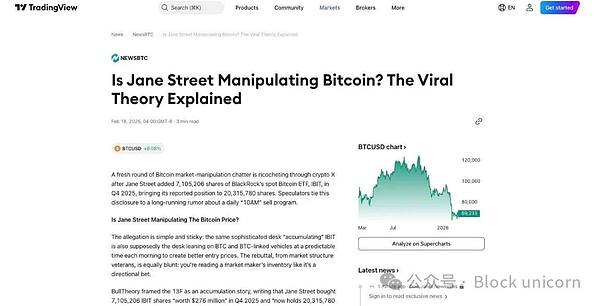
These numbers are significant. The chart from December 2025 shows that on some days, the price of Bitcoin plummeted from $89,700 to $87,700 within minutes, resulting in losses of up to $171 million for leveraged long positions before recovering. This occurred repeatedly on December 1st, 5th, 8th, 10th, 12th, 15th, and in January and February 2026.
... The crypto Twitter community calls this the "10am crash." The blame is being placed on Jane Street, and for good reason. Jane Street is one of only four authorized participants in BlackRock's IBIT (the world's largest spot Bitcoin ETF). The other three are Virtu Americas, JPMorgan Securities, and Marex. As an authorized participant, Jane Street has unique authority to create and redeem ETF shares, meaning they are directly involved in the flow of Bitcoin among institutional investors. Their 13F filings confirm their large holdings. As of the third quarter of 2025, Jane Street held $5.7 billion worth of IBIT stock. They added another $276 million in the fourth quarter of 2025, bringing their total holdings to over 20 million shares, worth approximately $790 million at year-end prices. At its peak, their IBIT stock holdings were worth close to $2.5 billion. However, what is suspicious is that Jane Street allegedly sold off spot Bitcoin every morning, while simultaneously increasing their holdings of MSTR (Strategy, formerly MicroStrategy) stock by 473% in the fourth quarter of 2025, accumulating 951,187 shares, worth approximately $121 million. Meanwhile, other large funds, such as BlackRock and Vanguard, were selling billions of dollars worth of MSTR stock. Think about it: sell Bitcoin at the open, causing a price crash, liquidating leveraged long positions, and then buying it back at an even lower price. Simultaneously, buy large amounts of the most leveraged Bitcoin alternatives on the market, then wait for the inevitable rebound. Glassnode co-founders Jan Happel and Yann Allemann reignited this theory through their Negentropic account, linking algorithmic trading to the Terraform lawsuit. The Milk Road account further reinforced the theory, describing "persistent rumors" about institutional trading departments operating "very specific/questionable operating manuals." Then the lawsuit was filed. Then something extraordinary happened. The expected 10am crash after Terraform filed its lawsuit against Jane Street…didn't happen. For the first time in months, Bitcoin didn't crash at the US open. Instead, it rose. On February 25, 2026, Bitcoin surged over 3%, breaking through multiple resistance levels and trading above $68,000, whereas just days earlier it might have even fallen below $60,000. Over $323 million in short positions were liquidated. The Stochastic Relative Strength Index (Stochastic RSI) reached 100. ETFs saw a record $257.7 million in inflow in a single day, the highest since early February. This pattern has been broken. Now, I want to be cautious. Correlation does not equal causation. Multiple factors are at play: Trump's State of the Union address, oversold technical conditions, and short covering. The Fear & Greed Index reached 11, indicating extreme panic, which typically signals a turning point for contrarian trading. The RSI fell to 15.80, a level not seen since the 2020 COVID-19 crash, which was followed by a 1400% rebound. But timing is not to be ignored. Rumors are circulating on X that Jane Street was "forced to shut down their trading algorithm" after the lawsuit. Jane Street told Cointelegraph that these claims are "baseless and opportunistic accusations." Whether they were forced to stop or chose to suspend operations out of legal caution, the result was the same: the selling pressure disappeared. What does this really mean for Bitcoin? Spot Bitcoin ETFs were initially expected to act as market equalizers. They had institutional access, were regulated products, and were endorsed by BlackRock. And they did achieve tremendous success, with IBIT alone raising over $20 billion since its launch. However, the structure of ETFs introduced something Bitcoin originally intended to circumvent: privileged, trusted intermediaries with access to the core trading system. When the U.S. Securities and Exchange Commission (SEC) approved spot Bitcoin ETFs in January 2024, it stipulated that subscriptions and redemptions could only be made in cash. Each time subscriptions or redemptions were needed, someone had to buy and sell actual Bitcoin. The institutions participating in this process, i.e., authorized participants, possess a structural advantage over all other participants in the market. In September 2025, the U.S. Securities and Exchange Commission (SEC) approved the physical creation and redemption of IBIT, meaning authorized participants can now directly exchange Bitcoin for ETF units without going through fiat currency. This gives institutions like Jane Street, Virtu, JPMorgan Chase, and Marex greater direct control over Bitcoin inflows and outflows in this largest institutional-grade ETF. The 10am plunge is essentially a symptom of the same intractable problem that has plagued the gold market for decades. As I explained in my article "The Beginning of the Gold Endgame": the competition between simulated trading platforms allows institutions with the most privileges to manipulate prices before other market participants can react. JPMorgan Chase traders Greg Smith and Michael Novak were convicted of fraud in the precious metals futures market, a scheme that lasted eight years and involved thousands of illegal transactions. JPMorgan Chase paid a $920 million settlement. Deutsche Bank also paid $30 million for the same offense. UBS, HSBC, and six individual traders faced charges from the Commodity Futures Trading Commission (CFTC) for violating anti-fraud measures. Same tactics, different assets. Each time, these companies called it "market making," "arbitrage," or "hedging"—the euphemisms are numerous. The result is always the same: ordinary people get ripped off, while insiders profit. So, what do we do next? The broader structural problems haven't changed. The $4.5 billion outflow from ETFs in the first eight weeks of 2026 is worrying, but Strategy (Saylor's company) just bought $39 million worth of Bitcoin, accounting for 99% of all publicly traded companies' Bitcoin purchases during that period. Large institutions aren't selling off; they're waiting for the algorithm to finish its work. Perhaps, the algorithm really has. If Jane Street is forced to halt its so-called daily sell-off program (whether due to legal risks, multi-continental regulatory scrutiny, or simply self-preservation), the structural resistance that has plagued Bitcoin for four months will be eliminated. Bitcoin was born for this moment. It is a monetary system that does not rely on trusted intermediaries, requires no authorized participants, and cannot be preemptively traded by former interns through private channels. But let's not forget what brought us to this point. Companies that were supposed to be "market makers" and "liquidity providers" have been accused of front-trading, manipulating national stock indices, and running daily algorithmic sell-off programs to trade assets tracked by their ETFs. And this is precisely the system that Bitcoin aims to replace.