A company saw its third-quarter revenue grow by 21%, and its data center and AI businesses grow by 78%, yet its stock price plummeted nearly 29% in a single day, retreating more than 50% from its year-to-date high.
This company is Intel.
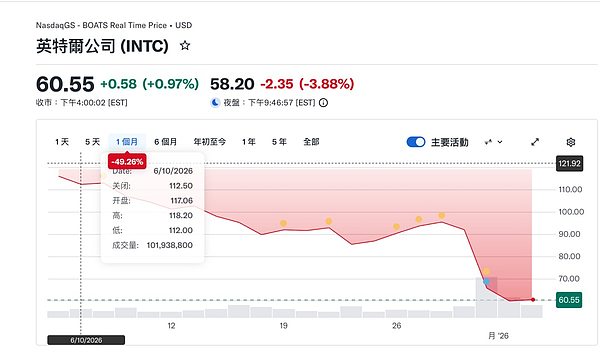
On October 30th, Intel's stock price fell 28.58% in a single day, closing at $65.76, wiping out approximately $140 billion in market capitalization in one day. On November 2nd, the stock price continued to fall by approximately 8.8%.
Compared to its June high of $140.94, the cumulative decline has exceeded 50%. Intel wasn't the only one impacted. During the same period, semiconductor companies such as AMD, Qualcomm, and Arm also experienced significant declines, with Nvidia falling 4.22% and the Philadelphia Semiconductor Index falling 7.2%. A thought-provoking question arises: Why are chip companies facing such a sharp sell-off when AI computing power demand remains strong? 01 Earnings Growth, Yet Stock Price Plummets: What's Wrong with Intel? Judging from the third-quarter financial report, Intel's performance was not bad. Revenue reached $16.5 billion, a 21% year-over-year increase; Data Center and AI revenue reached $7.3 billion, a 78% year-over-year increase; Adjusted earnings per share were $0.52; Adjusted gross margin was 44.1%. Especially in the data center business, with the growth in demand for AI inference, intelligent agent applications, and servers, CPUs have once again become a crucial component of AI infrastructure. However, what disappointed the market was Intel's outlook for the future. The company expects fourth-quarter revenue of $15 billion to $16 billion, lower than the market's expectation of approximately $17.1 billion; adjusted earnings per share are expected to be only $0.25, and gross margin will also decline to around 38%. What worries investors even more is that Intel expects to fail to achieve positive cash flow in 2026, while still needing to maintain large-scale capital expenditures in the future. This means that even with rapid growth in its AI business, the company may not be able to convert demand into profits and cash flow in a timely manner. Specifically, Intel is facing three intertwined problems. First, its traditional PC business is under pressure, while AI demand is actually driving up supply chain costs. The PC business remains a significant revenue source for Intel, but AI data centers are vying for increasing storage resources. In particular, the growing demand for high-bandwidth memory (HBM) is driving storage supply chain capacity towards the AI market, putting supply and price pressure on the traditional DRAM market. This increases procurement costs for PC manufacturers, further impacting PC market demand. Intel faces a dilemma: AI data centers require more chips, but the traditional PC market is under the dual pressure of rising costs and weak demand. Second, server CPU demand is strong, but Intel's production capacity cannot keep up. AI data centers are not just about GPUs. GPUs are responsible for massively parallel computing, while CPUs handle task scheduling, data processing, and system management. As AI inference and agent applications increase, the importance of server CPUs is also rising. Intel's 78% year-over-year revenue growth in its data center and AI business perfectly reflects this trend. However, the problem lies in the supply constraints of advanced packaging, substrates, and certain manufacturing processes, preventing Intel from fully meeting the needs of its server customers. Meanwhile, the accident at its Israeli factory has also placed additional pressure on production and delivery. Third, advanced processes and wafer foundry still require significant capital investment. Building wafer fabs, upgrading processes, and improving yield all require long-term investment. Intel hopes to regain its manufacturing advantage through advanced processes such as 18A, but technological progress does not guarantee immediate commercial returns. When capital expenditures continue to increase while profit and cash flow improvements fall short of expectations, investors will naturally reassess the company's valuation. Intel's problem is actually a mismatch between demand, capacity, and funding. 02 The demand for AI is real, but can Intel turn it into profit? If we only look at the 78% growth in its data center business, Intel seems to have regained its AI dividend. However, a closer analysis of the financial statements reveals that business growth does not equate to genuine market competitiveness. This is particularly evident in Intel's foundry business. In the third quarter, Intel's foundry revenue reached $6.7 billion, a year-over-year increase of 58%. However, approximately $6.3 billion of this came from Intel's internal operations, with only $411 million coming from external customers. Meanwhile, the foundry business still lost approximately $1.9 billion in the quarter, with a cumulative loss of approximately $6.4 billion for the first three quarters of 2026. This means that while Intel's manufacturing business appears to be growing rapidly, the actual revenue from external customers remains limited. For a company aspiring to become a global leader in advanced wafer foundry services, this is clearly not enough. Intel needs to prove three things: Technological capabilities: Stable mass production of advanced processes like 18A, with continuous improvement in yield and cost. Customer capabilities: Ability to attract truly large-scale, sustainable external customer orders. Profitability: Gradually reducing losses and ultimately achieving stable cash flow with continued investment. These three things are indispensable. Intel's predicament reflects a reality in the semiconductor manufacturing industry: possessing advanced factories and process technologies is merely the starting point for competition. The ultimate value of these assets is determined by their ability to acquire customers, improve capacity utilization, and achieve profitability. Why did Intel's stock price plunge cause tension across the entire AI supply chain? If it were merely a problem with Intel's own operations, theoretically, it shouldn't have triggered such a significant adjustment across the entire semiconductor sector. In the past few years, tech giants have made large-scale purchases of GPUs and built data centers, driving rapid growth in the server, memory chip, power, and network equipment supply chains. However, the high costs of construction, procurement, and operation have also led investors to question whether the AI business can generate enough revenue to cover these continuously increasing investments. Taking a major global cloud provider as an example, UBS had projected that its capital expenditure would grow by 76% to $673 billion in 2026, but the growth rate might slow to 25% in 2027 and further decrease to 6% in 2028. As investment scales up, the differentiation within the semiconductor industry chain may also intensify. Chip design companies reap high profits thanks to their technology and software ecosystem, while manufacturing companies bear huge capital expenditures and depreciation. Meanwhile, memory, advanced packaging, power, and heat dissipation sectors face pressure from capacity expansion and cyclical fluctuations. AI is no longer an industry where simply being involved guarantees profit. 04 What stage is the AI industry entering? If we simply divide this round of generative AI industry development into three stages, we can see... Phase One: Technological Breakthroughs, Market Pays for Imagination. Represented by the generative AI boom sparked by ChatGPT, the market primarily focuses on model capabilities, technological breakthroughs, and future application potential. Whoever can launch a more powerful model will have the opportunity to gain more attention and capital support. Phase Two: Infrastructure Expansion – The Market Pays for Increased Computing Power. As the demand for large-scale model training and inference increases, tech giants begin large-scale data center construction. GPUs, servers, memory chips, advanced packaging, and power equipment become the focus of industry investment. In this phase, the market focuses more on who can acquire computing power and who can scale up. Phase Three: Verification of Commercial Returns – The Market Begins to Focus on Real Profitability. As investment in AI infrastructure continues to increase, investors are beginning to demand that companies demonstrate the sustainability of their business models. How long does it take to recoup the investment in computing power? Can AI products generate stable revenue? Can revenue growth cover model training, inference, depreciation, and operating costs? Companies need to answer these questions with more specific operational data. Judging from recent market performance, the AI industry may be gradually moving from the second stage to the third stage. However, this does not mean that infrastructure construction is over. On the contrary, with the development of AI inference and agent applications, the demand for computing power may continue to grow; it's just that the market is beginning to pay more attention to investment efficiency and commercial returns. 05 Where are the opportunities in the AI industry chain in the next stage? As the capital market begins to reassess the return on AI investment, the competitive logic of the entire industry chain may also change accordingly. Next, three directions are worth paying attention to. 1. Shifting from expanding computing power to improving infrastructure efficiency. In the past, companies competed on the number of GPUs, the size of data centers, and capital expenditure. In the future, computing power utilization, cost per inference, data center operational efficiency, and investment recovery cycle may become more important. Companies that can provide higher computing efficiency with the same investment will be more likely to gain market recognition. 2. AI applications need to prove real commercial value. If infrastructure investment needs to yield returns, downstream applications must generate sufficient revenue. Enterprise-level AI, automated workflows, and AI agents have the potential to create business value by reducing enterprise costs and improving work efficiency. However, application companies also need to demonstrate that users are willing to continue paying, and that revenue can cover model usage, customer acquisition, and operational costs. 3. The semiconductor industry chain will see more pronounced structural differentiation. Future competition will not only be about who has the most advanced chips, but also about who has more stable customers, supply chains, and profitability. GPUs, server CPUs, HBM, advanced packaging, power, and heat dissipation may still benefit from AI infrastructure development. However, for investors, it's crucial to distinguish between genuine demand, effective production capacity, and ultimate profits, rather than simply lumping all AI-related companies under the same valuation logic. 06 Conclusion: AI is not over, but market patience is waning. Intel's stock price plunge of over 50% cannot be simply attributed to the bursting of the AI bubble. Behind this lies both internal issues such as a weak PC market, supply chain bottlenecks, imbalanced capacity allocation, and losses in wafer foundry services, as well as a reassessment of the capital market's investment returns on the entire AI industry. In the past, the market was more willing to pay a premium for the future potential of AI. Now, investors are starting to ask: how much investment is needed for this future, and how long will it take to truly recoup the investment? The demand for AI still exists, and the construction of computing infrastructure is far from over. However, technological leadership, revenue growth, and the scale of capital expenditure are no longer sufficient to individually support the high valuations of all companies. The next battle in the AI industry will be about who can be the first to translate technological advantages into sustainable business returns.


 Weatherly
