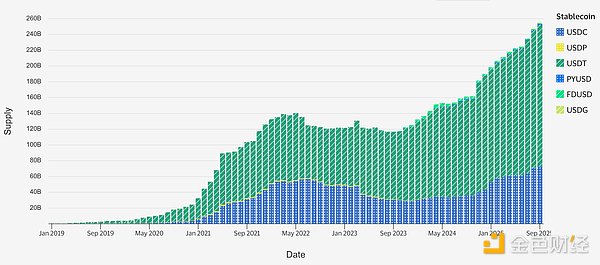
Source: insights4.vc, compiled by Shaw Jinse Finance. Institutional adoption is surging, with monthly active blockchain users increasing by 30%-50% year-over-year. Currently, stablecoins have a monthly on-chain transaction volume of $3 trillion (August 2025), with a total market capitalization exceeding $250 billion. Fintech payment companies are integrating stablecoins to enable fast and low-cost payments. A recent survey found that 71% of Latin American businesses already use stablecoins for cross-border payments. Using stablecoins can reduce average remittance fees (approximately 6.5% for a $200 bank transfer) by approximately 60%, a trend already evident in regions like Sub-Saharan Africa. PayPal's launch of the US dollar stablecoin (PYUSD) and Visa's ongoing USDC settlement pilot demonstrate that traditional businesses are adopting cryptocurrencies to improve financial and merchant settlement efficiencies.
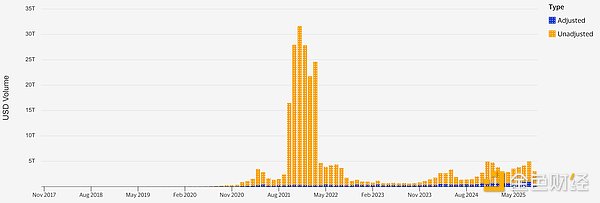
Stablecoin trading volume (adjusted and unadjusted)
Technical Risks
In addition to smart contract risks, scalability and performance limitations are also crucial. If an institution suddenly conducts millions of daily transactions on Ethereum, fee costs could skyrocket and throughput could be hampered. Scalability risks can be mitigated by choosing an appropriate network (such as a Layer 2, a high-speed layer, or a sharded architecture), using batching to aggregate transactions whenever possible, and adopting asynchronous processing for smaller transactions that don't require instant finality. Interoperability and cross-chain bridge risks are also important, as institutions often need to transfer assets across chains—for example, storing tokenized assets on one chain and liquidity on another. Cross-chain bridges are notorious points of failure, with billions of dollars lost in past hacks. Consequently, institutions minimize their use of third-party cross-chain bridges. Some institutions choose a burning and minting solution operated by a trusted party. Circle's cross-chain transfer protocol eliminates the need to hold assets in a cross-chain bridge by burning them on the source chain and minting them on the target chain, thus reducing custody risk. When third-party cross-chain bridging is required, institutions prefer bridges with strong security features, such as multi-signature mechanisms, insurance coverage where possible, and audits. Some institutions also require cross-chain bridge providers to conduct risk assessments, and there are frameworks that rate the security of cross-chain bridges.
Conclusion
Blockchain has evolved from the proof-of-concept stage to a production-ready stage for fund flows, collateralization, and capital allocation. Regulatory clarity in the US, EU, and Hong Kong has reduced policy risks, while rising stablecoin trading volumes and tokenized fund assets under management demonstrate real demand.The short-term winners will be banks and asset managers that combine public chain coverage with permissioned controls, measurable KPIs, and strict custody. The current enforcement focus is on supplier selection, privacy design, and risk control, rather than whether to participate.


 Jixu
Jixu


