When stablecoins become volatile, only two things matter: whether you can redeem them, and how quickly. These two things are all contained in the "reserve" and "yield." What's in the reserves directly determines whether you can redeem your tokens 1:1; how the money is earned determines what the stablecoin will do in extreme market conditions. This article follows the 6th episode of the "Mastering Stablecoins" podcast, "EP06 | Is a DeFi 'Subprime Crisis' Coming? Avoiding Pitfalls: Deconstructing the Underlying Assets of Stablecoins and Regaining the Security of Earning Interest." We won't pile on concepts; we'll just explain things clearly: what money is behind stablecoins, how this money earns interest, and whether you can redeem them in case of market fluctuations. The following text will divide mainstream stablecoins into two types, summarize common methods for judging the security boundaries of stablecoins, and break down the reserve and yield structure of the top 10 stablecoins, providing a set of intuitive judgment and scoring methods. Cash Reserve Type: Essence and Core USDT, USDC, PYUSD, USD1, USDtb, etc. Its essence is simple: it maps assets like US dollar cash, short-term US Treasury bonds, RRPs (reverse repurchase agreements), and money market funds—assets that are "quick to sell and have stable value"—into an on-chain liability. The tokens you hold are essentially the right to redeem that basket of highly liquid US dollar assets. Returns come from coupon payments and reverse repurchase interest; the path is short and predictable, and it typically doesn't rely on leverage or complex strategies. Safety Margin: 1:1 Reserve: Look at the ratio and maturity structure of "cash + short-term debt/RRP," aiming for short duration and minimal mismatch. Focus on two key things: How much money is invested in cash that can be readily or quickly converted into liquid assets, overnight reverse repos (RRPs), and short-term debt of 7–90 days; and whether the maturities of these assets are short. The shorter the maturity, the faster the money can be obtained in case of an emergency, and the less need there is to sell at a discount. Regarding compliance and attestation, consider three points: the amount of disclosure, the quality of disclosure, and the level of detail. Higher disclosure frequency (daily/weekly/monthly) is better; in attestation, "reasonable certainty" is stronger than "limited certainty"; in terms of details, is it disclosed whether "when the funds mature, which institutions (counters) the money is held in, and whether there is excessive concentration"? Regarding redemption channels: Who can redeem (whitelisted institutions or everyone), where to redeem (off-chain vs. on-chain PSM contract), how long does it take (T+0/T+N), and are there any limits (single address/single day/queue rules)? Pay attention to whether there is a direct redemption channel that you can "use"; if there is no direct redemption, look at market depth and arbitrage efficiency.
Flow Limitation and Contingency: How to cut costs in extreme situations (temporary limits, fee increases, suspension of some channels), whether there are "guaranteed redemption paddings" (such as USDS's PSM pool) and transparent queuing.
Synthetic Yield Tokens: Essence and Core
USDS, USDe, USDf, etc.
It doesn't put US dollars into a pool, but rather puts a "strategy" into a token. The common underlying approach is: take long positions in assets such as ETH/LST, BTC, etc., and simultaneously place an equal amount of short positions in perpetual contracts or futures, aiming to hedge the direction; then add funding fees, staking rewards, market making and lending spreads to "synthesize" a seemingly stable cash flow. Where does its revenue come from? Mainly from three categories: Funding fees and basis: When the long position is greater than the short position in the perpetual contract market, the futures price is higher than the spot price, and the funding fee is positive. The market will pay interest to the short sellers, and the strategy profits. Once the funding fee turns negative or the price spread narrows or even inverts, the strategy will incur losses, and the cash flow will worsen. Lending and market making: Lending stablecoins to earn interest spreads; or acting as a limited partner (LP) in a trading pool to earn transaction fees. The advantage is more stable cash flow; the cost is bearing the credit of the counterparty (platform/market maker), the risk of contract hacking, and the "impermanent loss" caused by price fluctuations during market making. Collateral Interest: If the collateral is LST (Liquidated Securities), it will generate collateralized interest; placing it in RWA (Retail Funds, etc.) will also generate coupon interest. However, because the strategy also has hedging or margin positions, these interest rates must be calculated together with "short position cost/margin usage" into a comprehensive account. Safety Boundaries: Strategy Failure Points: When will losses occur, for how long, and what is the maximum drawdown? Are historical and scenario calculations provided? Are there any strict "stop-loss/leverage reduction" rules? What will happen: Reserves will be used to replenish margin or cover losses, the redemption pool will decrease, limits/queues will appear, and over time, the price may decouple. Counterparties and Margin: Which exchanges are they on, where is the custodian, how is the margin replenished, and what threshold triggers forced liquidation? What happens: Positions held on a few exchanges or with a few market makers may be forced to liquidate or liquidate positions when risk control tightens/margin requirements increase/platform outages occur, leading to hedging imbalances; at the same time, more cash is tied up in margin, leaving less available cash for redemption. Limits and Restrictions: Daily/block redemption limits, T+N, queues and priorities; in extreme cases, will the liquidity tap be turned off first and then liquidation proceed slowly? What happens: It acts as a "liquidity gate," used to buy time for liquidation; when liquidity is restricted, the secondary market may experience discounts, and those who are in a hurry to sell will suffer greater losses. Transparency: Frequency of disclosure of positions and hedging ratios, third-party verification, on-chain verifiability; whether only a verbal commitment of "nominal neutrality" is given. What will happen: You cannot predict the tipping point; the market cannot establish stable expectations. Panic precedes, and runs occur earlier and more violently; issuers are forced to impose stronger liquidity restrictions, creating negative feedback. Having read this far, you have obtained a "method" for judging stablecoins. The next step, what you should be most concerned about, is to apply this yardstick to specific projects: where exactly does each stablecoin put its money, how does it generate interest, and how will it handle runs? To this end, "Mastering Stablecoins" has compiled publicly available official information (reserves/audits and attestation, redemption terms, on-chain dashboards and announcements) of the top ten stablecoins by market capitalization, reconstructing their mechanisms and operational key points into a "stablecoin profile." Simultaneously, a set of comparative scores is used across all dimensions to help you quickly identify differences. Top Ten Stablecoin Scoring List To ensure comparability, we used the same scoring criteria in this sample: Reserve Quality 30%, Redemption Certainty 20%, Transparency 20%, Strategy and Counterparties 15%, System Correlation 15%. The ratings are used solely for horizontal comparisons within this survey to help readers identify the strengths and weaknesses in specific dimensions. They do not constitute any investment advice or recommendations to buy/reduce. The data will be dynamically updated as disclosures and ecosystem changes occur, and the ratings will be adjusted accordingly. (Updated to 2025-11-15)
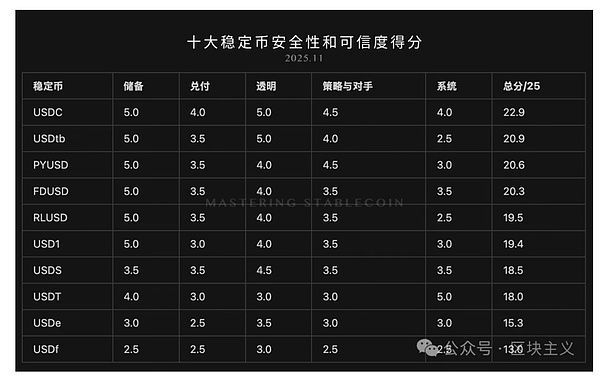
Rank 1 - USDC | Profile and Comparison Score
Basic Information:Issuer: Circle; Market Cap: Approximately $70 billion; Main Chain Distribution: Ethereum≈67%, Solana≈11%, Arbitrum≈10%. Reserve Structure: 100% Cash + Short-Term US Treasuries + RRP, short duration, highly standardized, pure "cash coupon" route. Custody/Management: Circle Reserve Fund (managed by BlackRock, funds held in regulated banks and RRP, etc.); cash deposits held in the regulated banking system. Issuance/Redemption: Direct redemption from whitelist (minimum approximately $100), daily limit of $100 million per address; retail investors mostly use secondary markets or fiat currency deposits and withdrawals. Transparency: Daily "reasonable confidence" level disclosure (AICPA), frequency and granularity industry benchmark. **Activity and Systemic Position:** Multi-chain main routing, deep market making, and high arbitrage efficiency; its size and depth are second only to USDT, but it is more "institutionalized" in terms of compliance and custody.
**Key Risks:**
**Institutional Cost Control:** Whitelists and daily limits provide "smooth flow with thresholds," and queues may still occur during extreme periods.
**Jurisdiction and Bank Dependence:** Mainstream US compliance is an advantage, but also an external variable due to its single jurisdiction.
**Historical Events:** Bank-related events have triggered short-term decoupling in the secondary market, but recovery is possible.
USDC Score
Reserve Quality: 5.0/5
Repayment Certainty: 4.0/5
Transparency: 5.0/5 Daily AICPA "reasonable conviction," high frequency and high granularity. Strategy and Counterparties: 4.5/5 Pure cash coupon path + mainstream US compliant custody; diversified across multiple banks/funds; risk controllable due to concentration in residual jurisdictions/banks. System Correlation: 4.0/5 Strong multi-chain depth, but overall not as large or deep as USDT.
One-sentence review: The "industry benchmark" for compliance and transparency; liquidity is second only to USDT, but it makes custody and disclosure easier for the risk control team.
Ranking 2 - USDtb | Profile and Score
Basic Information:Issuer: Ethena; Launched in April 2025; Medium size, high concentration on a single chain.
Reserve Structure:100% short-term US Treasury bonds (held through RWA Fund/tokenization instruments, such as BUIDL), short duration, quick to liquidate, typical cash reserve type.
Custody/Management: Primarily uses tokenized US Treasury instruments (such as BlackRock BUIDL); related custody chains include BNY Mellon (BUIDL custody) and institutional-grade crypto custody/settlement networks (such as Coinbase/Copper/Fireblocks ecosystem participation). Revenue Sources: US Treasury coupons/reverse repurchase agreements/demand interest; not reliant on leverage or hedging, returns fluctuate with interest rate cycles. Issuance/Redemption: Primarily direct off-chain redemption by qualified institutions; retail investors mostly use secondary and fiat currency deposit/exit routes; in extreme cases, flow is limited according to rules. Proof and Disclosure: Reserve composition and net asset value changes are verifiable on-chain (real-time/high-frequency); transparency is stronger than monthly reporting models. **Activity and Systemic Position:** While the overall size is steadily increasing, systemic depth and routing remain significantly lower than USDT/USDC. **Key Risks:** **Redemption Threshold:** Primarily direct redemption by institutions; retail investor experience relies on secondary market liquidity and market-making depth. **RWA Toolchain Dependence:** Custody, access, and legal compliance of tokenized US Treasury bonds are key external dependencies. **Systemic Depth:** A seamless, end-to-end routing system that allows direct access to any scenario has not yet been established; its buffering capacity during periods of stress is weaker than that of leading companies. USDtb Score Reserve Quality:
5.0/5100% Short-term US Treasury bonds/reverse repos, held through RWA instruments such as BlackRock BUIDL; short duration, mature disposal path3>Repayment Certainty:3.5/5Institutional direct redemption + quota management and KYC; retail investors mostly go through the secondary market, spread and queue risk increase during the pressure period3> Transparency: 5.0/5 On-chain net asset value/holdings are frequently verifiable, and external fund disclosures and custody chains (such as BNY Mellon) can be cross-verified. Strategy and Counterparties: 4.0/5 Cash coupon type + top-tier RWA tools and custody; however, new products and high dependence on the RWA toolchain pose secondary risks due to changes in jurisdiction/channels. System Relevance: 2.5/5 Scale and multi-chain depth are still limited; the main route has not yet been formed. Total Score: ≈20.9/25
Rank 3 - PYUSD | Profile and Score
Basic Information:Issuer: PayPal/Paxos; Launched in August 2023; Multi-chain available, primarily Ethereum and Solana, with steadily increasing scale.
Reserve Structure:100% Cash + RRP, short duration, clear path, typical cash reserve type.
Custody/Management:Paxos Trust Custody
Income Sources:Coupon interest/Reverse repurchase/Demand interest; Synchronized with interest rate cycles, not reliant on leverage or hedging.
Income Sources:
Monthly reasonable confidence and component disclosure, frequency is not as high as daily/on-chain high-frequency verifiable
Strategy and counterparties: 3.5/5
System correlation: 3.5/5
Total score: ≈20.3/25
Strong in size and activity, but overall not as deep or buffered as USDT/USDC
Total Score: ≈18.5/25
One-sentence evaluation: High transparency, flexible design, and supported by a "guaranteed redemption cushion"; however, the returns and collateral are more "mixed," making it more sensitive to parameters and counterparties in extreme situations.
Rank 8 - USDT|Profile and Score
Basic information: Issued by Tether, established in July 2014; market capitalization approximately $180 billion (November), main chain distribution Ethereum≈51%, Tron≈44%, Solana≈1.3%.
Total Score: ≈18.5/25
One-sentence evaluation: High transparency, flexible design, and supported by a "guaranteed redemption cushion"; however, the returns and collateral are more "mixed," making it more sensitive to parameters and counterparties in extreme situations.
Rank 8 - USDT|Profile and Score
Basic information: Issued by Tether, established in July 2014; market capitalization approximately $180 billion (November), main chain distribution Ethereum≈51%, Tron≈44%, Solana≈1.3%.
Reserve Structure: Cash and equivalents, short-term US Treasury bonds, money market funds, precious metals, etc.; approximately 80% is comprised of "cash + US Treasury bonds". The core is short-duration US dollar assets, which are quickly convertible to cash, but the composition includes non-US dollar assets (such as gold) and other categories, with limited granularity in details and counterparty disclosures. Custody/Management: Diversified distribution of US dollar reserves; the US Treasury bond position management and matching parties have been publicly identified as Cantor Fitzgerald (media and third-party disclosures). Sources of Income: Primarily coupon/money market fund interest, with a clear path and minimal reliance on leverage or complex hedging; yield fluctuations are related to interest rate cycles. Issuance/Redemption: Off-chain redemption via the official website; direct redemption is only authorized to partner institutions, typically ≥$100k per transaction; queue details are not publicly disclosed, retail investors mainly rely on the secondary market and market-making depth. Proof and Disclosure: Monthly "Limited Conviction" attestation; frequency stable but less than daily/real-time; limited granularity of disclosure regarding maturity structure and counterparty concentration. Activity and Systemic Position: Multi-chain coverage, large market-making and trading volume, extremely strong secondary market liquidity, generally good price discovery and arbitrage efficiency during runs. Key Risks: No Inclusive Direct Redemption: Retail investors lack official 1:1 redemption and can only access liquidity in the secondary market. Transparency Threshold: Attestation types and disclosure granularity are weaker than some competitors (e.g., daily reports). Compliance/Jurisdiction and Freezing Authority: Changes in the compliance environment of the issuer and custodian/bank counterparties may affect redemption arrangements. High system coupling: Once a negative event occurs, the transmission is wide and fast, but because it is "too big and too deep," it also has a stronger market-making buffer. USDT Score: Reserve Quality: 4.0/5 80% short-duration USD assets; deductions for non-USD components and detailed disclosure restrictions. Redemption Certainty: 3.0/5 Only authorized institutions can redeem directly off-chain through their official websites (usually ≥$100k), retail investors rely on secondary markets; queues and details are not transparent. Transparency: 3.0/5 Monthly "Limited Conviction," counterparty and duration granularity is weaker than daily plans. Strategy and Counterparties: 3.0/5 Cash coupon is the main path, but counterparty and jurisdiction disclosure is not as good as USDC-related; transparency and external verification are relatively weak. System Relevance: 5.0/5 Largest volume, deepest market making, widest routing; also the most "buffer depth" during crises. Total Score: 18.0/25 One-sentence evaluation: Liquidity ceiling, but "no inclusive direct redemption + granular disclosure" is the main weakness. Rank 9 - USDe | Profile and Score Basic Information: Issuer: Ethena; Market capitalization: approximately $9 billion; Primarily based on Ethereum (almost entirely on Ethereum). Reserve Structure: Primarily long positions in spot/collateralized BTC/ETH and LST, plus an equal amount of short positions in perpetual/futures contracts; supplemented by some stablecoin and cash positions. "Cash + US Treasuries" accounts for approximately 58%, with the remainder being a combination of crypto collateral and hedging. Custody/Management: Spot/collateralized assets are held in custody by qualified third parties (Ceffu, Copper); hedging positions are primarily held on the exchange side through notional hedging/notional margin, often combined with off-exchange settlement networks to reduce on-exchange risk exposure. Revenue Sources: Primarily Delta-neutral (≈60%), supplemented by on-chain DeFi (≈25%) and cash/deposit interest (≈15%); returns are highly sensitive to funding fees and basis. Issuance/Redemption: Primarily based on contracts and whitelists, with daily limits; regular "redemption to stablecoins," but no guarantee of returning the original LST/ETH; on-chain redemptions have block and single-asset caps. Proof and Disclosure: Weekly third-party verification and operational disclosure; position/hedging ratio disclosure is not real-time and requires cross-verification with dashboards and announcements. Activity and Systemic Position: Significant volume and on-chain usage, but lower overall depth compared to USDT/USDC; high single-chain concentration. Key Risks: Strategy Sensitivity: Negative funding fees, widening basis, one-sided market trends, and tightening liquidity can lead to increased hedging costs or forced position reductions. Counterparties and Margin: Exchange/market maker credit, margin call timing and thresholds directly impact redemptions and liquidity limiting. Limits and Restriction: Daily/block limits should be "turned off" in extreme cases, shifting price anchoring to queue-based trading. Asset Redemption Scope: Redeem stablecoins instead of native LST/ETH; user expectations for management must be clearly stated in advance. USDe Score Reserve Quality: 3.0/5 Cash + US Treasuries constitute a moderate proportion, with the remainder being a combination of crypto collateral and hedging. Redemption Certainty: 2.5/5 Whitelist + Daily Limit + Block Limit, with cost-cutting implemented in extreme situations. Transparency: 3.5/5 Weekly verification + operational disclosure, but not real-time and with limited granularity. Strategy and Counterparties: 3.0/5. Nominal hedging + third-party custody reduces exposure to "direct exchange defaults"; however, legal and operational risks remain regarding funding fees/basis, PB/custody tripartite arrangements, and margin adjustments and cost-saving risks under extreme market conditions. System Correlation: 3.0/5. Significant volume, but depth and routing are inferior to USDT/USDC. Total Score: ≈15.3/25. In short: Hedging-driven synthetic returns, with nominal hedging and third-party custody mitigating exchange exposure; however, funding fees/basis and margin management are weaknesses, with liquidity restrictions implemented during extreme periods, and price anchoring relying more on secondary market making. Rank 10 - USDf | Profile and Score Basic Information: Issued by Falcon/DWF; Launched in February 2025; Primarily Ethereum, medium size, stable growth. Reserve Structure: Primarily a multi-asset mix (stablecoins, BTC, ETH, DOGE, etc.), with a relatively low proportion of cash/short-term debt (approximately one-third); clear asset stratification, with a significant weighting of volatile assets. Custody/Management: Limited public disclosure; multi-asset portfolio + synthetic yield path, no authoritative disclosure from the custodian - Revenue Sources: Primarily synthetic yields (hedging/funding fees), market making and lending spreads in parallel; yields are sensitive to market trends and funding fee direction. Revenue Sources: Primarily synthetic yields, specifically including funding fees/basis income, market making and LP fees, lending spreads, collateral interest/pledge income. Project cash flow is highly sensitive to market trends and funding fee direction; it will decline significantly when funding fees turn negative or the basis converges. Issuance/Redemption: T+7, available to qualified individuals; two paths coexist—exchange for stablecoins at face value, or return of collateral (determined by market price for "1:1"); in extreme cases, priority is given to flow restriction. Proof and Disclosure: Primarily weekly "limited confidence," with moderate frequency; granular disclosure of details and counterparties is limited. Activity and Systemic Position: Multi-chain availability but predominantly single-chain; market-making depth and routing are still under construction, secondary buffers are weaker than top-tier chains. Key Risks: Asset Hybridization and Long-Tail Exposure: Volatility-based assets are significant, leading to complex discounting and liquidation paths during runs. Redemption Uncertainty: Two redemption methods coexist, making it easier to enter the "return of collateral" uncertainty zone during extreme market conditions. Strategy and Counterparties: High reliance on funding fees, exchange/market maker credit, and margin management.
Flow limiting mechanism: T+7 naturally reduces flow; price anchoring within the event window relies more on secondary market making.


 Jasper


