Source: Hyperliquid Q2 Report; Compiled by: Jinse Finance Claw
Financial Highlights
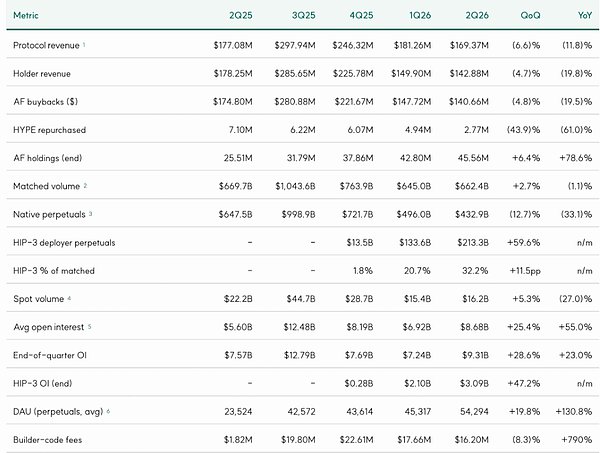
Hyperliquid Overview, Five-Quarter Trends
Ownership revenue declined 4.7% sequentially, while almost every operating metric rose sequentially: this divergence stems from “growth model” pricing.
Overall Background for the Second Quarter
HYPE has decoupled from the crypto asset class for the second consecutive quarter.
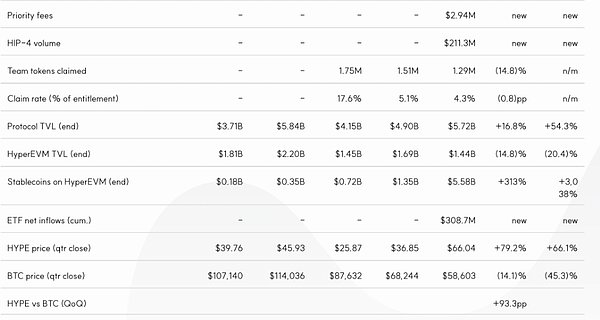
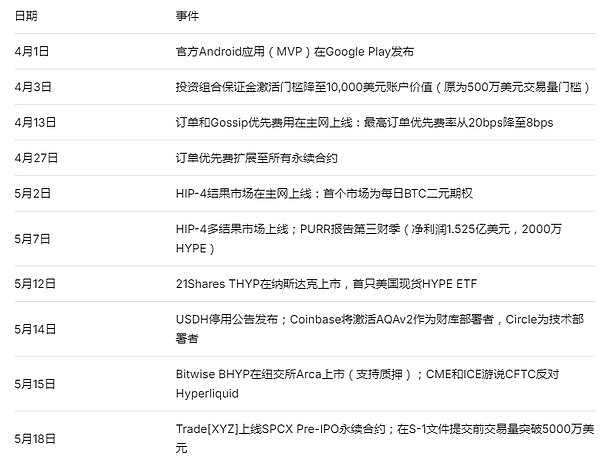
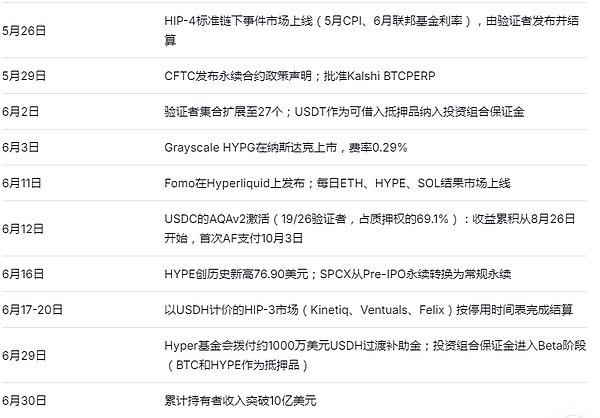
Bitcoin fell 14.1% in Q2 2026, marking its third consecutive quarterly decline and roughly halving from its October 2025 high. HYPE, on the other hand, returned +79.2% over the same period, reaching an all-time high of $76.90 on June 16th, with a quarterly excess return of 93.3 percentage points, following a 66.9 percentage point return in Q1 2026. Such significant excess returns over two consecutive quarters are difficult to attribute to beta or position factors. We believe the market has begun to view Hyperliquid as a cash flow-generating protocol rather than a high-beta crypto exposure, a judgment supported by the fundamentals this quarter. Revenue bottomed out in April and ended the quarter with its strongest monthly run rate since November. Protocol revenue was $169.37 million, a 6.6% decrease quarter-over-quarter, but the trend is more important than the numbers themselves. April was the weakest month under the modern fee structure; June was 52% higher than the April low, with an annualized revenue of approximately $840 million. The recovery was driven by trading volume, native fees remained stable, and cumulative holder revenue surpassed $1 billion at the end of the quarter, nineteen months after traceable fees began to be recorded for buybacks. The decisive decision of the quarter was the USDC recalibration. Hyperliquid discontinued its native stablecoin USDH on May 14 and designated USDC, deployed by Coinbase, as the aligned quote asset. Validators approved AQAv2 on June 12 (19/26 validators, representing 69.1% of the staked assets). Approximately 90% of the cost-adjusted reserve earnings on the platform's USDC will accumulate to the aid fund every 30 days, with the first accumulation starting on August 26 and the first payment on October 3. The circulating supply of stablecoins on HyperEVM quadrupled this quarter, reaching $5.68 billion. We estimate the arrangement to be worth approximately $135 million to $200 million annualized at current interest rates, representing the largest single increment in the holder economy since the builder code was introduced, at the cost of relinquishing stablecoin sovereignty and the exit of the issuer that pioneered the model, while each deployer quoting USDH faces a mandatory decision point. HIP-3 set a trading volume record, while its deployer tier consolidated into a single operator. Deployer trading volume increased 59.6% quarter-over-quarter to $213 billion, representing about one-third of paired trading volume, and HIP-3 open interest increased 47% quarter-over-quarter at the end of the quarter. Beneath the surface is increased concentration. Trade[XYZ]'s trading volume share rose from 85% in March to 97% in June, and actually reached 100% in July. Ventuals and Felix exited during the USDH settlement period from June 17th to 19th; Dreamcash ceased operations in early July; Kinetiq completed its settlement according to the same schedule and chose to migrate, launching its first USDC trading pairs on July 1st. HIP-4 launched on the mainnet and immediately demonstrated both sides of its argument. The results market launched on May 2nd under validator-curated Phase 1 rules, generating $211.3 million in trading volume, 13,046 new traders, and a peak daily trading volume of $12.1 million, with a near-zero fee structure. The World Cup market accounted for 84% of the tracked trading volume, while the regular BTC market declined to approximately $100,000 per day. Third-party analysis shows about ten active markets, while centralized competitors have thousands. In June, the category's combined monthly trading volume on Kalshi and Polymarket was approximately $4.5 billion. Hyperliquid possesses a structural advantage in this category—results contracts are co-collateralized with perpetual and spot contracts in the same account—but this advantage has not yet been fully realized. Wall Street is coming from both directions. Three US spot HYPE ETFs were launched within eight weeks (21Shares THYP, May 12; Bitwise BHYP, May 15; Grayscale HYPG, June 3), with a cumulative net inflow of $308.7 million by the end of the quarter. Hyperliquid Strategies reported a quarterly net profit of $152.5 million, and its treasury has since grown to $29.3 million HYPE, according to its dashboard. The vested interests responded with litigation. CME and ICE lobbied the CFTC against Hyperliquid in May; the commission, in turn, issued a policy statement on perpetual contracts on May 29 and approved Kalshi's BTCPERP—the first regulated Bitcoin perpetual contract in the US; CME sued its own regulator on June 18. US entry barriers remain a hard constraint on addressable markets, and these barriers are now being challenged in court by vested interests. Supply discipline persisted amid rising prices. The team claimed 1.29 million HYPE out of the 29.8 million owed amount this quarter, a claim rate of 4.3%, marking the third consecutive quarter of decline, even as the token price doubled: the cumulative unclaimed unlocked tokens reached 64.9 million, equivalent to approximately $4.3 billion at the end of the quarter. The aid fund repurchased 2.77 million HYPE for $141 million, and the foundation's delegated staking rights fell below half of the total staking for the first time, while the validator set expanded to 27. A notable contrarian trend is that HyperEVM TVL decreased by 14.8%, while the stablecoin's circulating supply quadrupled. 262Q Event Timeline USDC recalibration, HIP-4 launch, and the ETF product line defined this quarter.


 Weatherly
