The birth of Hyperliquid stems from a core contradiction in the crypto industry that has never been properly resolved.
The industry once envisioned creating a trading market without custodian institutions, with opaque balance sheets, and without reliance on third-party intermediaries. However, the place where professional traders truly obtain liquidity, leverage, and efficient execution remains centralized exchanges. These platforms are fast and have ample market depth, but the cost is that users must hand over asset custody rights and completely trust the platform operators.
Hyperliquid directly addresses this contradiction and provides a solution.
Instead of simply piling on decentralized concepts, it focused on creating a product that resonated with ordinary traders—a group that doesn't care much about decentralized ideology. The resulting on-chain derivatives trading platform offered a trading experience nearly indistinguishable from a professional centralized exchange, capable of handling large, real-world trading volumes while fully preserving the self-custody, transparency, and programmability that decentralized finance has long promised. By mid-2026, Hyperliquid was no longer a decentralized exchange (DEX) in the traditional sense. It had become a benchmark for on-chain order book trading, expanding its business from crypto perpetual contracts to commodities, stock-related derivatives, and pre-IPO equity synthetic asset markets, and gradually launching event-driven derivatives and options products. This platform, initially created to optimize the trading experience, has now grown into a customized public chain with a built-in native exchange and a continuously iterating market deployment infrastructure layer. The founder's background is key to understanding the project; Hyperliquid's market architecture is almost a reflection of Jeffrey Yan's personal growth trajectory. He was raised by a single mother on Redwood Shore, who taught him to break through mental limitations. He encountered advanced mathematics late in life, and after setbacks, turned to physics research, winning a gold medal at the International Physics Olympiad. He then went on to study mathematics and computer science at Harvard University. After graduation, he joined Hudson River Trading, believing that while the logic of financial markets was pure, personal development was limited. Jeffrey Yan's departure wasn't due to a dislike of quantitative finance, but rather his desire to build a product where he could deeply control its ultimate development.
Jeffrey Yan, founder of Hyperliquid
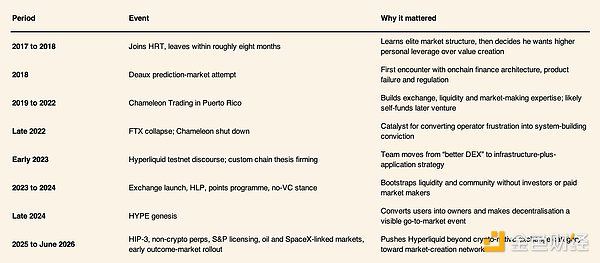
With this question in mind, he first worked on a prediction market project in 2018, which ultimately failed; then he founded Chameleon Trading; and finally created Hyperliquid.
This project didn't originate from a fundraising plan, nor was it born out of a desire to issue a token. Rather, it was a product of the frustration experienced by platform operators who witnessed firsthand the vast gap between the crypto industry's advertised vision and the reality of liquidity hubs. This article argues that Hyperliquid's significance lies not only in its ranking among the most successful crypto exchanges, but also in its representative attempt to rebuild the entire market trading architecture within the existing limitations of the crypto industry. The core debate is no longer about whether on-chain transactions can be implemented; Hyperliquid has already provided an answer with its tangible results. A more challenging question is whether this financial network, backed by the exchange's own funds, can become a neutral infrastructure capable of supporting larger-scale global financial transactions. The reason Jeffrey Yan's past is worth analyzing is not because it's a formulaic inspirational story, but because the series of decisions he made before founding Hyperliquid clearly explain the design philosophy behind the system's final form. He grew up in Redwood Shore, in the heart of the Bay Area's tech industry, but not from an privileged background. After his parents divorced, his mother, an accountant, single-handedly raised him and his sister. This family experience is not just a part of his resume, but also shaped his mindset. His later insistence on self-control, his aversion to deliberately flaunted status, and his disregard for the empty titles of traditional companies all stem from his upbringing in Silicon Valley, surrounded by opportunities, yet never possessing the financial security of a comfortable and stable life. His mother's often-quoted phrase, "Aim high," instilled in him both lofty ambitions and a perpetual restlessness. This contradictory trait—an intense competitive drive coupled with skepticism towards praise and compliments—permeates Hyperliquid's overall corporate culture. One of the most telling aspects of his early life that foreshadowed his future was not just his exceptional talent, but also his late entry into top-tier academic competitions, culminating in the ability to compress years of preparation into just a few months of self-study. In eighth grade, he participated in competitions with classmates from a private school, his first encounter with advanced mathematics; from then on, he woke up at 5 a.m. every day to work on past Olympiad problems alone. Within a year, he was selected for the US Mathematical Olympiad training camp, but failed to make the national team. He did not stop there, but turned to physics. He taught himself using textbooks left by his seniors and Feynman's physics lecture notes. In just about a year, he joined the top tier of high school physics students in the United States and eventually won a gold medal in the International Physics Olympiad.
Jeffrey Yan during the International Physics Olympiad
Applied to the Hyperliquid project, the key is not that Jeffrey Yan is exceptionally talented, but that he is adept at recognizing the gap between himself and the top level in the industry, and then relying on high-intensity, self-driven research to catch up with that gap. Hyperliquid's rapid iteration from a testnet concept to a dedicated public chain and reaching the scale of an institutional-grade trading platform is a replication of this approach he used in his youth in adulthood.
Hyperliquid Product and Market Structure Timeline
Why Hyperliquid Was Inevitable
To understand why Jeffrey Yan believed Hyperliquid had to be created, one must first understand the underlying architecture of the crypto derivatives market before the project's inception.
In the crypto space, perpetual contracts have become a mainstream speculative instrument: compared to traditional futures with delivery at expiration, they have a lower entry barrier and allow traders who want to maintain long-term exposure to achieve higher capital utilization. The prototype of this type of product can be traced back to Robert Shiller's theory in the 1990s, but the crypto industry implemented it through BitMEX, followed by major centralized exchanges. By 2025, the global perpetual contract market was enormous: Reuters data showed its annual trading volume reached $61.7 trillion, with offshore trading platforms routinely offering high leverage, 24/7 two-way speculative trading to global users. While centralized exchanges like Binance and FTX have addressed some pain points, they have exacerbated another contradiction. They offer traders extremely small bid-ask spreads, mature order books, high leverage, and stable execution services, but require users to unconditionally trust the platform throughout: trust its asset custody mechanism, solvency, liquidation and settlement processes, internal conflict of interest management, and the underlying infrastructure to ensure it does not favor internal personnel. Jeffrey Yan's team initially gained in-depth understanding of this system through quantitative bots and market-making operations. Later, they delved into decentralized finance (DeFi) and ultimately concluded that the most liquid trading platforms in the crypto industry ironically reproduced the intermediary trust problem that Bitcoin and Ethereum should have eliminated. The FTX collapse was not the origin of this viewpoint, but rather it turned this potential problem from a theoretical concept into an undeniable reality. In Jeffrey Yan's own words, the FTX incident was the clarion call to action, not the origin of the initial concept. The obvious alternative at the time—early DeFi—was simply not up to the performance requirements for trading. Jeffrey Yan clearly explained the team's core judgment from a market architecture perspective: the team's choice of the order book model was not driven by an obsession with decentralization, but rather by the real needs of traders: low latency, clearly visible liquidity, low slippage, and a smooth user experience. Measured by these standards, the first-generation decentralized exchanges' entire technology stack had multiple inherent flaws. While Constant Product Automated Market Makers (AMMs) are efficient cold-start tools, from a market maker's perspective, funds are repeatedly exploited by arbitrageurs, a problem that becomes increasingly prominent after the liquidity mining craze subsides. Therefore, Jeffrey Yan's criticism of AMMs stems from underlying architectural flaws, not factional bias. These mechanisms distribute trades to passive liquidity providers; without substantial subsidies, professional market makers simply cannot operate sustainably. Solutions relying on oracles and hybrid architectures, while fixing some problems, introduce new drawbacks. His assessment of GMX is representative: such oracle-dependent systems are merely clever patchwork solutions, offering better capital efficiency than simple AMMs, but still requiring trust in oracle logic and manually set rules, while also possessing highly vulnerable boundary mechanisms. In his view, a design requiring continuous fine-tuning to prevent oracle manipulation cannot be the ultimate solution for core trading platforms. His criticism of dYdX v3 was even sharper: at that time, the order book in that version was essentially an off-chain centralized operation, with only the clearing process on-chain, and order placement and cancellation all relying on privileged servers. From an economic perspective, the core aspects of the platform, which are most sensitive to latency and directly determine market fairness and transaction quality, were still detached from the open and transparent on-chain consensus. Hyperliquid's initial core product idea was precisely to completely eliminate this on-chain and off-chain separation architecture. This also explains why Hyperliquid didn't just build a completely new front-end interface, but instead developed its own dedicated public chain. The team initially tested the solution on Arbitrum Layer 2 and considered compromises such as hybrid architecture and batch auctions, but concluded during the testnet phase that the existing public chain infrastructure could not support the trading experience they wanted to achieve. Order placement, cancellation, order matching, margin calculation, and forced clearing must be highly coupled and have extremely fast response times to ensure that the user's trading experience is no less than that of a centralized exchange. This meant that the deployment convenience of general-purpose public chains had to be abandoned, and a dedicated trading execution environment had to be built from scratch. Jeffrey Yan stated frankly that if a Layer 2 network with sufficient performance and the capacity to handle massive order throughput existed at the time, the team would have chosen it directly. Therefore, developing their own public chain was not an industry trend of creating a Layer 1 chain or blindly expanding the ecosystem, but rather a necessary technological choice driven by product needs. This is the core logic of the entire strategy: Hyperliquid's self-developed public chain is not because Layer 1 chains are an industry trend, nor is it simply about finding a carrier for tokens. Jeffrey Yan and the team believed that the only way to achieve perfect synergy between order book trading, clearing, margin mechanisms, and user experience under uncushioned and transparent constraints was to treat the entire system as a unified state machine. The initial positioning of this public chain was merely as an underlying tool supporting exchanges, not a general-purpose blockchain platform. This early focus on functionality actually became an advantage: the team only needed to optimize for a single high-value scenario, without having to force themselves to address all aspects of blockchain. The timing of the project's inception was equally crucial. The FTX collapse was an emotional catalyst, directly demonstrating that trusted intermediaries could destroy user confidence overnight. However, the underlying dissatisfaction with Hyperliquid existed long before the collapse, when the team had been developing it for months. Jeffrey Yan later admitted that his only regret was not launching the project sooner. This distinction is of significant analytical value: if Hyperliquid had merely been a custodial security exchange built to mitigate FTX-style risks, it would have remained confined to a niche market. But the project established a higher positioning from the outset: decentralized finance itself has sound values, it simply lacked a mature and efficient underlying transaction execution mechanism. The FTX incident merely solidified the team's mission, rather than giving rise to it. The adoption of an on-chain order book also brought secondary ripple effects. Having the entire order book on-chain improves auditability and data integrity; every order, cancellation, and settlement record can be fully traced. This brings transparency advantages, but also places stringent performance requirements, while exposing the platform to comprehensive public scrutiny. The liquidation turmoil and the controversy surrounding the JELLY token in October 2025 fully demonstrated the duality of this trade-off: Hyperliquid possesses on-chain auditing capabilities that centralized exchanges cannot achieve, but its fully disclosed volatility data also easily makes headlines in the industry. The platform's long-term strategic bet is that, in the long run, the benefits of transparency will outweigh the negative impact of short-term public opinion. An academic study on the microstructure of the Hyperliquid market in June 2026 corroborates this logic: publicly disclosed time-weighted average price (TWAP) orders, compared to hiding large orders, can reduce overall transaction costs, attract liquidity supply, and transfer adverse selection costs to traders unwilling to disclose their orders in advance. From a market architecture perspective, Hyperliquid's openness and transparency are not merely a matter of lip service, but a tangible change in the logic of transactions. In Jeffrey Yan's perspective, the birth of Hyperliquid was inevitable. The industry doesn't lack exchanges, but it lacks a non-custodial trading platform that treats order book performance, transparent trading, and asset self-custody as a unified whole, rather than separate, independent modules. From this perspective, Hyperliquid's underlying logic is far simpler than the various myths circulating in the industry: Jeffrey Yan and his team believe that professional traders' needs are always consistent, and existing crypto technology stacks either cannot meet these needs or can only achieve them by reintroducing intermediary trust. Hyperliquid's initial goal was to completely resolve this core contradiction. From Perpetual Contract DEX to Financial Network Hyperliquid's first key strategic move after its launch was not issuing tokens, but rather a liquidity cold start. The exchange officially began operations at the end of February 2023, initially attracting primarily early adopters, including NFT traders new to perpetual contracts. The professional liquidity required by the platform did not naturally form, and Jeffrey Yan refused to adopt the common crypto industry solution of subsidizing market makers with cash, equity, or tokens. In May 2023, he integrated the Chameleon Trading team's quantitative strategies into the Hyperliquid Liquidity Pool (HLP). Users could deposit funds into this transparent on-chain market-making and liquidity-guaranteeing tool, directly receiving corresponding returns without management fees or performance-based commissions. This mechanism was not just an efficient cold start method, but also a statement to the industry: the most profitable market-making business in the microstructure of the crypto market is, in principle, open to ordinary users, no longer an exclusive track for a few institutions. HLP also mitigated the platform's reputational risks. Hyperliquid needed liquidity but did not want to rely on its own market makers in the long term, repeating the mistake of Alameda's deep reliance on FTX. Jeffrey Yan explicitly required that HLP not become the core pillar of the platform's operation. The liquidity pool served as a transitional bridge, allowing the startup platform with zero liquidity to gradually attract independent market makers without direct cash subsidies. This is also Hyperliquid's typical design philosophy: relying on deeply integrated native underlying tools to solve the listing problem, and then gradually decentralizing the core economic functions outwards. The next strategic shift is into spot trading, whose value is often underestimated. Perpetual contracts only require book settlement, without the need to actually hold the underlying assets; the spot market, however, cannot avoid the most difficult custody issue in the financial field: who actually owns the assets and who completes the liquidation. It was during the stage of laying out the spot business that Jeffrey Yan no longer regarded Hyperliquid as "an exchange on a public chain," but redefined it as "a dedicated public chain with a built-in exchange." This reversal of thinking was crucial, paving the way for HyperEVM, the third-party developer ecosystem, and the full range of on-chain financial products. Spot trading is not a new complementary product, but a core driver that forces the platform to upgrade from a single application to infrastructure. In November 2024, the HYPE token was launched, simultaneously achieving multiple strategic goals: approximately 31% of the total supply was airdropped to 94,000 early users, and the team allocated 23.8% which was unlocked over several years. Publicly available data clearly demonstrates the project's fairness orientation: there are no private placement shares from venture capital institutions, internal personnel have no priority access to the primary market, and a large number of users acquire network ownership through airdrops. This token issuance simultaneously carries four values: first, it implements decentralization, broadening the scope of token holders; second, it promotes the market by rewarding genuine transactions rather than simply marketing; third, it establishes industry credibility, with crypto practitioners generally recognizing the fairness of its distribution mechanism; and fourth, it serves as a user retention mechanism, allowing existing trading users to directly hold the right to future economic benefits from the network. This design is not purely altruistic, but rather the most efficient way for the platform to leverage its own assets to gain long-term credibility. The token airdrop also changes the path of public chain governance and security development. Jeffrey Yan defines the token generation event as a decentralized milestone, not an operational node: the token uses native proof-of-stake consensus, and the distribution of verification nodes is more decentralized. This means that HYPE, from its inception, is not just a speculative target, but also serves as security collateral, market deployment collateral, and a tool for aligning ecosystem interests, gradually becoming a core meta-asset that carries various network functions. This directly impacts valuation logic: if HYPE is merely used as an exchange fee token, Hyperliquid can only be defined as a high-yield trading platform; however, multiple attributes such as staking, market deployment, and application-layer composability broaden the token's economic value boundaries. Nevertheless, as of mid-2026, the token's value remains highly dependent on transaction fee revenue. HyperEVM emerged in this context. Jeffrey Yan positions it as a programmable interface, rather than a typical sidechain compatible with the Ethereum Virtual Machine. This positioning is significant: HyperEVM's core value is not just about enabling developers to migrate Solidity contracts, but about allowing contracts to directly call Hyperliquid's native underlying capabilities: account balance, global liquidity, staking equity, and exchange order status. Once this architecture is implemented, EVM ecosystem applications will not need to build independent liquidity pools from scratch; they can directly access the platform's existing liquidity. This is the most feasible financial operating system concept: Hyperliquid does not intend to create an application store filled with various scattered decentralized applications, but rather to build an underlying financial foundation with a mature liquidity core. Developer incentive codes are the first step in distributing traffic externally. Third-party developers can build user-facing trading front-ends based on Hyperliquid's underlying liquidity and share in the transaction fees generated by these front-ends. As of 2026, since October 2024, third-party developers have accumulated over $70 million in revenue sharing. Matt Huang likens this model to a franchise, precisely differentiating it from the underlying organization of Binance and Coinbase: Hyperliquid attempts to separate infrastructure ownership from front-end interface ownership. If this model continues to scale, the underlying protocol will be difficult to replace because the platform does not need to directly control every end-user. Of course, this model has drawbacks: ecosystem fragmentation and increased difficulty in product quality control, but the strategic direction is clear: Hyperliquid encourages external entrepreneurs to build independent businesses based on the network. The HIP-3 proposal extends this open logic from the front-end interface to the trading market itself. The mechanism stipulates that anyone who stakes a sufficient amount of HYPE tokens can list on the perpetual contract market, customize trading parameters, and retain half of the transaction fees. Jeffrey Yan's interpretation of this model clearly conveys the underlying concept: the financial market is diverse and highly specialized, and a single team cannot complete the listing, research, and operation of all products. Centralized listing departments are more efficient in the short term, but permissionless deployment networks, if stably deployed, possess greater resilience and global expansion potential. This is one of Hyperliquid's most far-reaching designs: HIP-3 is not just about adding new trading categories, but also a decentralized listing system, a fee-sharing mechanism, and a channel for distributing professional knowledge. Exchanges thus transform from trading venues with their own fixed trading products to infrastructure that allows professionals to independently build their own trading products.
By early 2026, this market creation concept had completely transcended the scope of crypto assets. Leading market deployment provider Trade [XYZ] listed silver, crude oil, stock indices, and forex contracts, and the trading volume of third-party self-deployed markets accounted for a considerable proportion of the platform's total trading volume.
Jeffrey Yan stated that HIP-3 silver contract trading volume accounts for approximately 2% of the total global silver price discovery volume. Even if this data is only disclosed by the founder and has not undergone a complete third-party audit, it is enough to demonstrate the platform's long-term ambition: Hyperliquid is no longer limited to putting crypto derivatives on-chain, but hopes to make perpetual contracts a universal trading platform for all assets with sufficient liquidity. Reports in the Wall Street Journal in March and June 2026 confirmed the actual value of this strategy. During the period when the Iranian geopolitical conflict caused sharp fluctuations in oil prices, Hyperliquid's 24/7 oil perpetual contracts provided global traders with an uninterrupted trading channel, while traditional futures markets were closed; the platform's oil contract trading volume surged from $339 million to $7.3 billion in just a few days. Subsequently, S&P Dow Jones Indices authorized Trade [XYZ] to launch S&P 500 perpetual contracts, which the Wall Street Journal called the only officially authorized S&P 500 perpetual product. In June 2026, SpaceX-related perpetual contracts on the platform ranked among the top in trading volume, and pre-IPO equity contracts became a speculative target for real-time valuation of top global unicorn companies. Its core value lies not in Hyperliquid solving traditional financial pain points such as stock ownership and commodity clearing, but in building a mature synthetic asset issuance layer that compensates for the shortcomings of traditional markets, such as limited trading hours, high entry barriers, and cumbersome listing processes. The HIP-4 proposal is the next direction for business expansion. Jeffrey Yan, in an interview with *Colossus*, defined it as a path to deploy options and event-linked derivatives. There is a clear distinction between the two types of products: spot and perpetual contracts reflect linear price exposure, while event derivatives allow users to express ranges and non-linear price expectations. In mid-2026, *The Wall Street Journal* reported that Hyperliquid had officially launched its event prediction market and options trading, indicating that related products had moved from proposal to public business, but had not yet formed a mature, highly liquid core segment. Publicly available information shows that CPI inflation, Federal Reserve interest rates, and sports event contracts are only early-stage application scenarios and have not yet become pillars of stable growth. The collateralized asset track also has strategic significance, but there is less publicly available information about it compared to exchanges and the HIP-3 business line. Jeffrey Yan proposed a supporting native stablecoin solution: transactions using this stablecoin will have reduced fees, along with a protocol-level revenue sharing mechanism. The latest documents in June 2026 show that the platform plans to switch its benchmark pricing asset from USDH to USDC, with partners including Coinbase and the native market segment. The final legal and operational structure is not yet fully finalized. However, one thing is certain: Hyperliquid regards its pricing stablecoin as a core strategic infrastructure, not a supplementary tool. Whether the final solution will create a smoother institutional access channel or create a new dependence on compliant US issuers remains to be seen. So, how should Hyperliquid position itself as of June 21, 2026? The conclusion is that it spans multiple sectors, but the weight of each sector is not equal. Economically, the platform's core revenue and traffic still come from leveraged trading; architecturally, it's a blockchain with a built-in native exchange and a programmable extension layer; organizationally, the platform is evolving towards a decentralized market creation network, with third-party deployers and front-end developers controlling more of the terminal product ecosystem. Currently, the most fitting positioning is not "exchange" or "layered public chain," but rather a financial network with a built-in flagship exchange. The grand vision of building a universal financial operating system is still in the vision stage: the underlying network architecture has a corresponding prototype, but the economic scale of non-perpetual contract businesses is insufficient to fully support the realization of this narrative.
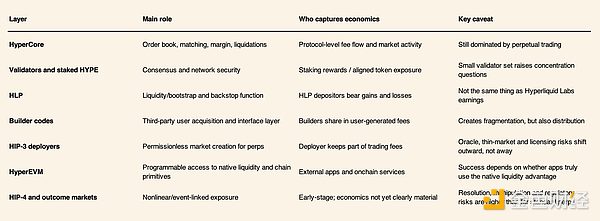
A Comparison of Hyperliquid Market Structure in Execution, Liquidity, Governance, and Ecosystem Design
An Organization Unwilling to Become a Traditional Enterprise
Hyperliquid Labs, the Hyperliquid Protocol, the Hyper Foundation, validator nodes, HLP liquidity pools, market deployers, and ecosystem developers cannot be simply categorized as "one company". This system, by its very design, cannot be contained within the framework of a single corporate entity. Jeffrey Yan has stated bluntly that Hyperliquid itself is not a company in the traditional sense; Hyperliquid Labs is merely a small core development team responsible for only a crucial small part of the entire ecosystem. This distinction is not a mere word game; it directly determines the flow of transaction fees, product expansion models, and how to interpret the platform's much-vaunted high-efficiency output metrics. Streamlined Team Model: Reality vs. Stereotypes The streamlined team size is an objective fact, but it is often over-interpreted and ridiculed by outsiders. A Colossus interview reported that the core team consisted of only 11 people at the time of the interview, with only 2 new members added afterward; Jeffrey Yan has also repeatedly described the core team as unusually small. People easily dismiss this as trivial anecdotes, but the real key lies in the operational logic behind this model. Hyperliquid primarily recruits from academic Olympiad participants and top engineering talents, favoring generalists with exceptional comprehensive abilities. Candidates undergo lengthy, multi-round technical interviews, and integrity is a strict entry requirement. Jeffrey Yan's philosophy is: any work that can be delegated to an external team should never be undertaken internally. Therefore, the lean staffing is not only proof of high productivity but also a proactive choice made by the team—refusing to consolidate all upstream and downstream supporting businesses internally. Hyperliquid Labs' small size is partly due to its deliberately narrowed product scope. The advantages and disadvantages of this design: Lower operating costs, fewer layers of bureaucracy, and extremely high efficiency in the transition from product idea to implementation. Colossus describes the atmosphere of the team's daily stand-up meetings: often long periods of silence, with everyone discussing in-depth technical issues; the management style emphasizes deep thinking, abandoning the perfunctory coordination meetings common in large corporations. Jeffrey Yan's mention of a team-wide voting system for recruitment, a management model based on full trust and high autonomy also confirms this. In the crypto industry, where bloated business development teams and token marketing departments abound, this management model seems out of place, aligning with the founder's growth trajectory: when operating Chameleon quantitative trading, he primarily worked alone or with only a very small team, and his personality inherently abhorred unlimited organizational expansion. This structure can also lead to dependence on key figures and hidden business bottlenecks. The consistency of the entire strategic logic largely depends on Jeffrey Yan's personal judgment: which features are worth developing, which businesses should be outsourced, which principles should never be compromised, and which compromises are absolutely unacceptable. While this highly unified top-level approach is undoubtedly an advantage, it also means that even as the project gradually decentralizes at the economic level, its culture and strategy remain highly centralized. From 2027 onwards, the platform will face a core test: can the unified development path, controlled by the founder, be sustained as the external developer ecosystem grows? In other words, can Hyperliquid maintain a unified development logic while decentralizing, and can it maintain strategic coherence without over-reliance on a single founder? Currently available information does not provide an answer, and this inherent contradiction remains to be resolved. Work Culture: A Discrepancy Between Rumors and Reality The founder's image, as portrayed by outsiders, is far more demanding than the actual situation. The Colossus article describes Jeffrey Yan as extremely disciplined, almost ascetic: wearing the same clothes year after year, cutting his own hair, maintaining mental focus through consistent exercise, and rarely holding celebrations. However, the report also mentions that he does not require everyone to replicate his lifestyle. Jeffrey Yan explicitly opposes glorifying himself by working all night, prioritizing output quality as the core performance indicator. This is crucial, distinguishing Hyperliquid from companies that package excessive overtime as a corporate culture. A more objective assessment is that Jeffrey Yan demands the utmost from himself, but he attempts to establish standardized work guidelines rather than forcibly imposing his personal lifestyle on everyone. While this model is difficult to scale, it is more resilient than a founder-worshipping culture.
Rejecting Venture Capital: A More Fundamental Strategic Choice Than Streamlining the Team
Not bringing in venture capital is a more fundamental decision than controlling headcount. Colossus revealed that in early 2024, Hyperliquid faced significant cash flow depletion, and several venture capital firms proactively contacted him. One investment proposal valued the company at $1 billion and offered $100 million. Jeffrey Yan ultimately rejected this funding. The practical impact of this decision is profound: without external investors, the platform doesn't need to reserve tokens for private equity firms, design point-based mining activities to cater to fund demands, or position itself as a venture-backed tech company seeking traditional exit paths. This is why HYPE's token issuance plan stands out in the market, not through deliberate marketing. "No venture capital investment" is more than just a slogan; it eliminates one of the most common token dumping risks in the crypto industry at its root. However, every coin has two sides, and the self-incubation model also has limitations. Venture capital brings more than just funds; it also provides manpower buffers, legal budgets, policy lobbying channels, and industry distribution resources. Hyperliquid's response was to narrow its internal business scope and fully rely on the external developer ecosystem. This choice balances ideals with practical needs. If it had received substantial venture capital back then, the platform might have been able to launch some institutional businesses and advance its compliance strategy more quickly; but it's also possible that the funding would have eroded Hyperliquid's unique community ownership narrative. In summary, the decision to reject venture capital funding has boosted the company's online credibility more than it has hindered product launch speed; however, the possibility of an alternative development path can never be fully verified.
Landing in Singapore: Balancing Compliance, Focus, and Personal Safety
Singapore is the platform's foothold for balancing regulatory compliance, business focus, and personal safety. The report states that the team's relocation stemmed from concerns about the US derivatives regulatory environment, and the choice was made after comparing and evaluating Hong Kong, Switzerland, and Singapore. Jeffrey Yan's description is straightforward: Singapore is safe, modern, and "peaceful and stable," meaning minimal external interference for him. This "peaceful and stable" environment is not accidental. Hyperliquid's corporate culture deliberately isolates it from external noise, and Singapore allows the team to focus on development without the pressure of frequently changing US regulatory policies and media turmoil.
However, there are also serious practical considerations behind this—personal safety.
The report mentions that as the project's popularity increased, the founders faced stalking and harassment, the team moved offices, hired bodyguards in Singapore, and implemented additional security measures for international travel; violent extortion incidents targeting crypto professionals are frequent globally. This isn't about creating sensationalism, but rather revealing a rarely discussed industry truth: building public financial infrastructure inherently carries operational risks. Hyperliquid's founding team abandoned the layers of protection typical of traditional corporate structures, issuing highly liquid and publicly available tokens. While this combination increased community acceptance, it completely undermined the founders' privacy. These kinds of problems are difficult to eradicate simply by expanding manpower and legal teams. The core organizational question: Should Hyperliquid Labs really grow big? The most thought-provoking fundamental question: Does Hyperliquid Labs itself plan to expand into a large enterprise? The answer is no. Jeffrey Yan repeatedly distinguishes between "financial super applications" and "underlying financial systems," indicating that Labs only wants to maintain a core set of underlying infrastructure components, rather than encompassing all business operations across the entire chain. This is also the reason why developer incentive codes, HIP-3 proposals, and HyperEVM share the same logic: platform expansion doesn't rely on hiring more employees, but rather on broadening the boundaries of business capabilities. For Hyperliquid to continue growing while keeping the Labs team lean, the prerequisite is that external entrepreneurs are willing to build their own commercial businesses based on the underlying infrastructure. This is the real test of this organizational model: not whether it can expand to 200 people, but whether it is necessary to have a large-scale expansion at all.
Hyperliquid Economic System Analysis
To understand Hyperliquid's economic model, it is necessary to accurately distinguish between various statistical methods.
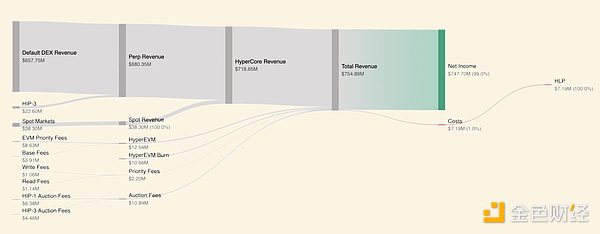
Current data shows that the platform has a total of 1.2 million users, a total transaction volume of $4.36 trillion, a total deposit of $3.7219 trillion, and a total withdrawal of $3.6849 trillion. There is also a separate table showing quarterly revenue data from the third quarter of 2025 to the beginning of the second quarter of 2026. The statistical period for the beginning of the second quarter of 2026 is from April 1st to mid-2026, totaling 82 days. Therefore, this quarterly data can only serve as a snapshot of the mid-2026 period and cannot represent the full quarterly performance. The 24-hour market data is only a static snapshot at a specific point in time at the end of June and is not real-time market data. Key Explanation of Data Definitions Before interpreting this data, it's crucial to clarify the statistical definitions: The cumulative "revenue" in this data includes HyperCore token buybacks, HyperEVM token burns, and market auction fees; the "costs" item only includes expenditures related to the HLP liquidity pool. Based on this definition, a more accurate term is protocol revenue and value accumulation, rather than corporate operating income. Looking at the publicly available on-chain protocol ledger, Hyperliquid Labs does not directly collect transaction fees. Jeffrey Yan has also explicitly stated that the platform does not have a token buyback plan at the team's discretion, and Hyperliquid Labs and the underlying protocol itself are two independent entities. Colossus further reports that all protocol fees do not belong to the development team, and the team's operating costs are still borne personally by Jeffrey Yan. Therefore, a clear conclusion can be drawn: the on-chain financial ledger records the flow of funds at the protocol level, not the profit and loss statement of a traditional software company.
Hyperliquid Revenue and Protocol Value Stream Overview
Hyperliquid Revenue and Expense Details by Protocol Activity
Hyperliquid's economic benefits are highly dependent on the HyperCore module, and within HyperCore, perpetual contracts are the absolute mainstay. In all quarters covered by the statistics, perpetual contracts contributed over 86% of the protocol value deposited; in Q1 and Q2 of 2026, this proportion reached approximately 93% and 92% year-to-date, respectively. Secondly, the HIP-3 proposal quickly generated revenue contribution after its implementation: almost no revenue in Q4 of 2025, 5.7% of the total protocol value deposited in Q1 of 2026, and rising to 6.3% year-to-date in Q2.
Third, while spot trading and HyperEVM generate stable revenue, they are only secondary businesses, and together they do not constitute the network's core profit unit. In summary, the existing data leads to the objective conclusion that Hyperliquid's underlying architecture has gradually transcended the scope of a single exchange, but from an economic perspective, it remains essentially a high-performing perpetual contract trading platform, with various supporting derivative businesses still in their initial stages. The limitations of the second-quarter data need to be addressed separately, as the data for this statistical period is incomplete. Based on the daily average level from the beginning of the second quarter to the present, as shown in the appendix, Hyperliquid's daily protocol value is approximately $1.7 million. A simple linear extrapolation would yield approximately $154.8 million in revenue for the full quarter, and an annualized revenue of approximately $620.9 million. This extrapolation is only for numerical reference and lacks sufficient reliability for analytical purposes. Hyperliquid's trading activity is event-driven and highly volatile: geopolitical funding flows, the launch of new non-cryptocurrency markets, and speculative trading based on trending topics can significantly distort annualized returns. The correct interpretation should not be "Q2 data proves the platform's annualized returns can reach $621 million," but rather "even after a period of rapid growth from 2025 to early 2026, the platform's returns remained high at the end of June." The cost items in the appendix correspond to the industry-renowned nearly 99% profit margin, but this figure is easily misinterpreted. The costs disclosed in the table only include HLP liquidity pool expenditures and do not include the vast majority of operating expenses typically categorized by stock analysts: employee salaries, equity incentives, cloud service and code refactoring costs, legal consulting, travel, security, tax planning, third-party audits, policy compliance expenses, and the founders' own financial burdens. In 2024, Hyperliquid's monthly cash outflow reached hundreds of thousands of dollars. Related interviews also mentioned that, as of the time of this report's publication, a large portion of team expenses were still borne personally by Jeffrey Yan. Therefore, the 99% surplus rate only holds true within this limited statistical dataset and cannot be used to answer the question of "how profitable is Hyperliquid Labs?" It only reflects one question: what percentage of the total on-chain verifiable protocol value is used to pay for on-chain visible HLP liquidity costs? User and cash flow data should also not be interpreted one-sidedly. According to the attached snapshot data, the cumulative net inflow was approximately $3.7 billion: the cumulative total inflow was $3.7219 trillion, the vast majority of which was offset by the cumulative outflow of $3.6849 trillion. Divided among individual users, the average cumulative inflow exceeded $310,000, and the average cumulative trading volume was approximately $3.63 million, with the trading volume being 1178 times the net inflow. The above averages do not represent the actual behavior of ordinary users, as the figures are significantly inflated by professional traders, routing bots, repeated deposits and withdrawals, market makers, and large accounts. However, the data clearly reflects the platform's capital turnover efficiency: it can support massive trading volumes with only relatively limited net capital reserves. This also explains two points: cumulative deposits do not equal total value locked (TVL); and the nearly 99% withdrawal rate does not indicate that the platform is under financial pressure, but rather that users view the platform as a trading venue, rather than an account for passively storing assets.
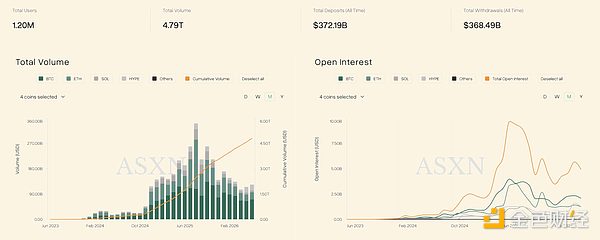
Hyperliquid Key Metrics Dashboard, covering user count, transaction volume, deposits, and withdrawals.
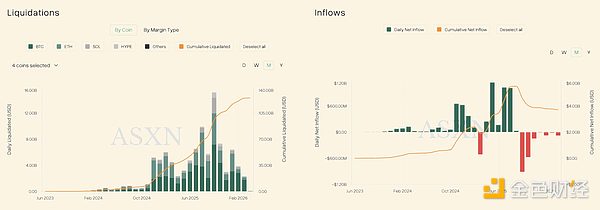
Hyperliquid Clearing and Funds Inflow Dashboard
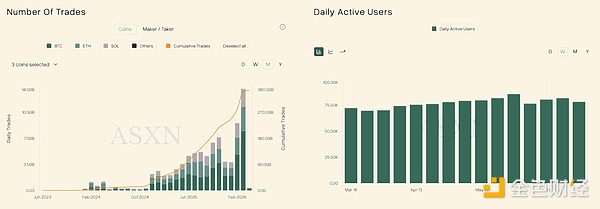
Hyperliquid Daily Active Users and Transaction Activity Dashboard
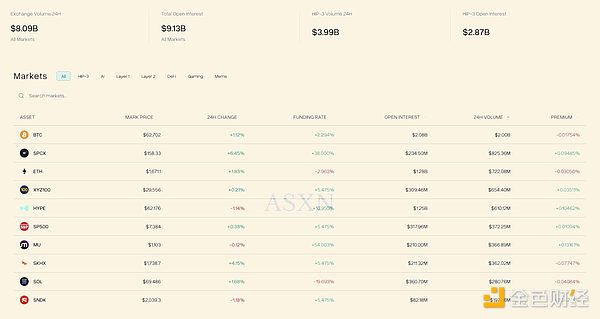
The token buyback, acquisition, and burn mechanism is the most logically complex section in Hyperliquid's publicly disclosed economic data. Data sets show: the protocol's cumulative revenue and value accumulation totaled $980.65 million, cumulative buybacks amounted to $954.12 million, and a cumulative purchase of 27.51 million HYPE; the aid fund holds 45.23 million HYPE. The annualized buyback scale is $768.55 million, while the protocol's annualized revenue is only $470.35 million. Simple calculations show that the average purchase price of HYPE tokens is approximately $34.68 per token. However, when comparing the percentage data with a total token supply of 1 billion, the figures are inconsistent: 27.51 million HYPE tokens represent 4.53% of the total supply, which translates to a total denominator of only about 607 million tokens, a significant discrepancy from the 1 billion total supply. The most reasonable explanations include: different calculation standards for the denominator of the total supply, differences in the statistical methods for circulating supply, or a mismatch between the annualized repurchase period and the annualized return period. Rigorous analysis should not force a perfectly consistent calculation result; the underlying raw data itself does not support complete reconciliation. Jeffrey Yan's own statements further introduce logical contradictions. In February 2026, he repeatedly denied that Hyperliquid had a buyback program at the discretion of management, instead comparing the mechanism to Ethereum's fee burning mechanism, claiming that the fee exchange for HYPE was a rule-driven, fixed process embedded in the chain's underlying logic. This general characterization is correct, but the specific destination of the purchased HYPE tokens in various modules is not entirely clear. The token balance of the aid fund proves that at least a portion of the HYPE obtained from the buyback is collected and managed by the protocol, rather than being permanently withdrawn from circulation. Therefore, a more accurate analysis should define it as an automated fee exchange and token value accumulation mechanism, rather than a corporate buyback operated by management at opportune times. Without a complete and clear reconciliation of fund flows, it cannot be assumed that every buyback token will be immediately burned. The economic accounts of the HLP liquidity pool must be viewed separately from the Hyperliquid Labs corporate accounts. Users who deposit into HLP directly receive all the revenue generated by the market-making strategy, and HLP-related expenses are listed as the only explicit cost item in the quarterly data table. When HLP incurs losses, this is not because Hyperliquid Labs is bearing operating expenses, but rather because the economic losses generated by the liquidity vault business are reflected on-chain; similarly, HLP profitability does not equate to the development team earning management fees. Many industry observers analyzing Hyperliquid fall into this type of accounting misconception: directly applying traditional corporate financial terminology to interpret on-chain fund changes at the protocol level, and then becoming confused by the blurred boundaries of various income and expenditure items. The reason for the blurred boundaries is that the system's underlying design deliberately downplays the clearly defined boundaries of rights and responsibilities found in a joint-stock company. The 24-hour market snapshot at the end of June clearly reflects business concentration: the total market trading volume was $8.9 billion, and the total open interest was $9.86 billion; among which, the HIP-3 self-deployed market segment had a daily trading volume of $3.42 billion and an open interest of $2.97 billion. Calculations show that HIP-3 contributed approximately 38.4% of the trading volume and 30.1% of the open interest during the snapshot's statistical period. This percentage is strategically significant, but it is insufficient to indicate that the network has moved beyond the core crypto-native market and achieved business diversification. HIP-3 is no longer a peripheral business, but it has not yet become a core pillar of the platform's business.
Overview of Hyperliquid's Perpetual Markets by Trading Assets and Market Activity
The business holdings structure reveals several key pieces of information: Bitcoin and Ethereum remain the foundation of the platform's liquidity. HYPE's native token itself accounts for a large portion of open interest, meaning that Hyperliquid's platform token is not only a governance and security staking asset, but also a popular speculative trading target within the platform.
Regulation: The Biggest External Variable
In late May 2026, the Financial Times reported that after the rapid expansion of the offshore platform Hyperliquid, reshaping the competitive landscape of the industry, the U.S. Commodity Futures Trading Commission (CFTC) approved Kalshi and Coinbase to launch U.S.-regulated Bitcoin perpetual contracts. Subsequently, Reuters reported that the Chicago Mercantile Exchange (CME) sued the CFTC over this approval, arguing that perpetual contracts should be classified as swaps, not futures.
This dispute has long transcended a single product dispute, marking the legal characterization of perpetual contracts as the core of the game in the U.S. market structure, with traditional exchanges, crypto-native platforms, and regulatory agencies all vying for rule-making power.
For Hyperliquid, this situation presents both advantages and disadvantages: on the one hand, the implementation of compliant perpetual contracts in the US confirms the legality of the product offerings promoted by Hyperliquid; on the other hand, the emergence of compliant domestic competitors provides institutional funds with alternative channels that do not require offshore or regionally restricted platforms. Event-based prediction markets and traditional asset synthetic exposures face similar challenges. While Hyperliquid has gained a first-mover advantage, its diverse business lines will attract more stringent compliance reviews, involving multiple issues such as operating licenses, market manipulation regulations, the distinction between commodities and securities, and the scope of event derivatives that can be offered on unlicensed platforms. In June 2026, the Wall Street Journal praised the platform's coverage of diverse categories such as oil, SpaceX, and event trading, while also pointing out that this business system is difficult to fit into the existing single legal framework. The current regulatory gray areas represent a growth dividend, but in the long run, they will hinder development or force the ecosystem to add front-end compliance verification and regional access restrictions. The mainnet upgrade on June 20, 2026, has not been identified as a system outage or vulnerability attack by various high-quality industry reviews and media reports. Unless new evidence emerges, it should be considered planned maintenance. This distinction is crucial. Hyperliquid currently enjoys extremely high industry attention, and routine upgrades, new product launches, and real-world market stress events are easily confused. Research and analysis must clearly differentiate between these three types of events to avoid confusion. In summary, Hyperliquid has both advantages and disadvantages, which is the core reason why it is valuable for in-depth analysis. The platform has proven five core facts: On-chain order book trading platforms can achieve considerable economic scale; a lean, self-funded team is capable of creating products that attract venture capital backers and traditional industry giants; token issuance enables genuine user ownership transfer, rather than merely providing a cash-out channel for internal personnel; third-party developers can contribute significant business segments, with the HIP-3 model being a prime example; and perpetual contracts are not just a niche in the crypto space but have become mainstream financial products, forcing regulators and traditional institutions to introduce corresponding rules. Five core propositions remain unproven: Can platform revenue move beyond high-turnover leveraged trading and achieve substantial diversification? Can the verification nodes and governance structure improve neutrality without sacrificing performance? Can event markets and options trading grow into stable, long-term businesses, rather than simply narrative tools? How to balance the decentralized nature of the protocol with the need for human intervention in extreme market conditions? How can a system that breaks away from traditional enterprise architecture design cope with the stringent requirements of regulators, courts, and institutional investors regarding the qualifications of traditional enterprise entities? So, is Hyperliquid's core product an exchange, blockchain, liquidity layer, market creation network, or a financial operating system? As of mid-2026, the most accurate definition is a financial network supported by exchange revenue. From a protocol revenue perspective, the exchange is the source of cash flow; the dedicated public chain gives the exchange a moat and composability; HIP-3 empowers the platform with market creation capabilities; and HyperEVM builds the application extension layer. If this long-term narrative holds true, Hyperliquid needs to achieve three major goals between 2028 and 2030: First, a significant increase in the proportion of revenue from non-crypto, non-perpetual contract businesses; second, the formation of a larger and more independent developer economy ecosystem; and third, the establishment of a governance and security system that is independent of the founder's personal influence and possesses credibility and neutrality. If the narrative falls short, Hyperliquid will still retain its industry position, but it will only be the most sophisticated leveraged trading platform of its time, rather than the underlying infrastructure serving global finance. Existing data is sufficient for the market to recognize its potential, but it cannot be definitively concluded that the goal has been achieved; a cautious assessment is still necessary.
Preview
Gain a broader understanding of the crypto industry through informative reports, and engage in in-depth discussions with other like-minded authors and readers. You are welcome to join us in our growing Coinlive community:https://t.me/CoinliveSG





 JinseFinance

