Georgia's New Congressman Dives into Ethereum Investments
Congressman Mike Collins invests in Ethereum, signaling a positive outlook for digital currency.
 Brian
Brian

Author: 0xWeiler Source: X, @0xWeiler Translation: Shan Ouba, Jinse Finance
During the 2024 US presidential election, prediction markets successfully entered the mainstream—election odds from platforms like Polymarket and Kalshi appeared alongside traditional polling data, becoming alternative indicators of election sentiment. Ultimately, the accuracy of these prediction markets' forecasts of election results far exceeded that of traditional polls.
In the five months leading up to the election, Polymarket and Kalshi experienced an explosive growth of 3186% in trading volume: from $140 million in May 2024 to $4.6 billion in October 2024 (the peak month before the November 5th election). This surge propelled prediction markets to become one of the first application scenarios in the crypto industry to achieve a breakthrough. However, in 2024, political markets accounted for 62% of total prediction market trading volume, leading many to believe that politics was the only real-world application for prediction markets and questioning whether market demand could be sustained after the election cycle. Initially, these skeptics seemed to be validated: in the four months following the election, monthly trading volume plummeted by 63%, from $4.6 billion in October 2024 to $1.7 billion in February 2025. But for the remainder of 2025, prediction markets demonstrated through their performance that, beyond politics, they possess a clear Product-Market Fit (PMF). After bottoming out in February, monthly trading volumes on Polymarket and Kalshi surged, growing by 441% to reach $9.2 billion by November. Trading volumes in September, October, and November 2025 all surpassed the historical high of October 2024. This growth was primarily driven by non-political markets, including sports, crypto, and culture. From July to December 2024, non-political markets accounted for 38% ($6 billion) of total trading volume on the two major platforms; while from January to November 2025, this proportion had risen to 80% ($31.1 billion). The prediction market successfully overcame the limitations of election-driven demand, achieving sustained application in non-political scenarios. Where does this growth momentum come from? Where will 2026 lead?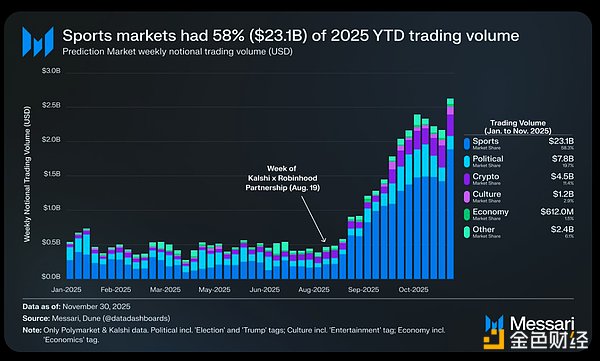
In 2025, the sports sector is projected to become the primary engine for growth in forecast market transaction volume. From January to November, the sports market led with a 58% share ($23.1 billion), followed by the political market at 20% ($7.8 billion), the cryptocurrency market at 11% ($4.5 billion), and the culture market at 3% ($1.2 billion).

In 2025, the open interest (OI) in the forecasting market will be dominated by two giants—Polymarket and Kalshi will together hold 91% of the market share ($627.7 million).
From June 1st to November 30th, Kalshi's open interest increased by 258%, from $93.7 million to $335.3 million; during the same period, Polymarket's open interest increased by 133%, from $125.3 million to $292.4 million. Throughout the year, the gap between the two platforms remained relatively small, but both significantly outpaced smaller competitors. This growth in open interest coincided with a year of active ecosystem development for both platforms. In 2025, both expanded their distribution channels by establishing partnerships with mainstream brands such as CNN, CNBC, the Ultimate Fighting Championship (UFC), the National Hockey League (NHL), and Yahoo Finance, which is expected to further enhance their mainstream exposure. Meanwhile, both companies raised substantial funds: Polymarket completed three rounds of financing throughout the year, including a $2 billion investment from Intercontinental Exchange Group (ICE), the parent company of the New York Stock Exchange (NYSE), on October 7, valuing the company at $9 billion; Kalshi completed two rounds of financing, with a $1 billion undisclosed investor round on November 19 raising its valuation to $11 billion. Overall, the growth in open interest, expansion of distribution channels, and new capital injections in 2025 have laid a solid foundation for Polymarket and Kalshi, and they are expected to maintain their current growth rate in 2026, even without considering additional product launches or incentive programs. In the second half of 2025, Polymarket is pushing forward with the launch of its US app, which opened to waiting list users on December 3. This public launch represents a significant breakthrough in distribution channels and is expected to substantially increase Polymarket's open interest and trading volume in 2026. Following its partnership with Robinhood in August, Kalshi experienced a surge in both open interest and trading volume, successfully attracting non-crypto native users. If Polymarket's US app follows a similar growth trajectory after its full launch, its open interest and trading volume are expected to see a significant increase. In addition to distribution channels, a potential airdrop will be another major growth catalyst. On October 24th, Polymarket's Chief Marketing Officer, Matthew Modabber, confirmed plans to launch the $POLY token and conduct an airdrop in the future. While the specific timing is yet to be determined, the market anticipates it will happen in 2026. Combined with the full launch of the US app, the airdrop will provide Polymarket with additional incentives that Kalshi currently lacks. If these two catalysts are successfully implemented in 2026, Polymarket's open interest growth is expected to surpass Kalshi's, widening the gap with its closest competitor. For most of 2025, apart from Polymarket and Kalshi, other prediction market platforms saw little progress in open interest until Opinion entered the market. On October 24th, Opinion launched its prediction market platform, Opinion.Trade, on the BNB Chain, and its open interest quickly reached $63.2 million. Before Opinion's launch, no prediction market platform, except for Polymarket and Kalshi, had an open interest exceeding $3 million, making Opinion's early performance particularly outstanding. Opinion did not simply copy the models of existing platforms; instead, it launched the first native prediction market based on the BNB Chain, equipped with the differentiated product Opinion AI. This is a market creation tool that allows users to generate clearly defined "yes/no" trading markets with just simple prompts, achieving a creation speed far exceeding competing platforms. In terms of open interest and trading volume, Opinion has significantly differentiated itself from long-tail crypto-native competitors such as Limitless and Myriad. By combining differentiated market-building products with BNB Chain's user base, Opinion successfully entered the top three in the market by the end of 2025. In 2026, we believe it has the potential to become one of the best-performing crypto-native alternative platforms outside of Polymarket and Kalshi. Traditional sports betting platforms from outside the crypto industry will also intensify market competition. In 2026, DraftKings and FanDuel are expected to enter the prediction market, with their core objectives being to reach users in states like California and Texas where traditional sports betting is still illegal, and to launch non-sports market products such as those related to politics and macroeconomics. Following its acquisition of Railbird, a CFTC-licensed exchange, DraftKings plans to launch DraftKings Predictions in the first quarter of 2026. FanDuel has also revealed a similar strategy, positioning its prediction market as a complement to its sports betting business, allowing users to trade predictions related to events such as elections and oil prices. In macroeconomic and non-sports markets, traditional sports betting platforms possess a significant distribution advantage and are expected to capture a certain market share in 2026, especially in markets previously inaccessible to their users. While DraftKings and FanDuel already dominate sports betting trading volume, launching prediction markets is unlikely to significantly increase their market share in the sports sector. However, the impact on non-sports markets will be far more profound—previously, crypto-native prediction markets held a unique advantage due to easily accessible market products such as Federal Reserve interest rate decisions. With traditional sports betting platforms launching similar prediction products, the exclusivity of these largest and most liquid non-sports markets will disappear. However, we believe that crypto-native prediction markets will maintain their advantage in market diversity and long-tail coverage, sustaining trading activity even as traditional giants compete for popular markets. Ultimately, despite facing dual competitive pressures from both crypto-native prediction markets and new challengers from traditional sports betting platforms, we still believe Polymarket and Kalshi will continue to dominate the prediction market space. If Polymarket successfully launches its US app, issues its token, and potentially airdrops, it could surpass Kalshi. In any case, both platforms possess brand recognition and capital resources, and will remain leaders in the prediction market for the foreseeable future.
Congressman Mike Collins invests in Ethereum, signaling a positive outlook for digital currency.
BrianDePIN Network's CESS, a revolutionary CDN and storage network, unveils its roadmap featuring testnet v0.7.7, global nodes, rewards, and token listing, backed by a successful $8 million funding round.
 Kikyo
KikyoVirtual Labs, under the mentorship of Binance Labs Incubation Program, is setting new benchmarks in blockchain technology with innovations like the Virtual Rollup SDK, Virtual Wallet, and OpenChannel. Their focus on user experience, cross-chain compatibility, and transaction efficiency heralds a new era in blockchain and crypto usability.
BrianIn 2023, heightened anticipation for a Bitcoin ETF led to a $2.25 billion surge in crypto investments, predominantly driven by Bitcoin's dominance. This resurgence marked a significant shift in investor sentiment towards digital assets, propelled by the prospect of a game-changing Bitcoin ETF.
 Joy
JoyCelsius Network plans to unstake its Ethereum holdings to aid creditor distribution amid ongoing restructuring after a liquidity crisis. Shifting focus to crypto mining, the company aims to recover while navigating legal challenges, marking a transformative phase in its evolution.
JoyThe rise in Solana's value has led to increased wallet drainer activities, targeting SOL and memecoin holders, with losses in hundreds of thousands and a call for enhanced security measures.
BrianSolana aims to scale its Layer 1, diverging from the Layer 2 focus, with a vision to synchronize a global atomic state machine.
Kikyo2018 Ripple-BlockTower debate on XRP's value re-emerges among crypto enthusiasts.
BrianNetflix's 'Bitconned' exposes Centra Tech's crypto scam, revealing fraudulent practices and shocking twists, leaving viewers outraged and intrigued.
JoySpain's Banco de España partners with Cecabank, Abanca, and Adhara Blockchain to test a wholesale CBDC, exploring innovative digital currency applications.
Brian