Source: Arthur Hayes, Founder of BitMEX; Translated by: Jinse Finance
If I had an online dating profile, it would probably look something like this:
Love Language
Euphemisms and abbreviations created by politicians and central bank officials to describe money printing.
This article will focus on two apt examples:
Quantitative Easing (QE)
Reserve Management Purchases (RMP)
I only added the new abbreviation RMP to my "love language" dictionary on December 10th, the day of the Fed's most recent interest rate meeting. I recognized it immediately, understood its meaning, and cherished it like a long-lost love, quantitative easing. I like quantitative easing because, in essence, it's printing money.
Fortunately, I hold financial assets like gold, gold/silver mining stocks, and Bitcoin, whose price increases consistently outpace the rate of fiat currency issuance. But this isn't just about my personal interests. If various forms of money printing can drive up the price and popularity of Bitcoin and decentralized blockchains, perhaps one day we can abandon this dirty fiat fractional-reserve system and replace it with a completely new system supported by honest currency. We haven't reached that point yet, but every additional unit of fiat currency printed brings that day one step closer. Unfortunately, for most people globally, money printing is currently destroying their dignity as workers. When governments intentionally devalue their currency, the link between labor and economic reward is broken. Ordinary people bound by wages may not understand sophisticated economic theories or explain why they feel like they're running in quicksand, but they know in their hearts that money printing is never a good thing. In a one-person-one-vote democracy, when inflation soars, voters oust the ruling party; under a dictatorship, the people take to the streets to overthrow the current regime. Therefore, politicians know all too well that governing in an inflationary environment is tantamount to a death sentence for their careers. However, the only politically feasible way to repay the massive global debt is to dilute it through inflation. Since inflation can ruin a political career and the future of political families, politicians' "skill" lies in deceiving the public, making them believe that the inflation they feel is not inflation at all. Thus, central bank governors and finance ministers concoct a bunch of obscure acronyms to cover up the inflationary pressures they are shifting to the public to avoid a systemic deflationary collapse. To understand what severe credit deflation and value destruction look like, recall how you felt when President Trump reneged on his tariff policies during what he called "Liberation Day"—April 2-9, 2025. This is certainly not good for the wealthy, as the stock market crashes; it's equally bad for others, as many will lose their jobs if global trade slows to correct decades of accumulated economic, trade, and political imbalances. Allowing deflation to spread rapidly will inevitably trigger a revolution, ending politicians' careers, and even their lives. As public awareness increases, this deceptive tactic will eventually be exposed, and the public will equate currently popular abbreviations with money printing. Like a shrewd drug dealer, those in power in the monetary field must change their rhetoric once they realize the public has figured out the new jargon. This wordplay excites me because it means the situation is critical; the printing press will be pressed hard, enough to propel my investment portfolio to new heights. Currently, the authorities are trying to convince us that RMP is not QE, simply because quantitative easing is already linked to money printing and inflation. To ensure readers fully understand that RMP is essentially QE, I have created multiple annotated accounting T-accounts. Why is all this so important?

Since the market lows in March 2009 following the 2008 global financial crisis, risky assets such as US stocks (S&P 500, Nasdaq 100), gold, and Bitcoin have escaped deflation and achieved astonishing returns.
Since the market lows in March 2009 following the 2008 global financial crisis, risk assets such as US stocks (S&P 500, Nasdaq 100), gold, and Bitcoin have escaped deflation and achieved remarkable returns.
QE Step One

1. JPMorgan Chase, as a primary dealer, opened an account with the Federal Reserve and held U.S. Treasury bonds.
2. The Federal Reserve conducted a round of quantitative easing (QE) operations, purchasing Treasury bonds from JPMorgan Chase.
3. The Federal Reserve created money out of thin air, paying for the bond purchases by crediting funds to JPMorgan Chase's reserve account.
EB - Ending Balance: The Federal Reserve added reserves and purchased Treasury bonds from JPMorgan Chase. How will JPMorgan Chase handle these reserves?
EB - Ending Balance: The Federal Reserve added reserves and purchased Treasury bonds from JPMorgan Chase.
How will JPMorgan Chase handle these reserves?
QE Step Two
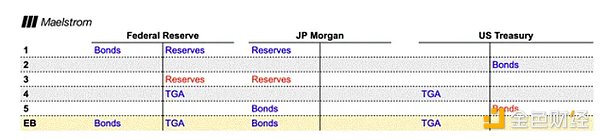
1. The money created by the Federal Reserve out of thin air is reflected in reserves. Once JPMorgan Chase uses these funds, the stimulative effect will appear. JPMorgan Chase will only purchase new Treasury bonds to replace the portion sold to the Federal Reserve when the new Treasury bonds are attractive in terms of interest rates and credit risk.
2. The U.S. Treasury issues new Treasury bonds through auctions, and JPMorgan Chase participates in the subscription. Treasury bonds are risk-free assets, and in this case, the yield on Treasury bonds is higher than the reserve rate. Therefore, JPMorgan Chase will choose to purchase these newly issued Treasury bonds.
3. JPMorgan Chase pays for the bond purchases with reserves.
4. The Treasury deposits these reserves into its general account at the Federal Reserve (equivalent to the Treasury's current account).
5. JPMorgan Chase receives the purchased Treasury bonds.
EB - Ending Balance: The Federal Reserve's money printing provides financial support for the increase in the supply of Treasury bonds (covering bonds held by the Federal Reserve and JPMorgan Chase).
QE Step Three

1. Printing money allows the Treasury to issue more national debt at a lower cost, which is essentially financial asset inflation. Lower Treasury yields increase the net present value of assets with stable future cash flows, such as stocks. Once the Treasury begins distributing various subsidies, inflation in the goods and services sector will follow.
2. The Tim Waltz Somali Childcare Center (established specifically for children with reading difficulties who wish to improve other skills) receives a federal subsidy. The Treasury debits the corresponding amount from its general account and credits the subsidy to the center's account at JPMorgan Chase.
2. The Tim Waltz Somali Childcare Center (established specifically for children with reading difficulties who wish to improve other skills) receives a federal subsidy. The Treasury debits the corresponding amount from its general account and credits the subsidy to the center's account at JPMorgan Chase.
EB - Ending Balance: Funds in the Treasury's general account are used for government subsidies, which in turn stimulate demand for goods and services. This is precisely the transmission path of QE-induced inflation in the real economy.
Short-term Treasury Bills and Long-term Treasury Bonds
Short-term Treasury bonds have a maturity of no more than one year. The most actively traded interest-bearing Treasury bonds are 10-year Treasury bonds (technically known as 10-year medium-term notes). The yield on short-term Treasury bonds is slightly higher than the interest rate on reserves held at the Federal Reserve. Let's return to step one and re-analyze by replacing Treasury bonds with short-term Treasury bonds.
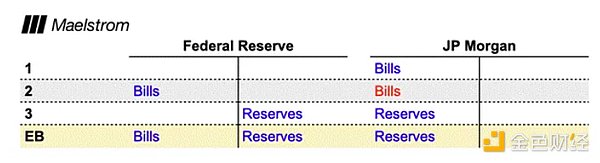
EB - Ending Balance: The only difference is that the Federal Reserve exchanged reserves for short-term Treasury bonds. Because the reserve interest rate is higher than the short-term Treasury bond yield, JPMorgan Chase lacks the incentive to further purchase short-term Treasury bonds, and the flow of funds from quantitative easing stagnates here.
The image above shows the difference between the interest rate on reserve balances and the yield on 3-month Treasury bonds, which is currently positive. Banks seeking to maximize profits will choose to deposit funds with the Federal Reserve rather than purchase lower-yielding short-term Treasury bonds. This highlights the crucial importance of the type of bonds purchased with reserves. If the interest rate risk or duration of the bonds is too low, the money printed by the Federal Reserve will simply remain on its balance sheet and have no real effect. Analysts believe that, technically speaking, the stimulative effect of using $1 for reserve management to purchase short-term Treasury bonds is far less than that of using $1 for quantitative easing to purchase long-term Treasury bonds. But what if the holders of short-term Treasury bonds are not banks, but other financial institutions? Currently, money market funds hold 40% of outstanding short-term Treasury bonds, while banks hold only 10%. Moreover, since banks can earn higher returns by depositing funds with the Federal Reserve to earn interest on reserve balances, why would they buy short-term Treasury bonds? To understand the potential impact of reserve management purchases, we must analyze the decisions money market funds will make when the Federal Reserve acquires their holdings of short-term Treasury bonds. Below, I will use the same analytical logic as with quantitative easing to break down reserve management purchases.
RMP Step One
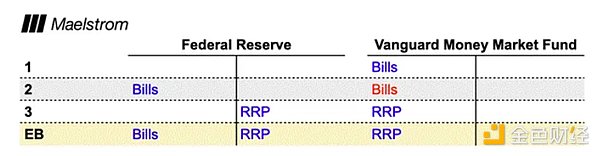
1. Vanguard Group, as a compliant money market fund, has an account with the Federal Reserve and holds short-term Treasury bonds.
2. The Federal Reserve conducts an RMP operation to purchase short-term Treasury bonds from Vanguard Group.
3. The Federal Reserve creates money out of thin air by crediting funds to Vanguard Group's overnight reverse repurchase facility account to pay for the bond purchases. The overnight reverse repurchase facility is an overnight transaction mechanism, and the interest is paid directly by the Federal Reserve daily.
EB - Ending Balance: How else can Vanguard utilize the funds in its overnight reverse repo account?
RMP Step Two (Vanguard Makes Additional Purchases of Short-Term Treasury Bonds)
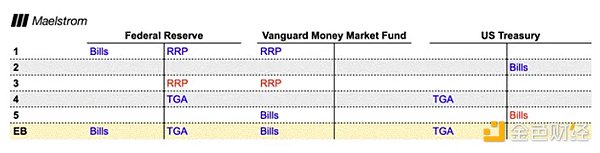
1. The money created by the Federal Reserve is reflected in the balance of the overnight reverse repo facility. Once Vanguard uses these funds, its stimulative effect will be apparent. Vanguard will only purchase newly issued short-term risk-free bonds when the yield is higher than the overnight reverse repo rate; in other words, it will only consider newly issued short-term Treasury bonds.
As a money market fund, Vanguard faces numerous restrictions on the type and maturity of bonds it can purchase using investor funds. Due to these restrictions, Vanguard typically only buys short-term Treasury bonds. 2. The U.S. Treasury issues new short-term Treasury bonds, which are ultimately subscribed to by Vanguard. 3. Vanguard uses funds from its overnight reverse repurchase agreement (IRA) account to pay for the bonds. 4. The Treasury deposits these funds from the IRA into its general account at the Federal Reserve. 5. Vanguard receives the purchased short-term Treasury bonds. EB - Ending Balance: The Federal Reserve provides financial support for the Treasury's newly issued short-term Treasury bonds through money printing.
Short-term Treasury yields will never fall below the overnight reverse repo rate, because money market funds, as marginal buyers of short-term Treasury bonds, will choose to keep their funds in overnight reverse repo accounts if the yields are equal. Technically, the Federal Reserve can unilaterally print money to pay overnight reverse repo interest, and its credit risk is slightly lower than that of the U.S. Treasury, which requires congressional approval to issue bonds. Therefore, unless short-term Treasury bonds offer higher yields, money market funds prefer to keep their funds in overnight reverse repo accounts. This is crucial because short-term Treasury bonds have short durations, and even if the Federal Reserve lowers their yields by a few basis points through reserve management purchases, the impact on financial asset inflation is very limited. Only when the Treasury uses the funds raised from bond issuance for spending on goods and services will it simultaneously drive inflation in both financial assets and goods and services. RMP Step Two (Vanguard Group's Participation in Repurchase Market Lending)

If the yield on newly issued short-term Treasury bonds is not higher than the overnight reverse repurchase agreement rate, or if the issuance of new bonds is insufficient, do money market funds have other investment options that could potentially trigger inflation in financial assets or goods and services? The answer is yes, money market funds can invest in the Treasury bond repurchase market.
Repurchase (repo) is short for repurchase agreement. In this case, bond repurchase refers to a money market fund providing overnight funding with newly issued Treasury bonds as collateral. When the market is stable, the repurchase rate should be equal to or slightly lower than the upper limit of the federal funds rate range.
Currently, the overnight reverse repo rate and the federal funds rate are both 3.50%, the 3-month Treasury yield is 3.60%, and the upper limit of the federal funds rate range is 3.75%. If the repo rate approaches the upper limit of the federal funds rate range, money market funds participating in the repo market can earn nearly 0.25% more in yield (3.75% minus 3.50%) compared to keeping funds in the overnight reverse repo account. 1. The Federal Reserve purchases short-term Treasury bonds from Vanguard Group by printing money, creating the overnight reverse repo balance. 2. The U.S. Treasury issues long-term Treasury bonds. 3. The resurrected Long-Term Capital Management (a relative value hedge fund) subscribes to these bonds in an auction, but lacks sufficient funds and needs to borrow money in the repo market to complete the payment. 4. BNY Mellon facilitates the tripartite repurchase agreement, receiving Treasury bonds as collateral from Long-Term Capital Management (LTCM). 5. BNY Mellon withdraws funds from Vanguard's overnight reverse repurchase facility account. These funds are first credited to BNY Mellon's deposit account and then transferred to LTCM's account. 6. LTCM uses this deposit to pay for the bond purchases. These funds ultimately become part of the U.S. Treasury's general account balance at the Federal Reserve. 7. Vanguard withdraws funds from its overnight reverse repurchase facility account to participate in the repurchase market. Vanguard and LTCM will decide daily whether to continue this repurchase agreement. EB - Ending Balance: The Federal Reserve, through printing money, purchases short-term Treasury bonds from Vanguard, providing financing facilities for LTCM to subscribe to long-term Treasury bonds. Regardless of the maturity, as long as the repurchase rate is stable and the cost is controllable, Long-Term Capital Management (RMP) will purchase Treasury-issued bonds at the agreed price. Thanks to the ample funding provided by the Federal Reserve through reserve management purchases, Vanguard will consistently provide lending funds at reasonable interest rates. The RMP is essentially a smokescreen for the Federal Reserve to pay for government spending, and it has a strong inflationary effect on both financial markets and the goods and services sector of the real economy. RMP Politics I have a few questions, and the answers might surprise you. Why weren't the announcements related to the RMP included in the formal statement of the Federal Open Market Committee, as was the case with previous QE programs? The Federal Reserve unilaterally asserts that QE is a monetary policy tool that stimulates the economy by withdrawing interest-rate-sensitive long-term bonds from the market; while the RMP is merely considered a technical operational tool, as it withdraws short-term Treasury bonds with cash-like characteristics and will not stimulate the economy. Does the RMP require a formal vote by the Federal Open Market Committee (FOMC)? The answer is both yes and no. The FOMC has authorized the New York Fed to implement reserve management purchases to maintain an "adequate reserve" status. Before the Committee votes to terminate the program, the New York Fed can decide to adjust the size of its reserve management purchases of short-term Treasury bonds. What are the specific standards for "adequate reserves"? This is a vague concept with no fixed definition; the New York Fed determines whether reserves are adequate or insufficient. In the next section, I will explain why Bessant can control the standards for adequate reserves. In fact, the Fed has relinquished control of the short-term yield curve to the Treasury. Who is the president of the New York Fed? What is his attitude towards QE and RMP? John Williams, president of the New York Federal Reserve, will begin his next five-year term in March 2026, and his position is very secure. He has consistently advocated for the idea that the Fed needs to expand its balance sheet to ensure sufficient reserves, has consistently supported quantitative easing in related votes, and has publicly expressed his approval of money printing measures. He believes that RMP is not quantitative easing and will not stimulate the economy. This position is actually extremely advantageous—if inflation inevitably recurs, he can shirk responsibility and continue to implement money printing policies through reserve management purchases. Unrestrained Unlimited Money Printing The sophistry surrounding "what is quantitative easing, what is non-quantitative easing" and "the specific standards for sufficient reserves" allows the Fed to arbitrarily pay for the government's massive spending. This is not reserve management purchase; it is clearly the printing press running at full capacity! Previous QE programs all had set end dates and monthly purchase limits, and extending the program required a public vote. Theoretically, the Reserve Required Fund (RMP) could be expanded indefinitely if John Williams wanted to. Moreover, he wasn't the true decision-maker, and his economic philosophy prevented him from realizing that the banks he led were directly exacerbating inflation. The introduction of the RMP stemmed from the free market's inability to absorb the pressure of a surge in short-term Treasury bond issuance. Reserve requirements must grow in tandem with short-term Treasury bond issuance; otherwise, the market will stagnate. In short, despite Bessant calling Janet Yellen's refusal to extend the debt maturity a serious policy mistake, the U.S. Treasury's reliance on low-cost short-term financing continues to deepen. Currently, the market needs to absorb approximately $500 billion in short-term Treasury bonds per week, up from approximately $400 billion per week in 2024. Trump campaigned on promises to reduce the fiscal deficit, but since taking office, the total issuance of short-term Treasury bonds has continued to grow. This trend is unlikely to change regardless of who is in power—even if Kamala Harris is elected, the issuance plan for short-term Treasury bonds will not change. The high and continuously growing total issuance of short-term treasury bonds is primarily due to politicians' persistent enthusiasm for distributing various subsidies and benefits.
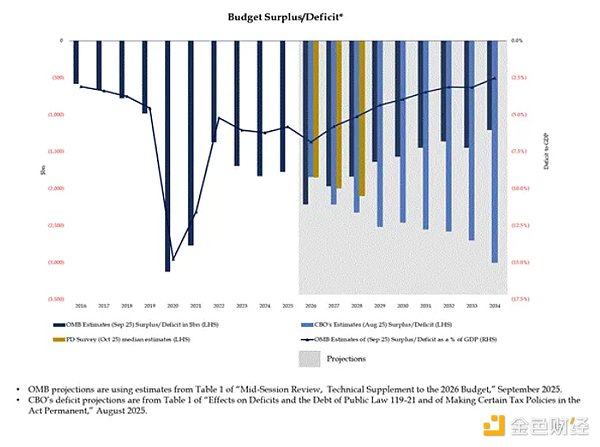
Both the Congressional Budget Office and primary dealers predict that the US fiscal deficit will exceed $2 trillion within the next three years, a lavish "feast" that no one can stop.
Before discussing those who believe that reserve management purchases are not equivalent to quantitative easing, I will first predict how Bessant will use reserve management purchases to boost the housing market.
RMP-backed Treasury bond repurchases
Perhaps some investors are reluctant to recall, but please remember the market dynamics in early April this year. Shortly after Trump reneged on the tariff issue, Bessant stated in an interview with Bloomberg that the Treasury market could be stabilized through bond repurchases.
Subsequently, the total nominal amount of Treasury bond repurchases increased. The Treasury uses the funds raised from the issuance of short-term Treasury bonds through repurchase programs to redeem older, inactive Treasury bonds. If the Federal Reserve prints money to buy short-term Treasury bonds, it's equivalent to directly financing the Treasury, allowing the Treasury to expand the issuance of short-term Treasury bonds and use some of the proceeds to repurchase long-term medium-term notes and Treasury bonds. I believe Bessant will specifically use the repurchase funds to purchase 10-year Treasury bonds, thereby lowering their yields. In this way, Bessant can cleverly remove interest rate risk from the market through reserve management purchases—which is precisely the core operational logic of quantitative easing! The 10-year Treasury yield is crucial for the 65% of American homeowners and struggling first-time homebuyers. Lower yields help American households expand consumption through home equity loans, while mortgage rates will also decrease, easing the pressure of homeownership. Trump has repeatedly stated publicly that mortgage rates are too high, and pushing rates down would help the Republican Party retain its ruling position. Therefore, Bessant will inevitably use its reserve management purchases and bond repurchase programs to buy 10-year Treasury bonds, thereby lowering mortgage rates. Let's quickly browse some charts of US housing market data. There is currently a large amount of home equity available on the market. The mortgage refinancing wave has only just begun. The current refinancing scale is far from reaching the peak during the 2008 real estate bubble.
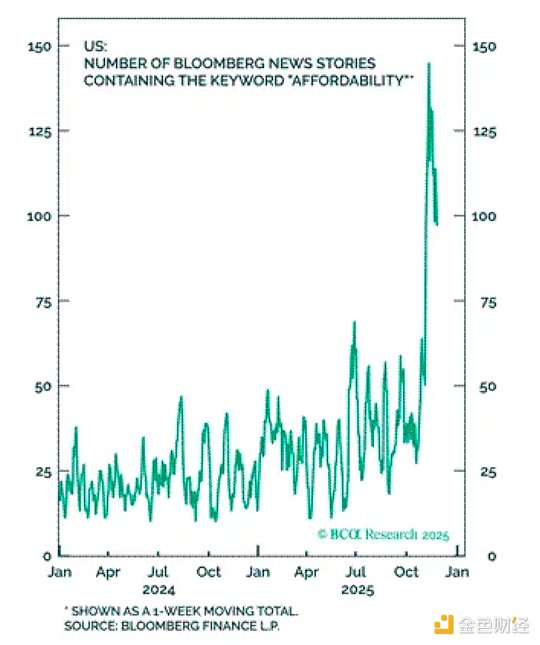
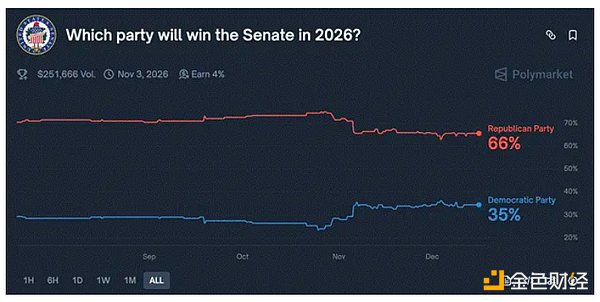
If Trump can improve home affordability by lowering financing costs, the Republican Party is expected to break the current unfavorable situation and continue to control both the House and Senate.

Bessenter has not publicly stated that he will boost the housing market through bond buybacks, but if I were him, I would use this new money-printing tool in the manner described above. Next, let's look at the arguments that reserve management purchases are not equivalent to quantitative easing.
Refuting the view that RMP ≠ QE
Some critics have raised the following questions regarding the ability of reserve management purchases to trigger inflation in financial assets and goods and services:
1. The Federal Reserve purchases short-term Treasury bonds through reserve management and long-term bonds through quantitative easing. Due to the short duration of short-term Treasury bonds, their impact on financial markets is negligible.
2. Reserve management purchases will end in April because the tax filing period will end then, fluctuations in the Treasury's general account will stabilize, and the repurchase market will return to normal.
My accounting T-accounts clearly show that the purchase of short-term Treasury bonds by reserve management directly provides funding for the U.S. Treasury's new bond issuance. This debt will be used for government spending, thereby triggering inflation, while the bond repurchase operation may also suppress long-term bond yields. Although reserve management purchases release liquidity through short-term Treasury bond operations rather than the long-term bonds commonly used in quantitative easing, the final effect is the same. Getting bogged down in these details will inevitably lead to falling behind in the market.
The continued growth in short-term Treasury bond issuance overturns the view that "reserve management purchases become useless after April." Driven by practical needs, the US government is structurally shifting towards short-term Treasury bonds as its primary financing tool. This article refutes the two aforementioned erroneous viewpoints and reinforces my belief that the four-year crypto cycle pattern no longer exists. The Bitcoin market clearly does not currently subscribe to my view; the gold market has reacted mutedly, while the silver market has performed strongly. To this, I can only say: be patient, you enthusiastic investors. In November 2008, after former Federal Reserve Chairman Ben Bernanke announced the first round of quantitative easing, the market continued to decline until it bottomed out in March 2009. However, choosing to wait and see at that time would have meant missing an excellent buying opportunity. Since the launch of RMP, Bitcoin (white curve) has fallen by 6%, while gold has risen by 2%. RMP will also change another liquidity landscape—previously, many believed that major central banks such as the European Central Bank and the Bank of Japan were in a balance sheet reduction cycle. Balance sheet reduction and the "only rise, never fall" trend of cryptocurrencies are contradictory. Over time, RMP will create billions of dollars in new liquidity, and the exchange rate of the US dollar against other fiat currencies will inevitably fall significantly. While a depreciating dollar benefits Trump's "America First" re-industrialization plan, it's a nightmare for global exporting countries—they not only face tariff barriers but also see their currencies appreciate against the dollar. Germany and Japan will expand domestic credit through the European Central Bank and the Bank of Japan, respectively, to curb the appreciation of the euro and yen against the dollar. By 2026, the Federal Reserve, the European Central Bank, and the Bank of Japan will work together to accelerate the collapse of the fiat currency system. This is truly cause for celebration!
Trading Outlook
While a monthly bond-buying program of $40 billion is considerable, compared to the total amount of dollars in circulation, this proportion in 2025 will be far lower than in 2009. Therefore, at current financial asset price levels, the resulting credit stimulus effect will be unlikely to reach the intensity of that year.
Trading Outlook
The monthly bond-buying program of $40 billion is certainly substantial, but compared to the total amount of dollars in circulation, this proportion in 2025 will be far lower than in 2009.
Based on this, since the market currently mistakenly believes that the credit expansion effect of reserve-managed purchases is weaker than quantitative easing, and there are doubts about whether this policy will continue after April 2026, the price of Bitcoin will likely fluctuate between $80,000 and $100,000 before the New Year. Once the market realizes that reserve-managed purchases are essentially the same as quantitative easing, BTC will quickly rebound to $124,000 and rapidly challenge $200,000. Market expectations for reserve-managed purchases to drive up asset prices will peak in March 2026, after which the price of Bitcoin will decline somewhat, but given John Williams' insistence on implementing an easing policy, its local low will still be well above $124,000. The altcoin market is currently in a slump. The market crash on October 11th severely impacted many individual investors and hedge fund short-term traders. I believe that many hedge fund LPs, after seeing the October net asset value reports, decided not to invest further. A wave of redemptions has led to continued pressure on altcoin buying. The altcoin market recovery will take time, but for investors who carefully preserve capital and study exchange operating rules, now is a good time to "hunt for bargains." Among the many altcoins, I am most optimistic about the Ethena project (token ENA). As the Federal Reserve cuts interest rates, leading to lower funding costs, and the increased money supply resulting from reserve management purchases, the price of Bitcoin will rise, thereby fueling demand in the cryptocurrency capital market for leveraged trading in synthetic dollars. This will drive up cash-futures arbitrage yields, prompting investors to issue synthetic USDe to obtain higher borrowing interest rates. More importantly, the gap between short-term Treasury yields and cryptocurrency perpetual contract basis yields will widen, with the cryptocurrency sector having a greater advantage. The interest income growth from the Ethena protocol will flow back into the project pool and ultimately be used to buy back ENA tokens. I expect the circulating supply of synthetic USDe to continue to increase, which will also be a leading indicator of a significant rise in the price of ENA tokens. This is essentially a game between traditional finance and the cryptocurrency sector regarding dollar interest rates, a similar investment opportunity that emerged when the Federal Reserve began its easing cycle in September 2024.


 Anais
Anais

