Author: Nancy, PANews
Seven years after its founding, cryptocurrency exchange HashKey has opened the door to the traditional capital market with a resounding gong.
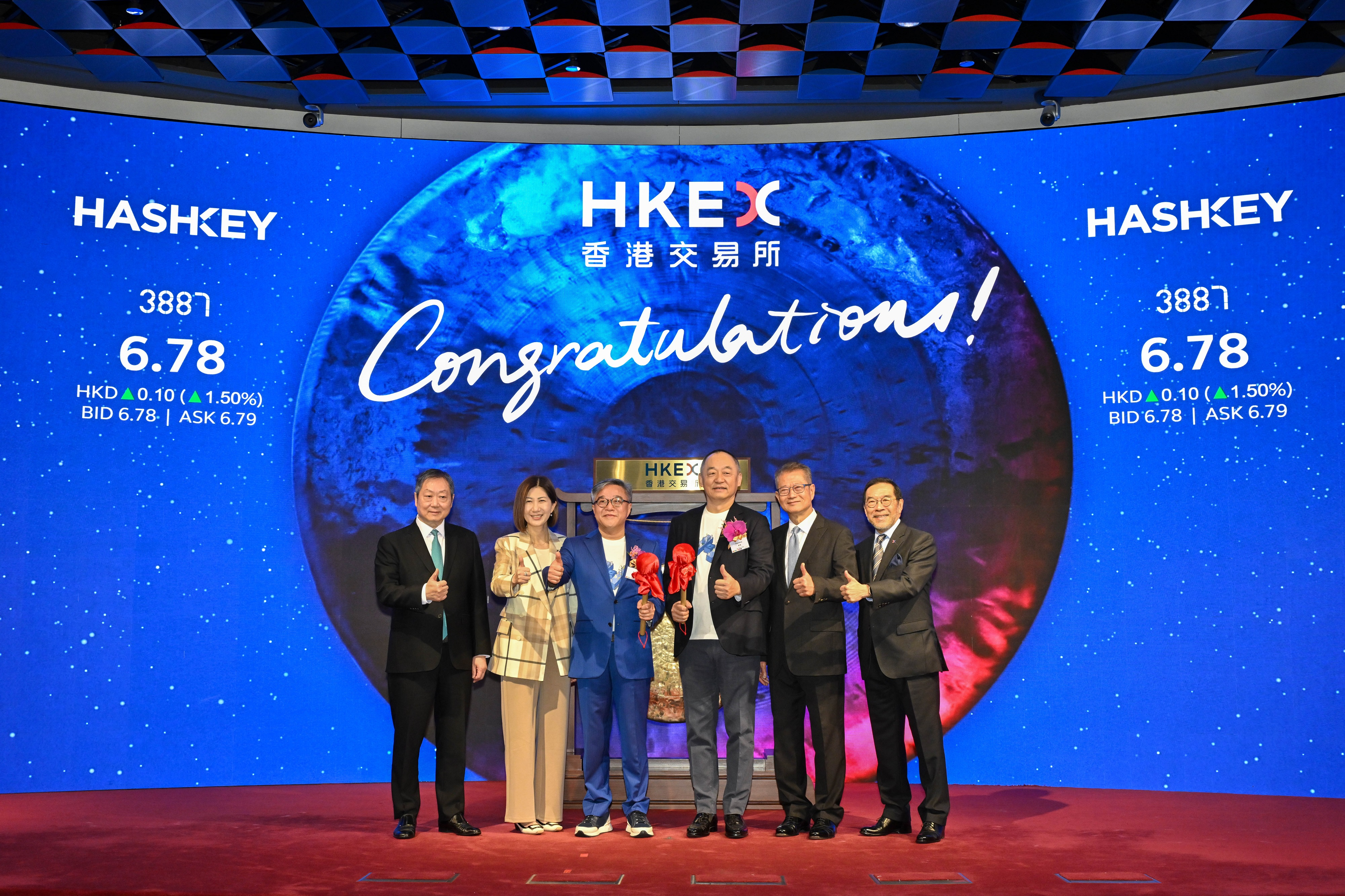
On December 17th, HashKey officially listed on the main board of the Hong Kong Stock Exchange. Starting with auto parts and now controlling multiple listed companies across various industries, the Wanxiang Group's years of deep cultivation in the blockchain field have finally yielded fruitful results. Under the leadership of Xiao Feng, known as the "Godfather of Chinese Crypto," HashKey has provided a compliant listing model for the cryptocurrency industry that can serve as a reference.
Preparing for listing began five years ago, with Wanxiang's chairman as a major shareholder
“Since its establishment in Hong Kong in 2018, the company has been preparing for listing.” Now, HashKey has officially listed on the main board of the Hong Kong Stock Exchange, becoming the first publicly offered stock in the Asian digital asset field in Hong Kong.
After the listing ceremony, Dr. Xiao Feng, Chairman and CEO of HashKey, said that digital assets are still an emerging industry, and to meet the audit and compliance standards required for listing, more time is needed to refine the system and business. Therefore, this successful listing is not accidental, but rather a natural outcome.
According to Xiao Feng, listing on the Hong Kong Stock Exchange is a new starting point. Although HashKey originated from a mainland team, it has developed into a homegrown Hong Kong company. In the future, it will remain rooted in Hong Kong, adhere to compliance, and practice the strategic direction of "upholding the fundamental principles of one country and making good use of the advantages of two systems," continuously improving its infrastructure capabilities and strengthening key capabilities such as security, custody, on-chain execution, and on-chain compliance. HashKey's successful listing is the result of Wanxiang Group's years of investment in blockchain. HashKey's largest shareholder is Lu Weiding, who directly holds over 40% of the shares, giving him absolute control over HashKey. This year, Lu Weiding made it onto the Forbes Global Billionaires list with a fortune of $3.8 billion. Born in 1971, Lu Weiding is the son of Lu Guanqiu, a traditional Zhejiang businessman and founder of Wanxiang Group. In the last century, Lu Guanqiu led six farmers to start a blacksmith shop with 4,000 yuan, which became the starting point of Wanxiang Group. In October 2017, after Lu Guanqiu's death, Lu Weiding officially succeeded him as chairman of Wanxiang Group. As Lu Guanqiu's only son, Lu Weiding became president of Wanxiang Group at the age of 23 and executive director of Wanxiang Holdings Co., Ltd. at the age of 30. Lu Weiding has made significant achievements in corporate operations, finance, and capital management, and single-handedly planned Wanxiang's financial layout beyond its core industries. Wanxiang Group holds shares or controlling stakes in Wanxiang Trust, Minsheng Insurance, and Zhejiang Commercial Bank, among others. To date, Wanxiang Group has gradually built a comprehensive industrial empire spanning automobiles, new energy, agriculture, real estate, and finance. In an interview with *China Entrepreneur* this year, Lu Weiding stated that the company's operations have always adhered to the philosophy of "wealth dispersed brings people together, wealth concentrated leads to dispersal; acquisition should be ethical, and use should be shared joyfully." Lu Weiding himself has always maintained a low profile, while Xiao Feng acts more like a spokesperson for HashKey, holding 16.3% of the company's shares. Xiao Feng left Bosera Funds in 2011 to join Wanxiang Group, serving as Vice Chairman of China Wanxiang Holdings and responsible for building Wanxiang's financial sector. In 2015, Wanxiang Group established the Wanxiang Blockchain Lab, with Xiao Feng as the initiator. That same year, Wanxiang invested $500,000 in Ethereum, which was facing financial difficulties at the time. Also in 2015, Wanxiang Holdings invested $50 million to establish Distributed Capital, China's first venture capital fund focused on investing in blockchain technology-related companies, with Vitalik Buterin as a co-founder, who became an advisor in 2018. It can be said that Xiao Feng was one of the key figures driving the early development of cryptocurrencies and a core figure in Wanxiang's blockchain strategy. Xiao Feng has been actively involved in the formulation of industry standards and policy discussions, and has promoted the improvement of relevant regulatory frameworks. After founding HashKey in 2018, Xiao Feng focused on a compliance-oriented approach. At the listing ceremony, Xiao Feng stated that HashKey has already successfully expanded its business overseas, using Hong Kong as its base to radiate globally, and currently holds 13 licenses across six jurisdictions. He believes the key to HashKey's ability to meet the Hong Kong Stock Exchange's stringent IPO standards is its consistent adherence to the operating principle of "licensed compliance and regulation," proving that a compliant approach can lead to success in the cryptocurrency industry. Following Wanxiang Qianchao, Chengde Lulu, Wanxiang Denong, and Shunfa Hengye, HashKey has become another listed company within the Wanxiang Group. Oversubscribed by nearly 400 times, raising HK$1.6 billion against the odds. Prior to its Hong Kong IPO, HashKey disclosed its true financial statements. According to previous PANews reports, HashKey's main businesses are transaction facilitation services, on-chain services, and asset management services. However, from 2022 to the first half of 2025, HashKey suffered consecutive losses, accumulating losses exceeding HK$2.86 billion. However, HashKey still has ample cash reserves. As of October 31, the company held HK$1.48 billion in cash and cash equivalents and HK$570 million in digital assets. (Related reading: HashKey Aims for Hong Kong's "First Crypto Stock": What Key Points are Hidden in the Listing Documents?) Regarding profitability, Xiao Feng frankly stated that the company will be in a period of investment in the near future, as the market is still in a phase of rapid growth. Profitability is not the company's most crucial operating indicator. The key is whether the company has sufficient cash reserves to support long-term development, especially since the next two to three years will be a critical window of opportunity for industry development. Insufficient investment may cause the company to miss out on the opportunity for rapid industry growth, which is also an important reason why the company is not currently seeking profitability. Despite facing financial pressure from years of losses and initially pessimistic market expectations for its IPO, the market response after subscriptions opened significantly exceeded expectations. The Hong Kong public offering was oversubscribed by approximately 393.7 times, involving approximately HK$66.8 billion and attracting over 88,000 investors; the international placement was oversubscribed by more than 5.4 times. HashKey's cornerstone investors include UBS AM Singapore, Fidelity Investments, CDH, Xinting Fund, Infini, Zhiyuan, Litong, Space Z PTE. LTD., and Shining Light Grace, who subscribed for a total of US$75 million. UBS AM Singapore subscribed for US$10 million, Fidelity Investments and CDH each subscribed for US$5 million, Xinting Fund subscribed for US$15 million, Infini, Zhiyuan, and Litong each subscribed for US$10 million, and Space Z PTE and Shining Light Grace each subscribed for US$5 million. According to the allocation results, HashKey's global offering totaled approximately 241 million shares. Of these, 10% (24,057,200 shares) were offered to the public in Hong Kong, and 90% (216,512,800 shares) were offered internationally. HashKey set the offer price at HK$6.68 per share, raising net proceeds of approximately HK$1.48 billion globally. The company plans to use the proceeds primarily for technology and infrastructure upgrades, market expansion, and ecosystem partnerships. On its first day of trading, HashKey did not replicate the surge seen by Circle, the "first stablecoin stock," upon its IPO. Its share price opened at HK$6.55, slightly below the offering price, giving the company a total market capitalization of approximately HK$18.112 billion, exceeding that of OSL Group, the parent company of OSL Exchange, Hong Kong's first compliant virtual asset trading platform. HashKey's status as the first crypto asset company to list in Hong Kong not only signifies the increasing maturity of Hong Kong's virtual asset regulatory framework but also provides an important reference for the industry's compliant development. Looking ahead, HashKey still faces numerous challenges, with achieving profitability likely being its primary task.


 Catherine

