Author: Digital Asset Research, Translator: Shaw, Jinse Finance
The cryptocurrency market is currently extremely divided. Some are proclaiming, "A bear market is inevitable, and a crash a year after the peak is imminent," while others are focusing on the real market signals.
I belong to the second view, and today I will explain to you why this decline is not the beginning of a terrible long-term bear market, but rather the last major low of the entire cycle.
I used the same tools to predict every important bottom in this cycle, and now this prediction is louder than ever.
While most people are still stuck in the overly simplistic "four-year cycle" mindset and ignoring other aspects, you know that what truly controls the overall picture are the longer, more dominant cycles.
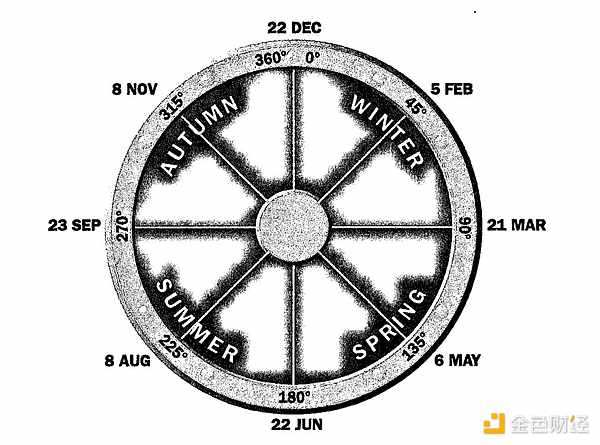
The four-year cycle itself isn't wrong; it's just a small cog in a vast machine, one that most people can't even see. Context is crucial. Conditions are crucial. And now, every layer of Gann analysis we rely on—time cycles, market structure, price levels, seasonal shifts, and the perfect time/price square—points to the same conclusion—we are at a turning point. Let me demonstrate this with five interconnected elements that have never let us down in this cycle. The 7-cycle is coming from all angles (7 years, 7 months, 7 weeks, 7 days) Market structure is actually strengthening, not weakening. The Gann price level (0.375) has captured every major low in this cycle, and this price level corresponds to all the important lows in this cycle. This week, a series of seasonal anniversaries and the 225°/45-day turning point have converged. Multiple time/price grids accurately mark the dates and price ranges we just marked. This is not wishful thinking or speculation, but a pure result of a perfect fit between market structure and timing, a fit that only occurs at the most important turning points. The market has accomplished its mission: weeding out weak-willed investors, completely reversing market sentiment, and convincing 90% of participants that the bull market is over. This is exactly what the market should do before the real rally begins. By the time you finish reading this article, you'll likely share our view of the current low as a turning point that will guide this Bitcoin cycle into 2026. The Cycle of 7 First, consider the 7-year cycle, which can be broken down into 7-month, 7-week, or 7-day cycles. We previously shared similar perspectives on the Ethereum cycle; now we'll explore the Bitcoin cycle. The following chart illustrates one of Gann's cycle principles, explaining why the number 7 is so significant in the market.

We can look at the monthly chart to understand the situation.
As shown below, 84 months is equivalent to 7 years, and we experience a significant low point every 84 months. With a 42-month cycle as the midpoint, it also shows a cyclical fluctuation from low to low.
As shown below, 84 months is equivalent to 7 years, and we experience a significant low point every 84 months. Using 42 months as the midpoint of the cycle, it also shows a cyclical fluctuation from low to low.
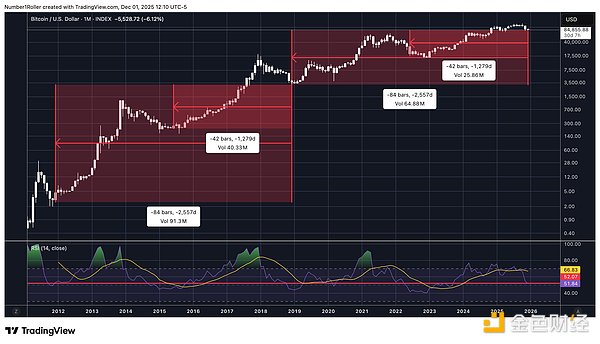
When we zoom in on this cycle, we can also measure the time interval between monthly lows. We find that each monthly low occurs exactly 7 months after the previous major low.
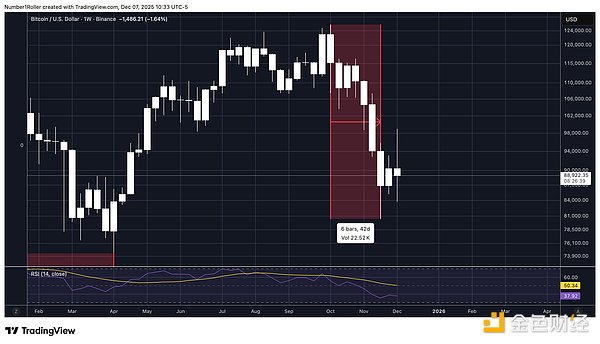
In summary, we can see that the seven cycles from monthly to daily converge, indicating that this is a significant turning point in the market.
Market Structure and Price Levels
Many people talk about market structure, higher highs, and lower lows, but very few truly understand them. This is similar to those who only understand four-year cycles; they know these things but don't truly understand cycles and their meaning.
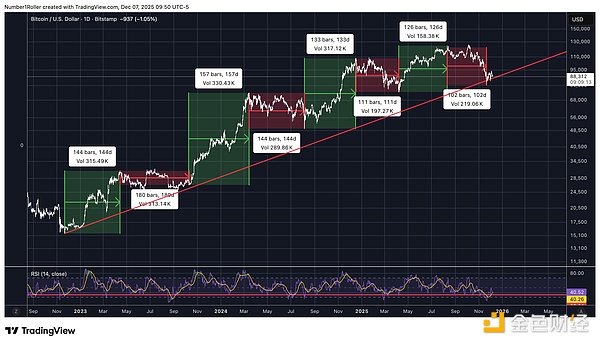
Those who believe this market structure has turned into a bear market don't actually understand what market structure is or how to judge it. Gann theory consistently emphasizes that the most important indicator of trend change is time. In a bull market, price increases last longer than price decreases. Furthermore, market declines don't last longer than the previous decline. This is what we call a period of equilibrium. When the duration of market declines is continuously shortening, the market sends a strong signal. Looking at the duration of pullbacks in this cycle, they have been consistently shortening, indicating that the trend hasn't changed and the market is actually showing strong momentum.
Next, we can talk about price adjustments. The following is an excerpt from Gann's book, *45 Years in Wall Street*.

Price Level
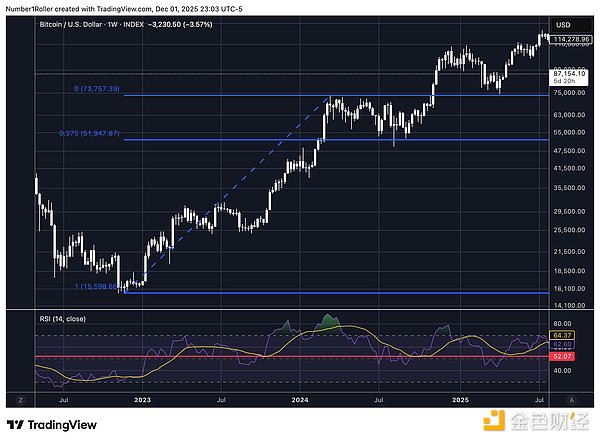
Measuring price retracements from the cycle lows, there is a key support level that has remained constant throughout the cycle and has played a significant role at each low.
This level is the 0.375 Gann level. Gann divides price fluctuations into eight equal parts, rather than using typical Fibonacci levels.
In this case, we can see that from 2023 to the present, this level marks the bottom of every major high.
2023 Highs

2024 High
January 2025 High
October 2025 High

Finally, I want to revisit what I consider to be the 15-year cycle, as it will be significant in 2026.
In that cycle, we hit the low point in the week of December 6th, 15 years ago.

Recently, we have seen a reversal in this major cycle, but a low point within this period is reasonable if we are to get back on track.
Last December we reached an important anniversary together, coinciding with the annual seasonal pattern, which suggests a possible reversal is imminent, consistent with the 180-month cycle.
In early December last year, we reached an important anniversary together, coinciding with the annual seasonal pattern, suggesting a possible reversal, consistent with the 180-month cycle.
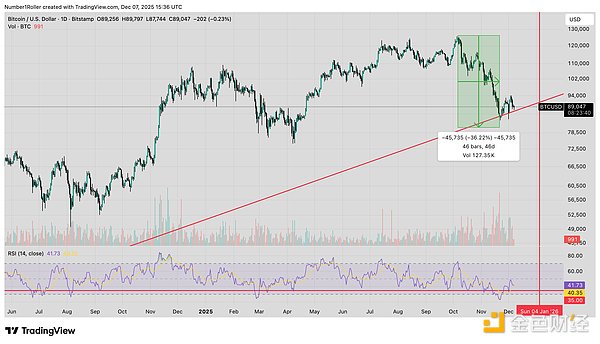
The Square Relationship Between Time and Price Measuring time ranges, degrees, and seasonality can give you 90% of the right approach to identifying major turning points, but this analysis only truly holds up when time and price align with all these factors. We know that price and time reached equilibrium during the decline, with a drop of 46,000 in 46 days, therefore we have a strong reversal point at the 1/1 angle on the daily chart.
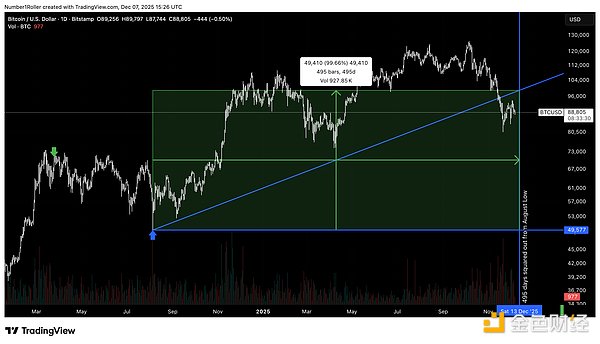
We can further reinforce this square relationship by looking back at the low point in August 2024. That low point occurred at 49577. If we count back 495 days from that low point, we get December 13th, which is only one day away from last year's top and seasonal time. *Note that the midpoint of this square occurs exactly at the bottom in April.
Next, if we look at the square of some higher timeframes from the cycle low of 15480, pushing back 1548 days, and rising 154800 points, we get the line shown in the following chart, which squares time and price starting from the cycle low.
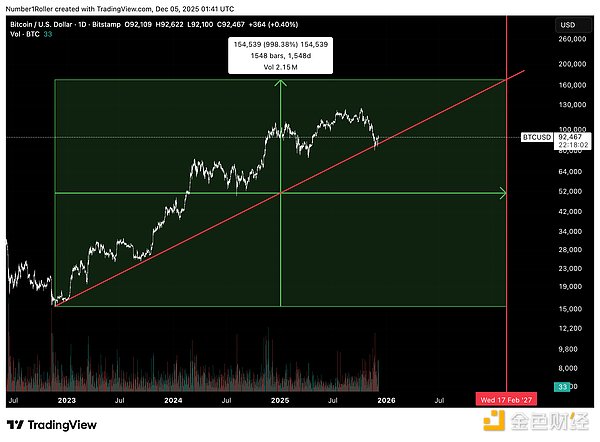
Furthermore, I want you to pay attention to the importance of cycle lows.
Note how the price of 15,480 moved upwards from the bottom of 15,500 in the first range.
Note how the price of 15,480 moved upwards in the first range.
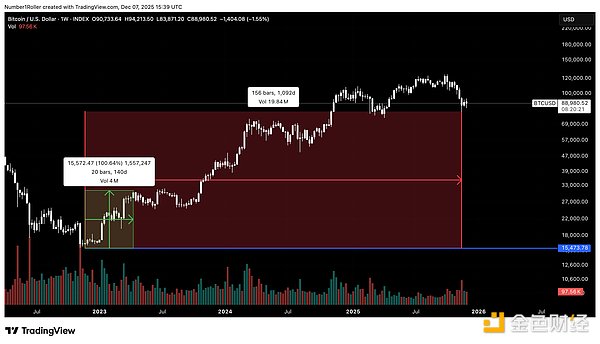
You will constantly notice the interplay between price and time. Therefore, looking ahead to the next 155 days, 155 weeks, and 1550 days is crucial. It's worth noting that the recent low occurred in week 156, the penultimate week of the three-year cycle, which also happens to be the anniversary of the cycle low on November 22nd.
Conclusion
This is not theory, nor is it wishful thinking.


 Jixu
Jixu


