Galaxy: The Current Status of Ethereum Blobs and the Blob Market in the Post-Pectra Era
Author: Zack Pokorny, Galaxy Research Analyst; Compiler: AIMan@Golden Finance
Foreword
On May 7, 2025, the Ethereum Pectra upgrade was launched on the mainnet. Among the implemented Ethereum Improvement Proposals (EIPs), EIP-7691 increased the target number of blobs and the maximum number of blobs per block. In last year's Dencun upgrade, EIP-4844 (formerly Danksharding) introduced blobs to provide dedicated data publishing space for Rollups. Since the launch of Dencun, the Ethereum network has maintained a target number and maximum number of blobs of 3 blobs per block; calculated at a data size of 128kb per blob, this means that the data capacity transmitted via blobs per day is about 5.5GB. Following the Pectra upgrade, the target and maximum number of blobs per block increased to 6 and 9, respectively, and blob data capacity increased to approximately 8.15GB per day. This change had an impact on the blob market, rollups, and Ethereum validators, with the increase reducing the scarcity of the fixed amount of blob space that rollups competed for and increasing the network’s data availability (DA) capacity through blobs. Below we explore the impact of the Pectra upgrade’s changes to Ethereum’s blob parameters on the blob market, rollups and their users, Ethereum validators, and the supply of ETH.
Key Takeaways
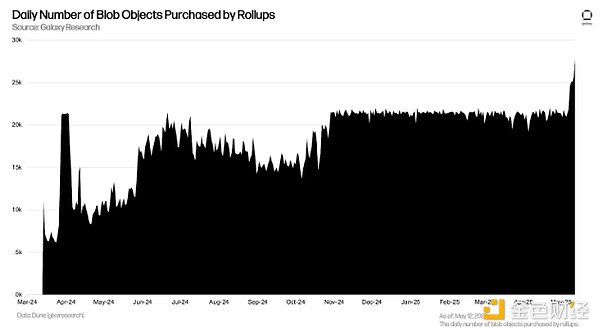
In the full five days after Pectra went live, the number of blobs purchased by rollups per day increased from approximately 21,200 to 25,600. Despite the increase, the average number of blobs per block is still 33% below the new target of 6 blobs per block.
With the actual number of blobs per block well below the updated target rate, Blobs are nearly free for the first time since mid-April 2025. Since Pectra went live, less than one thousandth of a cent has been paid in fees via Rollup per day, with the total cost of Blob objects being just four thousandths of a cent. This significantly reduces the amount of ETH consumed to purchase and publish Rollup data space on Ethereum via Blobs.
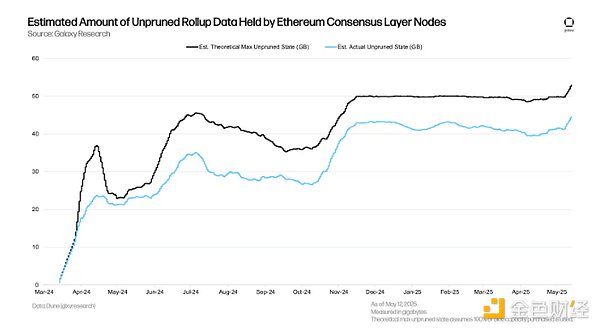
Nodes must retain rollup blob data for at least 18 days before they can remove it from their machines. The increase in the number of blobs purchased daily has brought the amount of data that consensus layer nodes must maintain between prunings to a new high of 44.6GB.
The reduction in Blob costs has increased the relative and absolute profitability of Rollups, with Base being the biggest beneficiary in terms of net revenue after on-chain costs. Meanwhile, transaction costs for some top Rollups have remained constant or even slightly increased since Pectra went live.
All data used is taken from Galaxy Research’s public dashboard on the Ethereum blob market and its impact on Rollups.
Blob Market
Since Pectra went live on May 7, 2025, rollup platforms have purchased 20.8% more blobs per day than before the upgrade. In the 60 days before the Pectra upgrade, rollup platforms purchased 21,200 blobs per day. In the five days after the upgrade, they purchased an average of 25,600 blobs per day. This means that the amount of data purchased per day was 2.7 GB before the upgrade, and now it is 3.3 GB.
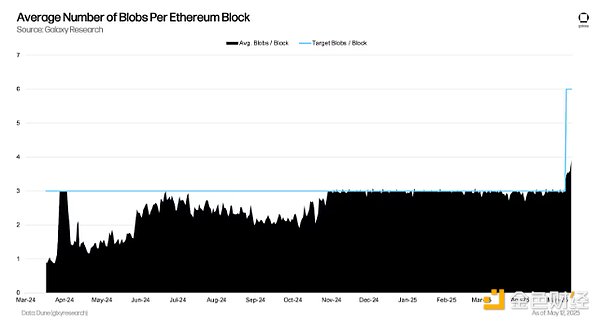
Despite the increase in the number of blobs purchased, the average daily blob usage per block since Pectra went live has been only two-thirds of the new target blob limit. So while the average number of blobs per block was consistently at the target rate before Pectra increased the number of blobs, the demand for rollups has not yet reached a level to consistently reach the new target rate.
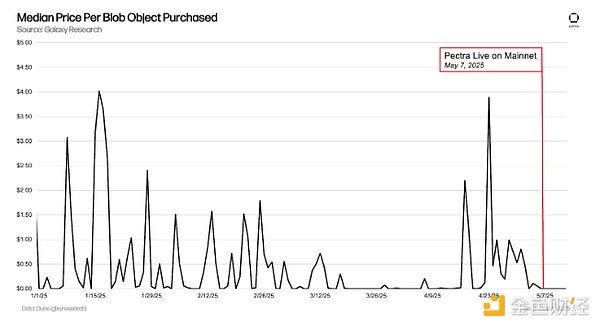
Thus, since only two-thirds of the blob object is used per block, blobs are effectively free. This is the first time blobs have been this cheap since mid-April 2025. Since Pectra went live, the median cost per blob object has been just $0.0000000035 (nine zeros). This has resulted in rollups paying no more than $0.0000092 (five zeros) per day since Pectra activated; in the full five days since Pectra activated, a total of just $0.0000395 in blob object fees was paid. You read that correctly, since Pectra went live, rollups have paid less than one thousandth of a cent per day in fees, while blob objects have cost four thousandths of a cent in total. Note that this number does not include the type 3 transaction costs required to execute the blob on-chain, only the cost of the blob object itself. This means that blob object fees paid by rollups into Ethereum have dropped by nearly 100% - in the 60 days before Pectra rollups, the average daily blob fee was $16,250, totaling $1.095 million.
Data Capacity Usage and Its Impact on Ethereum Nodes
In the post-Pectra era, more of the total daily data capacity provided by Ethereum through Blobs is not purchased. Therefore, although Rollup is purchasing more Blobs from the network, thereby obtaining more data space, the purchase share of the total daily Blob data capacity has been relatively small since Pectra went live. Once Rollup demand reaches the updated target rate, the Blob market will operate more efficiently from a capacity perspective, as the new target rate is only 33% lower than the maximum, compared to 50% under the old parameters.
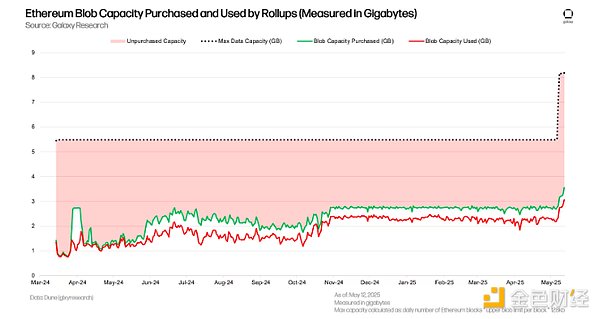
With an updated blob capacity of 9 blobs per block and a daily Ethereum block count of approximately 7,100, Ethereum can sell a maximum of approximately 8.17GB of blob space per day, or 5.45GB at the target blob count per block; this value fluctuates with the actual daily block count. However, only 3.3GB of data space has been sold so far - only 40% of the maximum available daily data capacity and only 61% of the target. In comparison, in the month before the Pectra program was implemented, when the target blob count was reached (3 blobs per block), the average daily sales were 50% of the total capacity and 99% of the target.
Each blob object can hold up to 128 kilobytes (KB). Rollup data does not need to occupy the full 128KB of each blob (for example, each blob can use 100KB if necessary), however, the capacity of a single blob cannot exceed the 128KB limit. The difference between purchased blob capacity (green line in the chart) and used blob capacity (red line in the chart) highlights how many blob objects fill up the 128KB limit with rollup data each day. After upgrading to Pectra, the average blob utilization was 86%, compared to 82% in the 60 days before the upgrade.
The increase in the amount of Blob data purchased daily causes consensus layer nodes to have to carry more Rollup data on their machines. Nodes must retain Rollup Blob data for at least 18 days before they can remove it from their machines (prune). Before Pectra, this meant that nodes had to carry 40GB to 44GB of data continuously. In the days after Pectra, this number has been climbing as Rollup purchases more Blobs, and it may continue to increase as Rollup saturates the new Blob parameters. As of May 12, 2025, the estimated unpruned Rollup data held by consensus nodes has reached an all-time high of 44.6GB. If demand for Blobs remains at current levels, consensus nodes will have to carry about 60GB of Rollup data; at the target rate, they will have to carry about 95GB to 100GB of data.
Rollup costs and ETH burning
Since Pectra went live, Rollups have paid an average of $11,015 per day in Blob-related fees, including transaction costs for Blob objects and Type-3 execution layers. In comparison, in the 60 days before the update, an average of $20,660 was paid per day, which means that the total daily cost of purchasing and executing Blobs has dropped by 51%.
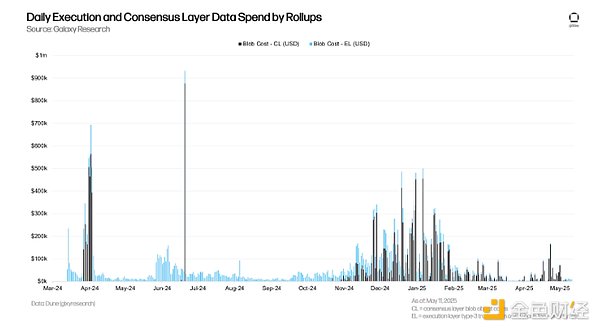
The sharp rise in Ethereum Layer 1 fees has caused the costs paid by Rollup on Blob activities to remain high. In the days after Pectra was activated, Ethereum Layer 1 base fees rose by more than 650% week-on-week. Without this surge, Rollup would have required less fees to execute Blobs, and Rollup Blob activities would have consumed less ETH.
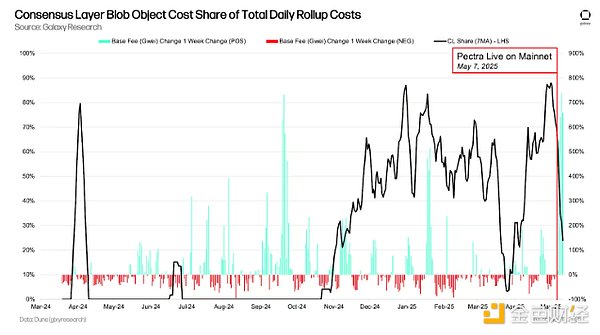
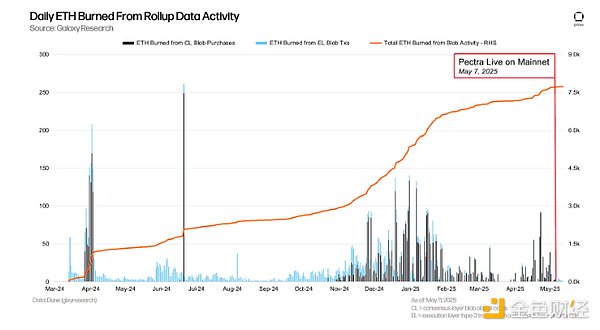
Since Pectra was activated, the amount of ETH consumed to publish Rollup data through Blobs (including ETH used to purchase Blobs and execute on Ethereum Layer 1 through Type 3 transactions) has dropped significantly. In the 60 days before the upgrade, an average of 11.22 ETH was consumed per day, of which execution layer fees accounted for only 37.1% of the total daily consumption. Since Pectra was activated, only 3.26 ETH is consumed per day (down 71%), and 99.99% of the total consumption comes from the base fees of Type 3 execution layer transactions.
Impact on L2
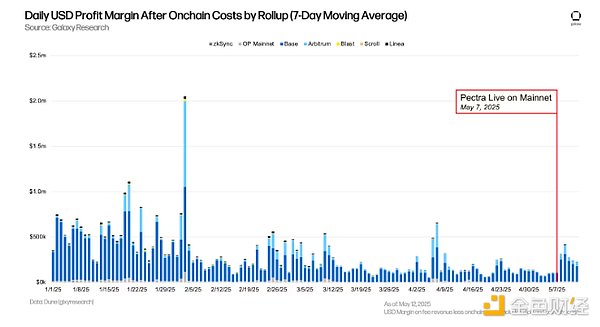
After Pectra went live, both the relative and absolute profitability of Rollups after deducting on-chain costs increased significantly. Linea and Base had the highest percentage of profitability after deducting on-chain costs among the observed Rollups, at 98.86% and 98.54% respectively, calculated using a seven-day moving average. Blast had the most significant increase in percentage of profitability after deducting on-chain costs, rising from a high of 50% to a low of 60% in the days before Pectra went live, and now exceeds 80%.
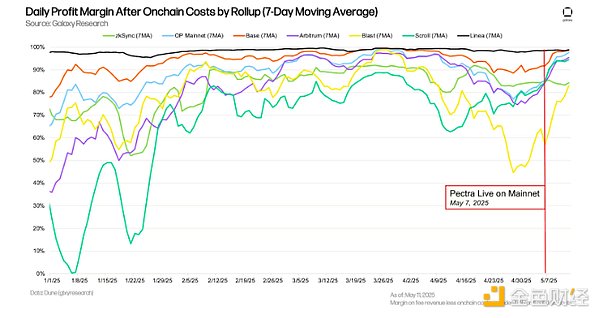
After Pectra went live, on-chain costs increased, but net benefits from Rollup decreased. This is mainly due to the combined effect of lower data costs (as described above) and higher activity and transaction costs. The revenue and net profit after deducting on-chain costs for each Rollup platform observed slightly doubled, but in absolute terms, Base was the biggest beneficiary in the near term. Base had revenue of $1.22 million and a net profit of $1.12 million after deducting on-chain costs.
Conclusion
Rollups have not yet fully utilized the increased Ethereum data availability brought by the Pectra upgrade. As a result, it has reduced the cost of owing Ethereum per day for DA activity through Blobs. This upgrade, at least for now, makes it more financially advantageous for Rollups to operate while increasing the number of Blobs used daily. Pectra's changes to Ethereum Blob parameters also raise a key point about node requirements for storing Blob data. As Ethereum begins to expand its Blob DA, this may have an impact on node operators who must bear higher Blob data holding requirements.


 Kikyo
Kikyo

