Elon Musk Forecasts AI to Surpass Smartest Human by 2025
Elon Musk has made a bold prediction, foreseeing that advancements in AI will surpass the capabilities of even the most intelligent humans by 2025.
 Catherine

Translation from @AlanaDLevin's "Crypto Trends Report 2025 Edition"
The "Three-Stage S-Curve" of Industry Growth:
A Composite Spiral of Creation, Accumulation, and Application
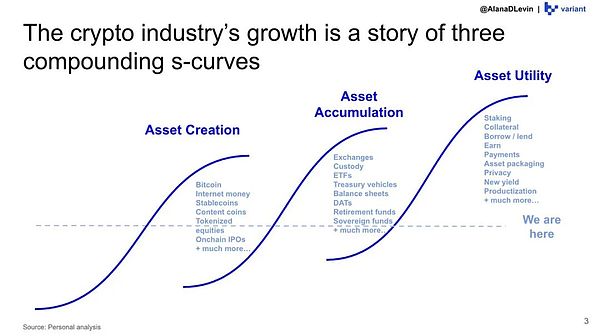
If we stretch the development of the crypto industry over the past fifteen years into a long line, we will find a highly explanatory main axis:

The most obvious winner in the "asset accumulation" trend
CEX
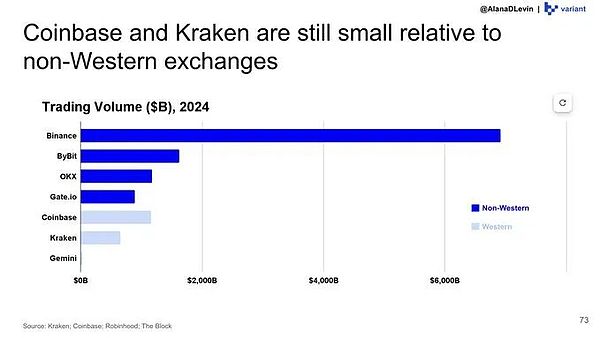
As more and more people want to buy, sell, and hold crypto assets, exchanges are benefiting significantly. Among them, centralized exchanges are undoubtedly one of the most obvious winners in the "asset accumulation" trend.
The primary mission of exchanges is to make it easy for users to trade crypto assets.
The primary mission of exchanges is to make it easy for users to trade crypto assets.
As more people accumulate assets, exchanges are taking on the role of providing access and distribution channels. Simultaneously, more traditional platforms are looking to offer crypto asset trading services. We've already seen many traditional brokerages begin supporting the buying and selling of crypto assets, behind which are a group of infrastructure companies responsible for routing, matching, and ensuring order security. Meanwhile, centralized exchanges (CEXs) are also benefiting significantly from this "accumulation effect" as asset size and user numbers grow. With more people flocking to the crypto market for buying, selling, storing, and investing, the massive volume of crypto trading still primarily occurs on CEXs—contributing trillions of dollars in trading volume annually. Despite the ongoing evolution of decentralized finance, CEXs still dominate in terms of user access, compliance services, asset custody, and liquidity. Coinbase has built other, more robust business lines around the secondary needs of users trading and staying on the platform, including custody, staking services, and yield products. Many new ways to utilize crypto assets will be built directly on-chain, but may gain widespread adoption through centralized exchanges such as Coinbase, Robinhood App, and Kraken. So why will higher asset utilization applications be built on-chain in the future? On-chain activity is a hotbed of innovation. Every stage of an asset's lifecycle can be experimented with on-chain (whereas in traditional finance these steps are mostly restricted and permissioned). Today, it's easier than ever for new users to get started with on-chain transactions—meaning anyone, anywhere, at any age, can start creating, accumulating, and using crypto assets. The number of newly created tokens is one of the fastest-growing metrics in the cryptocurrency space. As a result, total trading volume surged, and decentralized exchanges (DEXs) continued to grow. The market share gained by DEXs in the first half of 2025 exceeded the total for the entire years from 2021 to 2023. Another area where early signs of utilization in the on-chain lending space can be seen is... Assets in lending protocols (such as Morpho) have grown more than 5 times in the past few years (and continue to grow!). Against the backdrop of continuous asset accumulation and rapid growth of stablecoins, another main theme of on-chain innovation is beginning to emerge clearly: the infrastructure trend of "built on-chain, used across the entire network" is accelerating. Protocols like Morpho are representative of this model—the core logic is executed entirely on-chain, but users and applications are found in every corner of the ecosystem, truly realizing an expansion path of "native on-chain, ubiquitous scenarios." More importantly, while mainstream assets are stabilizing, there are still significant gaps in the "asset creation curve." The next batch of assets with structural growth potential is likely to be nurtured on-chain, with institutionally issued on-chain assets being the most typical example. Finding Future Trends Back to On-Chain Over the past year, we have seen more and more institutions begin to try deploying Tokenized Treasuries. This is the first wave of institutional assets going on-chain, but it certainly won't be the last. As regulation and technology mature, on-chain assets will extend from government bonds to a wider range of categories, including corporate bonds, structured notes, and even more complex financial instruments. Finding Future Trends Back to On-Chain In the past year, we have seen more and more institutions begin to try deploying Tokenized Treasuries. This is the first wave of institutional assets going on-chain, but it is clearly not the last. As regulation and technology mature, on-chain assets will extend from government bonds to a wider range of categories, including corporate bonds, structured notes, and even more complex financial instruments.

In fact, this leap has already occurred in perpetual contracts (such as Hyperliquid) and lending protocols (such as Morpho): from initial functional products, they gradually attract developers, strategies, users and external builders, and eventually evolve into independent ecosystems.

On-chain Trends, Global Perspective:
Finding the Real Growth Drivers for the Next Phase of the Crypto Industry
Therefore, if you are looking for the next real trend, the answer has always been there—go back to the blockchain. Whether it's growth drivers, user needs, or innovative breakthroughs at the asset level, the most crucial changes are constantly brewing and accelerating on-chain.
Therefore, if you are looking for the next real trend, the answer has always been there—go back to the blockchain.
Elon Musk has made a bold prediction, foreseeing that advancements in AI will surpass the capabilities of even the most intelligent humans by 2025.
CatherineFriend3, in collaboration with ProBit Global, introduces decentralized donation mechanisms and trading competitions, leveraging the utility of F3 tokens to foster community engagement. Through Web3 technology, Friend3 pioneers community creation with innovative monetization options.
 Alex
AlexThe class-action lawsuit against BitMEX co-founder Ben Delo underscores the need for regulatory clarity and highlights the potential legal risks facing operators in the cryptocurrency industry.
 Weiliang
The Philippines SEC's ban on Binance raises concerns among investors, highlighting compliance issues and the SEC's commitment to protecting investors.
 Miyuki
Ubisoft unveils its groundbreaking Web3 game, Champions Tactics, amidst growing anticipation. Despite delays in the scheduled mint for The Warlords of Champions Tactics NFT collection, recent developments, including sneak peeks and strategic partnerships, signal a promising future for the game
AlexThe issuance of a Wells Notice by the SEC to Uniswap Labs has sparked a unified response from the crypto community, rallying in defense of DeFi innovation and decentralised principles.
CatherineIn light of the ongoing congestion on the Solana network, more than 75% of on-chain transactions have been experiencing failures, prompting users to migrate to Ethereum for smoother transfers.
 Kikyo
KikyoIn a recent court ruling in Taiwan, it was decided that the assets belonging to David Pan, the founder of Ace Exchange, along with others implicated in the case, will be confiscated.
CatherineGameCene raises $1.4M in seed funding, plans to expand its Web3 gaming platform, offering a diverse game library and empowering developers with its Omni-chain Game SDK.
AlexGameCene 筹集了 140 万美元种子资金,计划扩展其 Web3 游戏平台,提供多样化的游戏库,并通过其 Omni-chain Game SDK 为开发者提供支持。
Alex